
Photographic Power, Migration, and a New Americana
New York City has long held the tradition as the home to many artists working with photography. However, South American artists have largely been unrecognized in contemporary art circuits.
South Americans have made their home in NYC for decades, with Ecuadorians arriving in many waves, such as during the economic crisis in 1999, and Peruvians dating back to the 19th century. With around 190,000 Ecuadorians and 140,000 Peruvians living in the region, they are business owners, established members of their communities, recent immigrants, and everything in between. Despite Ecuadorians shaping Queens and Peruvians doing the same in Paterson, New Jersey, their contributions to photography are not as acknowledged.
To help rectify this, here are five South American artists exploring photography who currently live in New York. These five artists have voices that resonate in New York in different ways, in various frequencies, and are examples that being an immigrant is common in the city. Their journeys are proof of how heterodoxic our culture is, each unique even when shaped by similar urgencies. If we pause to listen, there is so much to hear.
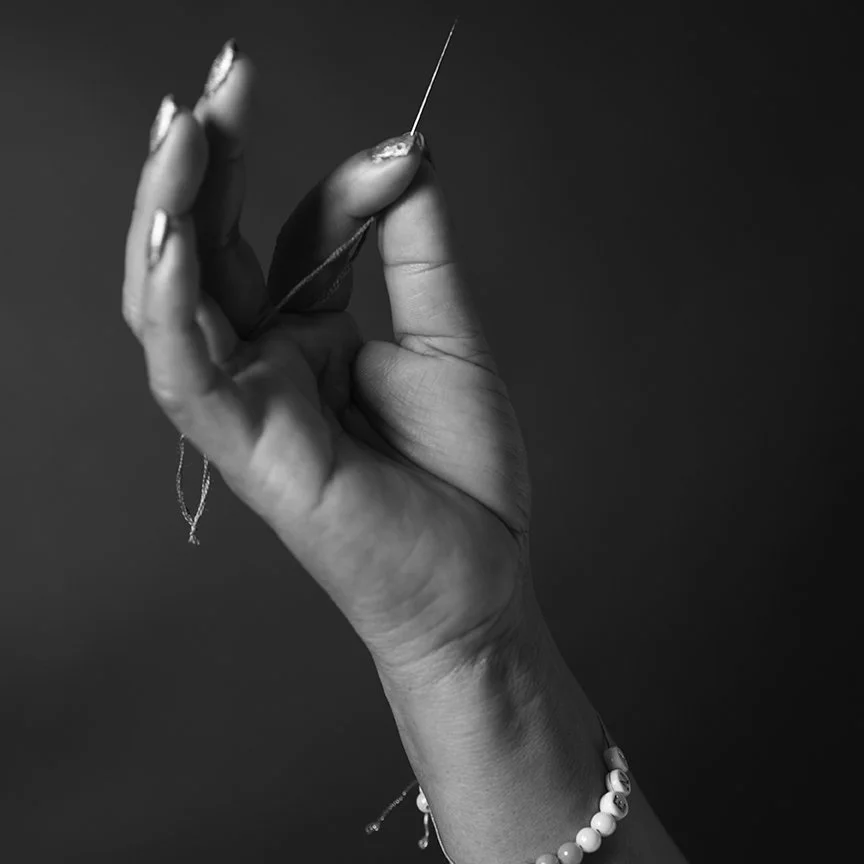
Un hilo de voz / a thread of voice 01 (2025), 12in x 12in, archival inkjet prints on hahnemuhle photo rag baryta. Photo by Andrés Altamirano.
Andrés Altamirano arrived in NYC in 2009 as a result of a political and banking crisis in Ecuador.
“Thousands of families lost their jobs and life savings, leaving many with no choice but to migrate,” Altamirano says. “For many of us, this has become our adopted homeland, where we have created bonds and planted roots, where we have transplanted our traditions and our culture.”
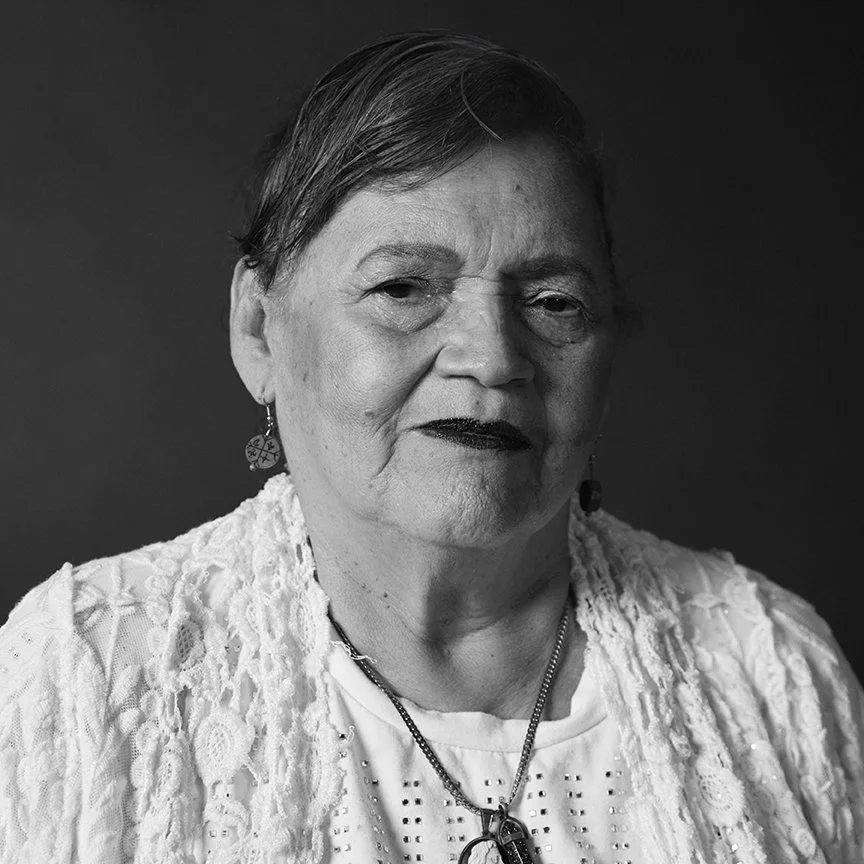
Marlene, 72 años. Milagro, Guayas, Ecuador (2025), 12in x 12in. Archival inkjet prints on hahnemuhle photo rag baryta. Photo by Andrés Altamirano.
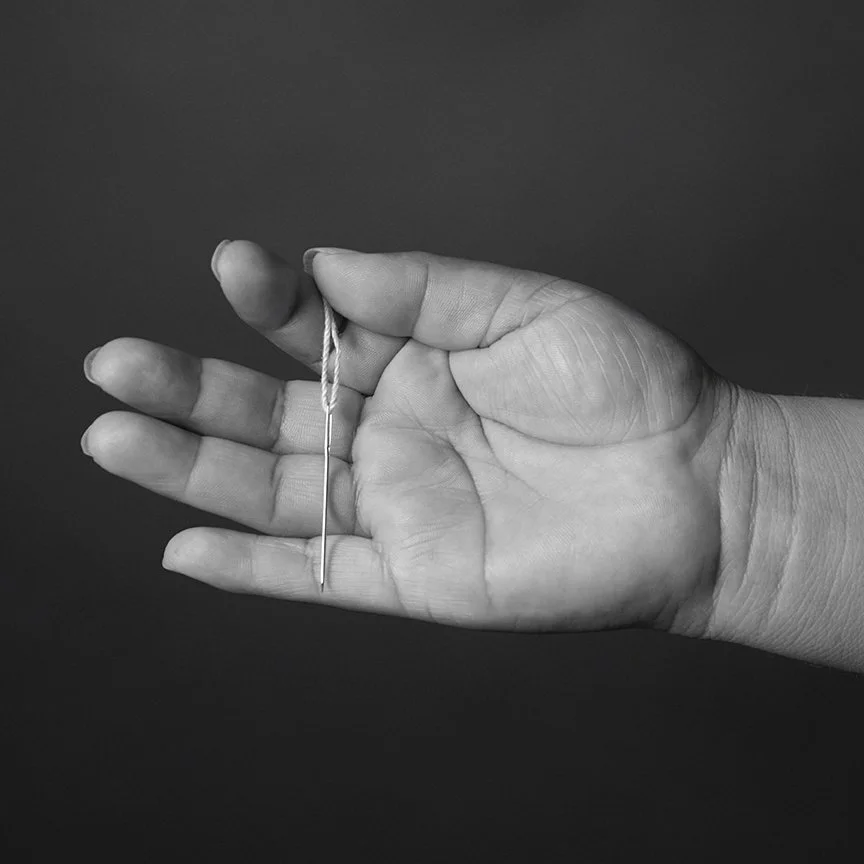
Un hilo de voz / a thread of voice 02 (2025), 12in x 12in, archival inkjet prints on hahnemuhle photo rag baryta. Photo by Andrés Altamirano.
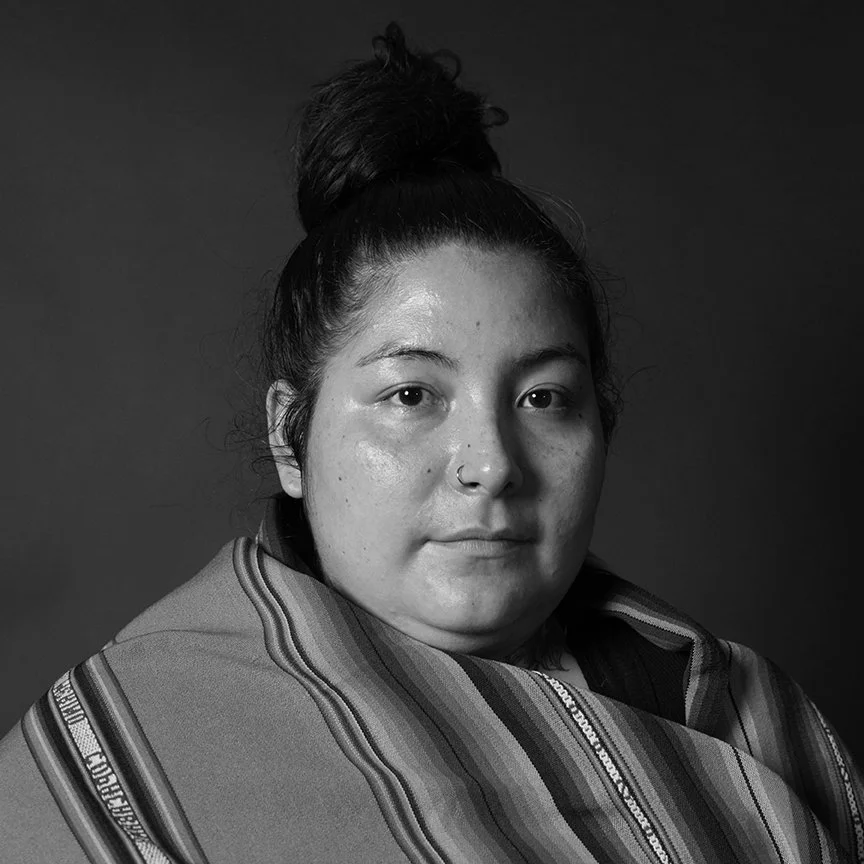
Andrea José, 31 años, Queens, Nueva York (2025), 12in x 12in. Archival inkjet prints on hahnemuhle photo rag baryta. Photo by Andrés Altamirano.
His photographic approach is both subtle yet profound, providing a calm atmosphere to each image with austere, symbolic elements.
Altamirano documents women from Ecuador and Latin America who devote their lives to weaving. He calls them “Las Tejedoras,” women who bring their ancestral knowledge to the modern life of New York City, a context that is often very distant from the realities of their upbringing. Their resilience manifests through their voice––the language of textiles.
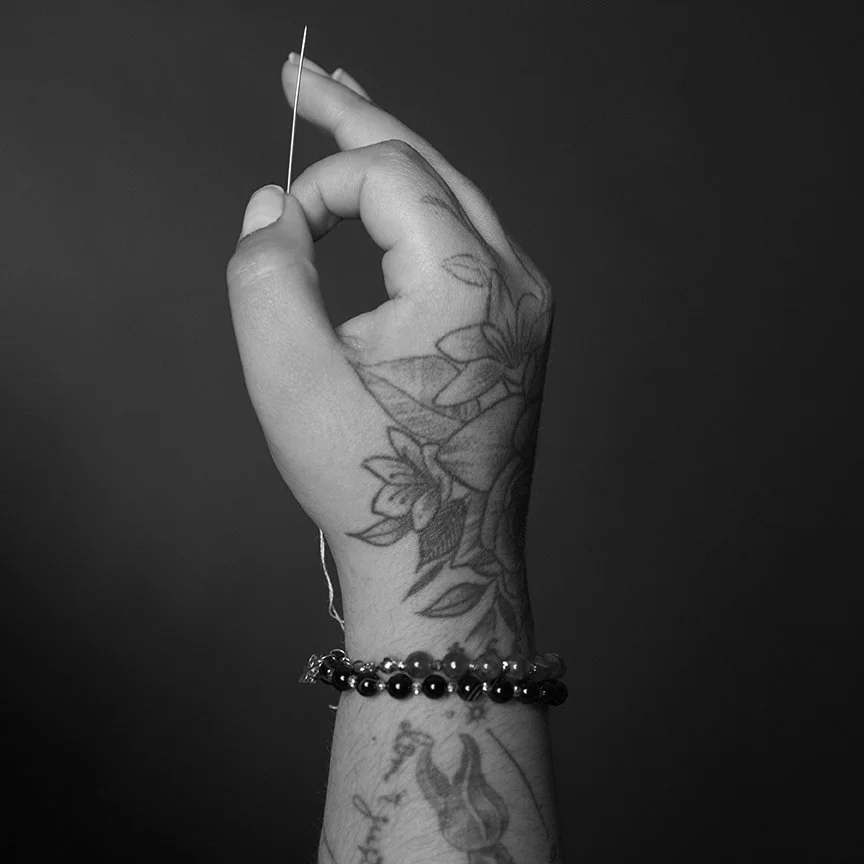
Un hilo de voz / a thread of voice 03 (2025), 12in x 12in. Archival inkjet prints on hahnemuhle photo rag baryta. Photo by Andrés Altamirano.
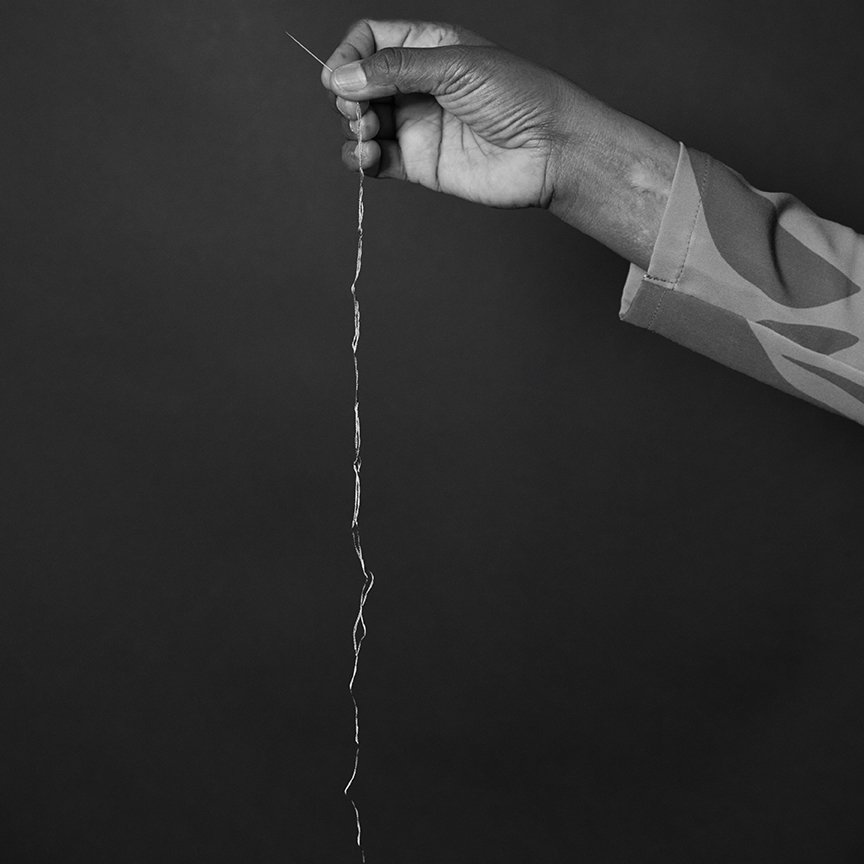
Un hilo de voz / a thread of voice 04 (2025), 12in x 12in, archival inkjet prints on hahnemuhle photo rag baryta. Photo by Andrés Altamirano.
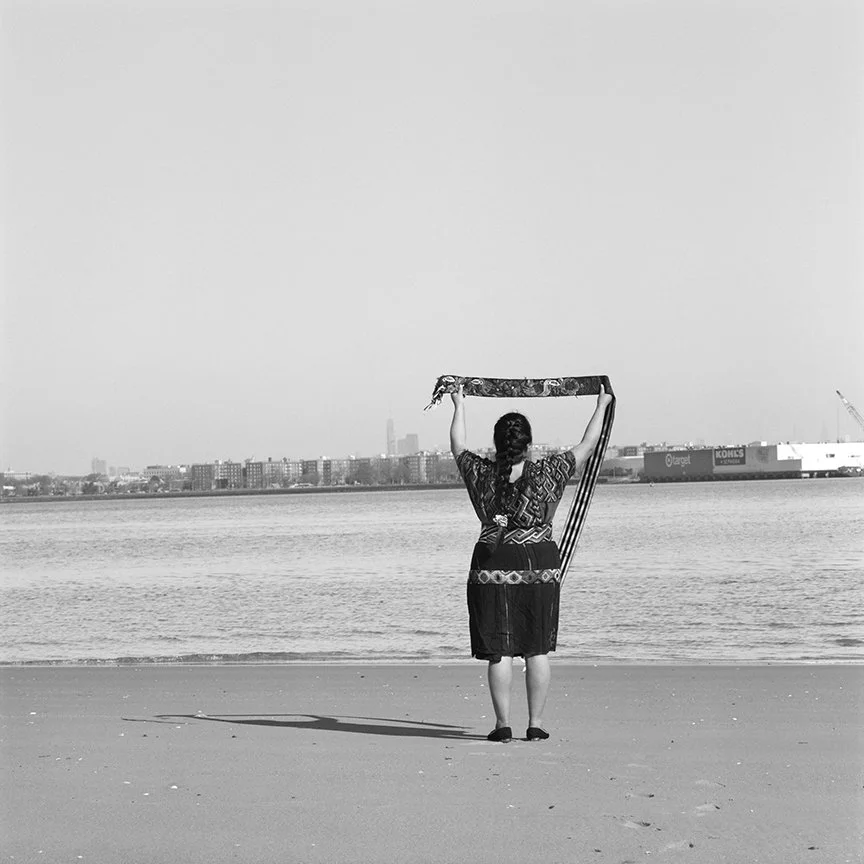
tejedoras / weavers (2025),15in x 15in, archival Inkjet Prints on Hahnemuhle Photo Rag Baryta. Photo by Andrés Altamirano.
Las tejedoras pass on their contributions to local peers through this active practice. Altamirano does not dwell on the past. Rather, he continues to embrace these traditions. In the series Un Hilo de Voz, he highlights the hands of these women holding thread, appearing as the protagonists of their stories. His portraits render their gestures poetically to leave the viewer satiated.
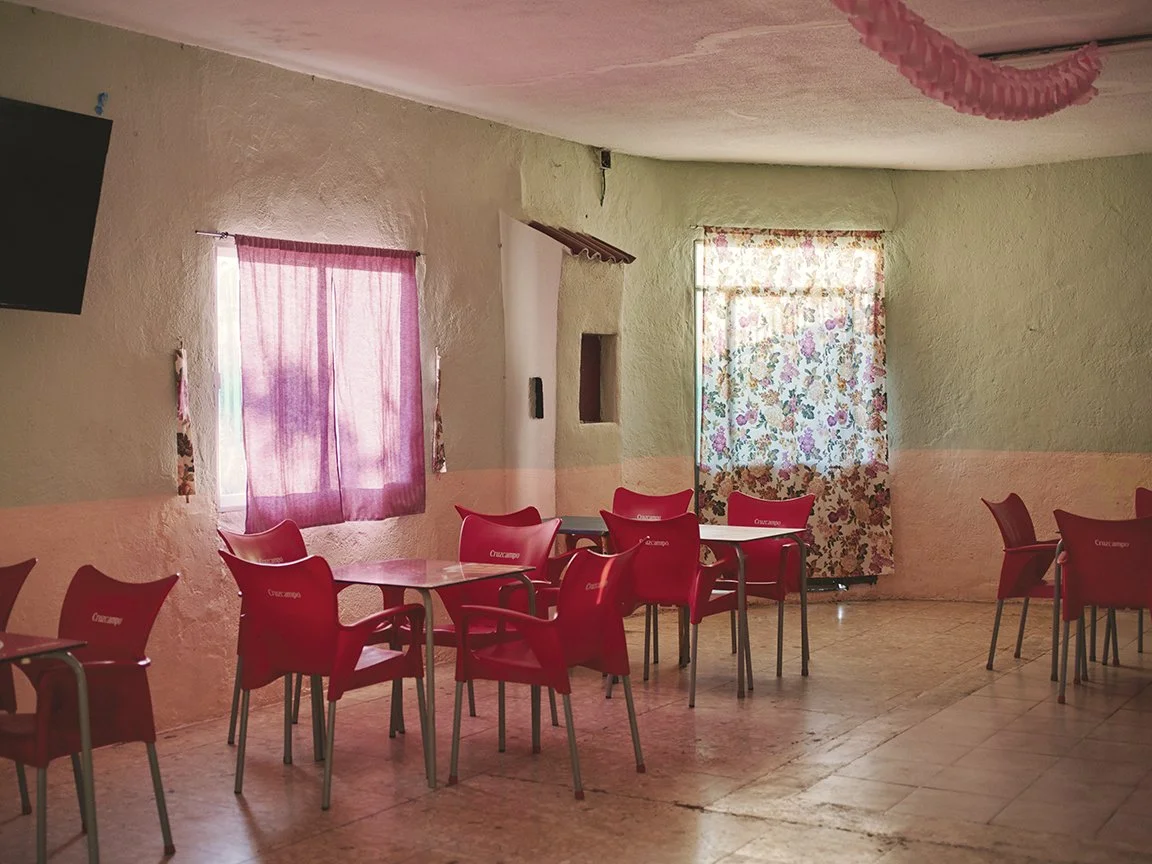
Photo by Johan Orellana.
Johan Orellana has lived in NYC since 2014. Previously, he lived in Ecuador for two years and in Spain for 12.
“The transition to my arrival to Brooklyn was somewhat fluid or rather easier than migrating to Spain as a kid and then again back to Ecuador as a preteen,” he says. “Those two were some of the most dramatic experiences I have lived through. My family migrated to Spain in the late 1990s after Ecuador’s economic crisis, which wiped out my parents’ life savings. Then, [they migrated] again in 2012 after enduring Spain’s economic crisis for four years. My parents could no longer afford to live there. They sold our home and decided to return to Ecuador.”
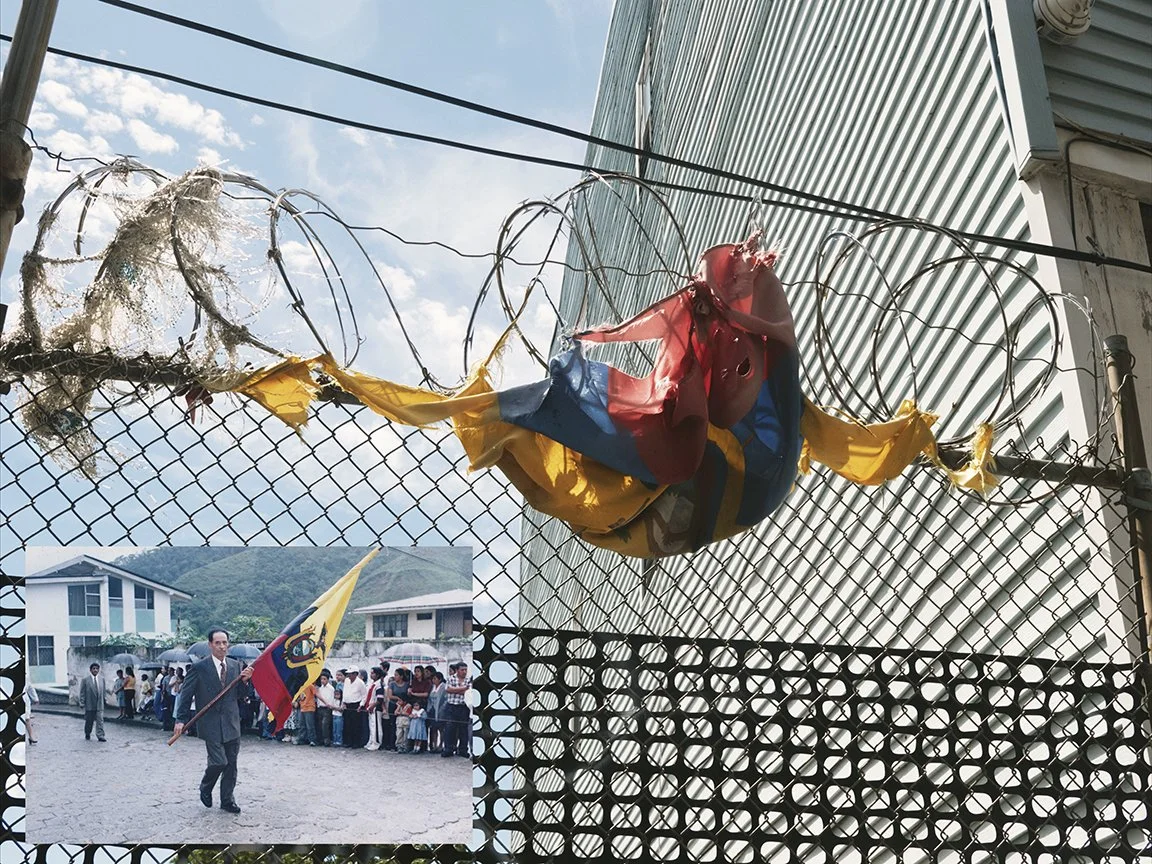
Bandera en alambre de púas y Celso desfilando (Flag on Razor Wire and Celso parading), Brooklyn, New York, US (2024), digital photograph, archival inkjet print. 36 x 48 inches. Photo by Johan Orellana.
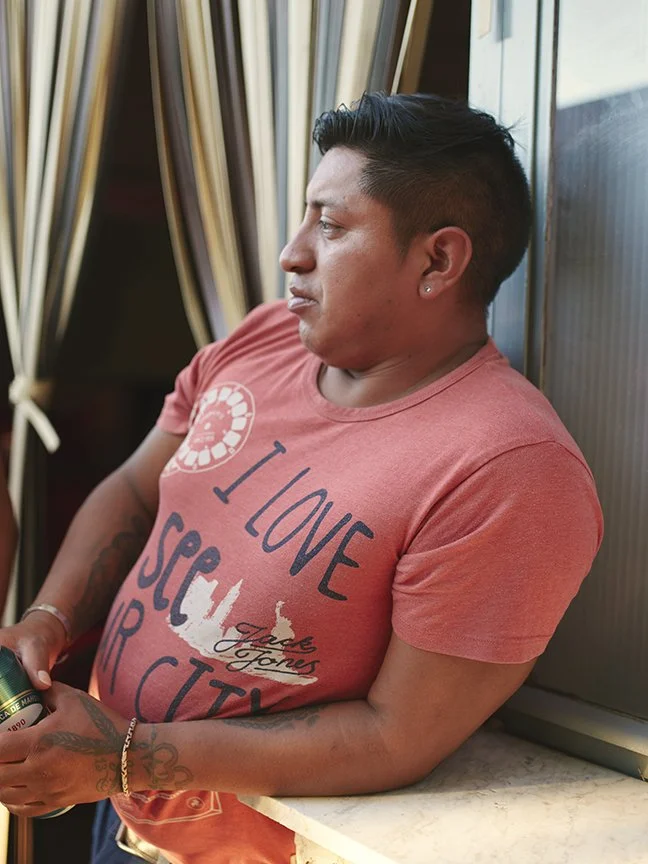
Photo by Johan Orellana.
This migration, particularly coming back to Ecuador, has influenced his work. While living in Ecuador for two years, the idea of desdoblamiento, or splitting, became a common occurrence.
“Through school and friendships, I became aware that the global history I learned growing up in Spain was deeply distorted,” he says. “As a child, I was taught that Spaniards had discovered America, bringing Catholicism and a life beyond ‘savagery.’ In Ecuador, I encountered a different reality; they had raped, killed, and stolen, leaving behind systems of violence and a religion we did not want.”
Orellana also learned that those who chose to remain in Ecuador during these moments of struggle believed those who left took the easier way out. But that didn’t capture his reality. “I knew the opposite experience—the outcome of assimilation and the absence of parental figures due to their constant work to make ends meet and help our family back home,” he says.
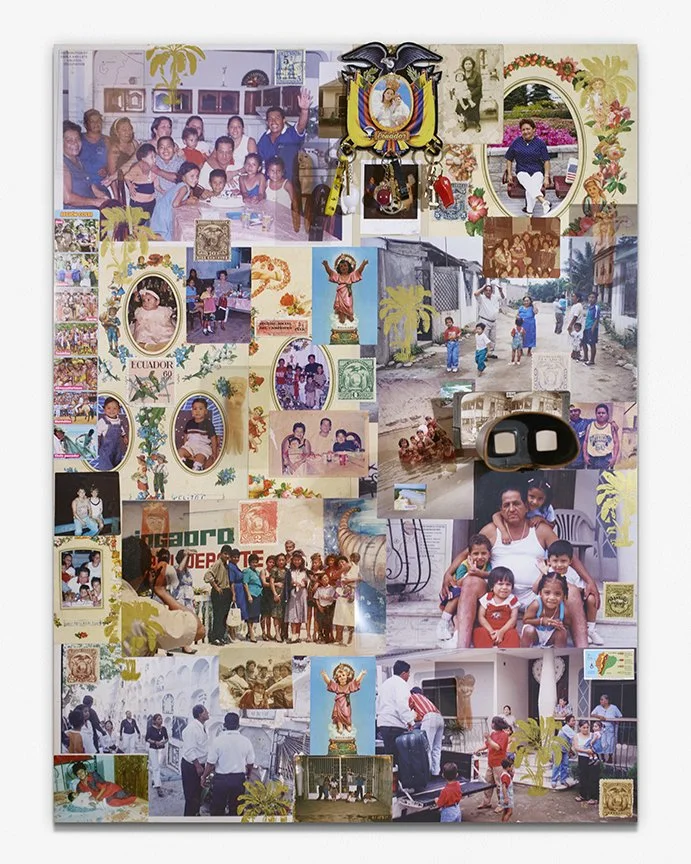
Photo by Johan Orellana.
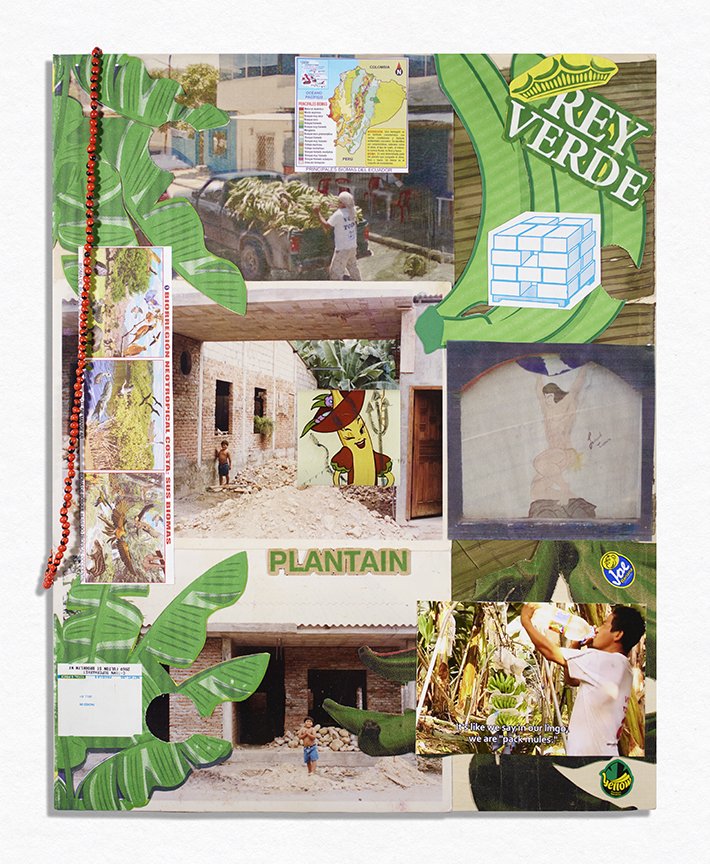
Untitled, mixed media collage on wood panel, 16"x20". By Johan Orellana.
All of this prepared him to once again migrate, this time ending up in NYC. “The transition into New York City life and culture was somewhere in between, not necessarily a rupture but rather an openness to new ideas, perspectives, and people.”
While he travels back to reconnect with his family in Ecuador and his paisanos in Spain, Orellana also wanders through different neighborhoods in New York in search of activities organized by fellow Ecuadorians. In his images, he searches for the peculiarities of everyday life and its contextualizing factors: Repeating motifs like the Ecuadorian flag with its yellow, blue, and red colors, appear in many forms in the streets, or in parks, or attached to gates; bodega signs with descriptive words in Spanish that mark a neighborhood inhabited by Latinos. There are parked cars, close-ups of food, or remains of what was eaten, bananas everywhere. In the series Remnants of Forking Paths, there is an "Ecuatoriana" dimension instead of “Americana,” as the U.S. landscape metamorphoses into pieces of Ecuador.
All those recognizable elements frame Orellana’s portraits of immigrant Ecuadorians. They are sharp and straightforward, so transparent that we feel like we share the same space as his subjects. Orellana makes the viewer feel close, near, and somehow part of these experiences.
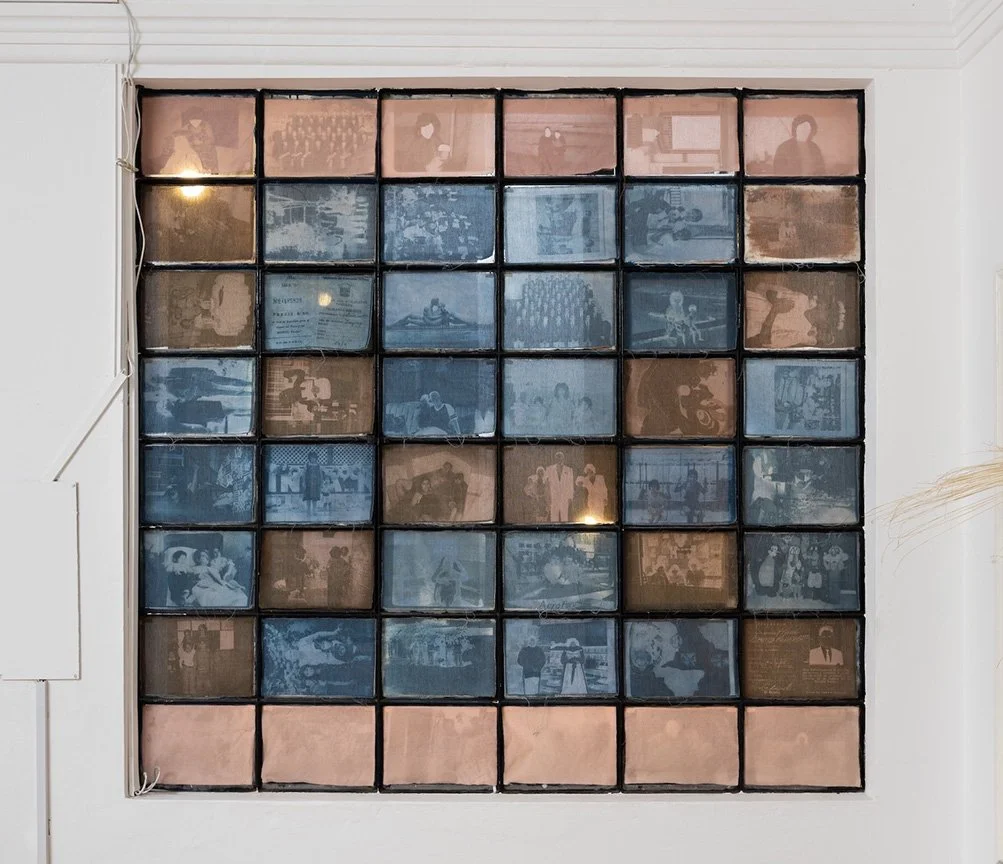
48 Recuerdos (48 Memories), 2025, cyanotype, Van Dyke, organic dyes on cotton fabric, manipulated film transparencies, metal window, 73” x 76” (185 x 192 cm). By Diana Guerra.
Also bringing memories from Peru is Diana Guerra, who seeks to remember more than she knows.
When she came to New York City in 2015, many of her friends were starting masters or PhD programs abroad. But she was beginning to experiment as an artist. “My journey felt open-ended and risky,” Guerra says. “I joined an English school in the city while practicing my photography with strangers I met through Craigslist.”
A year later, she applied to different MFA programs, including Parsons School of Design. As an international student, she didn’t qualify for student loans or federal financial aid. She paid her way with two small loans from Peru and by working at a Peruvian restaurant. However, this didn’t give her enough time to dedicate to her practice. She eventually had to transfer to the City University of New York to finish her MFA.
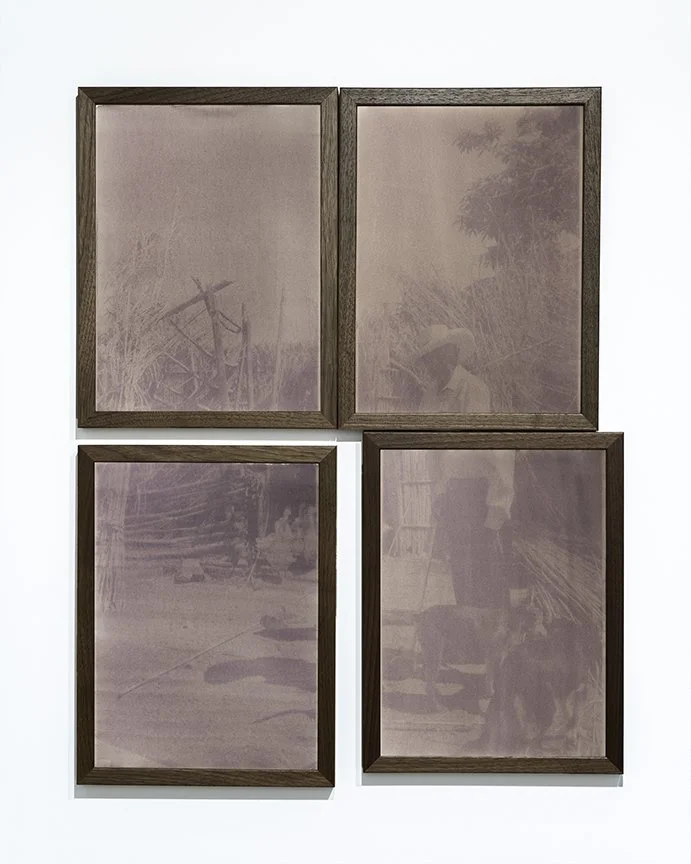
Grandfather In Chacra, 2020 (reprinted in 2022), anthotypes made with purple corn on watercolor paper, 4 components of 11 x 15” each with an overall dimension of 23 x 31". By Diana Guerra.
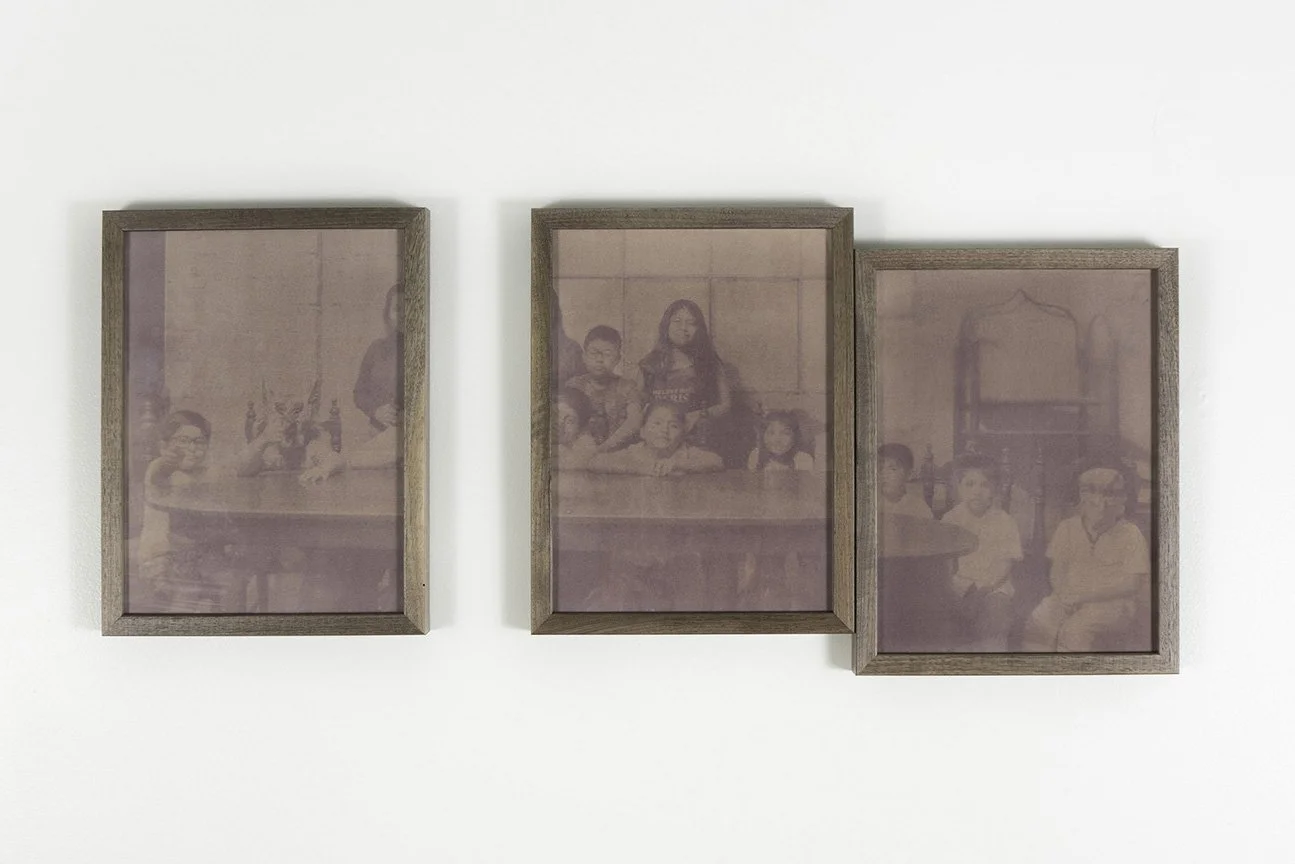
The New Generation (2022), framed anthotypes made with purple corn on watercolor paper
Triptych with an overall dimension of 35 x 15," By Diana Guerra.
These days she embarks on long trips to the towns of her ancestors in Peru to meet her remaining local family, creating tighter bonds, to better understand their mannerisms and ultimately, herself. Guerra builds a large archive of images from these interactions and later prints them with earthen materials like purple corn. Due to the organic nature of the printing materials, those encounters feel like they are fading in time. The images are literally disappearing.
Guerra compares her experience of immigration with that of many others in this country who import their traditions as “a must have” to continue to exist. But she is conscious of how much these traditions are going to transform. Her take is extremely personal, and as soft as a murmur. In Fleeting Under Light, a book of photographs that were also part of The Latinx Project’s Escenas exhibition, there’s an urgency to grabbing those moments and anchoring them in the present, even as they feel already gone, evoking an inevitable saudade.
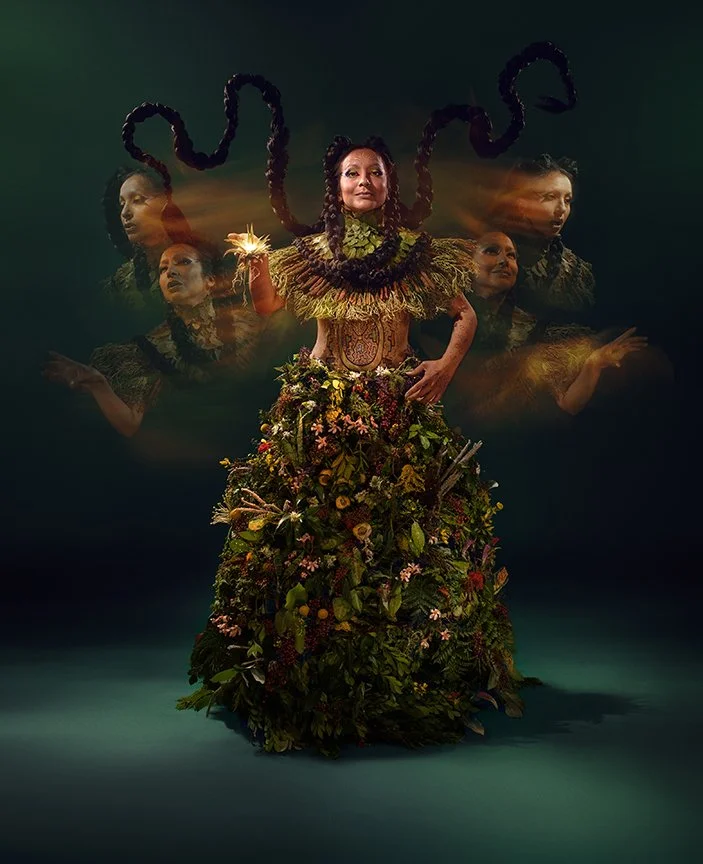
Goddesses of Sorority (2024), 48”x59” inches. Photo by Ana De Orbegoso.
In a different, yet related direction, Ana De Orbegoso brings Peruvian traditions to the United States through film, photography, sculpture, and performative actions. She is from northern Peru, the home of the pre-Columbian Moche culture, and draws from both the history of the Moche and Inca cultures for her projects.
De Orbegoso is fond of engaging with oral traditions. She made the film The Last Inca Princess about an Indigenous woman who marries a Spanish captain, narrating the serious struggle of cultural intermixing. More recently, she presented the project: Goddesses in Sorority: Llacsahuato and Mirahuato.
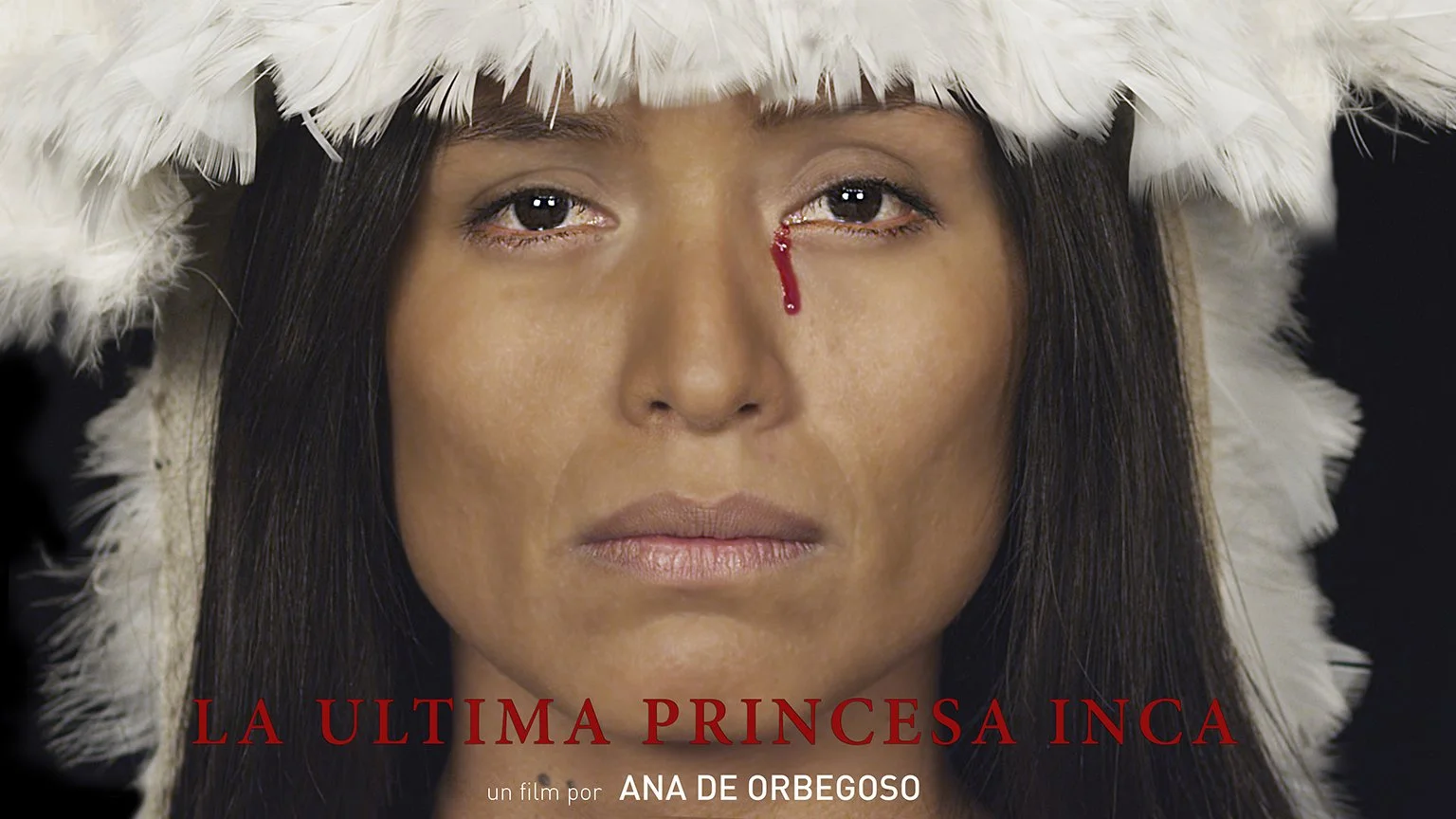
La Ultima Princesa Inca/The Last Inca Princess (2015), poster. Courtesy of Ana De Orbegoso.
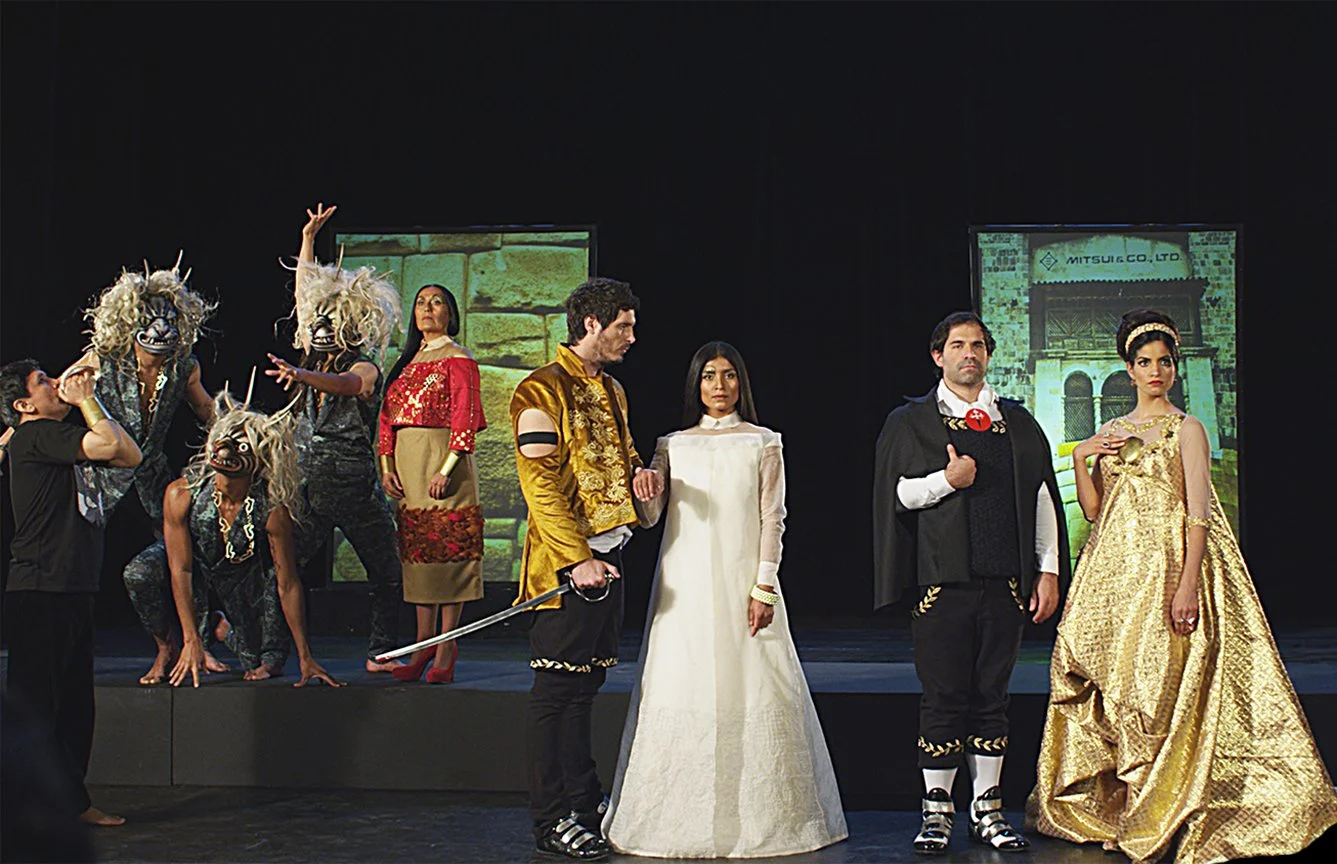
La Ultima Princesa Inca/The Last Inca Princess (2015), still. Courtesy of Ana De Orbegoso.
The work, based on the 17th-century Andean Inca chronicle from the Huarochirí Manuscript, centers on a mythical dual goddess of two sisters living inside one body and whose mission in life is to heal. De Orbegoso creates photographs of this fictional being that resemble the posters of goddesses in some Buddhist temples; they exist in the faith realm of many. In 2025, this project was exhibited alongside the works of two other artists at the Cervantes Institute in New York, a Spanish cultural center. This exhibition encourages discussion about colonization, in the house of an ex-colonizer by a woman from a former colonized country.
While home is important to her work, De Orbegoso also knew leaving Peru was necessary. “My decision to leave Peru marked the beginning of a journey aimed at enriching my experiences,” she says. “I didn’t want to explore the world solely through short trips; I yearned for something deeper. I didn’t know when I would return home, but I viewed the world as a house, with my own birthplace as just one room. I felt compelled to explore the entire house, knowing I could always return to that room when I needed to.”
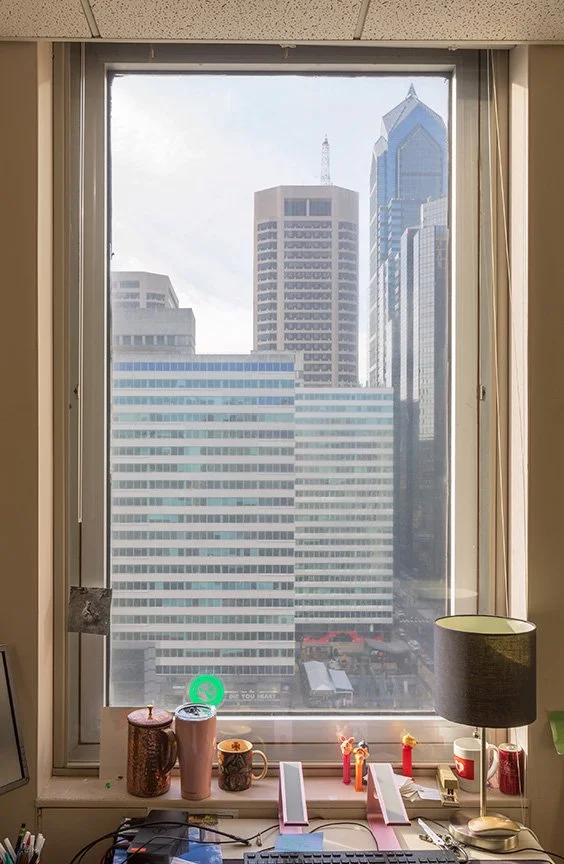
Philadelphia City Planning Commission, South (2021).
Over the years, Emilio Martínez Poppe, born in the United States to Peruvian parents, established himself in New York City, dividing his time between his artistic practice and his work at New York City’s Department of Cultural Affairs. These two spheres are deliberately intertwined as Martínez Poppe often draws inspiration from his role as a public employee and from the many people who serve large numbers of civilians within different government agencies.
A strong example is his latest project Civic Views, first installed in the courtyard of Philadelphia’s City Hall and now included in the Whitney Museum Biennial 2026. The project celebrates the municipal employees of Philadelphia through photographs taken from their office windows, and highlights the pride, complexity, and contradictions endemic to public sector work.
This project took shape when the artist came across what is considered one of the first photographs taken in the United States—a daguerreotype—shot from a government window of the former United States Mint in Philadelphia. The artist treats each window in Civic Views as a portrait of a worker's position behind it, asking: How does a worker's view, or perspective, on the city orient the work they do? These questions framed the anonymous stories of exchanges between city workers and the public.

Installation view of Whitney Biennial (2026). Photo by Ron Amstutz. Courtesy of the Whitney Museum of American Art..
Martínez Poppe installed the photographs on scaffolding structures challenging the notion that public institutions are immutable. First cited within a high-traffic space of city government, the work is on view at Whitney Museum where another audience can find new resonances with the work. Martínez Poppe's realization of this project also speaks to how the child of immigrant parents can become a true insider, offering a deeply informed perspective on society, including highlighting the role immigrants can play in shaping the potential of American governance today.
Martínez Poppe’s move to New York in 2012 and his mobilization with students helps shape his work. “Students were mobilizing against the introduction of tuition at the historically free university,” he says. “I joined that movement along with many other first-year students, participated in solidarity actions with students that were occupying the clocktower, and also participated in the occupation of the president’s office. That experience shaped my understanding of art education and production as a site for political struggle.”