
Imaging the American West as a ‘Verdant Land’
Now, after twenty years dedicated to this project, both of my grandmothers have passed away. I find myself thinking of my beloved Mama Chuy, who revealed her underlying sense of alienation in the United States by uprooting her life and returning to Mexico. I wish I could have offered the comfort of this history, these pictures, as a way to affirm her presence in this country–as a way to say that we, as Mexican-American immigrants, are not strangers to the history of this nation. —Kathya María Landeros, Verdant Land (2025)
Kathya María Landeros’ Verdant Land photobook evokes a lush, fertile, water-rich landscape. The book showcases nearly two decades of images in the American West, specifically in California’s Central Valley, an arid and semi-arid landscape known as an “irrigated desert.” Immigrants, mostly from Mexico, root, tend, and harvest the rice, tomatoes, wheat, peaches, pears, kiwis, nuts and seeds grown here. It is the confluence of water imported from the Sierra Nevada’s snow melt, the deep agricultural knowledge of the land-workers who farm this valley, and the plants they steward, working together, and in relation with each other, that produce the verdancy that Landeros’ camera tenderly captures in her photographs. “I pictured the expansiveness of the West as I wanted to imagine it,” she explains in an interview.
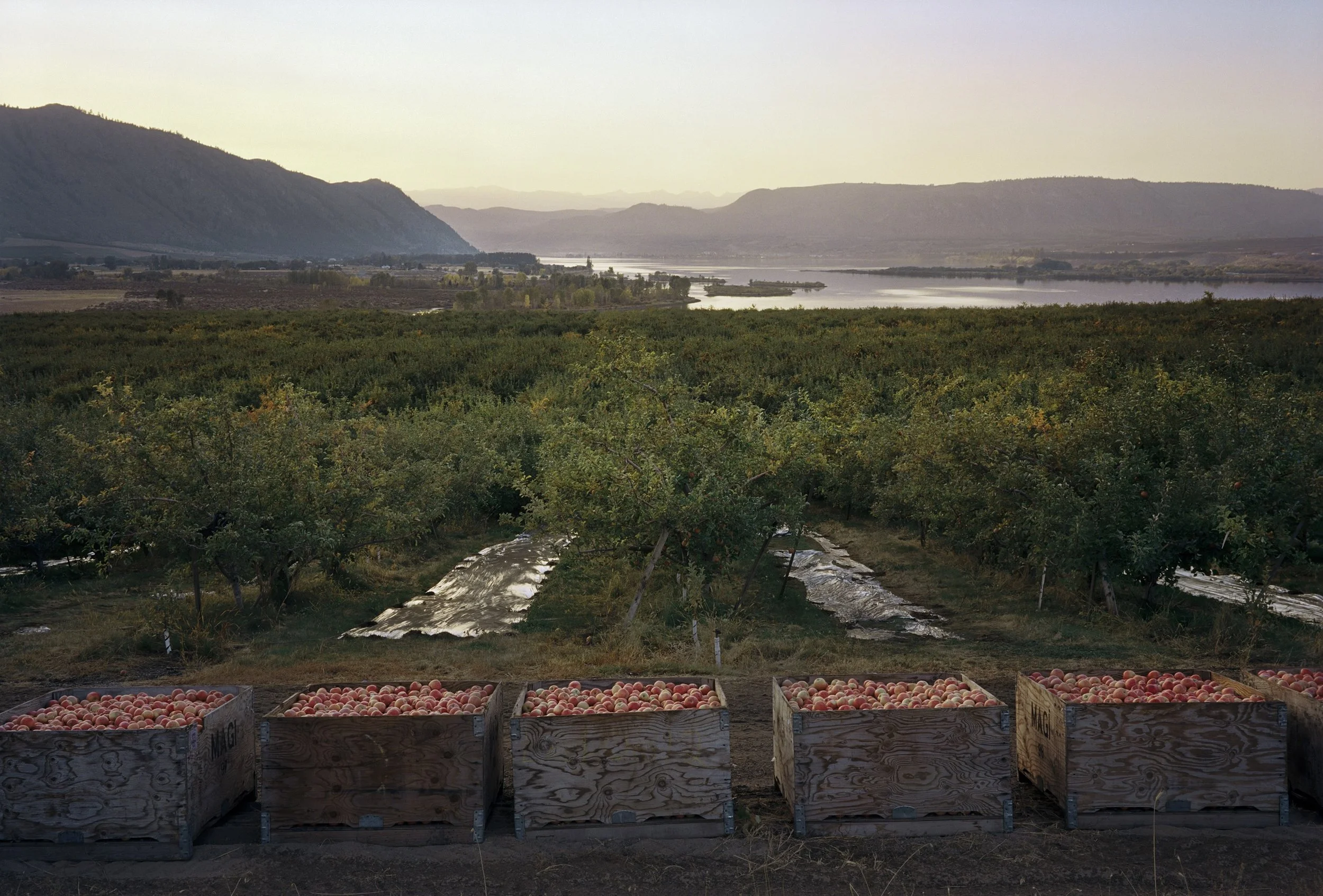
Apple Crates from Verdant Land. Photo by Kathya María Landeros.
Verdant Land stands as a metaphor for the livingness of the immigrant agricultural communities that Landeros’ work depicts. Her title indexes the social constructions and meanings we assign to land and its purpose(s). In this instance, the richness and fertility of the land is stewarded by agricultural workers to yield the “products” that will sell to hungry consumers. The historical imaginary of the American West has erased Indigenous habitation and constructed it as a conquerable frontier framed through ideologies of Manifest Destiny, visions of wild untamed land, and narratives of gunslingers and lawmen.
In more current renderings, the West invokes images of beautiful beaches, celebrity culture, and hubs of technology. What is often absent in these geographical snapshots are the everyday lives of people of color who work and live on the land on which the national mythology of the American West resides. By focusing on the quotidian, the photographs insert Landeros’ subjects into the narrative of the American West and, in the process, challenge the racial and historical construction of America. They tell a story of migration, labor, and community that remains unseen in the predominant white construction of the nation.
When Landeros turned her photographic eye toward California’s Central Valley, the place where she grew up surrounded by farm land, she meant to shun ethnographic depictions of the lives of the people who dwell there and their reduction to the unidimensional category of worker. Instead, she centered their full humanity and lives, capturing their beauty and their relationships with the more-than-human world with which they cohabitate. The strategy of honoring her subjects’ personhood and histories is clearly evident in her inclusion of archival photographs of her family’s album, which depict images of her then-young parents, uncle, aunts, grandmothers, and godmother, mostly in their U.S.-based gardens. As constant companions, gardens and their luxuriant colorful flowers—including dahlias, roses, camellias, geraniums, and more—frame not only her family’s now long-ago past, but that of the people she photographs.
An arresting photo in this project shows her beloved grandmother Mama Chuy—an important life-shaping matriarch in Landeros’ life—as an elderly woman staring at the ground pensively against a flowering camellia tree with brightly colored reddish-pink flowers. Mama Chuy cuts a robust figure, emanating strength and vitality, but her hunched back indexes a life of hard work. By incorporating the images from her family’s photo album, Landeros firmly positions her own roots within this verdant landscape and provides the viewer insight into the often-erased history of immigrants like her beloved Mama Chuy.
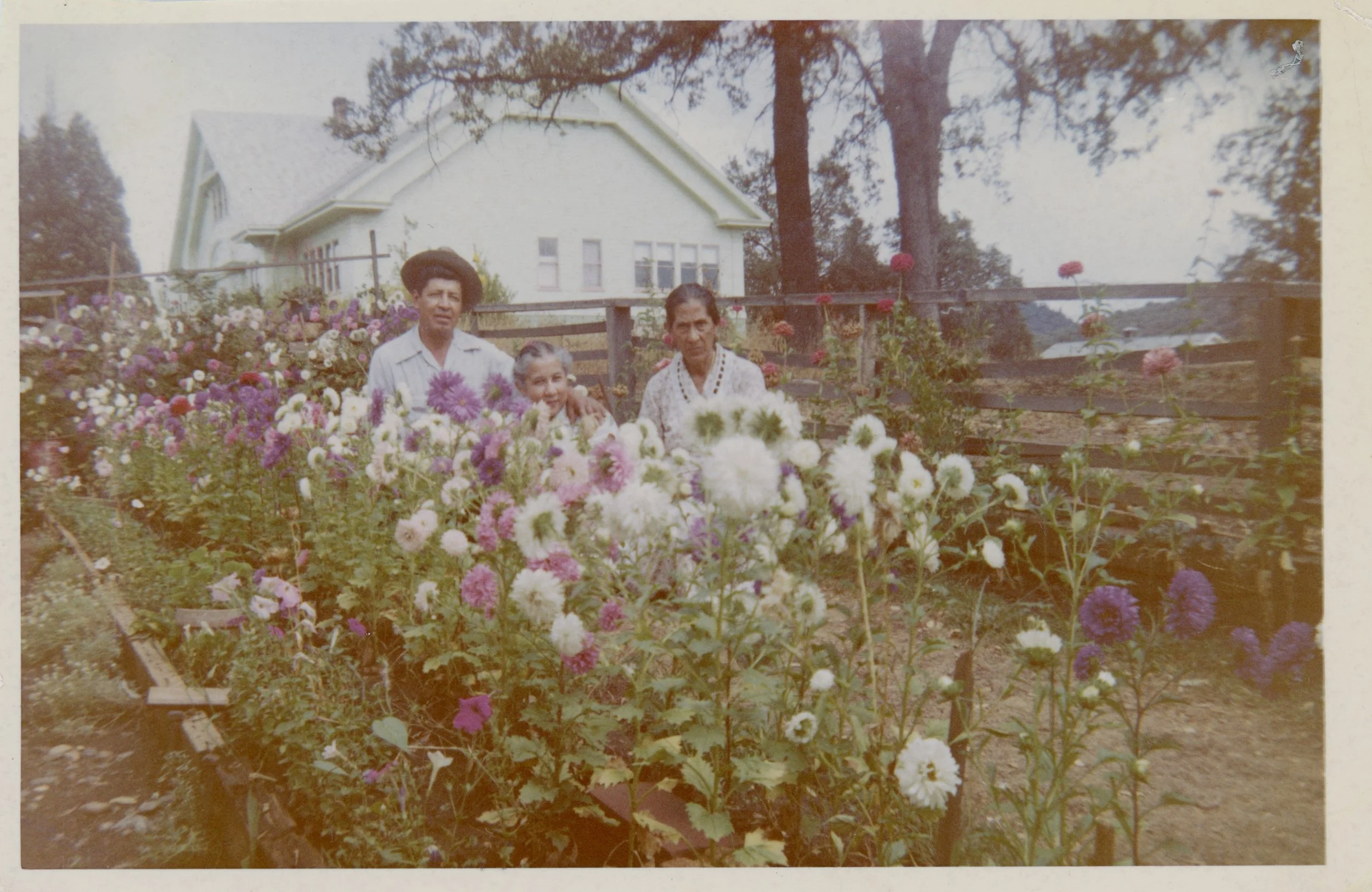
Nina Lala and Mama Chuy, family album, archival photo. Courtesy of Kathya María Landeros.
In our current historical moment, the attack on immigrants is facilitated by a discourse that strips them of their humanity and renders them disposable, expellable, and worse. Their history on the land and their significant contributions to feeding this country and sustaining the economy are diminished. Landeros’ photographs remind us that these Latinx and immigrant communities are integral parts of the American West—they are an intrinsic part of our national geography. Verdant Land captures the beauty and resilience of the Latinx community and reminds us of the unlimited possibilities of art to illuminate the unseen and resist historical erasures. Landeros shows that like the desert, these communities are teeming with life. One just has to know where to look.
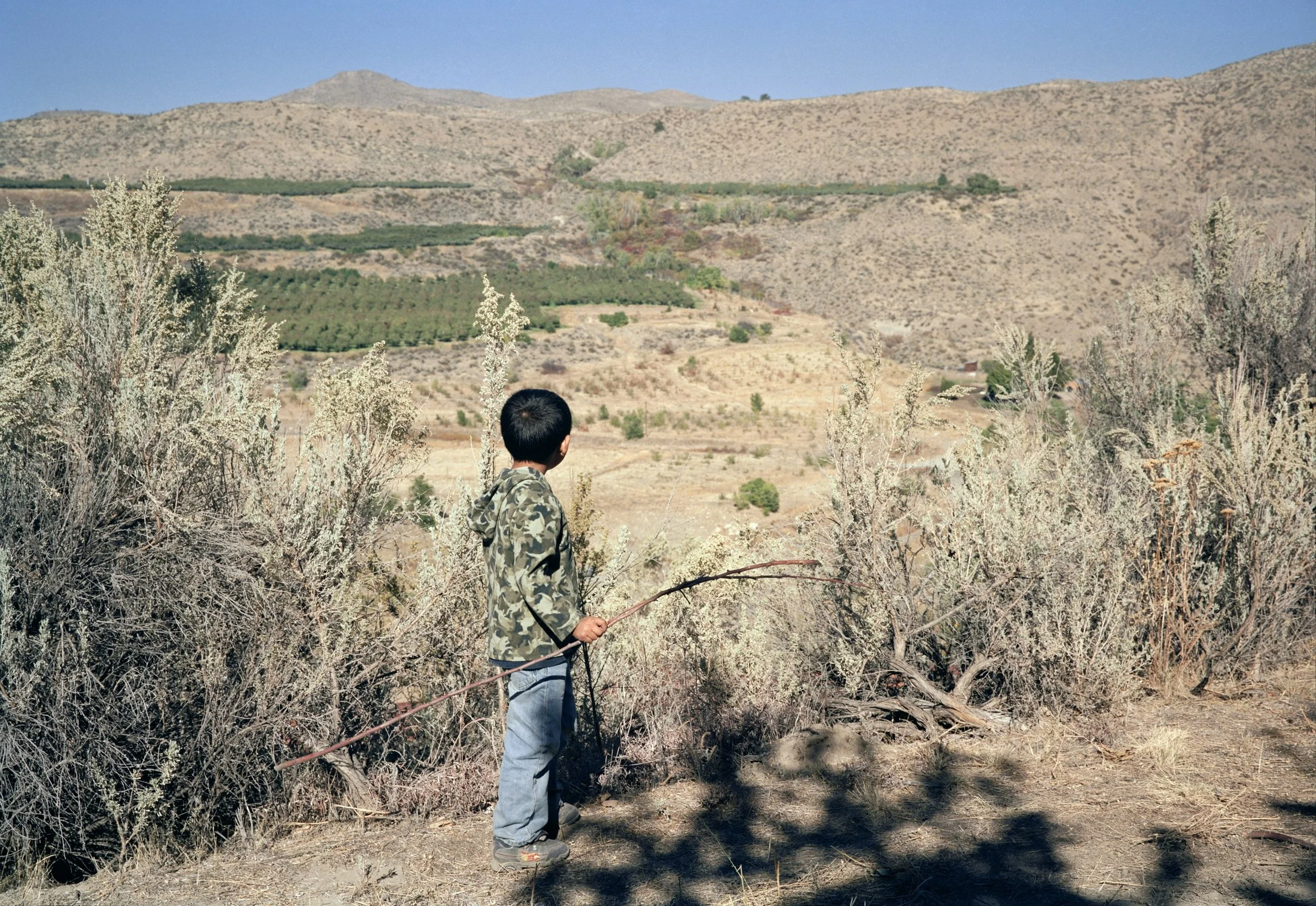
Ebodio’s Son from Verdant Land. Photo by Kathya María Landeros.
The lives of those that Landeros photographs are not stand-ins for romantic late-capitalism renderings of a return to an agrarian life or of humans commuting with nature in some state of bliss, but rather of rural life in its everyday fullness. This is clear in photos of boys playing, riding bikes in a circle in the yard of barracks-like housing. Or of adolescents in basketball clothes walking along a desolate-looking western street dribbling a ball. And by an image of La Milpa Lavanderia, depicting a laundromat at dusk, a man in a cowboy hat speaking on a mobile phone, while a woman stands nearby with her back to the camera speaking on a payphone. Patrons are captured in various states of sitting and standing inside the laundromat in what anyone who's ever depended on such an establishment recognizes as the ticking-of-the machine-timer’s countdown to finished laundry. Neon light shines from inside the laundromat while a working pay phone resists technological extinction.
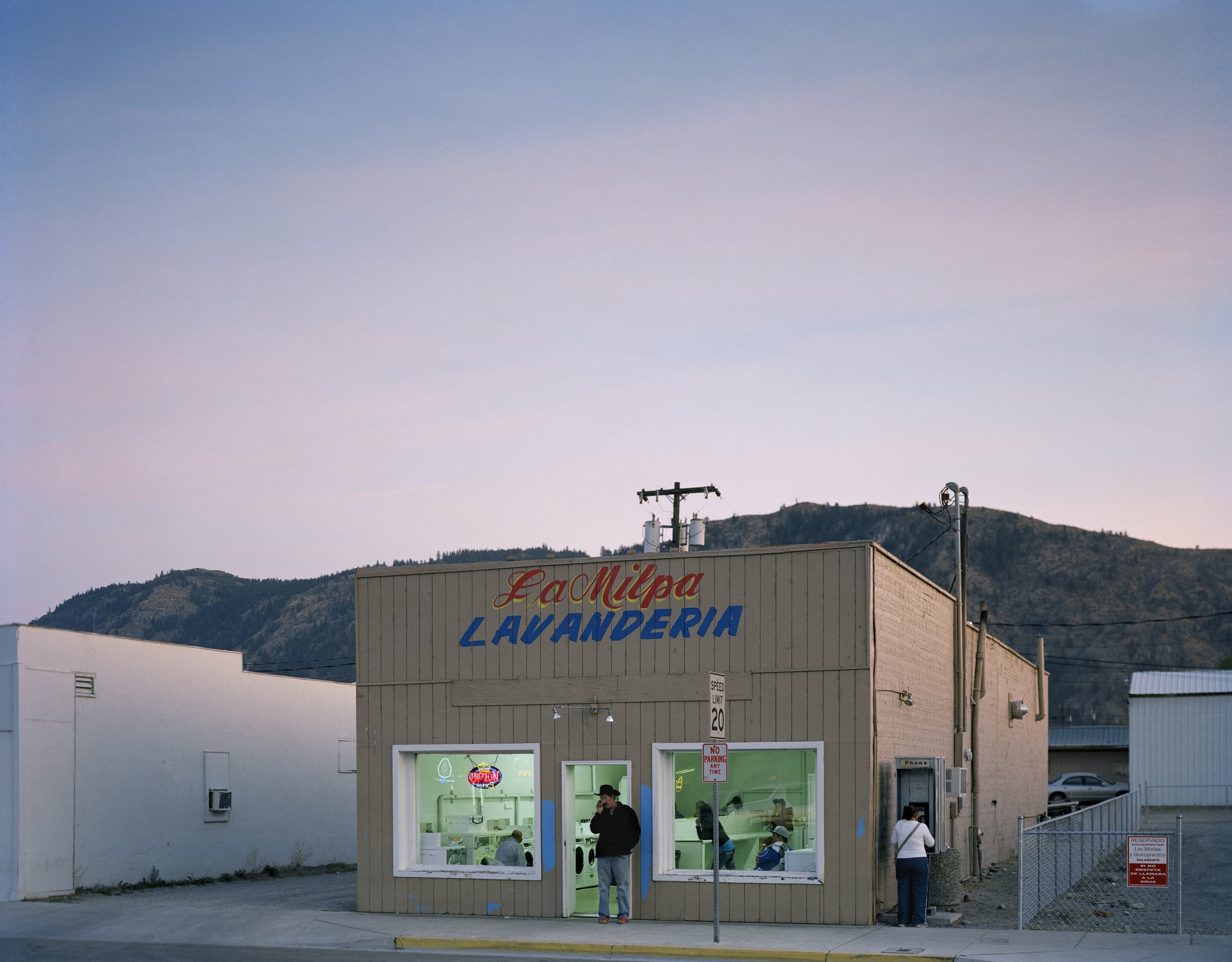
Lavanderia from Verdant Land. Photo by Kathya María Landeros.
We also see photographs of uniform homes—modern “little boxes”—commercial buildings, and empty store fronts. It is in this mosaic setting that Landeros captures the inhabitants, a setting that blurs the borders between these disparate landscapes. She juxtaposes vibrant images of lush greenery with rolling hills of desert scrub, often set against the backdrop of seemingly endless sky. The rows of crops, flowering shrubs, and looming trees stand in stark contrast to the arid and dusty desert. In the midst of this natural landscape, Landeros focuses her lens on the infrastructure that makes up life in farming towns.
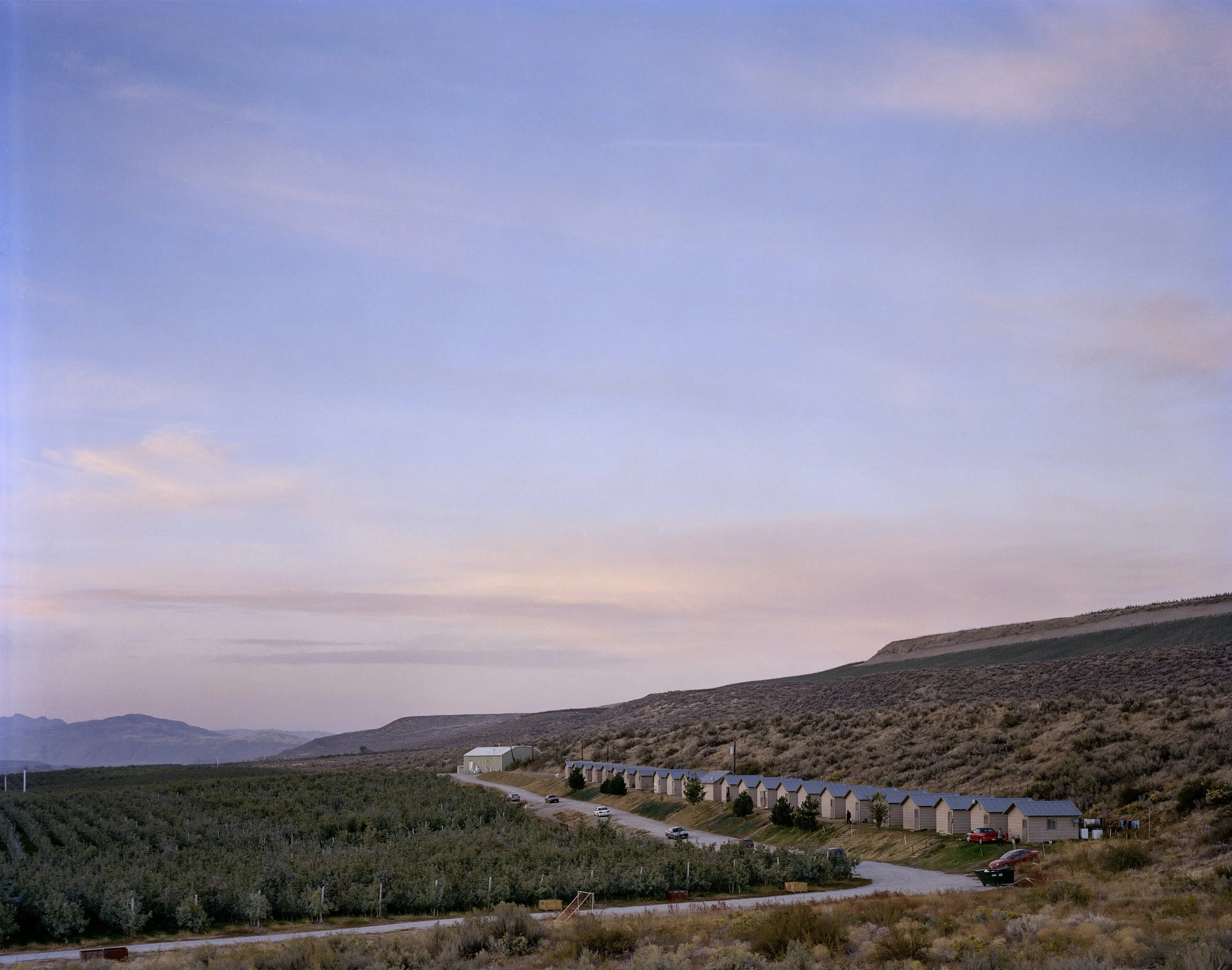
Farmworker Housing from Verdant Land. Photo by Kathya María Landeros.
The photos of those who live, work, play, and worship in the agrarian fields that help feed the nation, simultaneously represent recent immigrants who have come seeking a better life and those more established community members with long familial ties to the land. The subjects of Landeros’ photographs are the heart of agricultural communities and, while their work in the fields deserve acknowledgedment, the photographs remind us that they are mothers, fathers, daughters, sons, grandmothers, grandfathers, aunts, uncles, and more. They are individuals with hopes and dreams, who toil for the advancement of their families and communities, but who are not solely defined by their occupation.
While viewers may not know the people in the photographs, their images conjure a feeling of familiarity. We glean glimpses of childhood: a young teenage girl with her pet snake, a young man tenderly holding a rooster, a family’s chihuahua staring confidently into the frame. We witness a woman holding her baby girl who wears a voluminous white dress as if she is going to be baptized. A few pages later, we see a girl on the cusp of young womanhood in a white chiffon dress with a red crucifix and standing near the Virgin Mary as if to signal her recent Catholic confirmation. In another, a young boy in a three-piece suit wears “big-boy” dress shoes, while holding a crucifix and offering a crooked smile, leaning against a vintage Camaro. In his youthful swagger, he almost appears to simultaneously be swearing allegiance to church, nation, and masculinity.
Religiosity and the rituals that accompany the marking of children’s life trajectories (from baptism to confirmation) in relationship to God, family, and community are subtly indexed in these images. While most of the images portray individuals posing singly for the camera, the crucifix as a marker of their relationship with God, also signal their belonging to a broader community of believers. In this last image, Americaness is also evoked through the iconicity of the Chevy Camaro while also recalling Hollywood’s masculine fascination with American-made cars and heartthrobs in films such as 1975’s Aloha, Bobby and Rose.
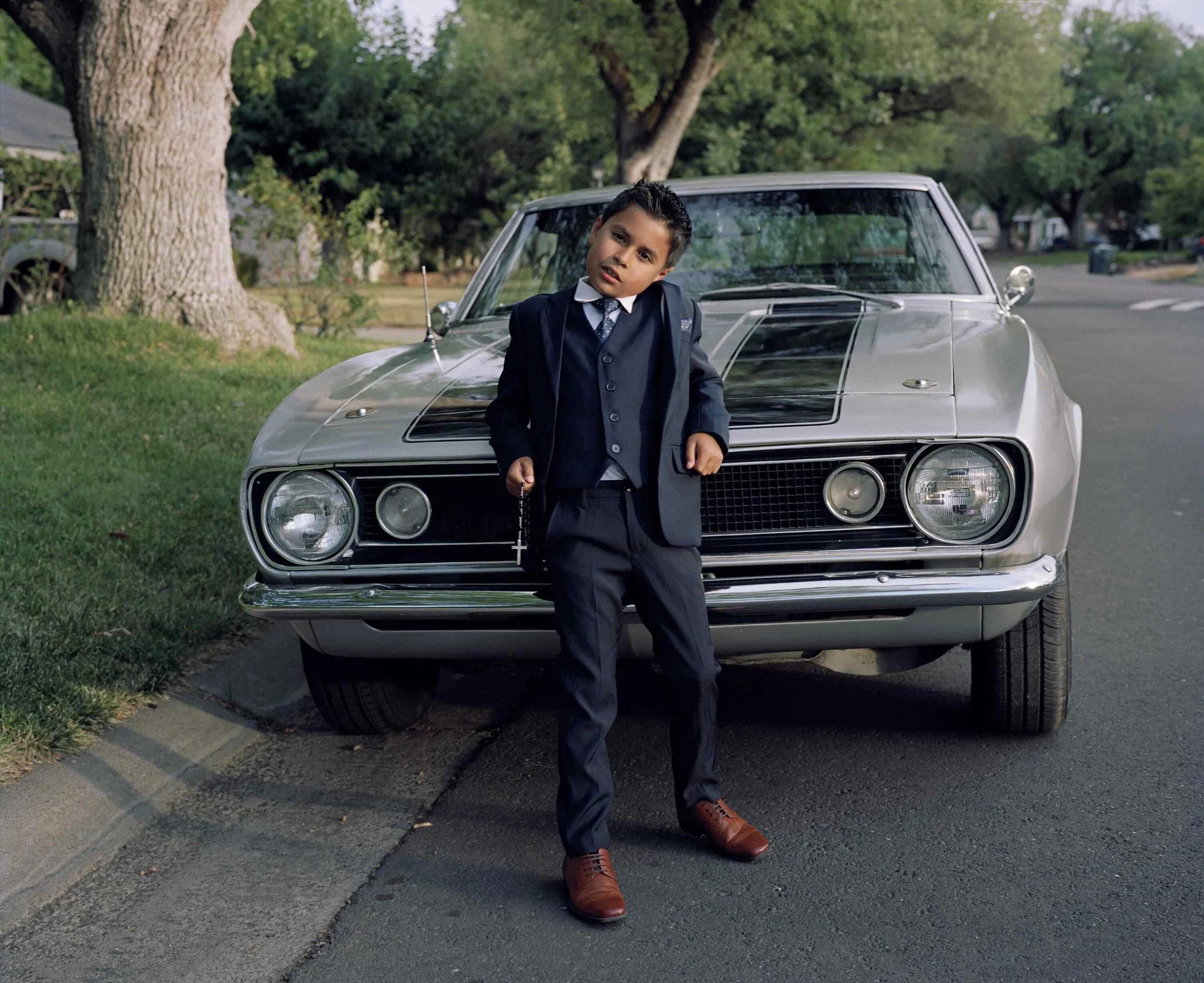
First Communion from Verdant Land. Photo by Kathya María Landeros.
In another photo that plays with American iconography, we observe a couple, leaning slightly toward each other, looking directly into the camera with a hard-to-pin-down countenance. Because of their middle-age and serious aura, the viewer might assume they are the well-respected patriarch and matriarch of a big family. Landeros has playfully remarked that this Mexican-American couple stands as her version of the American Gothic.
A full accounting of life is incomplete without depictions of rest, respite, contemplation, and sleep. Landeros includes images of children and adults in these various states of stillness and rest. Her lens captures people relaxing among trees, lounging on grass, and dreamily looking at endless skies. These captured images bring to mind, especially for viewers who know the West, the practice of immigrants and their families connecting to public green spaces. Sometimes in groups or alone, it is common to see them sleeping blissfully on the bare, grassy earth in what often resembles earth-body hugging in parks.
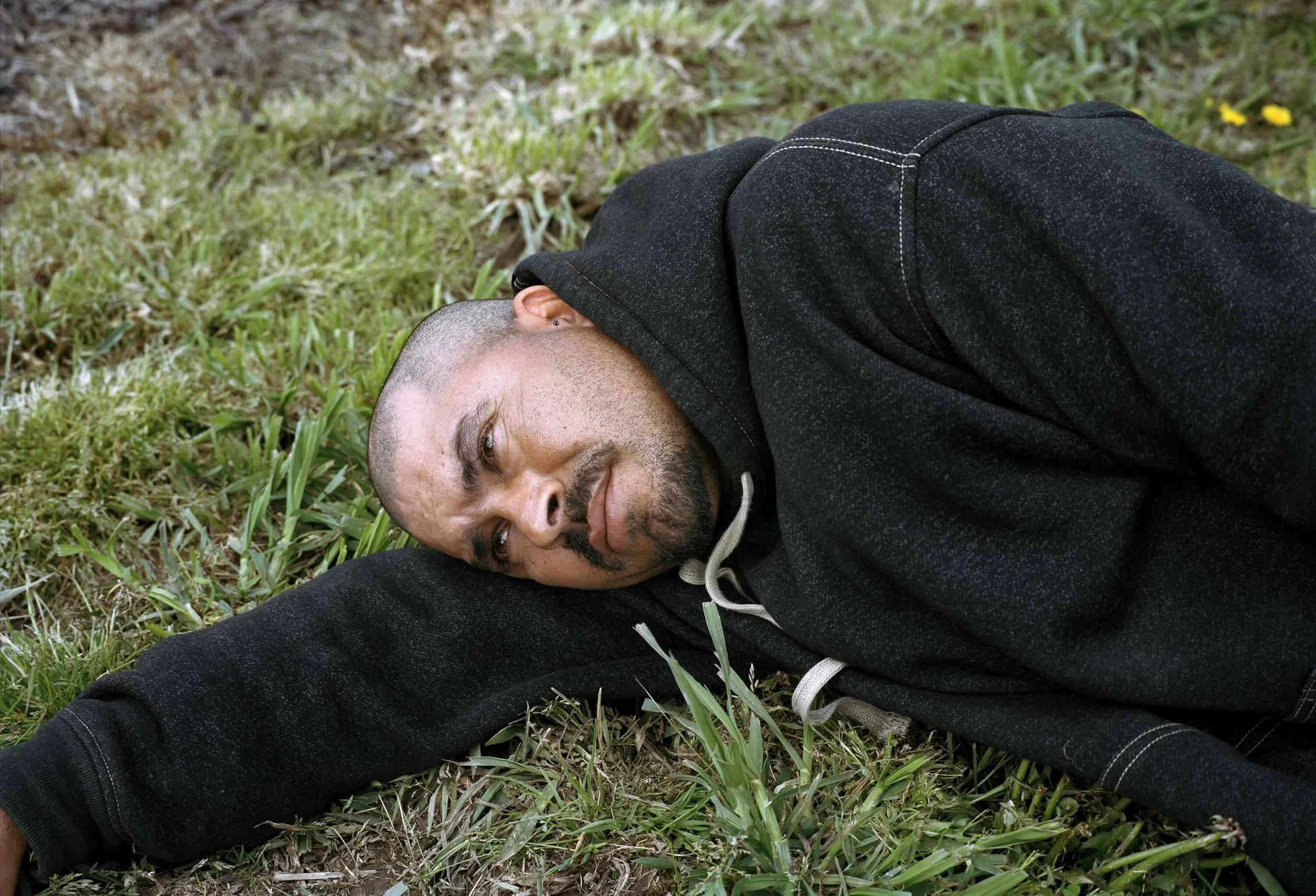
Victor Peach Orchard from Verdant Land. Photo by Kathya María Landeros.
Landeros’ photographs capture the vibrancy and complexity within this community and gesture toward the question of their belonging within the nation. The American flag is represented by Fourth of July trinkets hanging on a cyclone fence that looks as if it is holding back a mass of wild vegetation. It reminds the viewer of the nation’s constant need to control the land and that today's July 4 celebrations largely stand as an Americana symbol of late-capitalist culture of consumerist freedom based on the labor of immigrants. The flag also stands for a belief (now a myth?) in the possibilities for a prosperous future in this so-called land of opportunity. The Latinx agricultural workers pictured, whose very bodies, hands, sweat, blood, and tears are literally spilled working the American land, are intrinsic to American history. This is because history is not only made by those who fight wars or those who make laws and policies, but significantly a nation’s history is made by those who work the land and feed the nation. Landeros’ Verdant Land is a powerful visual reminder of this often-unacknowledged history.
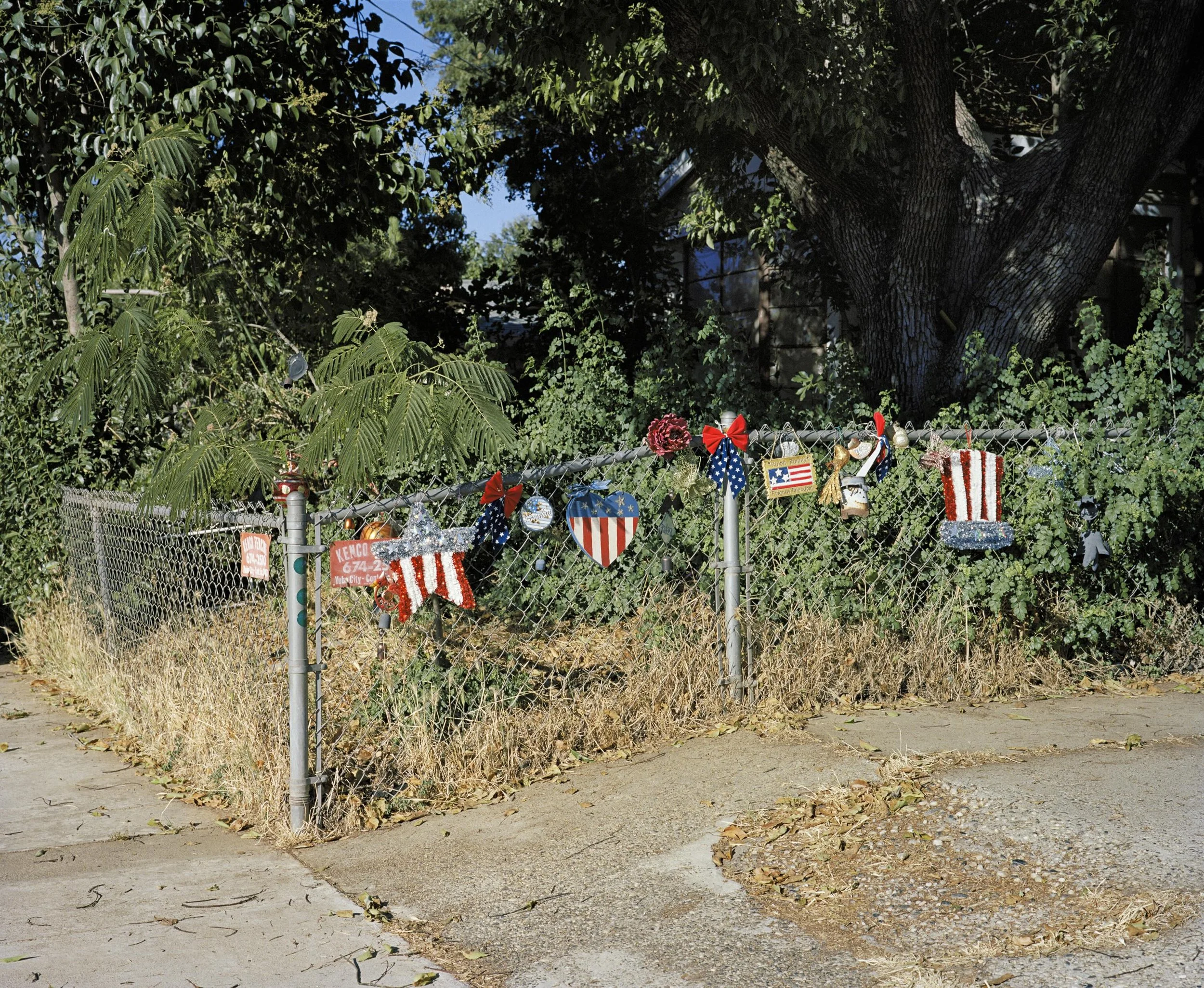
Fourth of July from Verdant Land. Photo by Kathya María Landeros.