
Robles-Alvarado’s ‘Burn Me Back’ Reignites Buried Histories
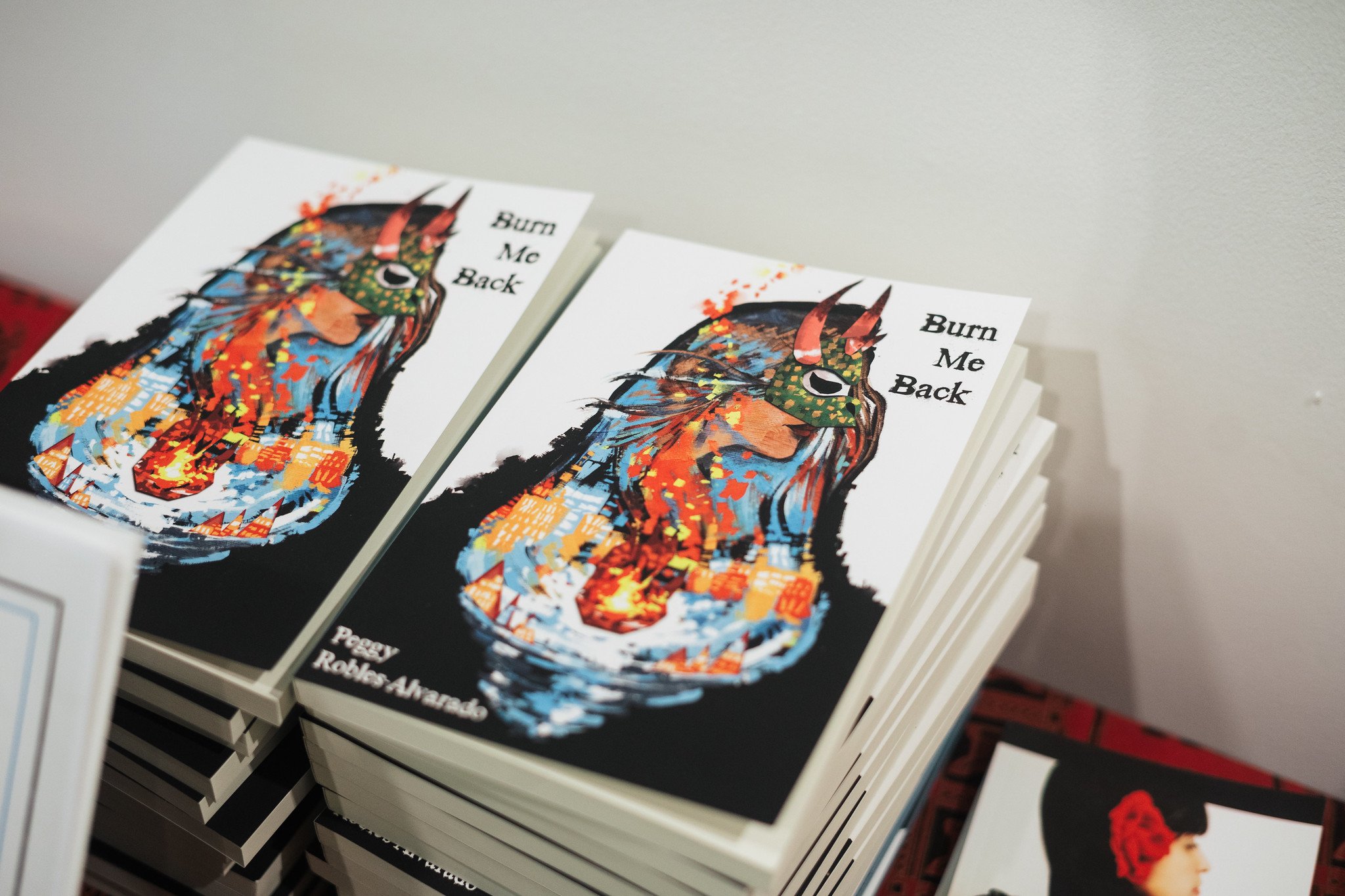
Photo by Mario Carrion.
Peggy Robles-Alvarado’s book Burn Me Back transforms the scars of migration, colonialism, and family trauma into a series of ritual flames. Her poems speak from the wounded body of the diaspora—one marked by alcoholism, silence about sexual abuse, and forced forms of love—but they also reclaim that body as a sacred space of rebirth, una casa fénix. The act of burning becomes both a metaphor and a method: a way of destroying the colonial, patriarchal, and racial legacies imposed on her while rekindling ancestral wisdom encoded in language, ritual, and memory. Through portrayals of fatherhood and motherhood, tías’ contradictory wisdom, and the purification ceremonies that animate her family and poetry, Robles-Alvarado stages a poetics of healing rooted in the logic of marronage—the fugitivity of spirit, body, and speech that preserves Caribbean expressive cultures from erasure. In Burn Me Back, fire becomes an ancestral tool of survival, reactivating DNA, memory, and the body itself as vessels of cultural permanence, strength, and healing.
Robles-Alvarado’s portraits of alcoholism, forced relationships, and paternal loss show how colonialism and migration leave emotional scars that lead to bodily and familial self-destruction. In Burn Me Back, the poet depicts Puerto Ricans in the Bronx as disposable citizens affected by imperialism, systemic neglect, and ghettoization. They are made to feel inadequate within the colonial, that is, racist, idea of U.S. citizenship. Meanwhile, Dominicans often appear as undocumented people pushed to hustle and prove their belonging through intimacy to survive the diaspora.
These wounds—emerging in “a lineage fractured by secrets,” as Willie Perdomo writes in his blurb—manifest through the cycle of addiction, where substance use and abuse often become both a sign and a symbol of dislocation and hidden grief, but also of endurance. It is no coincidence that Robles-Alvarado dedicates the book to “every kid who survived family parties where the grown-ups drank too much, and to all the kids who didn’t.” Robles-Alvarado celebrates the energy and musical rhythm of Saturday nights—the lively expression of life, Caribbean sound, and presence in NYC’s overlapping diasporas. Still, she also recognizes the aftermath: the hangover, Sundays of depletion, and sickness that reflect the wider exhaustion caused by colonial displacement.
Meanwhile, the absent father due to a terminal illness also functions as the absent patria—the “fatherland”— (also burdened by extractive debt, climate and energy crises, and the effects of necro-politics). “Papi’s death was a downed powerline on an island I tried to candle with breath,” Robles-Alvarado writes. His memory survives in fragments of language, cups of Don Pello coffee from Ciales, ron, gestures of recognition, and radical acceptance, which migration makes more visible and intense. “Papi, tell me again how I can hear your voice in the red,” the poet says.
The Caribbean migrant body, in her view, is ecstatic and wounded, driven by thirst: for alcohol, for ocean crossings, for love, for the promise of an easy landing or local recognition that never fully materializes. The migrant body, though disabled and exhausted, becomes a repository of survival knowledge. “Papi,” Robles-Alvarado insists, “Tell me again that all birth requires blood, and that rebirth yearns for salt water, honey, and dark rum.” . Robles-Alvarado’s refusal to stay silent, her fierce, sharp speech, transforms that inheritance, that spark, into testimony and visual art, reclaiming the potential and joy of conjoint healing amid the ruins of migration. “Papi, tell me again how the ocean places the blue of my songs in your palms,” she continues. Blue here is an African descendant sorrow, breath, bachata release, and creative transfiguration.
Against this inheritance of pleasure and pain, Robles-Alvarado reimagines the maternal and extended female lineage as a space of ritual renewal, where burning becomes a gesture of self-recognition. As professor and poet Urayoán Noel affirms in his blurb, Robles-Alvarado’s book is “unflinching in its reckoning with cross-generational violence and trauma as they connect to patriarchy.”
In a landscape shaped by survival and citizenship—where women endure the advances of viejos verdes or seek relationships as a means of protection in a hostile nation—the poet reveals how the demands of papeles have captured intimacy itself. Yet, instead of remaining trapped in these cycles, Robles-Alvarado turns to the tías, her own Dominican chorus embodying the contradictions of diasporic womanhood. “When a man asks where your body has been: remind him that you were never good at math, that pure + innocence no longer add up,” Tía Rocio advises. Through their gossip, lessons, laughter, and strategic acts of respectability, las tías demonstrate to their “perennials that bloomed best when surrounded by weed and tigueres” how to navigate between visibility and danger from hombres-perro, affection, and self-preservation. The maternal body, in turn, appears as both injury and remedy—its silences, omissions, and tacit understandings showing that love, too, can exist in restraint. “Mami’s life is a banned book I am forbidden to read . . . her tongue: where history has died . . . There is violence in Mami’s love. It’s a warning rupturing in rage and reopened wound. It’s clumsy self-suture when she can’t count on anyone to mend her.”
Still, the poet refuses to leave the unsaid unnamed. Her writing bears the psychic scars of exposure and reclamation, transforming pain into declaration and bodily inscription into agency. Through her language of burning and marking, Robles-Alvarado enacts a decolonial embodiment, contacting ancestral DNA as a living archive connecting her to Afro-Caribbean and Indigenous lineages of strength. This DNA activation becomes a spiritual practice through which she reclaims her body, her voice, and her cosmological Yoruba legacy.
Peggy Robles-Alvarado. Photo by Jorge Alvarado.
Robles-Alvarado’s bilingual, incantatory Spanglish language exemplifies a form of marronage. These fugitive poetics—translingual, performative, and somatic, in Noel’s words—refuse colonial containment by carrying the sonic, spiritual, and cultural rhythms of the Caribbean diaspora and the Bronx streets onto the page. Through “boca grande,” “malcriá,” “fre’ca” utterances, code-switching, loud imagination, deliberate opacity, and ritual invocation, her poems protect Afro-Taíno epistemologies and cuisines within a U.S. landscape that seeks to mute or commodify them. “My Spanglish cooks Farina, tembleque, habichuela con dulce, arroz con leche—calls it all comfort food,” she writes.
Her words move like fugitives—agile and untraceable—escaping the plantation logics of standard English and imperial legibility.
In the spaces between Spanglish, chant, and prayer, Robles-Alvarado creates a maroon language that speaks from the underground, preserving ancestral rhythms and barrio orality as acts of defiance and care. “My Spanglish,” Robles-Alvarado declares, “carries a Gillette under her tongue, ready to cut you if you say she is the sister of ghetto Spanish.” (Robles-Alvarado 51). Each poem feels like a ceremony, where language itself becomes a sacred drum Fire, in this context, stands for the voice: an insurgent force that burns linguistic plantations, yet also an illuminating one that clears space for new growth, an offering. “My Spanglish will never call herself broken.” Her poetic speech, wholesome and blazing, crosses borders, uncontainable and generative—showing ingenuity in experimental, visual, and conceptual poetic forms—a living continuation of maroon know-how within contemporary diasporic life.
By the end of Burn Me Back, Robles-Alvarado reimagines burning as a spiritual practice—a maroon strategy for transforming pain into collective memory and healing. These are “petroglyphs etched by a poet who knows something about brown girls made from fire,” as Denise Frohman’s blurb reads. Her rituals of language, word art, and embodied desire create a rebellious map for diasporic healing, where destruction and creation intertwine as powerful forces. Fire becomes a symbol of suffering and renewal, a way to turn loss into movement and remembrance. In Ricardo Maldonado’s blurb, these dresses of “fire and ashes” help us “learn our own geography,” “keep us safe,” and “feed” each other “tenderness.”
For Robles-Alvarado, life and death are interconnected processes of change and transition, reflecting the cyclical nature of diaspora itself. Survival involves endurance and ongoing revelation through linguistic effort and bodily devotion. By reigniting buried histories and embodied wisdom, her poetry envisions a future fueled by maroon resilience: a world where Caribbean descendants live burned yet alive under empire, shining through their scars and constantly practicing freedom.
I’d like to begin with the dialogical aspect of Burn Me Back. The book feels like a technology of personal communication, as if we’re eavesdropping on your conversations with la familia. Was that intimacy and sense of overhearing intentional?
I wanted readers of Burn Me Back to feel as if they were wiretapping my tías talking over each other about the boys they loved, the old men they were forced to marry, and the orgasms they faked between sips of beer and sing-alongs of Sergio Vargas’s “Madre Mía.” The women huddled in a cramped kitchen decorated with brightly colored plastic fruit and plants growing in cans of Bustelo, which helped them reminisce about the living and the dead they left behind in a countryside in the Dominican Republic and attempted to call forth in Nueva Yol. I wanted the bravado of Puerto Rican tíos dressed in sweaty, unbuttoned polyester shirts yelling at each other during card games at children’s parties that became late-night living room brawls, resonating between bars of Héctor Lavoe’s "Periódico de Ayer," and ending with apologetic hugs soundtracked by the boleros of Camilo Sesto.
Children, especially the girls, were seen but unheard, and this lent itself well to the gathering and sharing of information through gossip, even if we didn't fully grasp the gravity of those eavesdropped conversations, whispered between drags of a cigarette or made more boisterous by alcohol. We learned that storytelling was an inescapable, essential element of our shifting and growing identities and the foundation of origin stories of our family members and their working-class wisdom, their (im)migration, failures, triumphs, and motivations. We learned our history through the storytelling found in the tough love and tenderness of the colloquial Spanish, English, and Spanglish of arguments, games, confessions, accusations, celebrations, and even in observing the silences.
Readers of Burn Me Back are invited to listen in on conversations set to these intricate, innovative poems that began as an elegy for my father and have since traversed time and memory to recount the expanding complexities and precariousness of Puerto Rican and Dominican diasporas, colonialism, patriarchy, displacement, and family lore. I invite you to enter apartment No. 47, sit on the plastic-covered sofa, and join the bochinche.
You’ve mentioned that you see yourself within the lineage of Nuyorican poetry—with its strong emphasis on orality and performance—yet many poems in Burn Me Back also engage the visual and experimental traditions of Black and Latinx poetics on the page. How do you see those two poetic currents—oral and textual, performative and experimental—interacting in your work?
My work is deeply rooted in the voices of my ancestors, both living and deceased, whose cadences I can recall clearly. My father’s formal, steady pace when reading to me as a child from a weathered copy of the gospel of John differed from his jovial, improvised rhyme scheme when singing a décima for our guests at Christmas dinner. My mother’s consistent speed and pronunciation when reading articles from El Diario La Prensa aloud shifted to a more tender pitch when she read letters my abuelo sent from Ciales, Puerto Rico. His neat penmanship always leaning toward the right margin, offering la bendición and asking if I was living up to my nicknames: Paloma y Víbora.
Prayers and chants carried their own poetics in my family, depending on the sacred entity summoned through holy water and psalms or through drumbeats and cigar smoke. I found similar currents when introduced to the work of poetic predecessors whom I met in my early stages of writing, such as Sandra María Esteves, Tato Laviera, and Willie Perdomo. In Josefina Báez's work, I found the language patterns of my mother’s street in Santiago, Dominican Republic, and the Spanglish of our family members now living in Washington Heights. The vivid persona poems of Patricia Smith and the chorepoems of Ntozake Shange that fused poetic forms and drama led me to use English, Spanish, and Spanglish to intimately write, riff, and perform about neighborhood people, political and socioeconomic disparities, and neighborhood gathering spots with musicality, spirituality, and rhythm that merged the oral and textual, performative and experimental to make the multilingual pedestrian incredibly powerful.
My poetry, as well as the poetry of my artistic lineage, in print and in performance, finds beauty even in the most flawed and doesn’t shy away from the complexities and embedded knowledge found in the colloquial language commonly used by people of color, and of the diaspora, who scuffle with emotional, mental, and physical borders resulting from forced immigration, migration, inequality, and exclusion.
“My poetry, as well as the poetry of my artistic lineage, in print and in performance, finds beauty even in the most flawed.”
Toward the end of the book, you invoke the Kalûnga Line—a watery boundary in Kongo cosmology separating the land of the living from the realm of the ancestors. How did you envision that boundary functioning within the book’s world?
Although the Kalûnga Line—the threshold between the world of the living and the dead—may seem intangible and inaccessible to some, it is centered in my writing and ritual work. Ancestral intelligence is summoned and accessed through spiritual practice that informs my creativity and cultural production. Burn Me Back began as a requiem while mourning my father’s journey over the Kalûnga Line. As I explored the poetic compositions I was creating to honor his life, I discovered that the stories I was assembling and embodying simultaneously celebrated the complexities and flaws of the living family members who shaped my adolescence and continue to guide me as an adult. The veil between life and death is thin, fragile, and is often fractured by the idea that we, as full-bodied humans, should be remembered in the absence of our imperfections.
In Burn Me Back, I invite readers to cross over the Kalûnga Line by calling my father back in an opening palindrome poem and later in a pantoum that beckons for some semblance of closure and mercy from the weight of grief. I also call dissatisfied tías and heartbroken tíos into conversation while willfully disobeying my mother’s request to never write about her. The dead will continue to inform and shape the living. The Kalûnga Line will continue to be a permeable boundary that invites readers to travel between past and present, and look beyond and more deeply into ourselves and who we come from.
Since we’re speaking of water, let’s talk about liquids. Could you elaborate on the roles of water and alcohol throughout the collection—how these two substances move, blur, and perhaps animate the book’s emotional and spiritual landscape?
Both water and alcohol can heal or harm. Both are offered to the living and the dead. In Burn Me Back, both sit on either side of the Kalûnga Line, ready to bring forth life or end it. In the poem “Mami Told Me To Put Water Under The Bed,” water is associated with the sea and the Orisha Yemaya, goddess of the oceans and mother of humanity. In “Sábados De Gloria In Haiku,” water blesses our apartment before guests arrive, and in “Domingos De Recuperación In Haiku,” it is the base of sancocho—the soupy antidote for a feverish hangover.
Water is also the border many (im)migrants in my family crossed, a different threshold that also held their multitude of deaths and rebirths in exchange for the idea of a better life. When the weight of their sacrifices and the realities they encountered as newcomers settled, it was alcohol that was pressed to every physical and metaphorical wound, for better or worse. In “Paper Cranes,” my father disinfects my little feet with alcohol before bed, and in “Why I Have So Many Unopened Bottles Of Palo Viejo,” I recklessly imbibe each night of his novena, trying to soothe the hurt of his absence. Water and alcohol that once blurred, eventually adjusted my sight as I learned to navigate grief and sobriety.
“Both water and alcohol can heal or harm. Both are offered to the living and the dead. ”
And if we’re talking about liquids, we must talk about fire—the fire of cigarettes, of candles and ceremonies, the soul fire, and, of course, the demand to be burned at the book’s center. How did you come to transform that element—fire—into a poetics?
Fire, like water, can create or destroy. Grief, in its boundless complexity and relentlessness, can feel like being caught in the cycle of the phoenix, dying and rising from the ashes that remain each day, each hour, or each moment we remember the loss of a loved one. Drinking excessively can feel similar—the burn of a shot of whiskey can momentarily drown out pain, the light rush of flushed cheeks, the slow burn that, when kindled, leads to a warm but dangerous glow. It’s that glow that can sear. I witnessed it as a child at parties where the grown-ups drank too much and in days I mistook dark rum for the best salve for sadness. I used various poetic styles to inform, contain, or expand these experiences. I allowed poetry to equally imprint and expel memories, joyful and gut-wrenching, on my physical, metaphorical, spiritual, and emotional body to live side by side, celebrating my father’s life, accepting his death, allowing time for my grief, and welcoming my complex rebirth.
I want to conclude by discussing the visual dimension of Burn Me Back—from its cover art to the exhibition you organized in conjunction with the book’s release. How do these visual compositions expand or translate the book’s themes into another medium, and how do they interact with your live performances?
The cover art was created by Bryam Jiménez, an experimental animator and filmmaker from Puerto Rico, who understood my desire to have the visual dimension of Burn Me Back reflect the books’ internal emotional landscape and my community; composed of a vibrant amalgamation of Dominican, Puerto Rican, and Nuyorican culture; set in the late ‘80s and early ‘90s in New York City. The woman on the cover, whose heart burns at the center of an abstract city, wears a vegijante mask, symbolic of my cultural identity, heritage, and ancestral reverence but also how I hid and eventually learned to shed my grief.
The book celebration held on October 10, 2025, at my artist studio in the Bronx, began with performance poetry from Burn Me Back and original works from invited guest readers Ricardo Maldonado and Sheila Maldonado, warmly referred to as “Los primos Maldonados.” This was followed by an art installation that extended throughout the studio space, intended to immerse guests in my family lore through vintage photographs secured behind yellowed plastic album covers. Documents like expired passports, immigration papers, and money orders that resurfaced from boxes once forgotten in the back of my closets, and handwritten letters from family in the Caribbean, saving money for relatives or inquiring about newborns, complemented excerpts of Burn Me Back. Poems framed the kitchen area, fragrant with herbs and spices, a greca filled with coffee beans, canned vegetables, and plastic fruit, resembling the typical gathering spot for the women in my family. Poems surrounded the main wall, where a spotlight glowed over a straw hat that crowned my father's Yankee cap, perched atop his favorite shirt. A poster of Walter Mercado stared at the wooden replica of The Last Supper clock, and my aunt and cousin cried at seeing their photos set between verses.
An additional studio held the last section of the poetic installation. The room was divided by a physical Kalûnga Line that ran diagonally across the floor. On the left side, rested poems and a wall-length altar dedicated to my father and other ancestors. Three large ropes suspended from the ceiling held different-colored fabrics overhead, folded to resemble boats crossing the Kalûnga Line representing the (im)migration of my deceased family members, extended outward toward the right side of the room, where the living were having a party. Balloons, a large wicker chair, and table set were decorated with beer cans, shots of rum, scratched albums, and unspooled cassette tapes. A twin-size bed piled high with coats reminded people where the children in the family slept while the adults partied until sunrise. The night ended with a live bomba performance by Bomba Yo, inviting guests to partake in a communal dance despojo to shed our individual and collective grief.
The poetic installation for Burn Me Back was more than just decor. It intended to encourage viewers to tell stories and write poems about their own families, emphasizing that life and death are inseparable. Attendees understood that grief and joy can coexist. Many people were moved to tears, others to laughter, when the experiences mirrored their own. People were moved physically through memory and felt its burn.