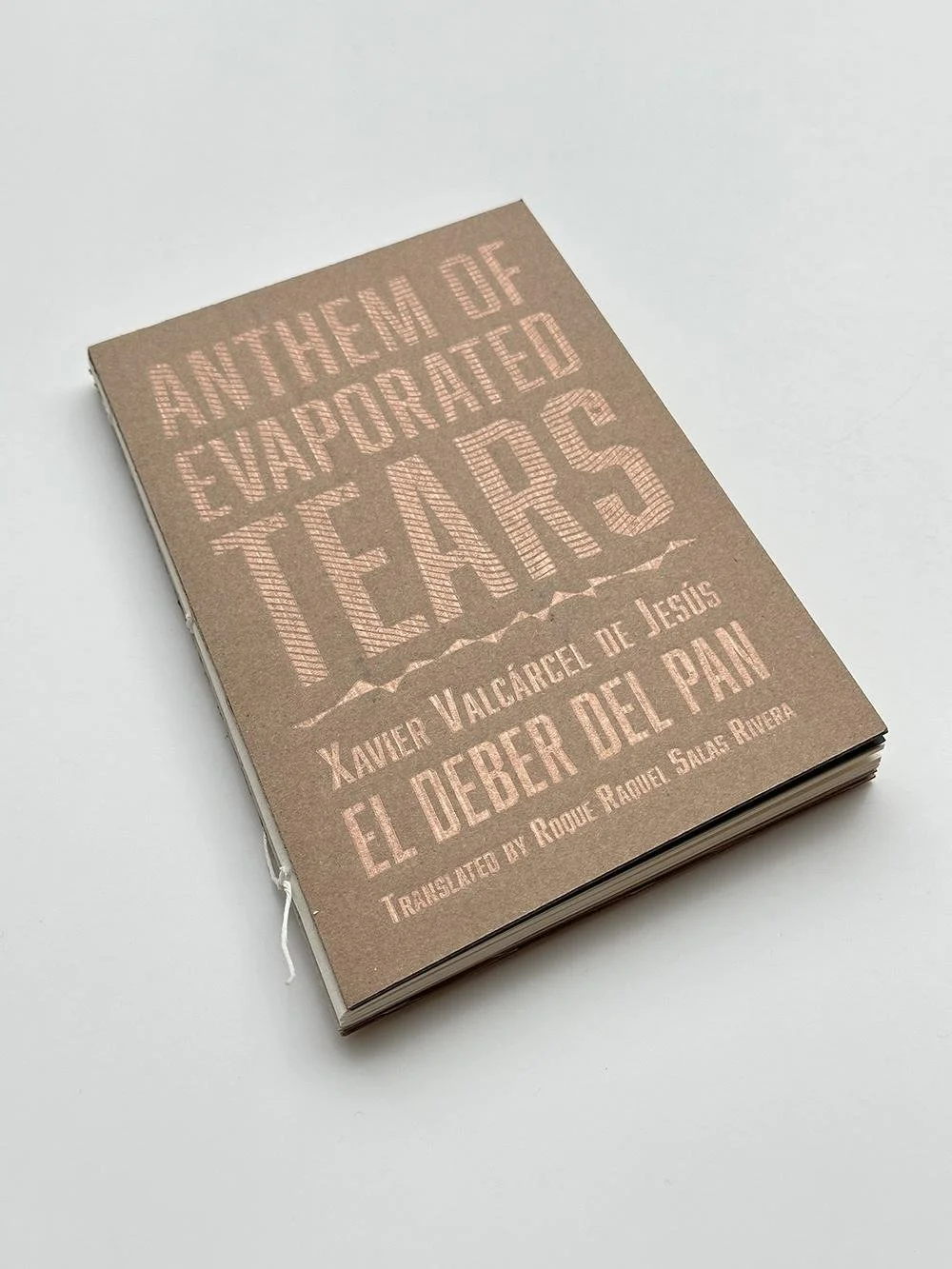
Credit: Cardboard House Press
Oye! Poetry is song. It’s not like song. It is. Always. If it isn’t, you’re probably doing it wrong, probably been fed a paler shade of quasi-poetry from El Norte. A poem can be musical, might share qualities of a song, but they aren’t interchangeable. Tell that to Camarón de la Isla as he houndwail’s Federico Federico García Lorca’s “La Leyenda del Tiempo” to Celia Cruz Cruz while belting José Martí’s “Versos Sencillos” in the form of “Guantanamera.”
For the Latinx, the Caribeño, no hay diferencia entre los dos. And so it is with Puerto Rican poet Xavier Valcárcel de Jesús’s Anthem of Evaporated Tears, published by Cardboard House Press, which supports and promotes Latin American and Spanish-language poetry. Roque Raquel Salas Rivera translated the text. His “anguila translation” methodology ensures the poems are sonorous in both languages.
This collection of poems openly announces itself as song in the English translation of the title, identifying itself as an “anthem.” Anthems are songs composed for a public voice. They are choral. They invite anyone to sing them out (off key) together in groups. Anthems also speak of or to communities bearing specific identities. Thus, we have pop anthems, rock anthems, sports anthems, Black anthems, queer anthems, national anthems, y mas.
Their rhythms stir pride or elation in the intended audience or provide space for a collectively shared grief. In all cases, an anthem’s blare has a unifying effect, which is why the repetition of choruses and refrains are so vital to their structure. When we chant together, we feel invincible—or at least less alone, for the anthem’s duration. We remember (or forget) in unison, laughing or crying as we shout lines together, the sensation building, the volume increasing, the anthem’s reach expanding, with each recurrence.
For Puerto Rican gente, Anthem of Evaporated Tears binds us in our collective colonial perennial mourning and what Yarimar Bonilla calls our “hopeful pessimism,” feelings that are particular to our culture and historical situation. If you sing it with us, you can feel it with us, perolike if you aren’t Boricua you can’t quite know it. The anthem that is these poems is a quintessentially Caribbean song. It is an anthem that is Puerto Rican, Latinx, and Caribbean to the bone. Mira, Boricuas have something of a knack for anthems. “En Mi Viejo San Juan.” “Lamento Borincano.” Héctor Lavoe’s “Mi Gente.” Bad Bunny’s “Nueva Yol.” Clemente Soto Vélez’s “The Blood That Keeps Singing.” Julia de Burgos’s “Song of the Simple Truth.” Pedro Pietri’s “Puerto Rican Obituary.”
Our anthems blast oceanic across centuries. Perhaps we have such a legacy of powerful anthems in our music and literature porque when you are told you can’t be autonomous and that you are “foreign in a domestic sense,” it becomes necessary to craft ways to assert your personhood and agency that fall outside of Empire’s grasp.
It is this legacy that Valcárcel de Jesús is drawing from and contributing to with this collection. Como dije, the anthem’s thrust relies on the power of its repetitions. In the most viscerally moving anthems, the repetitions flow out and then return, like the sea, with a subtle change in velocity and shape that provides new meaning, rather than flatten. An anthem’s chorus returns each time with more weight, a new way to read it.
Each time we sing “we are the champions” with Freddie Mercury, our conviction becomes stronger, but our sense of fatigue grows with it tambien. The Boricua anthem accomplishes this by constructing repetitions that are subtly varied and incongruous. In The Repeating Island: The Caribbean and the Postmodern Perspective, Antonio Benítez-Rojo maps the Caribbean as a “soup of signs” that connects to each other and repeats itself in “another way,” where each repetition “brings necessarily a difference and a deferral.”
In other words, the repetitions that make up Anthem of Evaporated Tears are circular but not symmetrical or verbatim, emulating the movement of the Caribbean sea and its sinuous history. Valcárcel de Jesús accomplishes this by shaping the collection like his home, the archipelago within an archipelago that is Puerto Rico. Each poem here is an island directly connected to all the other islands in its orbit, and a synecdoche for the larger archipelago/book.
As we move from one island/poem to the next, images and codes that we have seen before roll back to us, but in a new or altered form from their previous appearances in earlier islands/poems. These recurring root notes, these tidal signs and symbols, can be mapped five central repetitions throughout the book: “mother,” “burn,” “hotel,” “taxi,” and “bread.” The first four present themselves in the opening poem as the poet declares they and their mother will “burn it all”:
We’ll burn the dinnerware, knives
silver threads, windows
and later, faced with screams and light
we’ll flee in a taxi to a hotel in Punta Cana
to sleep off the sum of those years we lost
over men
until everything behind our eyelids
loses it alphabet and gives up
These circular, asymmetrical repetition of codes are not merely there to provide musicality and imagery. There is a reason these signs return. The ambiguous symbols of the poet and their mother can be read as both the literal victims of violence rooted in patriarchy or as the colonial subject are caught in a strange loop where they want to burn down that which holds them in a vice of debt and violence, then retreat to a “hotel” where they are no longer privy to the destruction. But a hotel is only a temporary refuge.
Eventually, the horrors return, or they must return to the horrors, because it is also the site of their home. This movement of flight and return can also be read through the lens of the historical circular migration of Puerto Ricans. For more than a century, our families have migrated from the island due to lack of work and social services, only to return later once the mainland has drained us of our labor and spirit. Many have followed this path countless times over the course of a single life, fleeing colonial abuse by foolishly running into the arms of our abuser, only to have to flee again and attempt to reclaim what was lost with each “burning.” This swirling “soup of signs” can at times feel comforting and familiar like our childhood barrio, and other times it can incite a dread for what seems inescapable.
Pero Puerto Rico’s cultural and political legacy of circular migration is not the only way to read the book’s “repeating island” linguistic structure of repetition with variations. Here, Valcárcel de Jesús is a queer Afro Latino being translated by a trans poet. The work is also necessarily inscribed with meaning through this identity and historical lens. As such, the anthem of recurring island/poems in the book also present themselves as a challenge to patriarchy and heteronormativity, perhaps the primary things the speaker wants to burn down.
And so with the morphing of images through each loop or repetition, there is also a fluid morphing of gender. Like in Rita Indiana’s Tentacle, where the main character switches genders each time they dive into a portal in the sea, in Anthem of Evaporated Tears, the poet/speaker is in a constant state of re/becoming, transforming through and across the gender spectrum with each recurrence of the root image/notes.
Valcárcel de Jesús’s anthem makes mythic, euphonic music of these overlaying circumstances of the Puerto Rican colonial subject and queer spirit in flight. As we traverse the collection, we sing in harmony with the poet in this ebbtide and flowtide of sound and symbols where the mother is swapped out for the aunt, the taxi for flight becomes a plane, the hotel refuge is surrendered for a return home, the bread that nourishes is sometimes the egg that is a seed of hope, all bookended by a mango tree that serves as the “head” (a jazz term for the central melody of a song played at the beginning and end of a composition), the place or origin that is also the end point.
In the final poem, the poet sings us one more repetition of these signs “in another way,” this time as a negation, an image of the ideal where there was never any “burning,” no fleeing to a “hotel” in a “taxi,” and an admission that the poet does not know how to make “bread,” with a final declaration in a verse that is a repetition—with variations—of the opening lines of the poem:
Now I write that my mother and I
will burn it all to hell, soon
in sync, humming
the anthem of evaporated tears
that we’ll clean our matches one-by-one
salt crystallized on the heads
to build a future fire, a future flight
but I lie.
The house is all that’s left
with me and her
inside
Antonio Benítez-Rojo’s repeating island theory asserts that “the Caribbean text’s most characteristic movement tends, paradoxically, away from the text, to project itself outside of its own nature as text to move it into music and myth.” This archipelagic anthem makes myth out of the personal search for freedom in the face of gendered violence, domestic violence, and colonial violence that when deployed in volume can fool us into thinking that such habitual and mundane oppressions are just “es lo que hay.”
But Valcárcel de Jesús also orchestrates the collection into an anthem to another, more empowering effect. Benítez-Rojo also identifies the repeating island rhythm of the Caribbean as “a machine for the suppression of time.” That is, Caribbean rhythms are performed as a means of resisting or transcending Western Imperialism’s imposition of time as linear and unidirectional in order to swallow up all subjects into its death-based economy.
The poems of Anthem of Evaporated Tears spin grief into myth by singing “bread” into a “recurrent dream,” crying “with this dance, burn everything,” vowing to escape it all in a “taxi” to a “hotel in Punta Cana.” Here, the looping rhythm of these symbols becomes a balm, holding our hand so we can keep going, in that other kind of way that Benítez-Rojo speaks of, like how “Te boté,” a song about being dumped, was on constant rotation around the island in the aftermath of Hurricane María, becoming a kind of oasis for people, something they could count on that let them know they could get through it all.
And that has long been the purpose of Puerto Rican anthems such as Anthem of Evaporated Tears: to suspend time as it is imposed on us by imperialistic neoliberal capitalism and its discontents or rather to break free from its conception of time by performing ritual burnings, fleeings, replantings, in an attempt to return to the rhythms of the “People of the Sea,” as Benítez-Rojo calls us, a mode of being that is cyclical, a “flux interrupted by rhythms,” attempting to “go nowhere” in our endless search of becoming a “totality.”
With dexterity, vulnerability, and a keen musical ear, Valcárcel de Jesús and translator Salas Rivera hold our trembling hands, remind us that there is power in our vulnerability, our humanity, and help us return to our source, our place as People of the Sea. This collection is un regalo for our gente (and absolutely everyone else), a gorgeous and heartbreaking song we can now add to our legendary Boricua anthem playlist. With touches of tenderness and mystery, the collection succeeds in pulling us all together to sing our mourning in unison, and washing our collective guilt and grief, then propelling us toward the possibility of crescendo in the form of a most decolonial hope, a yet to be imagined liberation. Pero until then, we will be making music of our distinctly Boricua laments, of our evaporated tears, for all to hear and sing along with us.