
State Violence and the Aesthetics of Transit
Courtesy of ISCP.
Bryan Fernandez’s En tránsito exhibition may first remind the viewer of the literal abundance of public transportation options available to New Yorkers. The works included in the Dominican-American visual artist’s exhibition at International Studio & Curatorial Program depicts Metropolitan Transportation Authority buses and people crossing busy uptown streets, evoking a feeling of constant movement and negotiation that is familiar to many Dominicanyorks. While this is an integral part of Fernandez’s artistic vision, “en tránsito” rather refers to the blurred diasporic cultural memories that dip from one place into another, often disjointed and sometimes changing altogether.
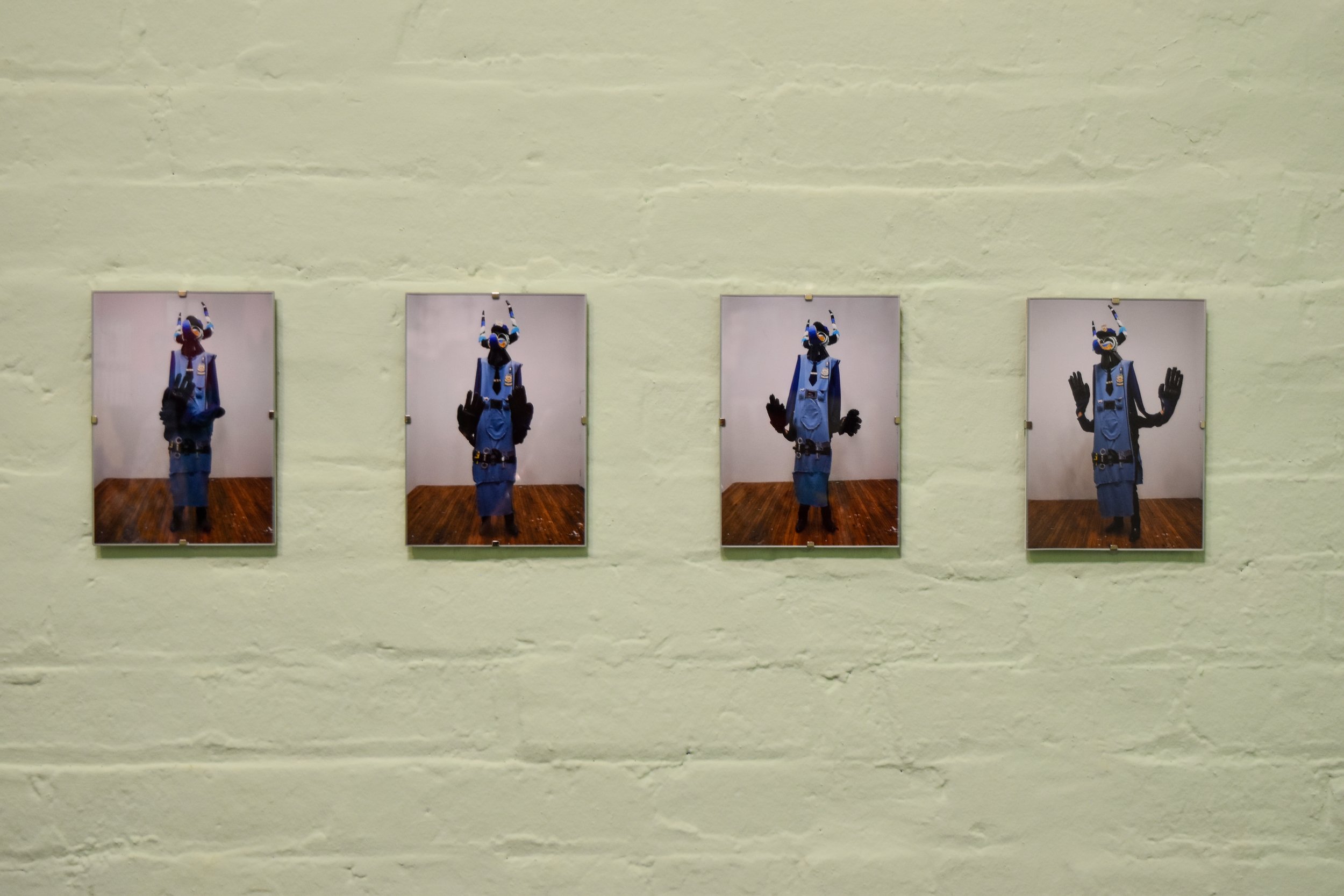
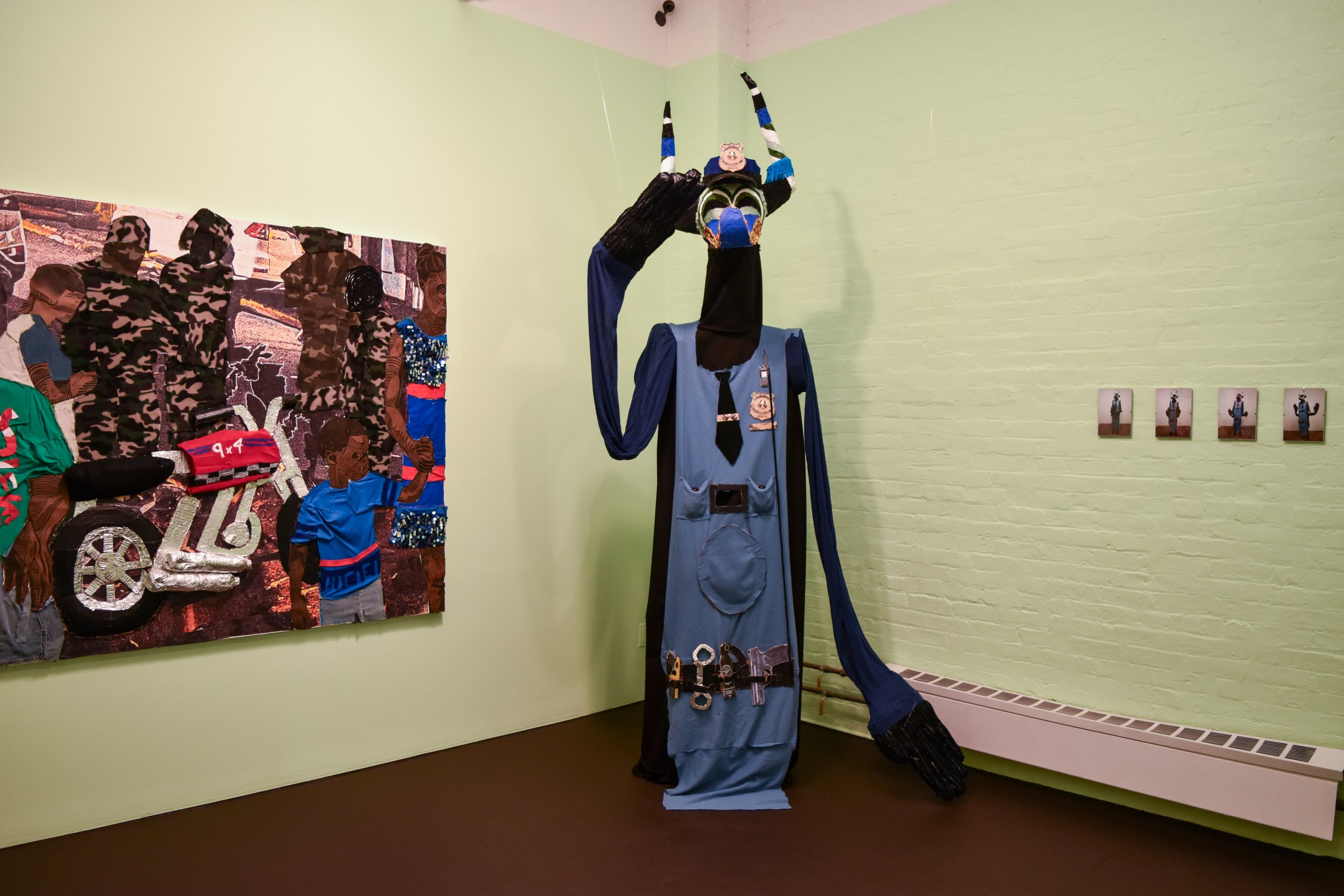
At the entrance of the exhibition is a larger-than-life policeman with the head of a “diablo cojuelo” mask, a design stemming from Carnaval costuming traditions of La Vega, Dominican Republic. The presence of the figure is looming, but the slinky shape of his arms and the heavy draping across the torso illustrate a caricature of the police state; a commentary on the systemic policing of Black New Yorkers throughout the city—a theme that he carries through across each of the large-scale works in the exhibition.
These works emerged out of a lack of proper painting supplies during the COVID-19 lockdown in 2020. Inspired to use found objects and unconventional materials like aluminum foil, felt, paper, and juice boxes, Fernandez incorporated assemblages into his paintings.

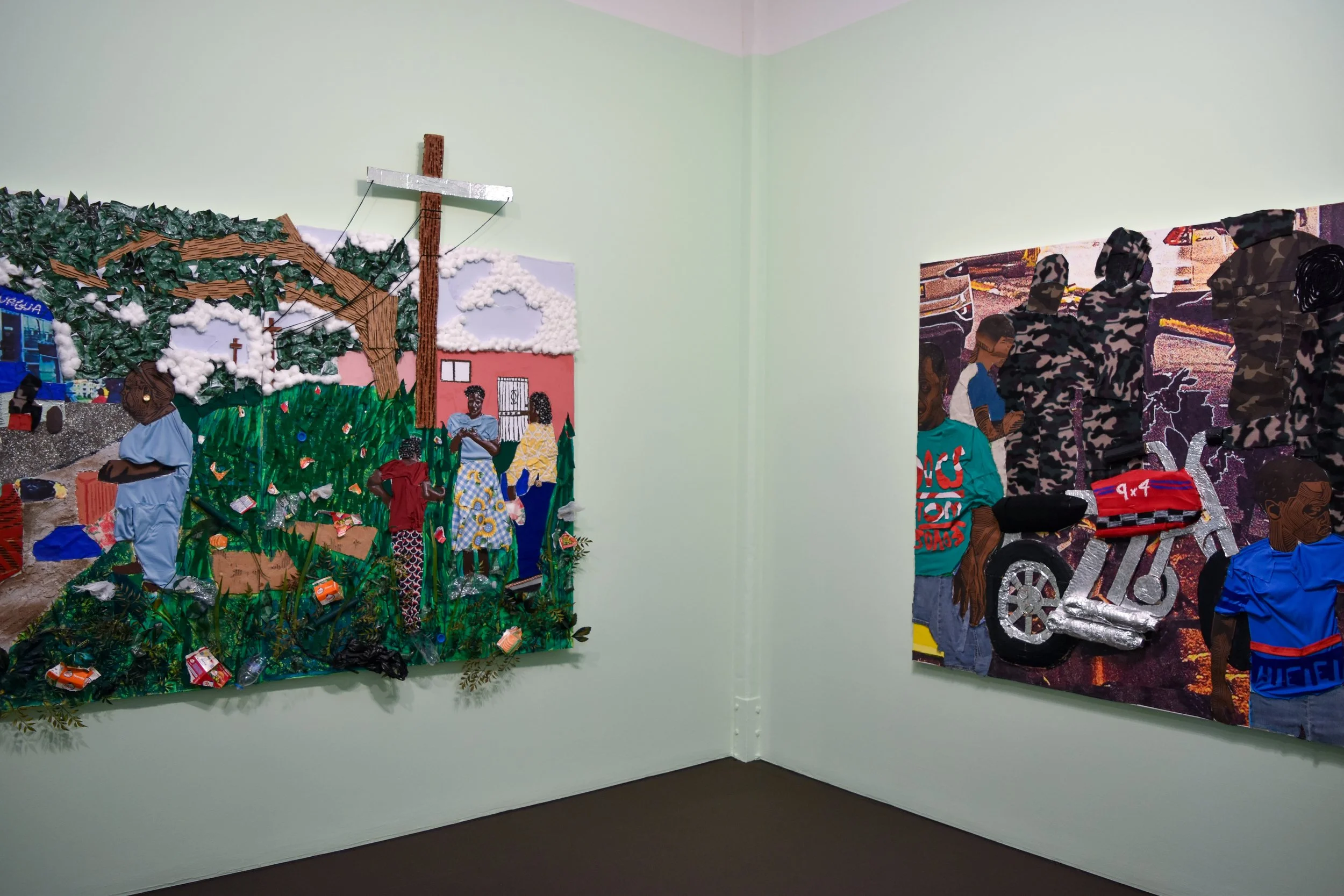
Bryan Fernandez, No mires atrás, hijo, sigue (Don’t Look Back, Son, Keep Going), 2025, oil pastel, cardboard, yarn, aluminum foil, fabric, paper, and relief print on canvas, 60 × 72 × 4 in. (152.4 × 182.88 × 10.16 cm). Courtesy of ISCP.
In the mixed-media work No mires atrás hijo, sigue, Fernandez depicts military men with their faces covered in camo-patterned felt as they stand behind a woman and her son. Their silhouettes are crafted in sequins, linocut, and fabric. The scene captures the high energy and sensory excess Fernandez experienced in his home of Washington Heights. An aluminum-wrapped motorcycle in the center of the work calls to mind the main method of transportation in Santo Domingo. Partly, this is due to the low cost of motorcycles and pasolas and additionally because of the constant standstill traffic that characterizes the capital’s highways. Similarly, in Study for Beso a la cámara, a blue MTA bus comes into view, with New Yorkers waiting at the bus stop. He depicts the bus passengers in clear daylight. As the bus approaches, a filter resembling surveillance camera footage surrounds the vehicle, commenting on how everyday necessities are often clouded by state policing and invasions of privacy.
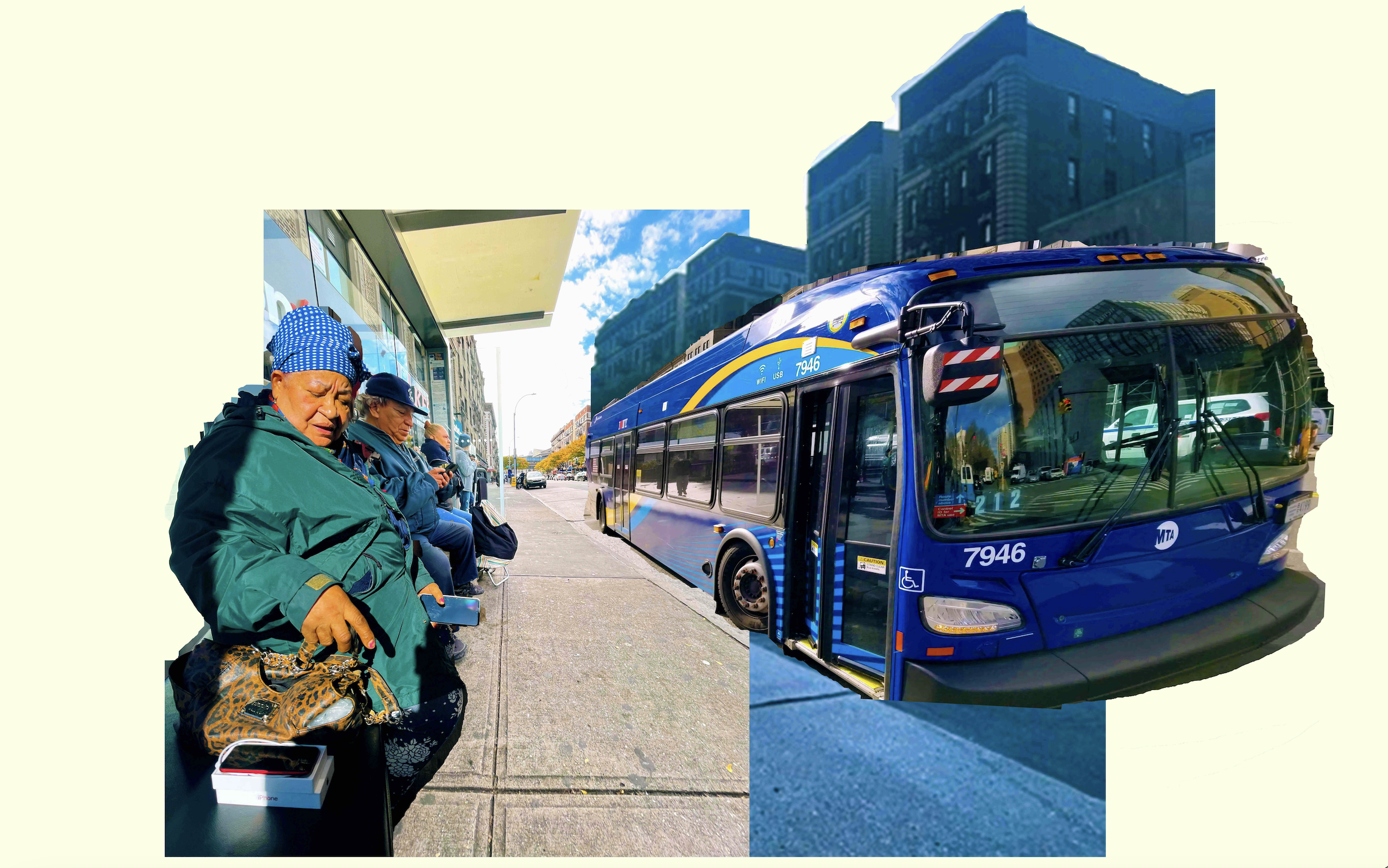
Bryan Fernandez, Study for Beso a la cámara (A Kiss to the Camera), 2024, digital collage on paper, 12 × 14 in. (30.48 × 35.56 cm). Courtesy of ISCP.
In both works, subjects sit atop a grainy photo background resembling the taped images of a surveillance camera, evoking a sense of continuity between the criminalization of Black Dominicans in both DR and the U.S. Afro-Dominican experiences are central to the exhibition, as they form much of the cultural bases of diasporic experiences—despite being marginalized by the non-Black (and more broadly, nonimmigrant) status quo.
Courtesy of ISCP.
A zine on display contextualizes his relationship to his practice and his experience as an emerging artist through letters and quotes from his peers at his 2024 ISCP residency. In the preface, Fernandez describes the array of emotions and memories associated with applying for the residency, figuring out what was next for his artistic career, and learning about his acceptance to the Van Lier Fellowship (an award given to underrepresented artists that funded his ISCP exhibition) at his mother’s home in Washington Heights. The pages of the zine are peppered with imagined advertisements for services and goods associated with the Dominican diaspora in NYC, such as selling traditional dishes, produce, and phone cards, all serving the purpose of reconnecting with life on the island.
Creating a parallel between the depictions of state repression in NYC, the zine also includes a statement from Bronx-based designer and writer BD Feliz asserting the workings of anti-Black fascism in the Dominican Republic. In the postface, Fernandez also credits the “rebellious group of Dominican artists and academics before me in the ‘90s,” referring to the connotation of “en tránsito” as a condition of statelessness. While the phrase “in transit” has denoted residency status since the 1990s, the 2010s saw an uptick in deportations for those classified as “in transit,” mainly Haitians and Black Dominicans. The 2013 ruling that authorized the stripping of citizenship for 250,000 Black Dominicans further exemplifies the nation’s anti-Black policies, forcing Afro-Dominicans into a literal state of transit.
Courtesy of ISCP.
Fernandez’s works also engage Dixa Ramírez’s Colonial Phantoms. The text explores the misrepresentations of Dominican history and identity since the nation’s founding, extending her argument into the diasporic community, centralized in neighborhoods such as Fernandez’s home of Washington Heights, or Little Dominican Republic. Ramírez notes the media portrayals of such diasporic hotspots as both gritty and full of opportunities require immigrants to deploy a level of tigueraje (masculinity and street smarts/ingenuity) to navigate successfully. Fernandez’s landscapes of the area acknowledge the colonial imaginary and all its weapons—a material-first depiction of power, surveillance, anti-Blackness, and immigrant dreams.
In these images, there is a rooted connection to the island that evades the eye but is present in mood. Similar dynamics of power have characterized the history of the Dominican Republic and Hispaniola as a whole, with race being a primary source of tension and (un)belonging, with movement (transit) or lack thereof as a method of limiting social mobility employed by the state.
En tránsito ultimately serves as a complex narrative portrayal of Dominican diasporic identity and its metamorphosis in densely populated sites like New York: these social hierarchies oscillating between ideas generated in immigrant hubs and the status quo of the island. Combining political attempts at negating Dominican Blackness and the myth of social mobility via migration, these elements “en tránsito” fulfill multiple meanings between the island and the neighborhood of Washington Heights.