
30 Years Later: Jim Mendiola’s Punk Borderlands
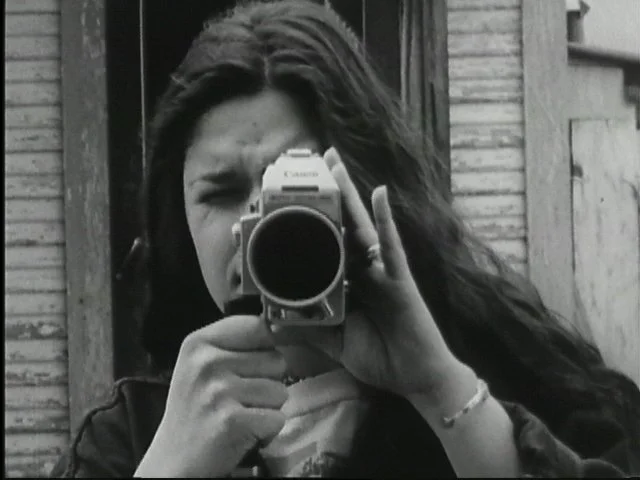
Molly Vasquez (“La Molly”), played by Mariana Vasquez, filming with her Super 8 camera. Courtesy of Jim Mendiola.
Set in 1994 in San Antonio, Tejas, Jim Mendiola’s independent short film Pretty Vacant tells the story of 21-year-old Molly Vasquez (“La Molly”)—a working-class, queer punkera; drummer of the all-Chicana band Aztlán-a-Go-Go; local record store employee; aspiring filmmaker; and creator of the zine Ex-Voto. In its 33-minute boisterous glory, Pretty Vacant, shot and narrated from Molly’s point of view, follows the protagonist as she tries to cement her place in rock ‘n’ roll history while avoiding her father and an impending family trip to Mexico.
Three decades since its release, the film still holds up. Pretty Vacant manages to capture the fierce reaching toward crucial to the process of understanding oneself as a subject and, with it, poses critical questions for anyone invested in feminist creation, archival legacies, the borderlands as a way of knowing, and punk.
Like any skilled narrator, Molly begins with an origin story:
“I was born 21 years ago, on January 23, 1973—the same day Raza Unida met for their first and only national convention and, across the Atlantic, David Bowie released Ziggy Stardust.”
This juncture of Chicanismo and Anglo rock ‘n’ roll from which La Molly is born, literally and symbolically, serves as the narrative and conceptual framework for the rest of the movie and for the protagonist’s life and sense of self. Not only does Molly inhabit the borderland geographically as a Tejana (at one point announcing, “the Alamo sucks!”), she also inhabits it culturally. The borderlands are not simply where fragments of Anglo and Chicano identity are pieced together, but a space whose “energy” scholar Gloria Anzaldúa describes as “continual creative motion that keeps breaking down the unitary aspect of each new paradigm.”
From this nexus, Molly stakes out her political, racial, national, sexual, gendered, economic specificities along with her specificities of taste—that is, the singularity of her personhood. In so doing, Molly’s borderlands (the Mexico–Texas border, Chicana feminism, Anglo, and international rock ‘n’ roll) are a site of identity formation, knowledge production, and the positing of theories about that which is overlooked, that which “shouldn’t” go together. This is not, as author Nicole M. Guidotti-Hernández notes, “about authenticity (who gets to claim borderlands as their concept), but rather how we create our own narratives to challenge authority, document existence, and name the subject as a subject.” In Pretty Vacant, it is the borderland that is capacious enough to hold the seemingly contradictory and out of place, and transform it into an assertion of life.
One of the things that makes Pretty Vacant great is the playful (though not unserious) symbolic work of this form of subversion. Just as Molly’s origin story is a creation story, the movie is, too. In fact, Mendiola and Mariana Vasquez, the actress who plays her, collaboratively created the character of Molly. Mendiola wrote the character specifically for Vasquez, who “was into the same things [he] was,” the director says.
During the film-making process, Mendiola would “write the monologue, give it to [Vasquez], and she would read it, tell [him] what worked, what didn’t, and add certain things to it—Spanish-language words especially.” The film’s metanarrative makes clear that the movie is Molly’s creation. There are shots of Molly filming with her Super 8, turning the camera onto the viewer. With this gesture, she subverts the racialized surveillance of the border—the cameras, the watching, the documenting become a process of subjectivization, of humanization, rather than dehumanization.
This inversion is mirrored in one of the film’s main plot points: behind the stage at Randy’s Rodeo, a local venue where the Sex Pistols played its first and only show in San Antonio during its one U.S. tour in 1978, Molly finds the band’s setlist and, there, “scribbled at the bottom,” is “El Kranke.” “It said ‘El Kranke!’ One of [Esteban Jordan’s] conjunto songs! Shit, man. The Pistols were gonna end that show that night with some conjunto,” Molly says excitedly. In this narrative crux, the function and relationality of discovery gets flipped. It is the Chicana, and the culture of the borderlands, who rewrites history based on the discovery of the white man; she is the agent of history.
In her seminal essay on Pretty Vacant and Los Angeles punk, Michelle Habell-Pallán rightly argues that Molly’s asserted “authority to chronicle the history of punk” troubles prevailing accounts of popular music that “erase the influence of U.S. Latinos from [its] sonic equation.”
Molly’s historic find literally restages the colonial encounter. It makes evident the value of Mexican, Chicanx, and Latinx contributions to what is often considered an “Anglo” or “white” genre. In doing so, she also counters the flattening and reductive tropes of what a Chicana “should” be or do or like, resisting the essentializing discourses of identity construction through circumscribed sets of cultural markers. One piece of feedback Mendiola has consistently gotten about the film over the years is that “people identify not necessarily with the details, but with the in-betweenness of identity . . . What I’ve seen is that a lot of people feel the same way, if not specifically punk rock Latino, but in other seemingly different kinds of identities.”
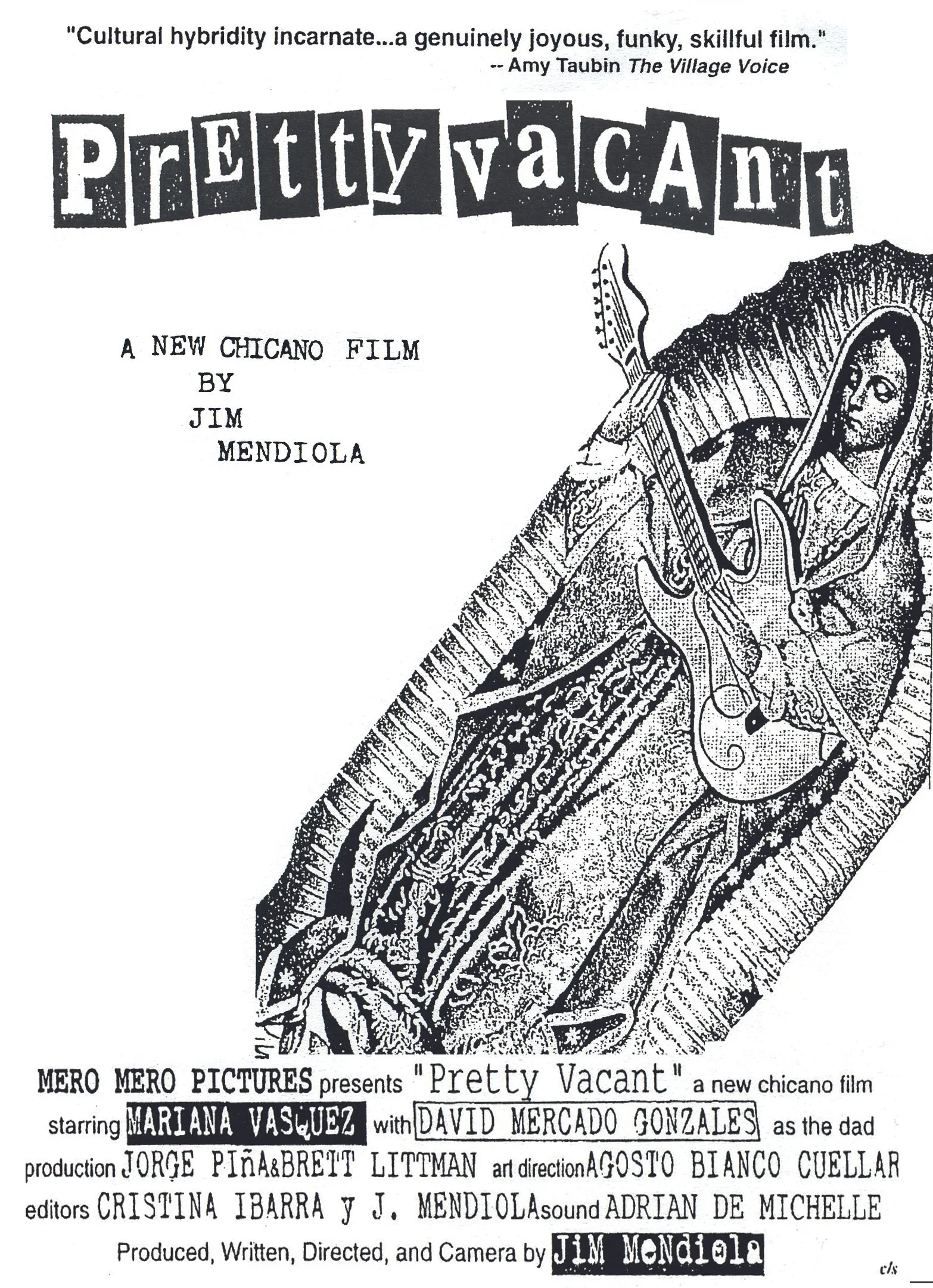
The cover for Pretty Vacant (1996), directed by Jim Mendiola. Courtesy of Jim Mendiola.
Molly’s insertion of herself and Chicanx/Latinx/Tejano culture into punk history is not simply fiction or rhetorical mechanism; it mirrors the reality of these groundbreaking and vital influences on the genre. In fact, music journalist Dave Marsh first introduced the term “punk” when he called a show by ? Mark and the Mysterians “a landmark exposition of punk-rock” in a 1971 Creem review.
? Mark and the Mysterians—whose members, Rudy Martínez, Frankie Rodríguez, Bobby Balderrama, Robert Martínez, and Frank Lugo, were all Mexican-American, Texas-born children of migrant workers—are one of the first punk bands. Famed music journalists Lester Bangs and Legs McNeil lauded the band’s hit song “96 Tears” as “one of the greatest rock and roll songs of all time” and “a safe candidate for first punk rock song ever,” respectively. “96 Tears” is distinctly Latinx, in composition as well as in production and distribution. Musically, journalist and professor Ed Morales points out, the song uses “the organ as a percussive instrument, the way Afro-Cuban music does, building to an other-worldly, moody apotheosis, especially when combined with Martinez’s eerie vocals,” and seems to “announce that as Mexican-Americans, [the Mysterians] felt like aliens.” Its recording and reach was made possible by fellow Chicanx rockers Joe “Pato” Gonzales, Lillian Gonzales, Rudy “Tee” Gonzales, and Manuel Gonzales, owners of the San Antonio Spanish-language music label Pa-Go-Go Records.
Despite the fact that the origins of punk are Chicanx and Latinx, indelibly shaped by a song that explores racial and cultural alienation, the media’s fixation on white British punk in the ‘70s—with the Sex Pistols as the emblematic group—recategorized the Mysterians as “garage,” reducing the Mexican-American band and its work as “merely influences on punk.” In naming the film after a Sex Pistols song that is largely about nihilism, apathy, and the perceived emptiness of youth culture in 1970s London (inspired by the 1976 song “Blank Generation” by the New York punk group Richard Hell and the Voidoids), Mendiola and Molly make a case for the deeply thoughtful, innovative, and vibrant cultural production happening in Chicanx, Tejanx, Latinx, and border communities. The movie’s titular borrowing remolds the cynicism of the white, male London and New York punks into the creative flourishing and subjective investment of the borderlands. The borderlands become a site of meaning-making—rather than meaning-negation, as London is for the Sex Pistols and New York is for the Voidoids—with the potential to disrupt facile assumptions about who or what we should be (or not be), and foregrounding the value of Latinx culture on its own terms.
Molly’s insistence on her and Tejana culture’s place in punk reflects that this is not a question of “crossing over,” of writing or recording herself and Chicanx artists and communities into a “white” and “Anglo” scene, but rather one of (re)asserting that punk hasalways been Latinx and Chicanx despite the mainstream/dominant punk “canon.” Molly is consciously placing herself in the rich tradition of artists like the Mysterians, and Latinas, Chicanas, and queer women of color like Alice Bag, Teresa Covarrubias, and Vaginal Davis who have transformed punk. The historical erasure of Latinas and women of color in punk does not signal their lack of participation in the punk movement, but rather, as Paloma Martínez-Cruz puts it, how “punk was yet another kind of labor rendered invisible by mainstream media’s inability to see, hear, and document Latina and Hispana performance practices.”
In active pursuit against this invisibilization, one of Pretty Vacant’s main premises is Molly’s archival mode of being. Her life’s work, primarily her short film and multi-issue fanzine Ex-Voto, is self-documentation. The impulse to archive, document, collect, and curate is an impulse of making the impermanent last; to prove that we are here and our lives matter. Molly poses for Polaroid portraits, dragging her X-acto knife through old movimiento newspapers, gluing individual letters to spell out titles, photocopying flyers. A printer spits out images of Malcolm X and la Virgen de Guadalupe. Molly rattles off the contents of her self-made, -published, and -distributed zine:profiles on Dolores Huerta and Emma Tenayuca, histories of retablos, and critiques of Octavio Paz live side by side with odes to Chrissie Hynde, articles on The Clash and The Ramones, and photos of Patti Smith.
Molly understands her own process of subjectivization as rooted in the specific geographic, historical, social, political, economic, and cultural contexts of her life, a process often left out of dominant depictions and understandings of creative and intellectually rigorous work. “I published [Ex-Voto] because no one was addressing my interests or my needs,” Molly declares. “Simple as that.”
Similarly, Cherríe Moraga put together This Bridge Called My Back, a foundational anthology of the women’s liberation movement of the 1970s and ’80s to fill in the gaps. “So much . . .had been missing in my own education,” she says in the book. “It was what never appeared on a reading list.” Molly’s DIY creative ethos is not only a cornerstone of punk, but also of Chicana grassroots feminist cultural production of this period. The self-archive, then, is a way of theorizing about ourselves in order to theorize about the world despite our out-of-placeness in “official” histories.
The archival and collage mode central to Pretty Vacant echoes the feminist contention since the late 1960s that the archive should be thought of and engaged with as a “site and practice integral to knowledge making, cultural production, and activism.” This reformulation of the archive inverts its relationality: from preservationist to generative; from women, especially women of color, as its objects to women as its intellectual and creative agents. The collage mode at the core of so much of the feminist archive of the late 20th century—the cutting and pasting, the taking and repurposing of material from wide-ranging sources and forms—is evident in Molly’s archival practice, including her zine-making, her room plastered in posters and cut-outs, and the movie itself. It is not a past relic offered up to a passive spectator, but a site of continuous engagement rendered incomplete without the participation of an interlocutor.
“Juxtaposing Sor Juana de la Cruz with Patti Smith and making a viewer consider them both in a single context suggests all kinds of political considerations,” Mendiola explains. “Something third, something different emerges from their juxtaposition. I like that idea. I like people drawing conclusions based on throwing specific and intentional images together and seeing what happens when a viewer views them.”
This “archival turn in feminism,” as Kate Eichhorn calls it, was in large part a response to the economic and political precarity brought on by neoliberalism. And Molly narrates her life from a crossroads of U.S. neoliberal policy in relation to Mexico: Texas 1994, the regional heart of the North American Free Trade Agreement (NAFTA) in the year it went into effect. The economic and political restructuring unleashed by NAFTA devastated the working and living conditions of people on either side of the border and went hand in hand with a crackdown on immigration to the United States. As privatization’s reach expanded and the public sphere shrank, the feminist archive became a liberating and necessary space to explore, cultivate, and validate knowledge and cultural production, working against neoliberalism’s pull to erode our sense of agency.
At the same time, that neoliberalism was gathering steam and institutional support for what were considered “anti-economic endeavors,” such as projects of arts and culture that deprioritized profit-making, was dissolving, materials and tools like copy machine and printers were becoming more widespread and accessible, prompting working-class artists to use DIY methods to express themselves, circulate ideas, and disseminate information without having to rely on dominant or mainstream venues.“The medium was perfect: cheap, easy,” Molly says. “No matter how I messed with the pictures, I found it always came out great xeroxed. Form follows function and all that. The rasquache aesthetic to the max, esa.” Even the printing of Ex-Voto is presented as guerrilla-style. “I knew a guy at Kinko’s, Alejandro. He’d let me use the machines free late at night,” Molly tells us. (At the end of the film, Alejandro gets promoted and lets more and more people use the machines.)
The reclamation of resources from a large corporation to create knowledge after hours, to draw on community to make something together, is a crucial reimagining of the world, where clandestinity becomes a site of collective artistic and intellectual blossoming. This is the feminist archive’s “ability to restore to us what is routinely taken away under neoliberalism”: an understanding of our everyday lives and our capacity as historical agents of change, Pretty Vacant, as a low-budget independent short film featuring local actors, is firmly in this lineage. The movie ends with Molly’s meta-commentary on her character’s cinematic project: “The movie’s all told in voice-over—it’s cheaper that way.”
While Molly fixates on rewriting punk history, she also resists the annual family pilgrimage to Mexico by avoiding her father and her nonrefundable plane ticket. Molly’s father appears throughout the movie as an allegorical figure of a México viejo, a particular strand of the previous generation’s Chicano nationalism (“my dad had this thing about Mexico”) that Molly doesn’t fully see herself in. Molly, who pinpoints her origin in the height of the Raza Unida Party, drums in the all-Chicana band Aztlán-a Go-Go, writes about the National Farm Workers Association, and scours old movimiento zines, is firmly and proudly Chicana, and makes it a central focus of her art-making and her life. But her DIY Chicana feminist punk constructs “an ‘alternative’ location away from patriarchal Aztlán, yet still oppositional to the racism of the dominant culture” that imagines “new ways of being in the world.”
Mendiola was also responding to tropes in Chicano film through Pretty Vacant, and cited Rosa Linda Fregoso’s 1993 Bronze Screen: Chicana and Chicano Film Culture as an influence. “Main characters in these movies were mostly men; I made mine a woman,” he says. “Most were set in California; mine was in Texas. Most were about gang life or anguished questions of identity; I made mine about a punk rocker.”
In Pretty Vacant, the daughter rebels and makes the borderlands in her image, deprivileging the patriarchal locus of a certain kind of Chicano nationalism. What Molly finds when she goes to Mexico is a lively and thriving culture of young people who are also invested in the subversive potential of popular culture. She shows them L7; they turn her onto Santa Sabina and Café Tacvba. She finds her place in Mexico, cementing art and music’s power to create community across borders, literal and otherwise.
Punk’s ability to hold and reflect our own lives, our own beings and needs and desires—in short, as a liberatory space—comes out of its existential premise of being community-made, without the need for mainstream institutions, expensive equipment, or formal education. Punk, like the borderlands and the feminist archive, contains within it the possibility to break down the walls of gender, race, sexuality, and nation-states without extinguishing difference, even if for brief moments in time and space. In Molly’s desire to make and remake, to excavate self- and community-knowledge one xerox and swapped CD at a time, the audience can see, hear, and feel the world.