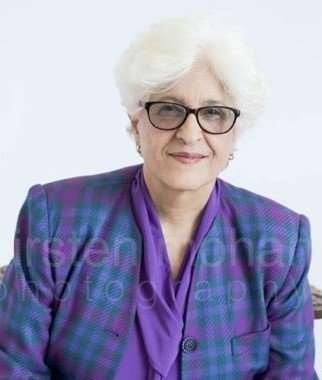
The Critical Character of Eliezer Parrilla Mena’s Art
It is difficult to examine in any profound depth Eliezer Parrilla Mena’s attitudes toward the act of creation. But a good place to start is the reason Parrilla Mena decided to pursue art over other professions. “I believe it is the vocation of the artist to search, think, doubt, explore, and follow the fundamental human desire to communicate and make art as a way to understand ourselves and our place in the times we live, while attempting to enthrall the experience and wisdom of those before us,” he tells me in an interview.
Parrilla Mena’s interest in art began at 12 when he independently went to the Metropolitan Museum of Art, where he was able to behold the Mona Lisa during its historic loan from the Musée du Louvre. This momentous experience ignited Parrilla Mena’s lifelong fascination with the complexity of artistic expression.
Born in New York City in 1950 to Puerto Rican parents, he spent his formative years in the city. During his childhood, he immersed himself in the vibrant urban environment of New York, shaped by the cultural dynamics of his family’s heritage. After several years, his family returned to Puerto Rico, where Parrilla Mena spent his adolescence.
This move marked a turning point in his life, profoundly influencing his outlook and artistic sensibilities. Living in Puerto Rico exposed him to the island’s rich cultural traditions and diverse landscapes, elements that had previously been unfamiliar to him. The experience of reconnecting with his ancestral roots and discovering the artistic and cultural tapestry of Puerto Rico played a significant role in shaping his perspective and future work as an artist.
While in Puerto Rico, he attended the University of Puerto Rico for two years before transferring to Brooklyn College in 1970, where he earned a bachelor’s degree, before earning a master’s degree in bilingual urban education. He began working as an educator and educational administrator. His 30-year career in education sharpened his analytical approach and deepened his understanding of cultural transmission.
These early experiences broadened his artistic outlook, and in 1979, he began studies at Pratt Institute. That period proved pivotal: It sharpened his skills in architecture and the visual arts and prompted a deeper examination of his creative endeavors. Surrounded by renowned artists and architects, he realized art was his calling. From then on, he devoted himself entirely to his craft, marking the true start of his artistic career.
In an imaginative and conscious manner Parrilla Mena describes his life in the creative world in a distinct way. “My practice assembles layered surfaces that preserve the remnants of documents, field recordings, and notational systems,” he says. “These traces function as both proof and firm material legible yet fragile, partial, yet telling. By placing formal abstraction alongside nonliteral wreckages, the work reveals the processes of removal and retention that shape collective memory. It invites viewers to occupy the space between loss and testimony and to reflect on how institutions, communities, and individuals decide what endures.”
As a result, he examines the complexities of social and cultural narratives in both his chosen themes and his creative strategies. His work does not merely present visual appeal; it asks viewers to reflect on the underlying stories and histories embedded within each piece.
He depicts the critical elements in his works by questioning norms and examining societal standards, including controversial topics that resonate deeply today and remain constant throughout his career. Parrilla Mena applies analytical approaches and research into history and aesthetics, which provide historical and conceptual context. This model ranges from ancient symbolism to myth and history to contemporary subjects, such as social justice and humanity’s relationship with the environment—central questions in contemporary art.
Parrilla Mena has spent over 46 years building a rigorous, multidisciplinary practice that fuses political commitment with continued aesthetic inquiry. Working across drawing, painting, collage, monotype, sculpture, music, and pedagogy, he uses modest materials and formal restraint to summon emotional depth and conceptual resonance.
Within his studio practice, Parrilla Mena draws inspiration from vintage historic documents, field recordings, and photographs. By integrating cultural documents, sound recordings, and various notational systems into his art, he skillfully weaves together abstraction and figuration, allowing him to explore concepts of memory and preservation in visually compelling ways. His commitment to artistic engagement extends beyond traditional gallery spaces, as he actively participates in teaching and facilitating public programs. Through these efforts, he fosters civic participation and encourages collaborative research, further expanding the impact and reach of his creative practice.

Eliezer Parrilla Mena’s Why We Kill, 1988, collage, 30"x22.” Courtesy of Eliezer Parrilla Mena.
The works Parrilla Mena created in those years find depth in simplicity across media—drawing, painting, watercolor, collage, sculpture, assemblage, and sound. Using modest materials and measured restraint, he reveals intricate emotional and conceptual landscapes. Each symbol and object acts as a deliberate prompt, inviting viewers to slow down, remember, and feel. In his practice he is continuously reinvented; formal rigor and intuitive risk-taking, creating a quiet, resonance that grows with every showing.
For the duration of that period, he created Why We Kill, one of his emblematic works that reveals the media’s filtering of news and images, underscoring his critical engagement with mass media as ideological tools shaped by market forces and internalized censorship. He questions the system we live in as an industrial process driven by war linked to our existence. Dominating the pictorial frame is the figure of the Pope of Death with a firebird on his headdress and a dove representing the potential for peace.
While in New York, he participated in solo and group exhibitions, notably Parrilla: Drawings and Paintings at Morivivi Gallery (1983) and Latin American Artists at Baruch College (1986). He also exhibited in Traces of Stone and Flesh, a group show at the Rotunda Gallery, Brooklyn War Memorial, curated by Rafael Colón Morales, which also featured works by Marina Gutiérrez, and Gloria Rodríguez; the artists used a visual language that blended personal and collective archetype’s themes. In 1988, he exhibited in the UNESCO show at the Chuck Levitan Gallery in SoHo.
Parrilla Mena’s commitment to exploring the complexities of sociopolitical and cultural narratives is evident in both the themes he selects and the techniques he employs. Grounded in historical research and a willingness to take intuitive risks, his layered surfaces and textures engage contemporary social, political, and cultural questions that illustrate his concern with substance over style, while developing a singular visual language, succeeding in a distinctive personal approach that fuses influences into a singular artistic vision.
In an exhibition essay, curator Rosina Natale writes, “His mindscapes are battle grounds—past, present and future where pessimistic dreams of man’s destiny and his own fears and pain are exorcised presenting concepts of birth and death from a metaphysical and socio-political perspective.”
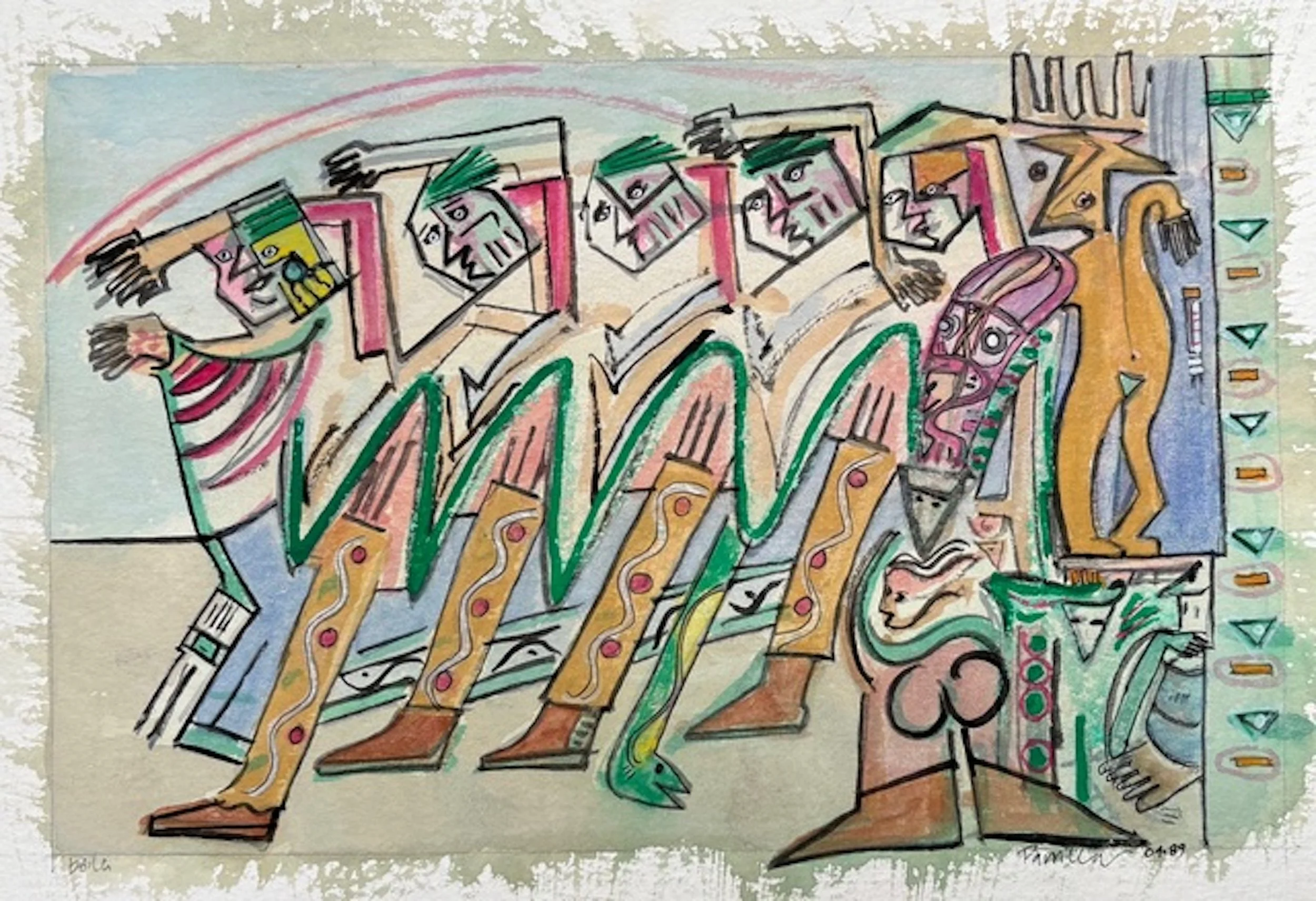
Eliezer Parrilla Mena’s El Baile (1989), gouache on paper, 10”x14.” Courtesy of Eliezer Parrilla Mena.
As his art demonstrates, Parrilla Mena uses elements fused with magical realism of Puerto Rican and Latin American cultural tradition. In 1989 he painted El Baile, a piece with portraits of five identically dressed dancers wearing unique masks and connected by a snake leading to a shamanic female figure. This matriarch, guided by an animal totem above her, represents leadership, spiritual guidance, and respect for ancestral beliefs. It takes him from the esoteric symbology of ancient cultures and a deep link to nature and the land, which are universal symbols of resistance rather than a regional one.
Beginning in the 1990s, Parrilla Mena challenged the boundaries embracing expressionist abstraction. This shift sharpened his distinctive critical character and deepened his interest in politics, and today’s evolving cultural landscape, grappling with several transformations that delivered a powerful vision for artists to respond to the cultural upheaval that provided for symbolic meanings in this era.
Over the decade, he deployed a wide range of expressive strategies—gestural brushwork, layered textures, relief, and collages so that, although his work remained rooted in abstract expressionism, individual pieces often moved beyond strict abstraction or pure expressionism.
One notable piece from 1990 is Scratching the Organizational Surface, a particular painting and companion short film that was inspired by the philosophies of Edward S. Herman and Noam Chomsky’s Manufacturing Consent: The Political Economy of Mass Media. The influential text argues that mass media in the United States functions as powerful ideological institutions advancing systemic propaganda through market mechanisms of ownership, advertising, and sourcing.
The piece draws directly from the ideas in Manufacturing Consent, using formal devices to make structural forces legible. This work questions mass media’s invisible architectures, translating institutional critique into visual form. The grid functions as both scaffold and filter—an organizing logic that channels movement and meaning—while the animal-to-human motif operates as a relational index, showing how identities and stories are mediated and constrained. Rather than depicting propaganda as a single act, the work stages the slow, cumulative processes by which institutions normalize certain viewpoints and marginalize others. Its refusal of easy judgment invites sustained, critical looking. It welcomes viewers to closely resist moral shorthand and observe the patterns that affect perception, self-censorship, and silence.
In 1991, Parrilla Mena had a solo exhibition, Visions and Symbols from the Womb to the Tomb, at the Ollantay Center for the Arts in Queens, NY. In its catalog, Parrilla Mena remarked: “We are living in a world of mass media and burials. As we watch what has been filtered to us as news, death embarks on its daily Traills.” His commentary reflects on the filtering of news and images of death through media narratives, underscoring the critical engagement with mass media as ideological tools shaped by market sources and internalized censorship.

Eliezer Parrilla Mena’s Check the Correct Box in Block 2, 1994, assemblage, 13.5”x13.5”x3.” Courtesy of Eliezer Parrilla Mena.
In Check the Correct Box in Block 2 (1994), Parrilla Mena positions his visual practice as a critique of how images of death are mediated, packaged, and circulated rather than experienced directly. The piece is a hybrid collage–assemblage featuring a female figure with a red cross over her womb, symbolizing both medical and bureaucratic control. The red cross over the womb reads as a clinical signifier—medicalized, diagnostic—but also as a bureaucratic stamp that can authorize, deny, or contain lineage and dependency. By inserting tax-form language and administrative grids next to a marked womb, the piece literalizes how state and institutional paperwork translates human lives into categories, entitlements, and liabilities. Photographic fragments, printed forms, and handmade marks overlap on the surface, suggesting a tension between structured bureaucracy and the anthropological prototype that evokes human interaction.
A trait of his is to allow ideas and concepts to emerge organically. He describes this creative process as “thoughtography,” or the act of projecting mental images to illustrate his artistic vision. This approach influenced the creation of Los Recovecos de la Mente (1997). opening a passage into the labyrinth of the mindset that would define his work from then on. The painting becomes a site where hidden meanings surface slowly, like memories rising through sediment. It transforms reality into something spectral: an image of death whose truth is deliberately blurred. By refracting global news and scenes of mortality through the lens of media storytelling, he reveals how mass media operates as an ideological machine, governed by markets and sustained by the quiet force of self-censorship.
It motivated him to incorporate media critique and institutional analysis into his art, exploring how media operates as a system supportive of underlying assumptions, and self-censorship—often without the need for explicit coercion, by way of the propaganda model of communication. Afterward he painted Los Caminos (1997), which upholds the implication of his critical character that typifies his work. Parrilla Mena stated this piece “created the illusion of empty spaces suggestive of how characters, space and forms are organized to make a connection between specific concepts and their arrangement in the pictorial space.” Like many of his works during this phase and beyond, he develops capsules of activities with containments of pictorial spaces and characters within.
Repeated exposure becomes a ritual that dulls moral urgency providing a general perspective on the random pattern that was formed to convey the essence of Parrilla Mena’s theoretical concerns.
In the early 2000s, Parrilla Mena concentrated his practice on the construction of uncommon assemblages, displaying workmanship and his intrinsic energy and creativity. This format allows him to develop works that function as “tryouts” for future projects, alongside more assertive pieces that stand on their own—vigorous, imaginative compositions that unfold stories through their material interplay. Together, they generate a sense of innovation within their visual language. The images express global and national concerns in a visual language. Parrilla Mena relocated to Hudson Valley, New York, in 2008, where he continued his prolific creative practice, amassing a substantial collection of artistic works such as drawings, collage, sculpture and mixed-media pieces.
In Hudson Valley, he developed an exhibition trajectory that included solo shows at The Falcon Gallery, The Storefront Gallery, and The Martinez Gallery, as well as participation in group exhibitions at the Woodstock Artists Association Museum (WAAM) and West End Gallery, In the fall of 2025, his works were included in Art Inspiration: Celebrate Hispanic Heritage, a video presentation at the Albany Library in collaboration with the Martinez Gallery.
All through his exploratory process, Parrilla Mena remained faithful to a distinctive synthesis of craftsmanship, architectural sensibility, and aesthetic rigor—measured by structural lines and spatial logic meeting a looseness of expressionist markmaking, so that form and feeling reinforce one another without contradiction.
This approach gives rise to the Etapas (2009) series, a sequence of visual stages that trace the artist’s iterative thinking, where instinct and structure coexist in productive tension. The series provided for a new format in which he explores the human graphic form and its relationship to created space. They represent the human stages from birth to parenthood as part of the cycles of life. Parrilla Mena created the series Criterio (2010), with recurrent motifs where his expressionist vocabulary—rich in symbolism and personal motifs—resolves into a more deliberate, codified language of signs and surfaces.
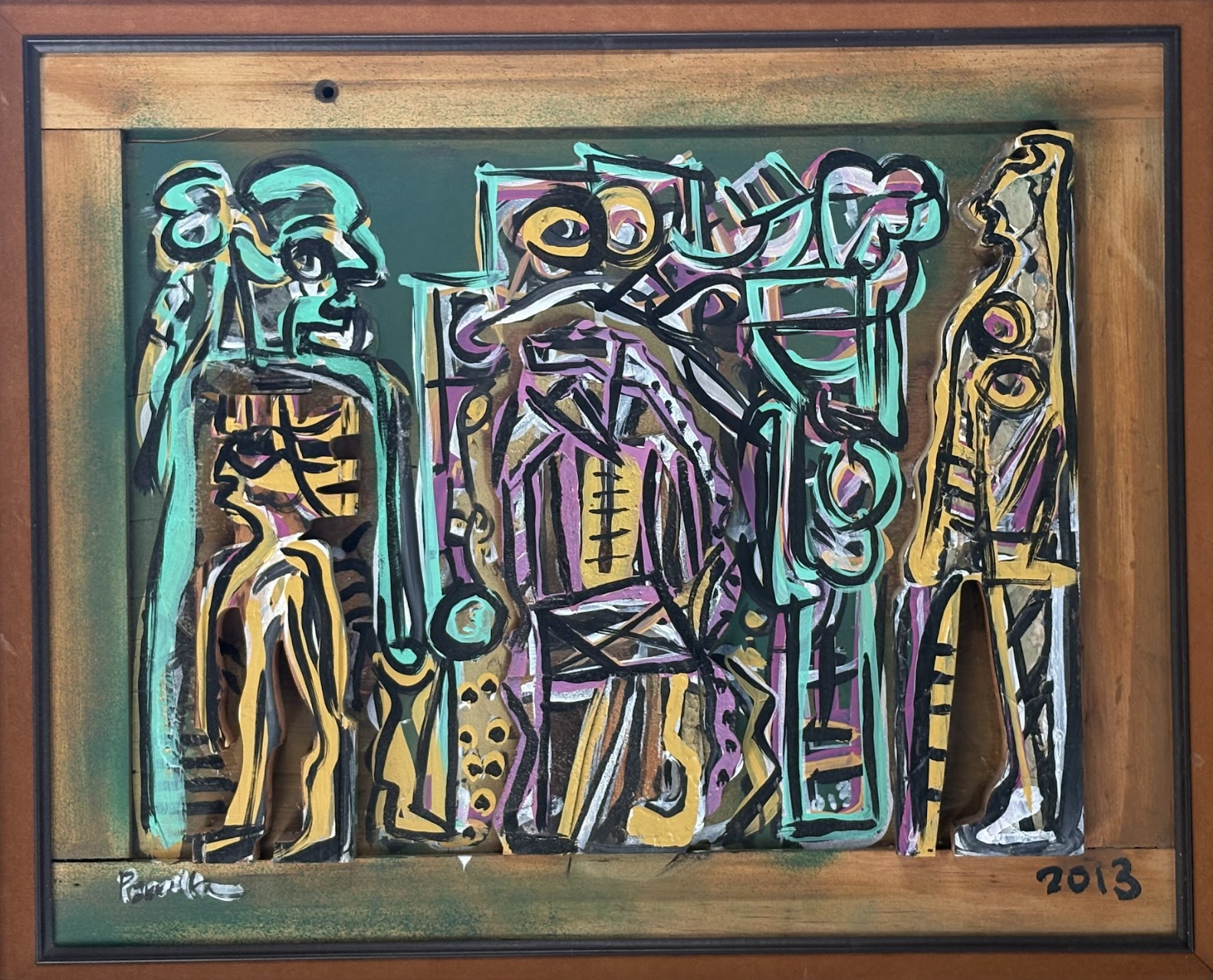
Eliezer Parrilla Mena’s Cube in a box, 2013, wood and metal assemblage, 16”20”x1.” Courtesy of Eliezer Parrilla Mena.
In his studio in the Hudson Valley, Parrilla Mena created assemblages that synthesized the artful dichotomy between creativity and instinct. A most striking example is Cube in a Box, created in 2013, which signaled a significant shift in his preferred media and style. Works like Cube in a Box are intuitive explorations of space and its relationship with form. He began incorporating industrial materials—and other found elements—into relief-based constructions that investigate spatial relationships, overlapping planes, and cubistic structures.
Color functions as a marker of ideas, shaping forms and creating a balance between figure and architectural backdrops, while asserting a distinct visual vocabulary rooted in intuitive cubism and expressionistic form.
Earth to Paradise is a poignant wood relief assemblage that Parrilla Mena began during a period of intense personal loss. “My father had passed away, and I was meditating on death as a transition within consciousness and beyond,” he says. Meditation becomes the work’s organizing principle. Rather than depicting grief as an inward collapse, the assemblage externalizes mourning into a constructed environment: Figures are arranged like actors on a stage, their flattened, emblematic forms emphasizing presence over individual detail. This economy of form allows each figure to function both as a portrait and as a universal archetype.
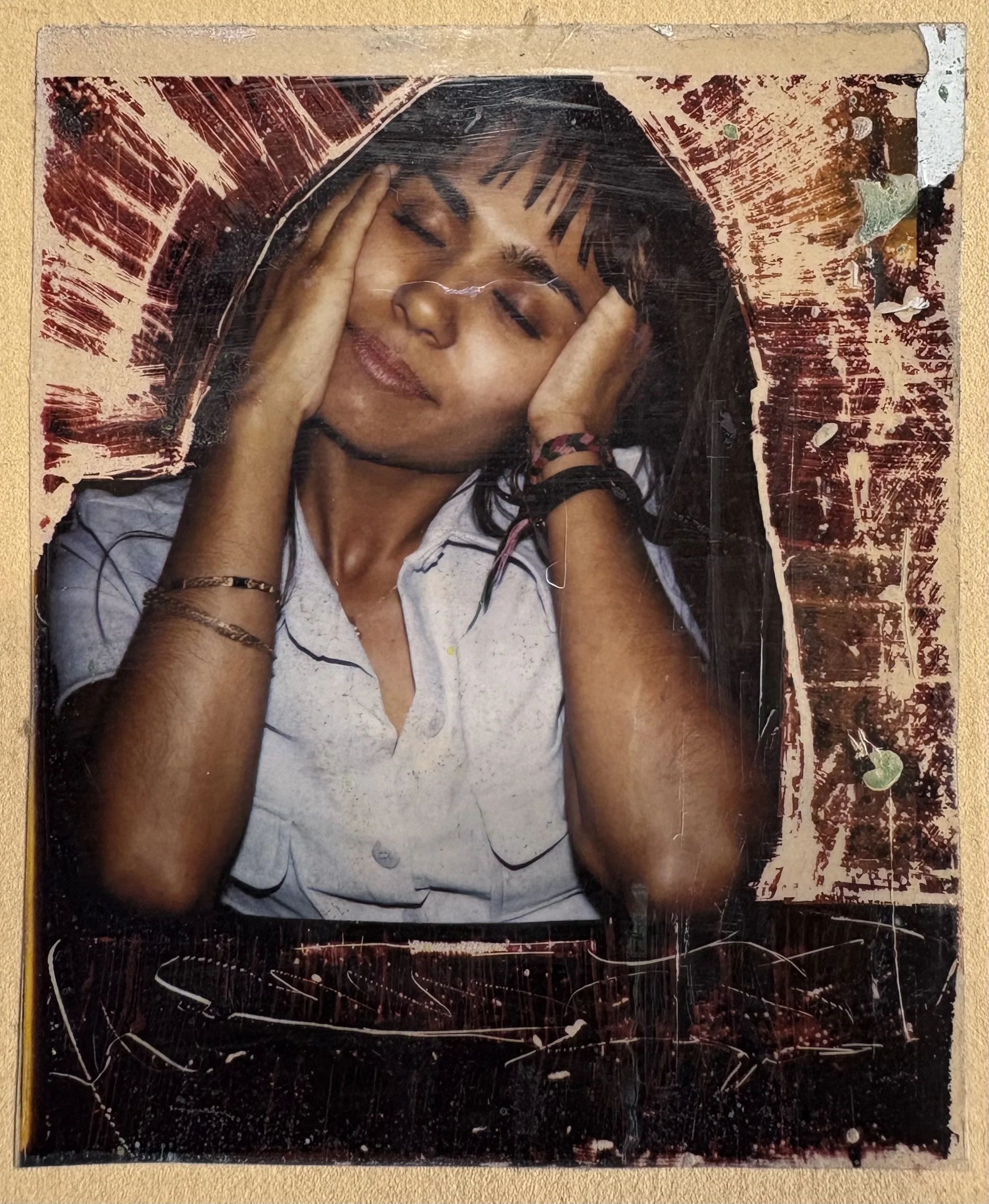
Eliezer Parrilla Mena’s Niña, Arcilla, Marrón I,1997, Polaroid. Courtesy of Eliezer Parrilla Mena.

Eliezer Parrilla Mena’s Niña, Arcilla, Marrón I,1997, Monotype and drawing on paper, 12" x7.5.” Courtesy of Eliezer Parrilla Mena.
Parrilla Mena’s ‘80s works laid the foundation for late ‘20s assemblages. In 2025, Parrilla Mena completed two impressive assemblages: Theater of War and Niña Arcilla Marrón. Though in different styles and times, they demonstrate recurrent exploration of the theme of war, ancestry, and death, topics central to the work he has produced in various forms for many years.
Theater of War and Niña Arcilla Marrón are transformed through different formal strategies—staged props, fragmented domestic architecture, and ritual objects—that make visible the social infrastructures that produce and contain trauma. These works do not offer
resolution. Instead, they map how individuals and communities relay loss, how ceremonial forms attempt repair, and how built environments archive memory. Read together, they reveal an artist persistently attentive to the ethical stakes of representation.
Theater of War suggests war executes the breakdown of civilization, turning institutions into props and people into actors in a destructive drama frames conflict as a staged collapse of social order. Through sharp contrasts of color, relief, and panel sequencing, the assemblage reads as a layered narrative of encounter, ritual, and aftermath.
Nina Arcilla Marrón (Brown Clay Girl) is the culmination of a decade of exploration that follows a single carved image through hundreds of repetitions. Originating from a photograph of a Puerto Rican muse. The motif becomes a recurring emblem—at once matrix and mirror— through which the artist mobilizes the image as both a formal matrix and a conceptual anchor through which questions of Iindigeneity, material lineage, and visual transmission are examined.
ather than treating the source image as a static referent, Parrilla Mena subjects it to a sustained process of translation through media—wood engraving, clay technologies, monotypes, painting, and assemblage— that generate a dynamic interplay of presence and absence. Each piece reads simultaneously as study and statement, balancing experimental reinvention with reverence for tradition.
Parrilla Mena stages a sustained dialogue between ancestral form and contemporary technique. The series ultimately offers a contemporary meditation on how ancestral forms endure, transform, and continues to shape material and cultural memory.
Throughout his artistic journey, Parrilla Mena has delved into a range of styles and mediums. Despite this diversity, he consistently maintains his critical perspective, which is especially evident in works that address sociopolitical and cultural themes that attend to the concept of war, the subject of life and death, and the broader realities of the world in which we live.
His creations serve as a visual record of ongoing thought, with ideas unfolding across the surface much like an evolving conversation between the artist’s hand and chosen materials. The emergence of unexpected shapes and textures—such as blotches that evoke gestures, ridges that catch and reflect light, and negative spaces that hint at imagined faces—suggests that elements are discovered organically within the process rather than strictly controlled. Each accidental feature is thoughtfully integrated back into the composition, adding depth to the overarching theme of human interaction.
My encounter with Parrilla Mena was serendipitous; engaging with his work has been profoundly inspiring. Subsequent research confirmed his meaningful presence as a creator whose bold visual language issues powerful statements that demand sustained attention. The artworks and stylistic shifts traces his creative evolution across distinct periods, revealing a practice committed to interrogating social norms and reframing historical narratives.
Parrilla Mena stands as a defining contemporary artist whose historically grounded, aesthetically daring work merits thoughtful consideration from curators, critics, and collectors. The moment has arrived for the arts community to recognize him as a consequential voice of our time.