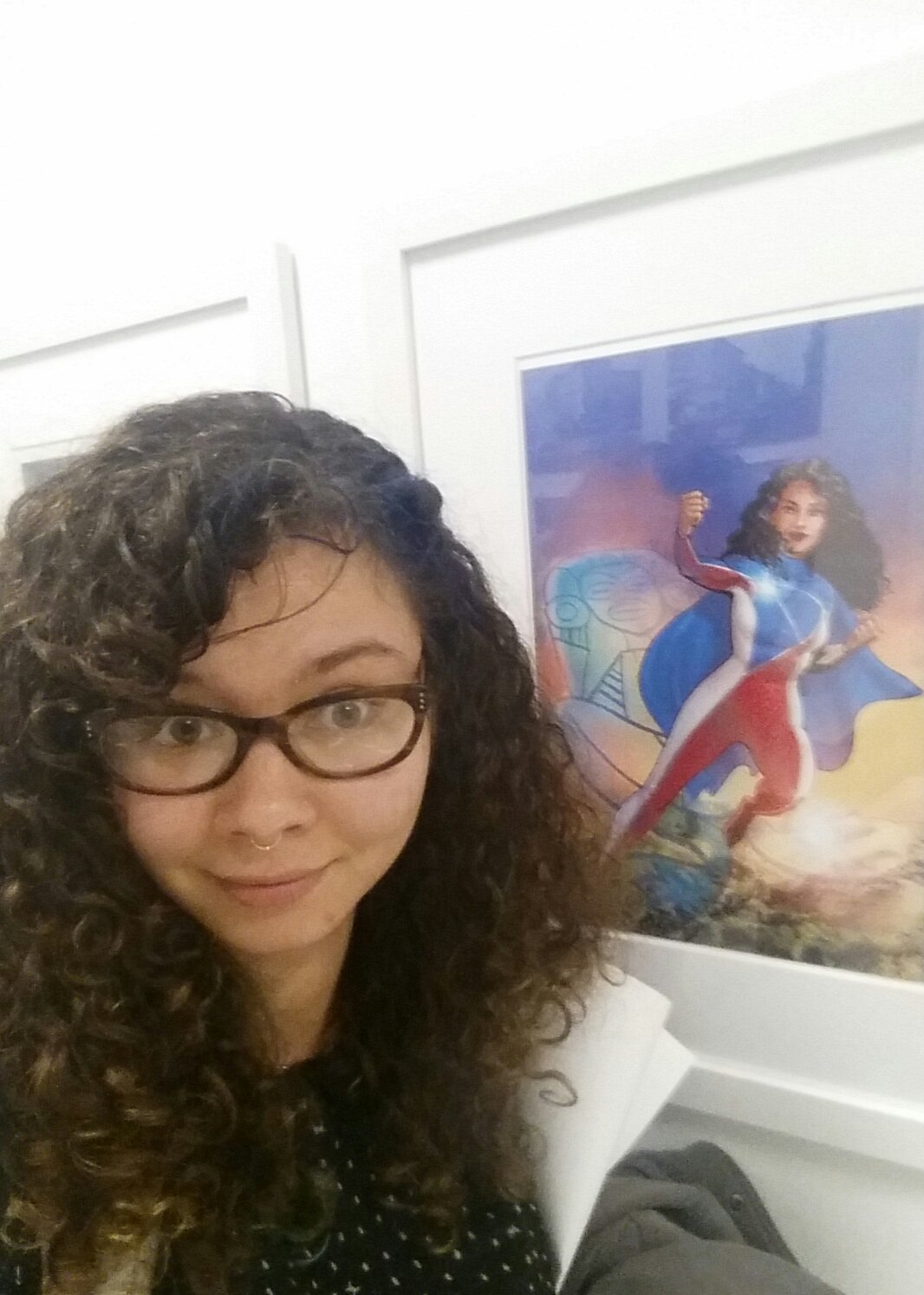
¡Wepa!: History, Culture, and Joy in Boricua Comics
“¡Wepa!”
Boricuas yell it loudly during the Puerto Rican Day Parade. It is a response to kin on the street. It is an exclamation of jubilation. To be Puerto Rican is to be proud, to recognize your own, to be joyful. There is always an exclamation point at the end of that word, the kind of punctuation often associated with the comics medium (think ZAP! POW!). Therefore, it was fitting for the New York Public Library exhibit ¡Wepa! Puerto Ricans in the World of Comics/¡Wepa! Puertorriqueños en el mundo de los cómics to include a salutation emblematic of what it means to be Boricua.
There was little Latinx representation in comics when I was growing up in the 1990s and early 2000s. Even less in previous decades. But now we have Miles Morales and La Borinqueña, two superheroes in bold black, red, white, and blue colors who offer a model of fighting evil. The increase in Latinx superhero comics has led to more specifically Puerto Rican characters that do not rely on a flattening of pan-Latinidad.
According to Puerto Rican librarian Manuel Martínez Nazario, Puerto Ricans in comics have taken on issues of immigration and gentrification that many Boricuas face—on and off the island. For the past three decades, Martínez Nazario collected comics from the 1950s to the 2020s by and about Puerto Ricans. In 2022, he donated his collection to the New York Public Library. For the first time ever, they are on exhibit. Paloma Celis Carbajal and Charles Cuykendall Carter curated ¡Wepa!
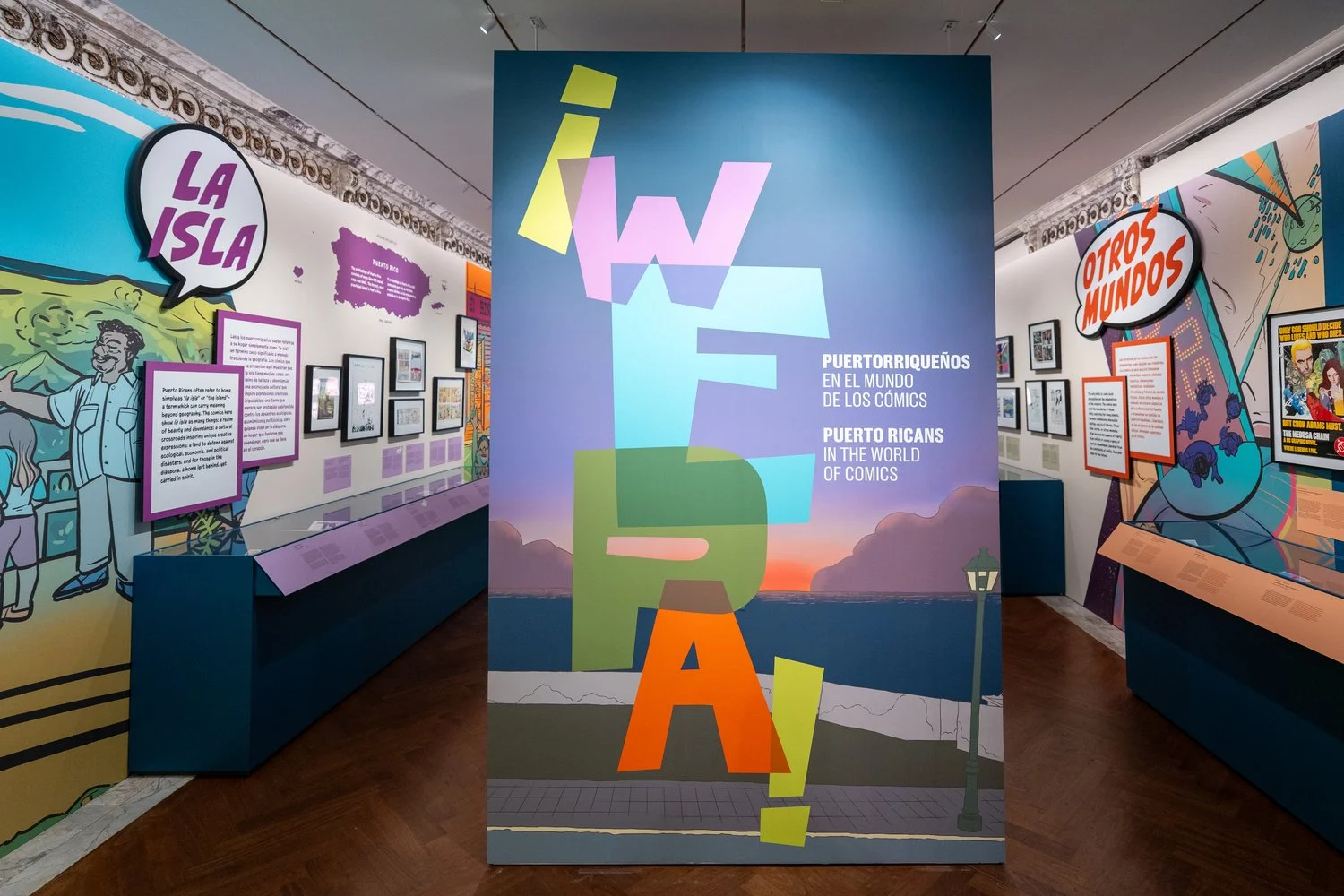
Photo of the ¡Wepa! Exhibit. Image credit: The New York Public Library/Jonathan Blanc (2025).
Entering ¡Wepa! is like stepping into a comic book. The bright colors of the walls, the sans serif font borrowed from speech bubbles, and the images of bombastic characters greet the audience.
Though exhibited in a small room, off the library’s gift shop, ¡Wepa! encompasses five sections, making it feel expansive. Each of the section titles is in Spanish (like “El Mundo” and “El Pasado”) with no English translation—a subtle resistance to the forced use of English in the U.S. colony. Every label and text appears in both English and Spanish, which reflects the bilingual nature of Puerto Ricans on the island and in the diaspora.
The diasporic experience of superheroes is canonical. Many superheroes come from other worlds; like other immigrants, they make homes for themselves in a strange land but carry their homeland with them. The first section, titled “La Isla,” showcases the influence of the island in the comics. Though fictionalized, La Isla appears in George Pérez’s Wonder Woman #1 (DC Comics, 1987) as Paradise Island.
The displayed pages are of Queen Hippolyta, who yearns for a child. Tight shots show the pain on her face. Instructed to go to the shores of Paradise Island at dawn, Hippolyta kneels in the sand; in the distance is the orange-red sky of dawn as the sun appears on the horizon. There, she shapes a baby from clay. A white bolt of energy strikes the inanimate form, and the single word “LIFE” booms in the caption. The baby comes to life. The Queen names her Diana—she would grow up to be Wonder Woman.
This scene reflects the interconnectedness of Puerto Rican and Jewish cultures in comics. Despite portraying an island paradise, the dark history of reproductive rights is alluded to in the comic. For instance, known as La Operación, the forced sterilization of women in Puerto Rico in the 1940 to 1960s. The clay baby trope comes from Jewish folktale. The golem was an inanimate, anthropomorphic creature made from clay and imbued with life.
The next section, “Nueva York,” transitions viewers to New York City, where a significant number of Puerto Ricans moved and settled. According to Sidney W. Mintz, between 1940 and 1950, over 80% of Puerto Ricans who immigrated to the United States relocated to New York City. Ivan Velez Jr.’s comic book Tales of the Closet, published in 1987 at the height of the AIDS epidemic, chronicles the fictional lives of several LGBTQ high schoolers in Queens, NY. Each row of four panels introduces a different queer adolescent. The speech and thought bubbles contain their insecurities and longing to connect. The images show teenagers lounging on a couch, sitting at a desk, or lying in bed.
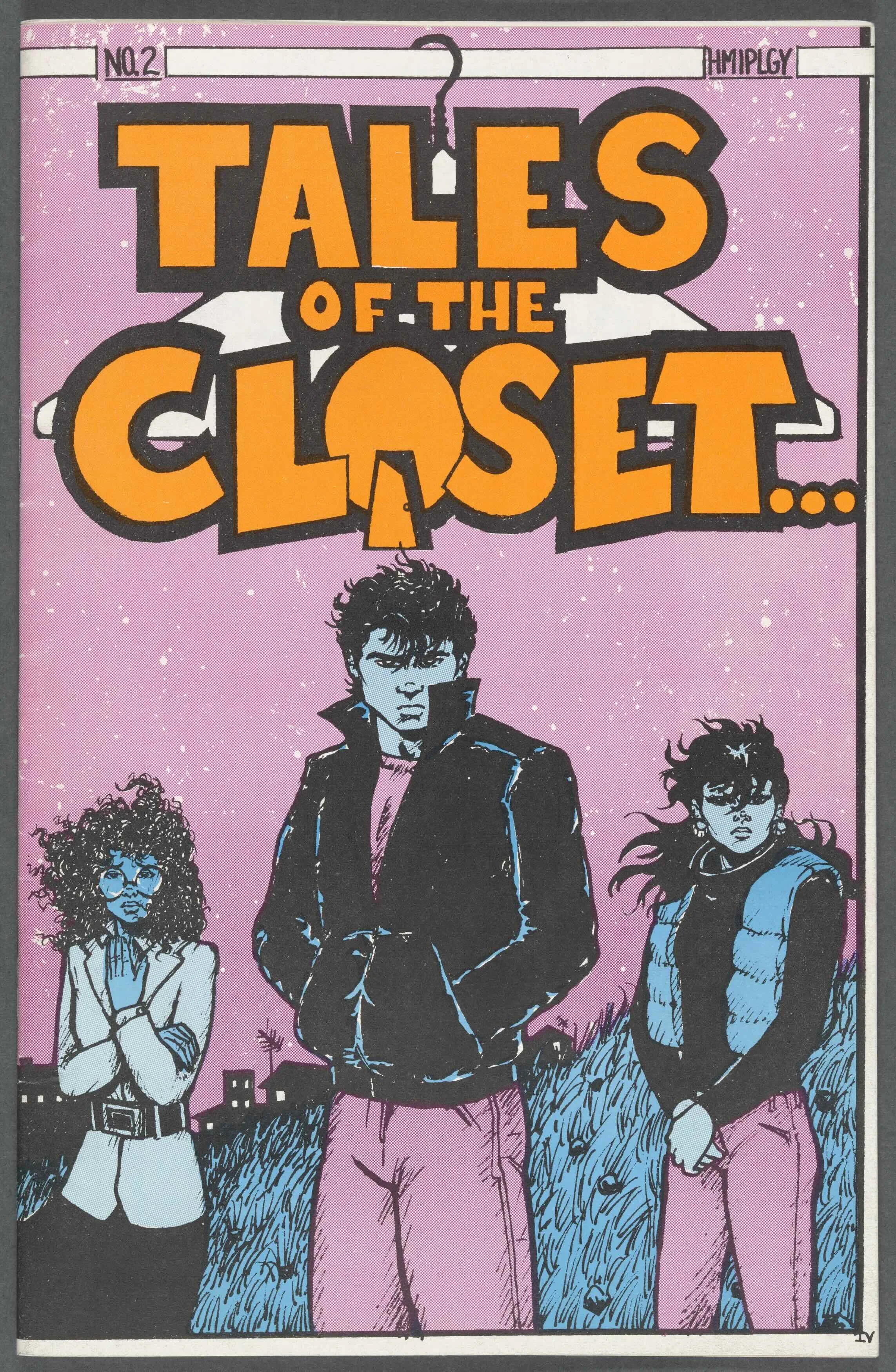
Ivan Velez, Jr. (b. 1961) Cover of Tales of the Closet #2, New York: Hetrick-Martin Institute, 1987.
Another comic, Edwin Vazquez’s The Werewolf of NYC #1, falls within the sci-fi/fantasy genre. While Tales of the Closet was in black in white, The Werewolf of NYC is in dark colors. The pages feature uneven panels and black fills in the gutter (the term for the space between the panels). The protagonist transforms into a monster. His figure is outlined in wavy lines, disorienting the reader, making them feel off-center and possibly giving a glimpse into what it feels like to lose control. Vazquez implements the werewolf as a monster metaphor to tease out some Puerto Ricans’ fear of becoming the “bad immigrant” in their adopted home of New York City.
The third section moves from a geographical focus to a temporal one. “El Pasado” dwells on Puerto Rico’s complicated colonial past imagined in comic form. Many of the comics, whether fictional or nonfictional, reckon with the unique and shared African and Indigenous histories. The comic biographies El Corderro negro: la vida del Maestro Rafael Cordero and Rafael y Celestina tell the stories of two free Black educators who work to teach children literacy during slavery in Puerto Rico.
Framed on the wall is the image of an older, dark-skinned Black man with a white beard who stares from the cover of the comic biography. Cordero’s face is lined with wrinkles, a significant feat for Black men of the time who did not often have the luxury of living to old age. These comic pages depict plantation scenery, the two educators wearing traditional white head coverings, and multicolored buildings of San Juan. Other comics, such as Alice Vanessa Falto Ayala’s Guailí: El Pequeno Taíno #1, center the lives of Indigenous people on the island. Vivid colors show a small Taíno child playing in the forest when their mother calls out to them. The art style is similar to that of an animated children’s show, with a contemporary art style and characters with large eyes. Falto Ayala takes the Indigenous past and transports it into the present imagination.
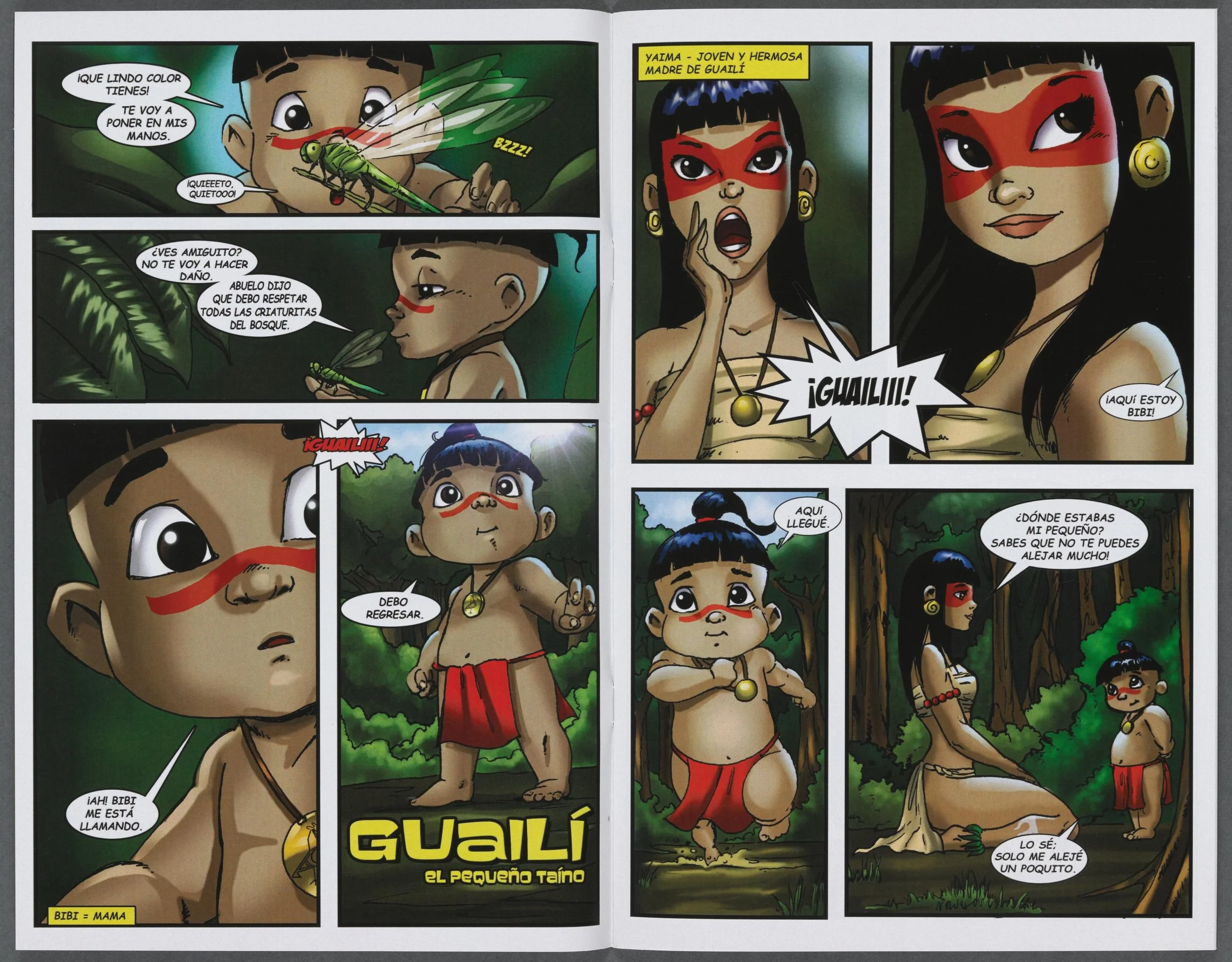
Alice Vanessa Falto Ayala (b. 1974) two pages from Guailí: el pequeño Taíno #1, Mayagüez, Puerto Rico: New Era Art Studio, 2018.
The penultimate section, “Otros Mundos,” shifts once more, both geographically and temporally, to how Puerto Rican comics imagine other worlds outside our universe. Alternative realities, like the multiverse, are a common trope in superhero comics. The graphic art in this section details how mainstream and independent Puerto Rican artists critiqued imperialism via the metaphor of alien expedition and violence against women via the horror genre. For example, Ernie Colón’s poster of The Medusa Chain and Rocío Herdández’s “Atrodidades marítimas,” a body horror comic from Soda Pop Anthology: Cómics hechos por mujeres puertorriqueñas (2014).
The final section, “Weathering Maria,” is not like the others. Not only does it have an English title, perhaps alluding to the English those in the diaspora speak, but its location is in the interior of the room, not along the perimeter. The exhibit is arranged like a comic page, where a reader can either follow the linear sequence of the panels or move around the page freely. By placing this portion of the exhibit in the center, ¡Wepa! allows the visitor to either follow the sequence of sections and end with “Weathering Maria” or choose to start with it.
In 2017, Hurricane María devastated Puerto Rico. Almost 3,000 people died. Some of the comics document how Puerto Ricans began to process that trauma. In her article “Traumatic Displacement in Puerto Rican Digital Graphic Narratives,” Puerto Rican comics scholar María Fernanda Díaz-Basteris writes, “Through the visualization of trauma and depression, these independent comics slowly unwrap a possible approach for a healing and recovery process based in communal sequential art initiatives.” Comics in this section range from scenes of devastation to daily life resuming, as if to show, this is how one comes back from disaster.
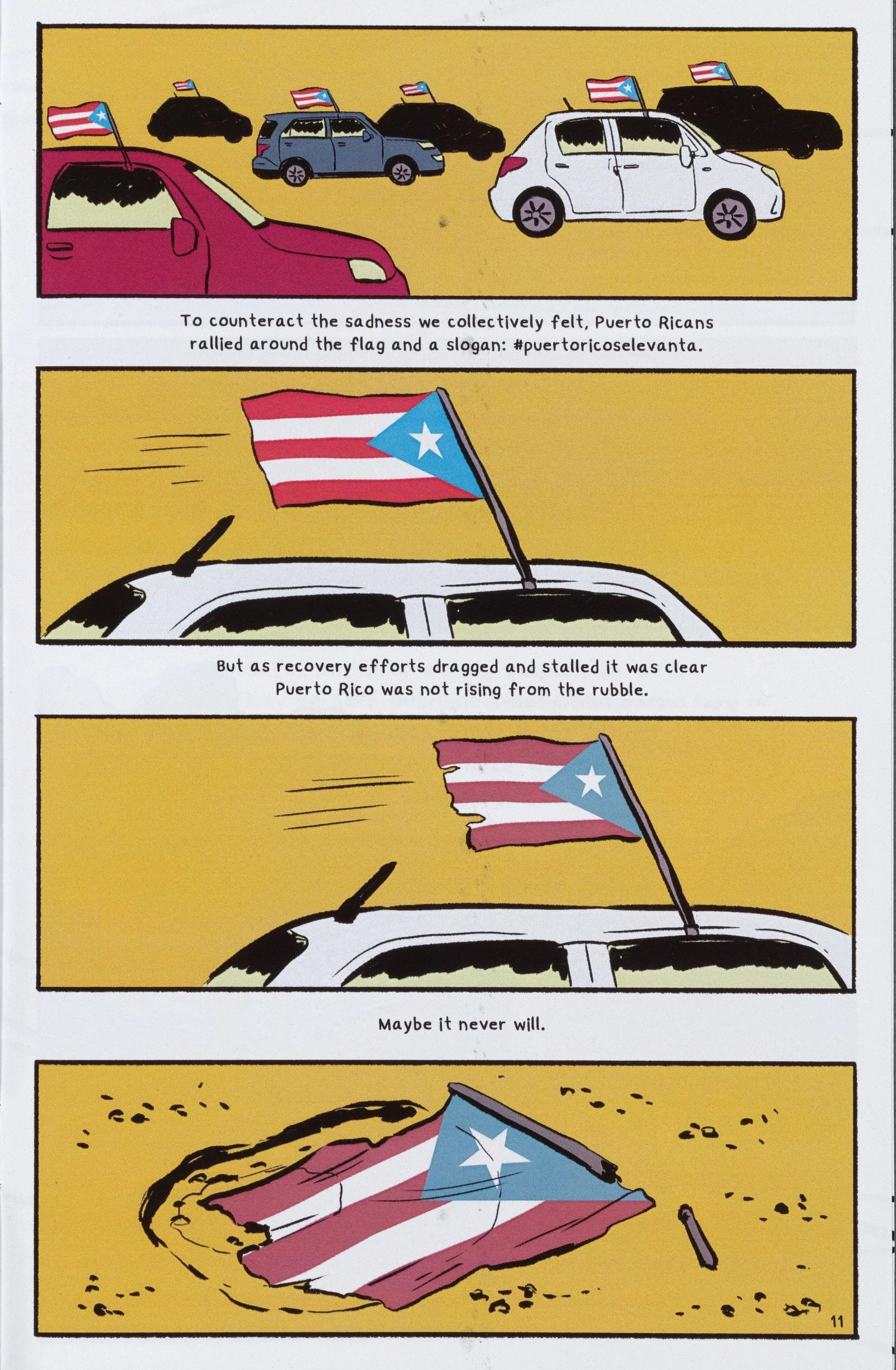
Rosa Colón Guerra (b. 1977) panel from María, San Juan: Soda Pop Comics, 2018.
The weight of colonial violence emanates from the comics. For example, in Rosa Colón Guerra’s comic María, a sequence of four horizontal panels illustrate several cars mounted with Puerto Rican flags driving around. Then a close-up shot of a white car with a flag. Next is the same image but the flag looks tattered. The final panel shows the damaged flag now lying on the ground. Sometimes, pride is not enough; Colón Guerra’s critiques the failure of the State to provide material resources to rebuild, neglect becomes violence.
Comics function as historical records. As Díaz-Basteris posits, comics can “challenge our understandings of notions such as disaster, memory, and collective trauma by revealing the hidden experiences of displaced citizens in their own countries.” Puerto Rican comics become a vehicle to process the trauma in the diaspora and transform it into aid. This is evidenced by the two anthologies on display, Puerto Rico Strong and Ricanstruction: Reminiscing and Rebuilding Puerto Rico, whose proceeds were donated to recovery efforts.
A comics art exhibit may seem like an incongruous mixing of “highbrow” and “lowbrow” art. It is not. The Puerto Rican graphic narratives in ’¡Wepa! range from mainstream superhero comic books depicting epic battles of good versus evil to independent comics that chronicle everyday life. Both illustrate the spirit of resolve of Boricuas on the island and on the mainland. Most importantly, the comics in this exhibition (with their loud speech bubbles, tropical scenery, bright colors, drawings of empanadillas) demonstrate that despite the centuries-long colonization of the island, natural disasters, and government neglect, Puerto Rico will always exude a sense of joy.
¡Wepa! Puerto Ricans in the World of Comics/¡Wepa! Puertorriqueños en el mundo de los comics will be on view at the New York Public Library, Stephen A. Schwarzman Building, until March 8, 2026.