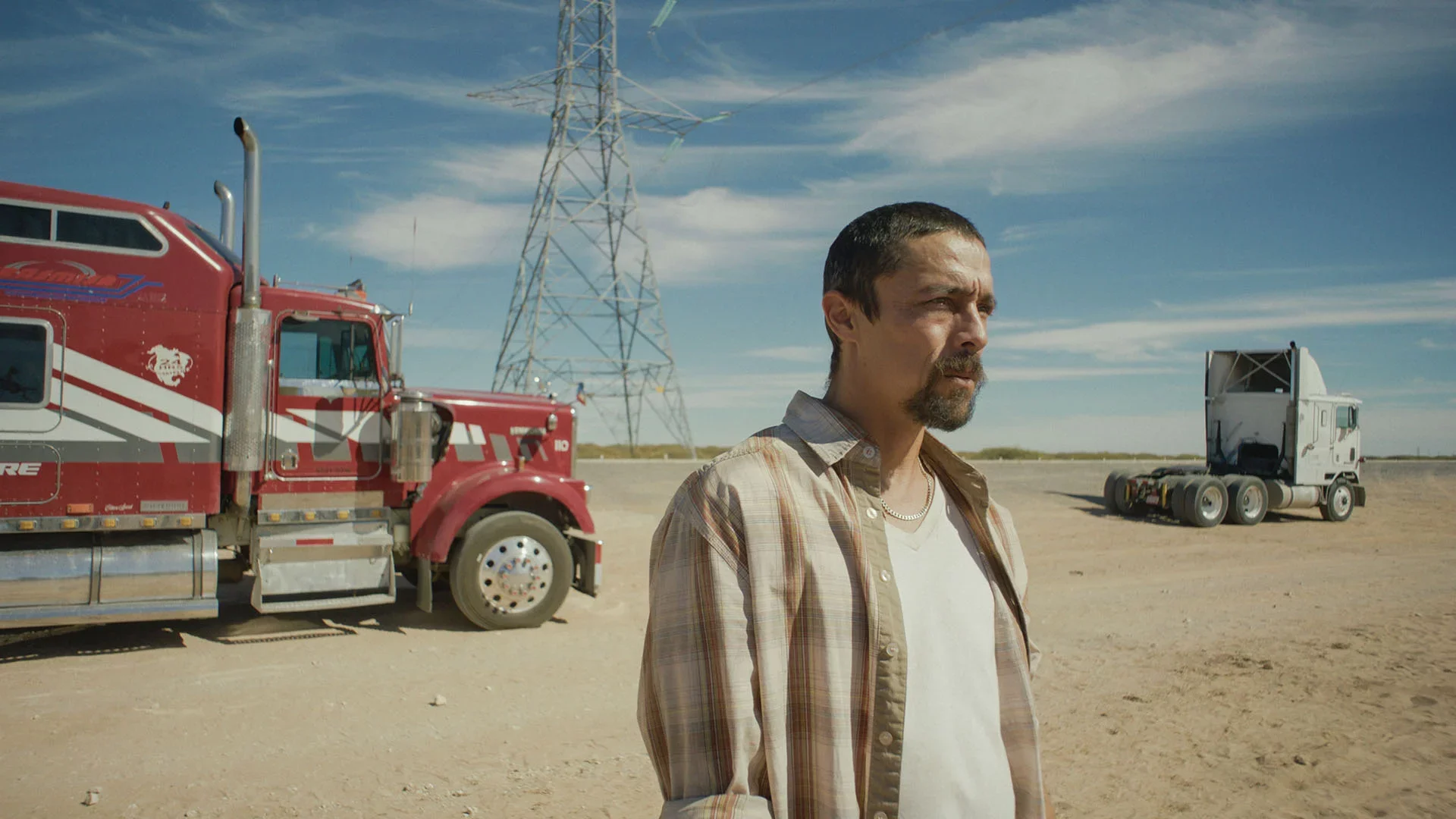
Still from En el camino.
When the 43rd Miami Film Festival took place in April 2026, David Pablos’s En el camino (On the Road) had generated conversation among filmmakers and critics after the film received the 19th Queer Lion Award at the 82nd Venice International Film Festival. By the festival’s close in Miami, On the Road received the Marimbas Award, the jury’s top prize, along with $10,000. The film’s life has only expanded since. Months later, in August , the Mexican Academy of Cinematographic Arts and Sciences selected it to represent Mexico in the race for a Best International Feature Film nomination at the 99th Academy Awards.
The awards were not, however, what first drew me to the film. What held me was the uncompromising way Pablos visually portrayed the worlds of mobility, addiction, masculinity, and sexuality among the truckers who inhabit northern Mexico’s highway system. At the center of the film is Muñeco, a truck driver worn down by drugs and life on the highway. His route crosses with Veneno, a young queer sex worker trying to survive within the same roadside communities and networks. As the two travel through northern Mexico, their uneasy intimacy brings into view the economies of desire, exploitation, and violence that gather around the movement of goods/commodities across nations.
Watching it, I found myself returning to questions that haunt my own research: How might we change the way we read the political, social, and cultural dynamics of the Texas-Nuevo Leon-Tamaulipas border? How do objects, machines, and infrastructures organize the everyday movement of the communities that inhabit these spaces? And what landscapes and forms of life take shape around them
Take tractor trailers; their presence is so familiar that it has become almost invisible. These enormous mobile machines cross the highways in the name of corporate distribution and logistics, carrying food, automobiles, and every kind of licit and illicit commodity. As they pass, observers likely don’t ask which communities inhabit their routes, what forms of life emerge around them, or whose bodies sustain their movement. To look at the border through this material infrastructure is to bring those bodies—those whose precarious labor and survival keep the routes running—back into view.
This is one of the critical possibilities in On the Road’s opening scenes. Although its story unfolds in northern Mexico, its highways lead toward debates in Chicanx and Latinx studies, fields that have developed a rich theoretical language around borders, mobility, and migration. To place the film in that conversation is not to recast it as a direct representation of life in one nation-state. It is to recognize that life along these highways is inseparable from the movement of communities across the border and from the economic and labor networks binding both territories together.
The film also invites Chicanx and Latinx studies into conversation with Latin American critique. Too often, these traditions are read separately, as though the border marked the limit not only of nations but of our critical tools. On the Road asks the viewer to consider the intersection. Its circuits of violence do not belong exclusively to Mexico, nor can they be reduced to the failure of a nation-state to resolve its own conflicts. They depend just as much on U.S. and Mexican corporate power and on trade economies that demand the uninterrupted movement of licit and illicit goods across the border.
These circuits do not operate solely at the economic level. They operate on the body, determining the conditions of habitability for those who sustain multiple economies, local and international, on this side and the other. Viewing the violence in On the Road as something that “only happens in Mexico” risks reproducing a gaze that confines its characters within an apparently isolated nation-state and leaves outside the frame of the transnational chains that profit from their labor, attrition, and vulnerability.
This is what makes On the Road so unsettling and profoundly desolate; it follows the circuits of violence that keep northern Mexico and U.S. border states in motion. From its opening sequence, Pablos places the viewer in a geography of precarity, silence, and exhaustion, where transit promises no freedom and instead becomes a form of capture. His characters move without rest, yet every mile seems to close off another exit. Here, mobility and immobility have the same condition of a cyclical motion that never allows an escape.
In this respect, On the Road belongs to a recent cinematic constellation in which Mexico emerges as a territory of thwarted movement, wounded masculinities, and young people forced to create precarious forms of belonging. Fernando Frías de la Parra’s I’m No Longer Here (2019) and Hurricane Season (2023), Elisa Miller’s adaptation of Fernanda Melchor’s novel, inhabit this same universe. In all three, violence is less an isolated event than an atmosphere; it organizes desire, friendship, labor, and the possibility of either staying or escaping. Their differences matter, but seeing them together reveals a shared attention to young and dissident bodies searching for community in landscapes shaped by abandonment, extraction, and violence.
Muñeco gives this contradiction a body. Consumed by substance abuse, insomnia, and a life fractured by distance, he embodies a masculinity exhausted by the route. He drives, uses drugs, hallucinates, makes his stops, and keeps going, as if movement were his only remaining option, even as it destroys him physically and mentally. By the time he appears on screen, the logistics machine has already absorbed his body. Muñeco does not just know the roads, restaurants, and rest stops. They made him who he is.
Even his sexual desire seems to respond to the rhythm of his truck: the engine’s acceleration and deceleration, the calculation of movement, and the need to keep going. The trailer is not merely transportation or a setting for his encounters. It is a workplace, bedroom, shelter, and intimate space. In Muñeco, the human body and the distribution machine seem to have become inseparable. The road allows him to cover enormous distances, but this mobility does not expand his possibilities. On the contrary, it keeps him trapped in a circuit of exhaustion, consumption, and repetition.
Seen from Muñeco’s cab, the highway becomes more than a thoroughfare, and the border more than a line between countries or a contact zone between cultures. It appears instead as a larger infrastructural network of highways, maquiladoras, freight yards, restaurants, rest areas, and clandestine economies. In my academic work, I call these networks necro-corridors; infrastructures that accelerate the movement of goods while distributing exhaustion, precarity, and uneven exposure to death. I developed the concept in dialogue with Iván Chaar López’s work on technologies of control and the border; Kyla Wazana Tompkins’s reflections on deviant matter and consumption; and Achille Mbembe’s, Rossana Reguillo’s, and Sayak Valencia’s accounts of necropolitics, the necromachine, and gore capitalism. I draw these thinkers together to ask what logistics does to mobility and habitability. In other words, which bodies have permission to circulate, which must keep circulation going, and which can be abandoned or exposed to death. Pablos gives this contradiction a visceral form. Everything must move, even when the people making movement possible can barely stay alive.
Veneno’s arrival unsettles this world and widens its frame. As a queer sex worker moving among truckers, traffickers, and clandestine spaces, he exposes another dimension of the corridor’s economy. If Muñeco shows us machines and logistics consuming the worker, Veneno shows the same system capturing, disciplining, and sexually exploiting a body. It's not a coincidence that his boss controls him materially and sexually, imposing rules that make him property and leave little room for autonomy. These corridors, the film insists, carry more than goods. Coercion, drugs, violence, and sexual torture move through them as well, producing sacrifice zones where a body can become labor, sexual object, vehicle, or waste. Veneno’s sexual economy and Muñeco’s logistics economy are not parallel stories; they are parts of the same system, both dependent on bodies that can be used, moved, and discarded once they cease to produce value.
This is why it would be limiting to describe On the Road, for all its queer and homoerotic vision, simply as a story of desire between men. What develops between Muñeco and Veneno is a precarious intimacy inside a devastated landscape that exceeds Mexico’s borders. The bond between the two main characters carries need, companionship, and a fleeting tenderness that can barely survive the brutal circuit around them.
At the same time, this intimacy introduces an interruption. While the corridor demands speed, performance, and constant movement, their bond produces stops, moments of care, conversations, and vulnerability. These stops do not place them outside structural violence, but they show that their bodies cannot be reduced entirely to the function the corridor assigns them. Through their relationship, the film explores the fragility of masculinities that can no longer hold themselves together under the codes of power, yet still cannot find an outside from which to reinvent themselves. Here, sexuality is traversed by violence but not wholly determined by it.
Pablos renders this devastation through a relentless material and visual language of abandonment. Even hygiene becomes politically charged as evidence of an infrastructure that has failed selectively. The film is clear that the route’s purpose is to move products, not to sustain lives. Workers load and unload goods beside roadside spaces without adequate bathrooms. There are improvised stops, brothels that occupy truck yards, and bodies that survive amid waste and exhaustion. The corridor produces wealth for some by condemning others to uninhabitable conditions and slow deaths.
Precarity, then, does not appear in the film as an accident of the landscape but as part of its design. What might look like incomplete infrastructure works to maintain the flow of goods and lower the costs of circulation. In the film, the abandonment of bodies does not mean the system stopped working; it means that it functions without regard for which lives deserve rest, safety, or care.
The result of the film is a sharp reflection on infrastructure and dehumanization. Wherever capital demands constant circulation, bodies are reduced to functions, waste, or objects of exchange. The maquiladora owner who appears as a figure of power is, therefore, not incidental because he connects intimate and sexual exploitation to larger economies of production and accumulation. In the map On the Road draws, labor, trafficking, desire, consumption, and violence bleed into one another. They are not separate crises but moving parts of the same mechanism.
The scenes of violence are especially disturbing because they condense this fusion of eroticism, power, and death. The image of a man performing oral sex on a gun, for instance, works as a device for shock and as a brutal synthesis of the world the film portrays. The scene can be read as an expression of the mortal risk involved in participating in, inhabiting, and surviving this circuit of violence, and of the way that circuit interlocks with desire, pleasure, and labor.
The same is true of the mutilations, burned bodies, gasoline poured over skin, and violence directed at certain characters’ genitals. In each of these moments, the body appears as the first territory on which the corridor’s logics are inscribed. Violence does not only kill; it marks, mutilates, disciplines, and leaves traces on bodies.
Thus, Muñeco’s name acquires an almost prophetic resonance. This nickname, “Doll,” seems to anticipate his fate within this universe of roads and waste. It is no coincidence that his body is reduced to a vulnerable object within a cycle that exceeds him. Nor is it accidental that the attempt to “save” Veneno by handing him over to the police opens no real possibility of liberation or resolution. The film refuses easy exits because it contains no escape or alternative, only stops along the route. Here, the highway connects different forms of violence, so escaping one can mean entering another.
The presence of la Santa Muerte at the beginning reinforces this sense of fatality. On the Road is permeated by the knowledge that certain lives have been organized around proximity to death. But the film does not present that proximity as cultural destiny or inexplicable fate. Death is produced by a specific economic, spatial, and affective order. The desert, highway, and silent hills are not mere backgrounds; they form part of an ecology of violence in which what the viewer cannot hear or see is as important as what is. There is something profoundly unsettling that no one hears anything that happens on the road, that the noise of the machine and its movement absorbs even the possibility of naming pain.
On the Road makes visible a world that cinema often leaves outside the frame. It refuses to romanticize the highway or turn transit into an easy metaphor for emancipation. Its characters' bodies keep moving because stopping can also be deadly, even when moving forward no longer takes them anywhere. The lack of an exit reveals the central contradiction of the corridors; an infrastructure capable of connecting entire markets while fragmenting the lives of those who sustain it.
After seeing the film, it is difficult to look at a tractor-trailer truck as a neutral machine or tool. Its passage along the highway is merely the visible portion of a much larger network. Accompanying it, even if we cannot see them, are exhausted workers, communities crossed by its routes, and the sexual and affective economies that form along their margins. This network does not end in Mexico or at the border checkpoint. It continues through distribution centers, stores, and homes where goods finally appear, severed from the stories of those who transported them.
This may be On the Road’s most unsettling achievement. It makes us ask what happens for something to reach us. Every delivered product appears to confirm the corridor worked, that the route fulfilled its purpose, that the cargo arrived safely. Pablos turns our attention instead toward everything the story of success must conceal. When the truck continues down the road and disappears from view, who and what parts of their lives had to be left behind so its cargo could keep moving?