Photo courtesy of Luis Corzo.
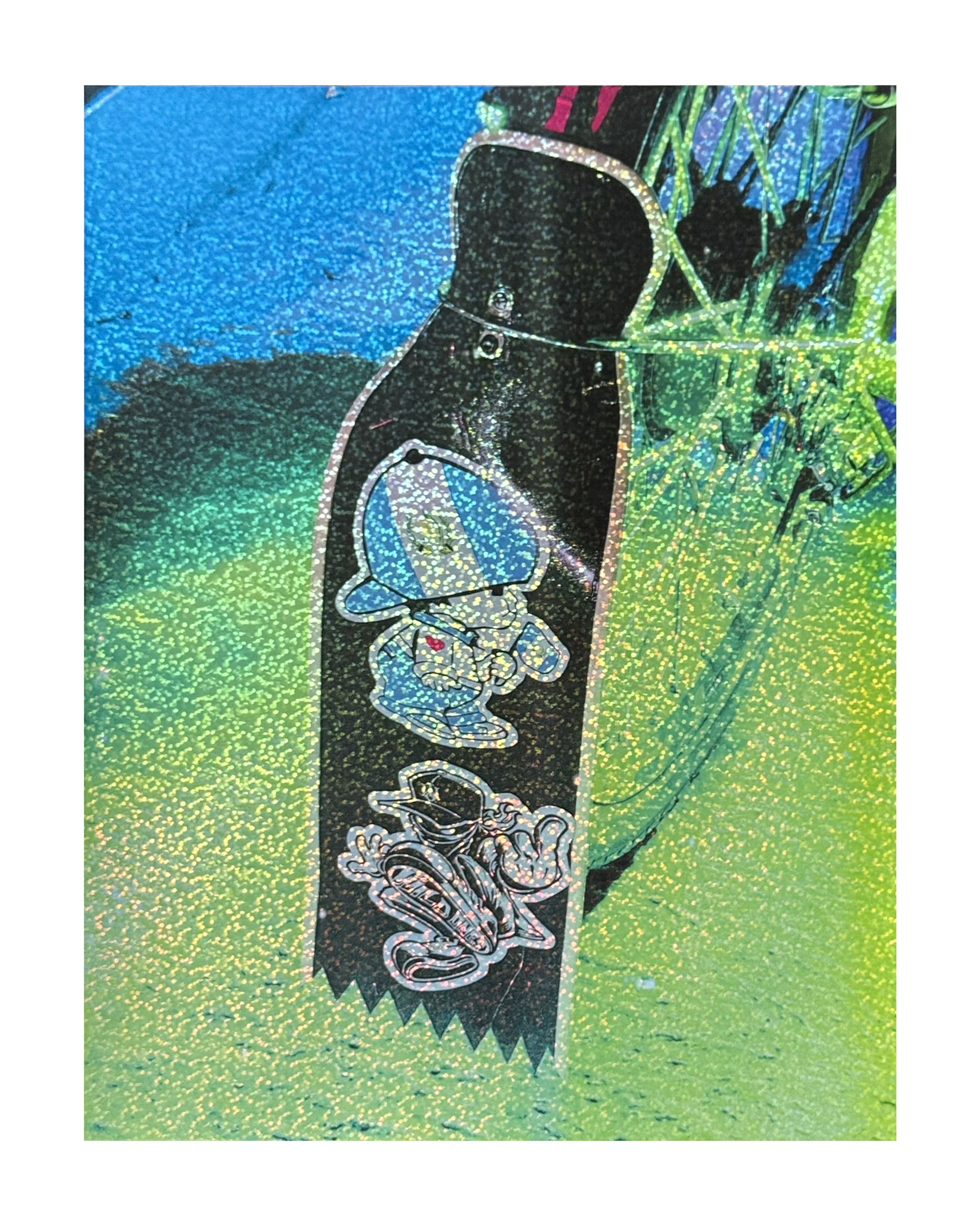
Photo courtesy of Luis Corzo.
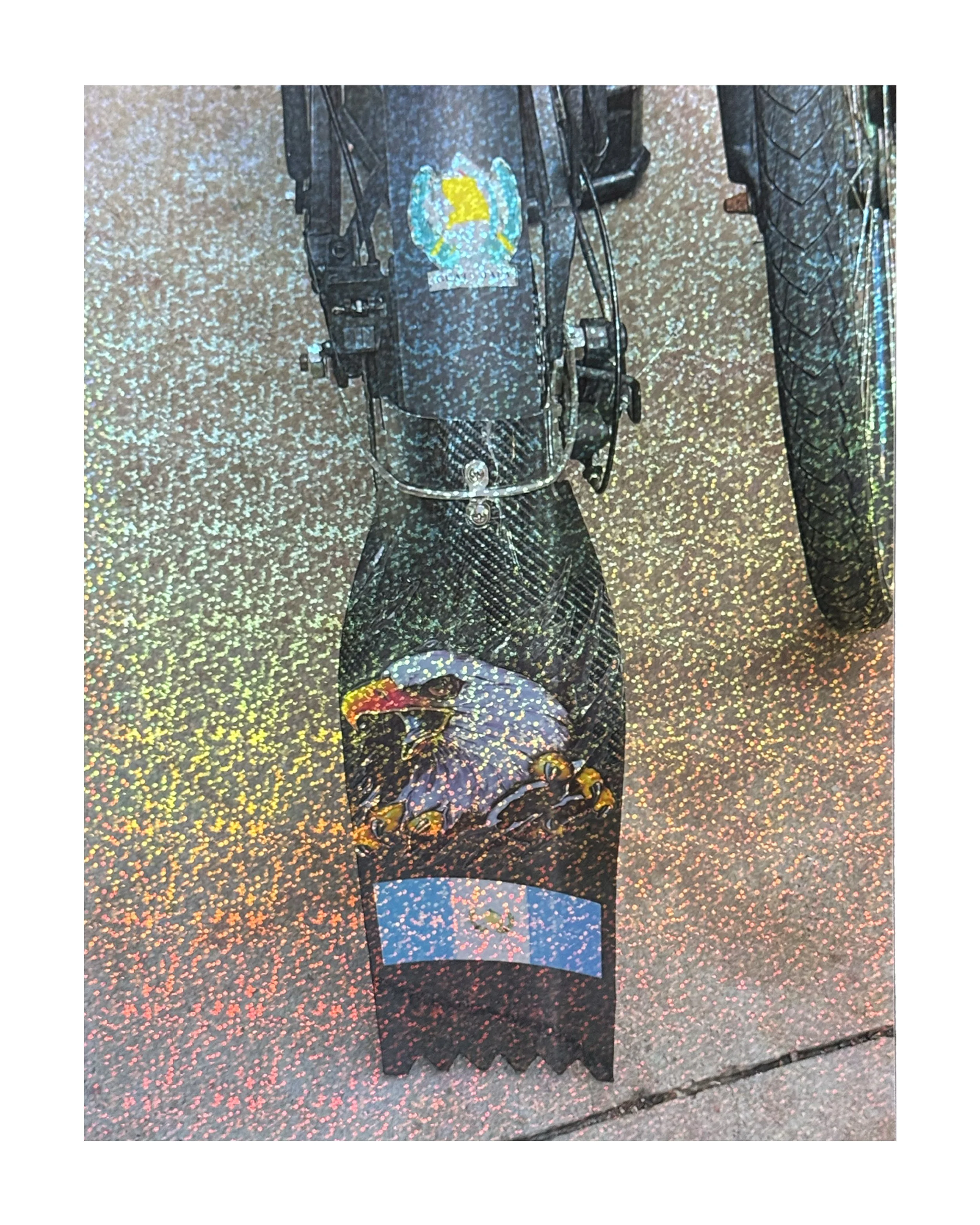
Photo courtesy of Luis Corzo.
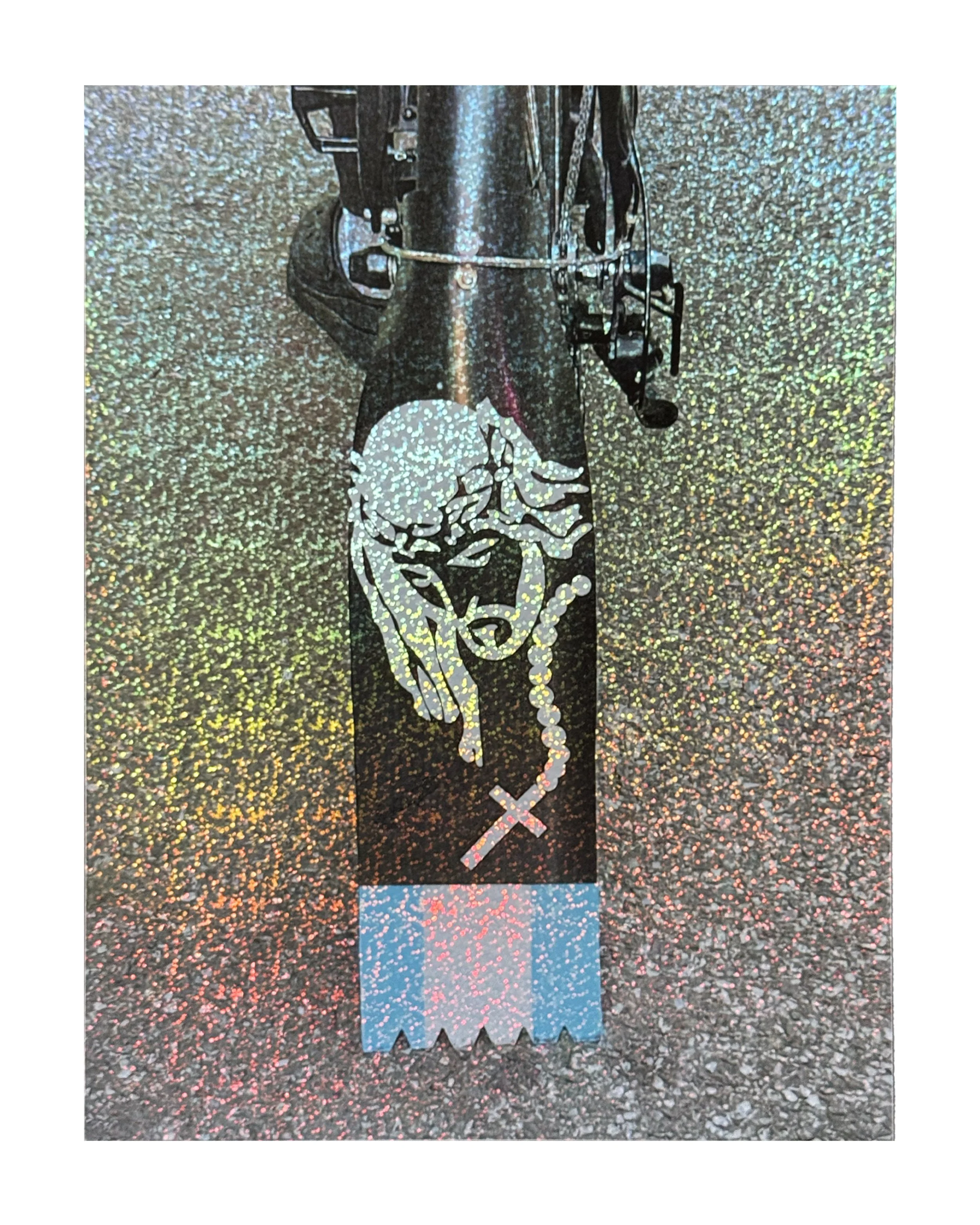
Photo courtesy of Luis Corzo.
On any given day in New York City, Guatemalan delivery drivers weave through traffic on motorcycles and bikes wrapped in decals, LED lights, and personalized flourishes. The vehicles are impossible to ignore, even as the people riding them are often treated as invisible. They carry dinner to buildings filled with corporate workers who hardly thank (or tip) them, pass legions of restaurants that depend on their speed to reach customers, and vanish again into the labyrinthic flows of the street. Artist Luis Corzo recognized a diasporic dialogue developing in plain sight and documented them in his most recent photographic series, Cohesión, 2026.
The award-winning Guatemalan photographer who now lives in Brooklyn captures these deliveristas and the hand-built aesthetics of their ride.¹ Cohesión, 2026 is a series of 30 digital prints, each about 29 by 35 centimeters, made on self-adhesive holographic paper flecked with tiny dots. Each print illustrates the decorations that adorn various Guatemalan delivery drivers’ bikes in New York. The result is a collaged aesthetic, in which the drivers' overlapping decals and Corzo’s own sticker-like prints build a visual language out of accumulation and ornamentation.
Yet, nothing about this ornamentation is incidental.
Read through Central American scholar Kency Cornejo’s concept of “shifting the border,” these vehicles become acts of visual disobedience: motorized countercartographies that assert mobility, presence, and belonging against an anti-immigration system that keeps Central American migrants out of sight. The border, in this reading, is more than a boundary they cross once. The border follows migrants into the city, into the workplace, and onto the street—contested through images and iconography. Undocumented and underpaid, many of these delivery drivers are legible to the state only as labor(ers), never as subjects. Against that erasure, Guatemalan delivery drivers challenge subjecthood, visibility, and who counts as an artist in the art capital of New York, turning their vehicles into mobile canvases of color, personalization, homeland connection, and spiritual expression.
While society renders their labor invisible, the vehicles that facilitate said labor demand that people stop and notice them. The placement of their adornment is strategic. It faces outward and trails them. Positioned on the back ends of their [motor]cycles, these images confront the drivers and passersby behind them, who cannot help but look at images that reclaim, recall, and reinstate subjecthood.² A driver idling behind a rider at a red light becomes, for a moment, an unwilling audience. The delivery driver ahead controls what they see and how they see it, a small reversal of the street surveillance that otherwise watches the delivery drivers.
In one of Corzo’s captured photographs of the [motor]cycles, three decals stack from top to bottom: the Guatemalan coat of arms, an American bald eagle, and the Guatemalan flag. By juxtaposing these emblems, the rider announces a diasporic identity and points to the entangled, motorized, and sticky political histories that brought him to the city in the first place. The eagle sits between two symbols of the homeland, as if held in place by them, a visual shorthand for the position of migrants themselves, shaped and straddled by two nations at once. In doing so, the drivers engage in their own economies of visual language, one that speaks to outsiders and another that their community can recognize––as was the case for Corzo. A decal can simultaneously say “I am here” to a stranger and “I am from where you are from” to a fellow rider or passerby, all in the same glance.
This visual language and collaged aesthetic, however, does not sprout in isolation. It has entrenched roots. It stems from Guatemala’s iconic camionetas: repurposed U.S. school buses, retired from one country and reborn in another as rolling murals. Painted, chromed, lighted, and lettered with saints, slogans, and names, they have long carried homeland identity across migration routes and daily commutes alike. They are themselves a multi-directional, maximalist collision of U.S. and Guatemalan aesthetics and diasporas––cohesion and explosion at once. What the camioneta does for a crowded public route on Guatemala’s bustling streets, the decorated bike does for a solitary worker in the buzzing streets of New York: It makes a vehicle of survival and labor into a statement of belonging and identity.
Corzo makes the lineage explicit in the description of the work, shown last September in Guatemala City, Guatemala, at the Centro Cultural de España en Guatemala (CCE) as part of the exhibition Con ojos propios: “Cohesión, 2026 es una serie de fotografías que documentan decoraciones de bicicletas de deliveristas guatemaltecos en Nueva York. La acumulación de símbolos culturales, religiosos y de orgullo nacional en estas bicis recuerda directamente a las camionetas de transporte público en Guatemala, vehículos intervenidos con una estética maximalista que funciona como forma de identidad colectiva.”³
The drivers’ visual language is in diasporic conversation with the camionetas of their homeland. As their diasporic descendants, the [motor]cycled aesthetics of Guatemalan delivery drivers’ vehicles carry a maximalism that saturated their culture long before the riders arrived in the United States. Nothing here about the Guatemalan delivery driver’s aesthetics derives from the art city capital. Rather, they witnessed them in the homeland, absorbed them into daily life, and gathered them alongside their personal belongings to be recycled and reimagined in New York.

Photo courtesy of Luis Corzo.
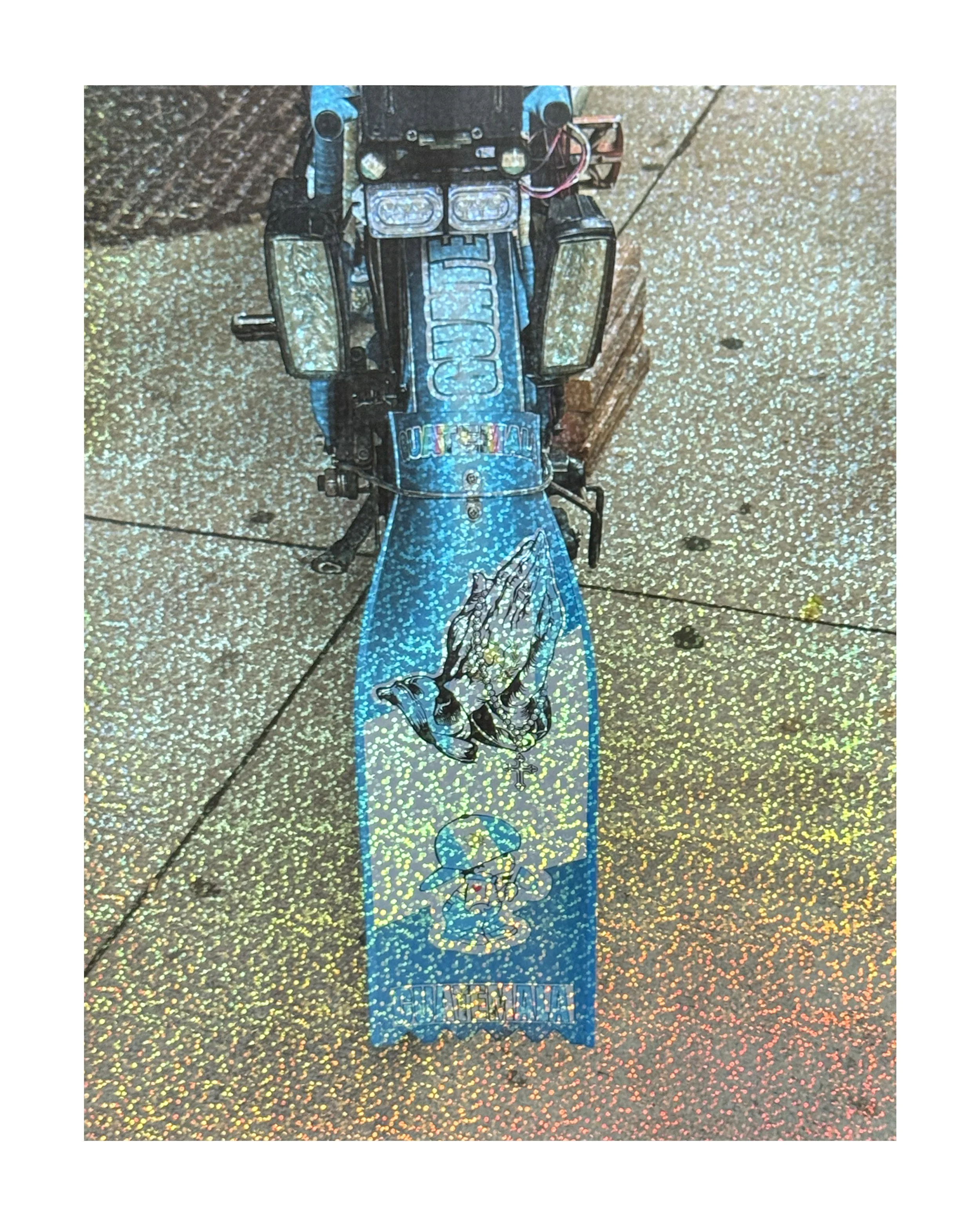
Photo courtesy of Luis Corzo.
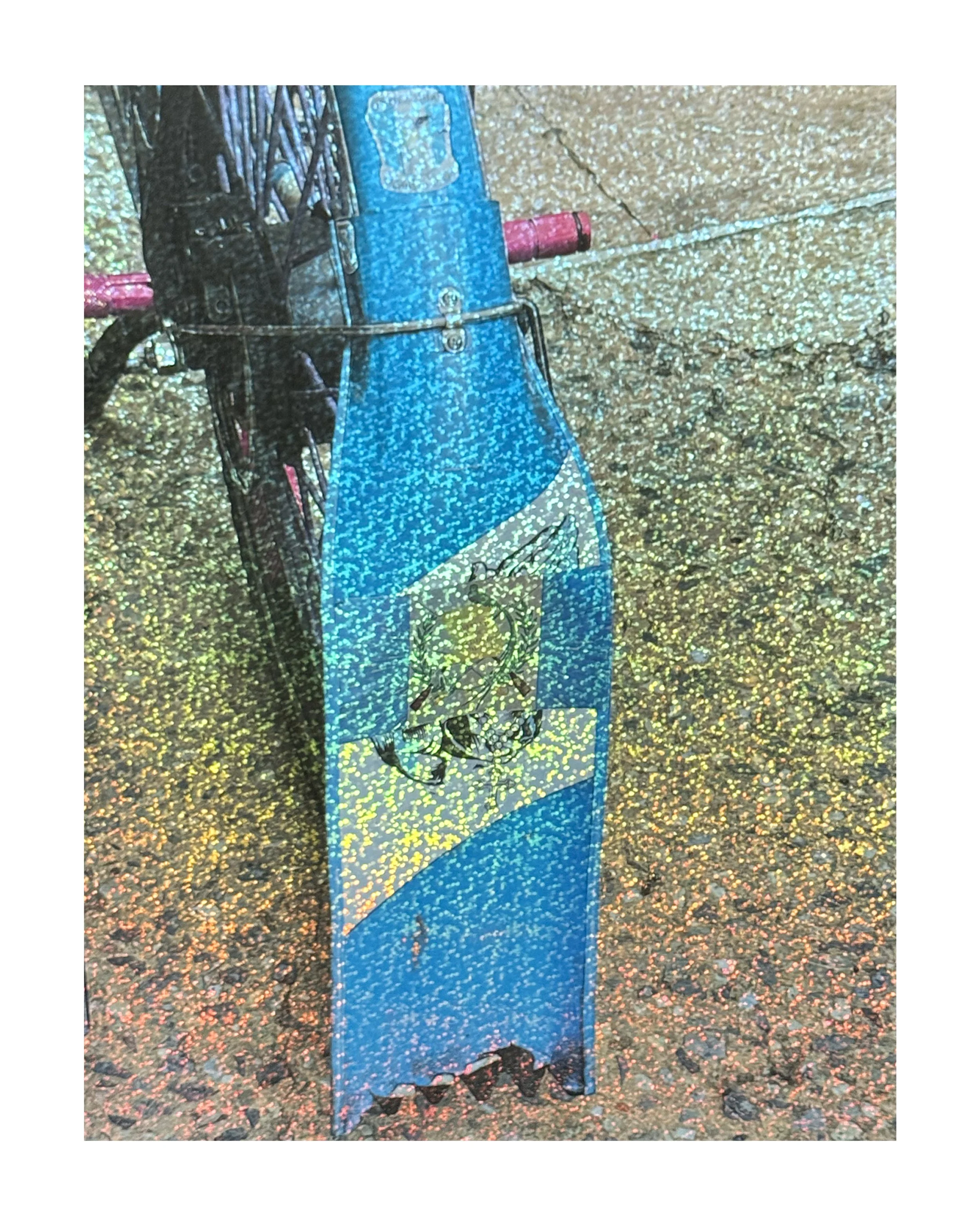
Photo courtesy of Luis Corzo.
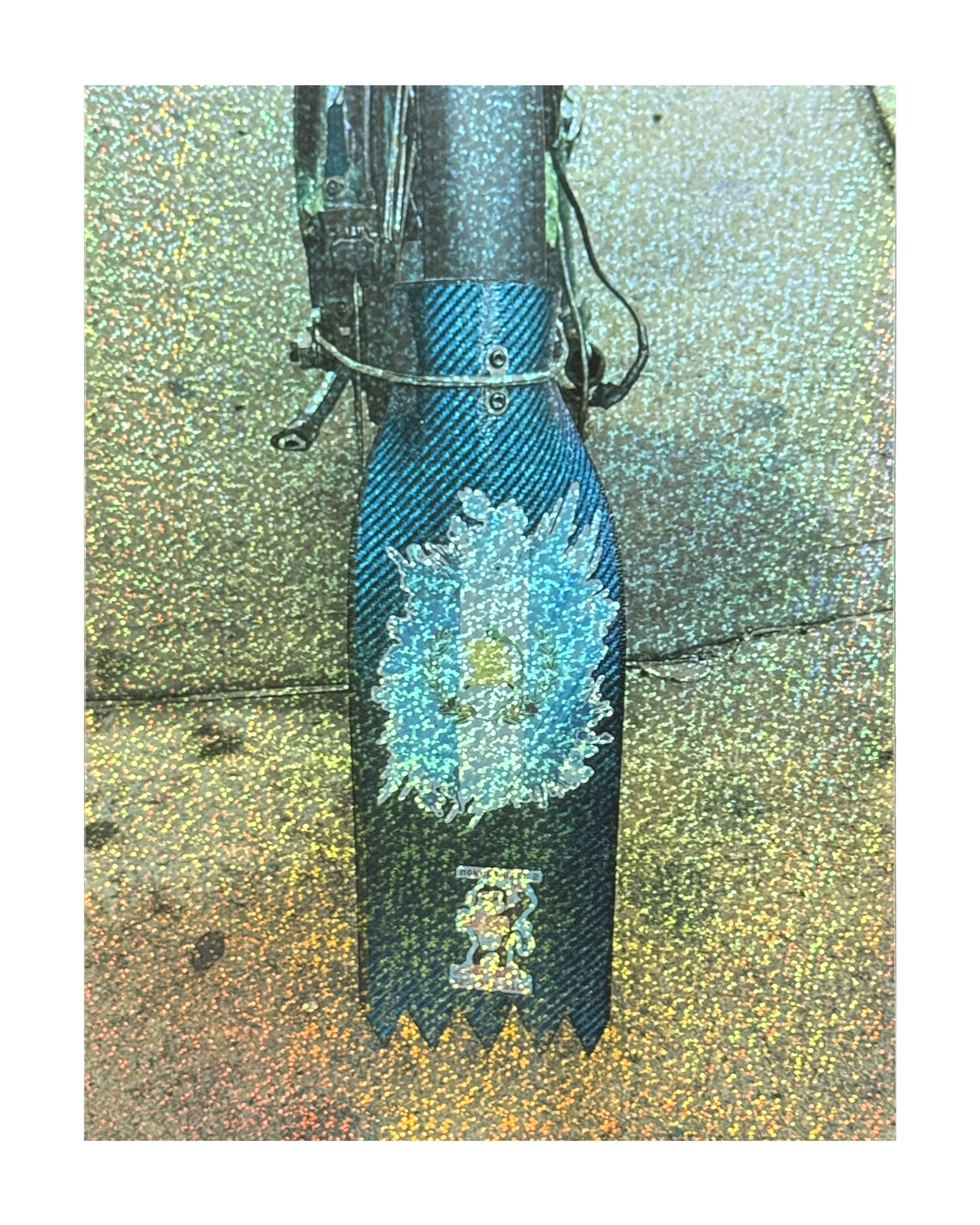
Photo courtesy of Luis Corzo.
That cultural cohesion, along with the very material that makes it possible, gives the series its title. Corzo writes: “El título refiere a la propiedad física del adhesivo, la fuerza que mantiene una calcomanía pegada a una superficie, pero también describe dos fenómenos paralelos: la manera en que los símbolos culturales se adhieren a la identidad de quienes migran, viajando con ellos aunque el contexto cambie radicalmente, y la cohesión de una comunidad que se reconoce a sí misma a través de imágenes compartidas en las calles de Nueva York.”⁴
The holographic material on which Corzo prints his photographs matches the stickers and decals the drivers affix to their bikes. As he explains: “Lo holográfico tiene la capacidad de transformar una superficie ordinaria en algo que capta la luz de manera distinta, que se mueve, que brilla, una cualidad que eleva el objeto y lo hace difícil de ignorar. Imprimir estas imágenes en ese formato es una decisión deliberada: una manera de darle a estos objetos, y a sus dueños, la visibilidad que merecen.”⁵ The medium becomes part of the argument. A photograph that shimmers as the viewer shifts position behaves like the vehicles it depicts: it will not hold still, and it will not be overlooked.
This is where the artist and the drivers meet–– exchanging artistic practices and methodologies. Corzo does not simply photograph an existing aesthetic from a distance. He adopts its materials, extending the drivers’ own strategy of visibility into the gallery. The result is a conversation between two kinds of authorship, one on the street and one on the wall, each insisting that these objects turned canvases, and the people who ride them, deserve recognition.
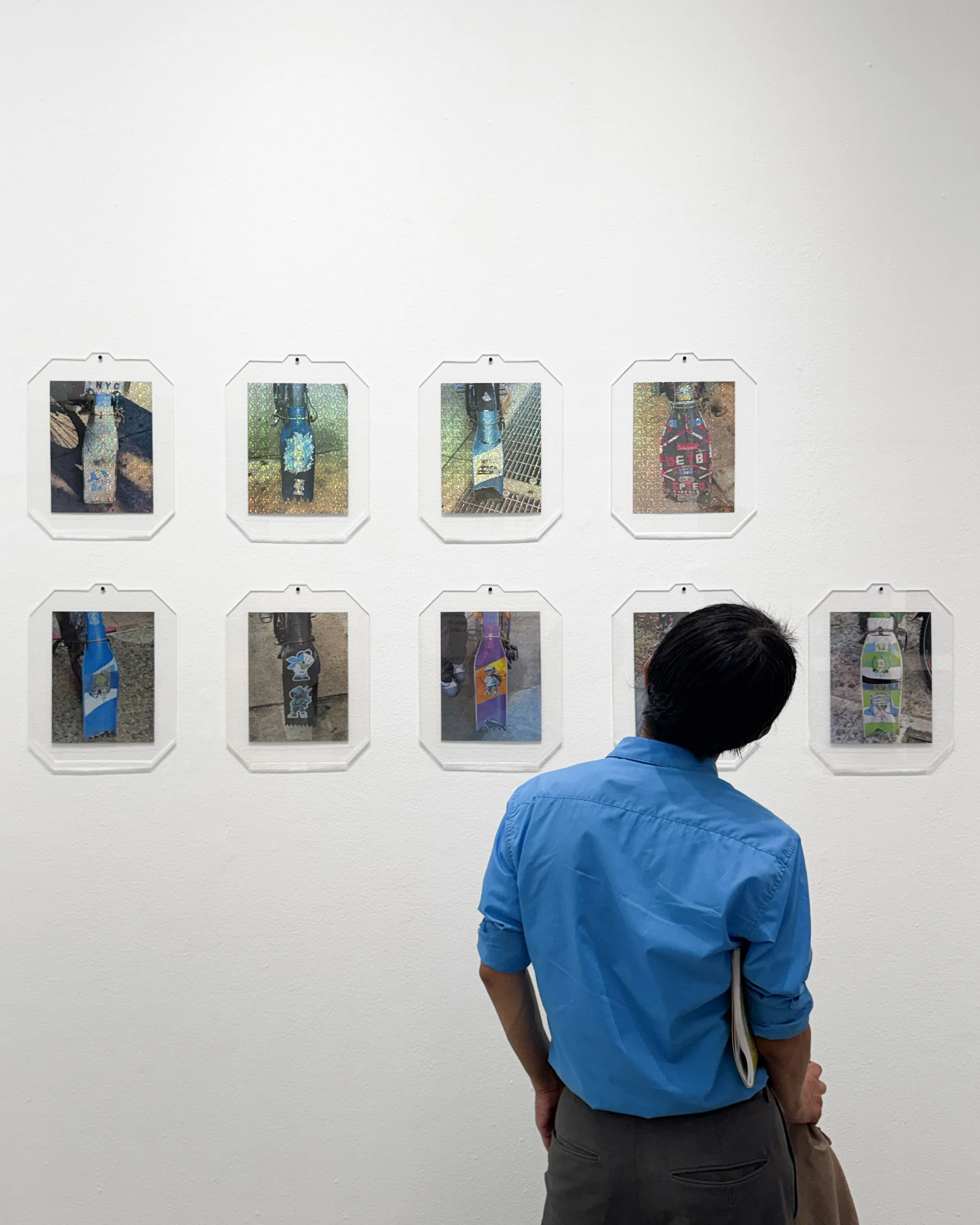
Photo courtesy of Luis Corzo.

Photo courtesy of Luis Corzo.
Cohesión, 2026 arrives at a charged moment. Since January 2026, Immigrations and Customs Enforcement has escalated operations in New York City under the banner of Operation Salvo, deepening surveillance and fear in immigrant communities and sparking protests and standoffs with city officials over sanctuary policies. Delivery workers, overwhelmingly racialized immigrants and often undocumented, sit squarely inside this tension. They now have city-mandated minimum pay protections regardless of immigration status, yet they remain among the most exposed and publicly visible immigrant workers in the city. Their work happens entirely in the open, on the street, and in the line of sight of anyone who cares to look and see.
Corzo’s photographs land just as the question of who gets to move freely through New York City––and who gets watched while doing so––unfolds in real time. That friction makes the drivers’ self-assertion more than a cultural curiosity or a practice of ornamentation. It is a direct political response to imperceptibility and desubjectification, a visual disobedience against the surveillance state closing in around them. To be watched is not the same as to be seen and to be known. The drivers understand this difference, and they continue to respond accordingly.
¹ ”Deliveristas” is a term that emerged among Spanish-speaking immigrant delivery workers in New York to describe themselves. Organizations such as Los Deliveristas Unidos (LDU), which organizes and advocates for the city’s roughly 65,000 app-based delivery workers, also uses the term.
² I write “[motor]cycle” with brackets to hold two ideas at once. Some of the vehicles in Cohesión, 2026 are motorcycles, while many are bicycles. Therefore, the brackets let one word cover both, with “motor” appearing and preceding depending on the bike. The brackets also play on the fact that even the bicycles are, in a sense, motorized: powered by the labor of the delivery workers who ride them, rather than moving on their own. The term also nods to the idea of recycling, as these vehicles are cycled and re-cycled through ornamentation, reuse, and migration.
³ Translated into English, Corzo says the series documents the decorations on Guatemalan deliverista bikes in New York, where an accumulation of cultural, religious, and national symbols directly recalls the public buses of Guatemala and their maximalist aesthetic of collective identity.
⁴ Cozo explains that the title names both the physical force that keeps a sticker fastened to a surface and two parallel phenomena: the way cultural symbols adhere to the identity of those who migrate, traveling with them even as context changes radically and the cohesion of a community that recognizes itself through images shared on New York’s streets.
⁵ Corzo says the holographic material transforms an ordinary surface into something that catches light differently, that moves and shines, and printing the images this way is a deliberate decision to give these objects, and their owners, the visibility they deserve.