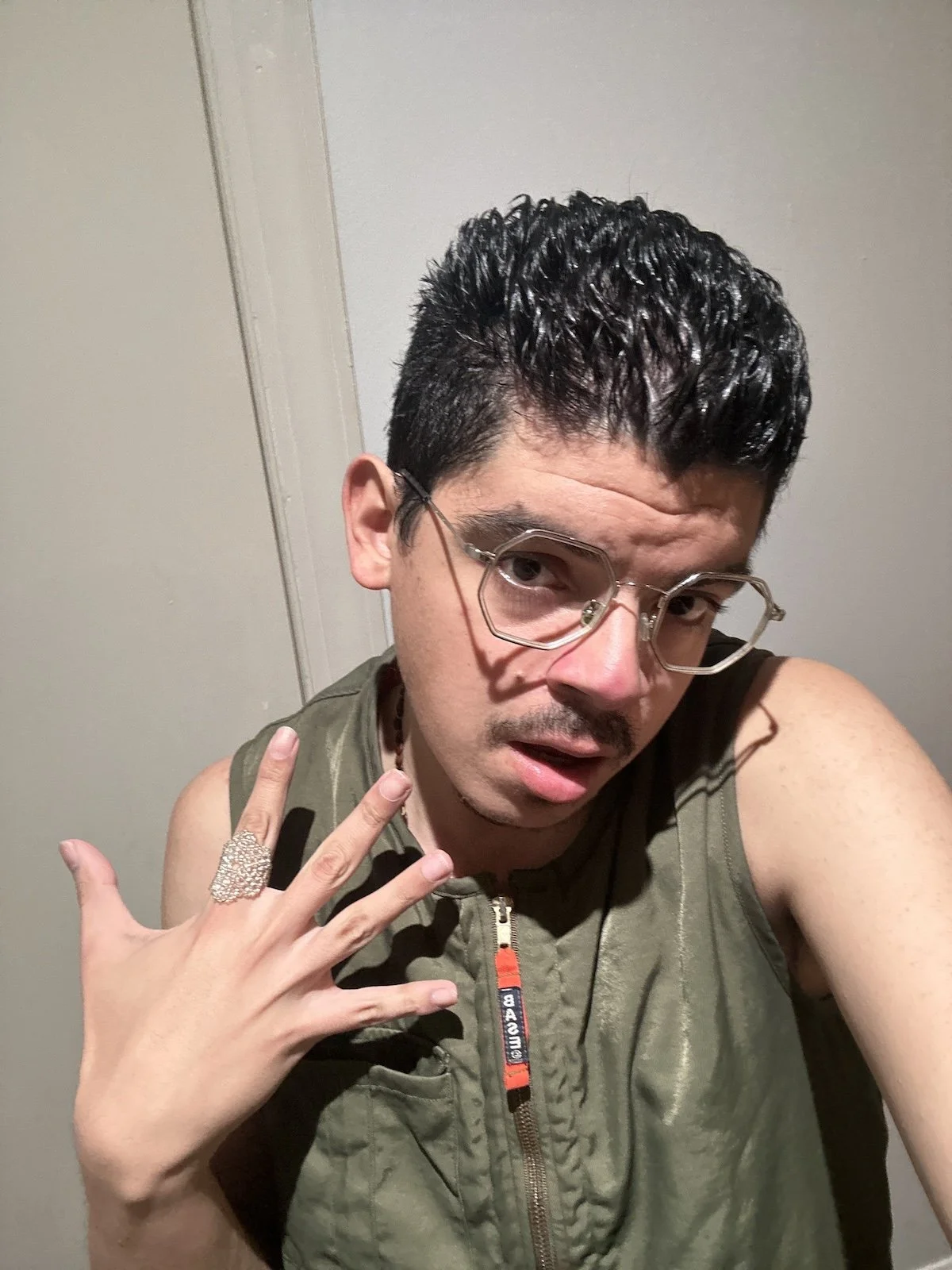
Putting it Together: A Conversation with Gían Pérez
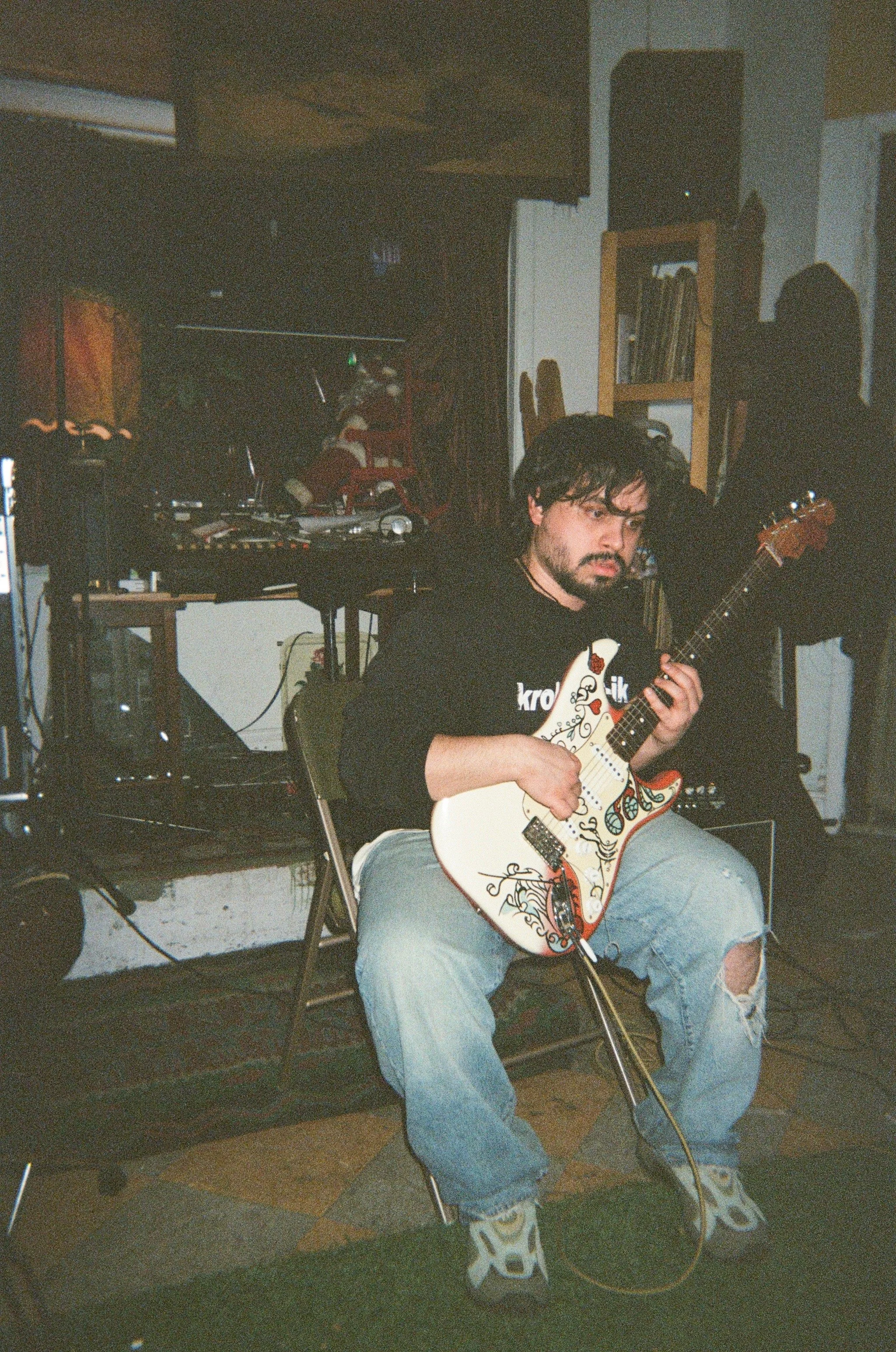
Gían Pérez. Photo by Pedro Hernandez.
Poet and educator Donika Kelly once said, “Does it matter what we call it? Or does it matter that we do it?” Kelly’s remark was in response to her not explicitly labeling herself a poet until the release of her first poetry book. This refusal to create tension when it comes to naming the type of genre, container, and style of one’s work rings true, too, with Puerto Rican actor and musician Gían Pérez.
Pérez’s work is expansive. He’s an actor who was in The Public Theater’s production of the Shakespeare play The Comedy of Errors. His live music can be fully improvisational and experimental, as with his performance on electric guitar at I-Beam in Brooklyn, alongside Mobéy Lola Irizarry of Las Mariquitas and musician Manuel Joe Perez III.
What harmonizes and titillates about Pérez’s work as an artist is simultaneously a tapped-in surrender for play and a knack for collaboration. On the heels of appearing in César Alvarez’s musical The Potluck, which the historic Latine theatre INTAR and Soho Rep coproduced, he released an EP titled William Shakespeare. A band member of both Office Hours and Los Primos, Pérez previews his new efforts as curator of live performance programming at Brothers Wash & Dry, a DIY performance venue in Queens that is not an operational laundromat. In our conversation, we whirl through his music and theatre encounters from Guaynabo, Puerto Rico, to Gowanus.
Gían, thanks for the time and your energy. I want to get started by having you share about who you are and the type of work that you do, and what types of fields you make things in.
I'm an artist. I work professionally, mostly in the theater and unprofessionally in other fields. But I do kind of everything and anything that is interesting and compelling. I play a lot of music. I've been playing music ever since I was a little kid. The guitar is my primary instrument. I like to deal with material, whatever that may be.I guess I'm a materialist. That's the best way I've been able to describe why I like to work in many fields.
You’ve said that your practice “denatures the electric guitar beyond its described historical identity as a means of envisioning a language that was never conquered and had instead been left to govern itself.” Is that what you're talking about with this engagement with material?
That little chunk of language specifically is about Puerto Rico. I'm from Puerto Rico. I think I've been playing guitar ever since I was fucking 5 years old. I don't even have a memory of my life before the guitar. And I grew up playing Guns N' Roses and Journey, all very American, white boots music. And for a while in my life, those were the metrics of good guitar playing.
I was born and raised in Puerto Rico, and I moved to Orlando, Florida, for my last three years of high school. That was honestly kind of like North San Juan in many ways. There were so many Puerto Ricans there, and then I moved to Michigan for college, and I kind of became allergic to the guitar.
If the guitar is just steel and magnets, how many different ways can those materials behave? And what sounds do they produce? And in direct and indirect ways, it became a decolonial practice of the guitar, which was so Anglo, whatever the fuck, tied up into it. I'm trying to sound like a percussion ensemble. I want to sound like pleneros or bomba music but done only on the electric guitar solo without anything else.
It sounds like you're saying that by engaging with those genres you enhance the material by blurring that line of whether or not it's sound coming from multiple musicians or just one. So it's amplifying the sound on the guitar.
You’re also bringing some type of group or choral energy to one instrument and allowing sound to mutate.
Yeah, a word that's used in music pedagogy is extended technique. When you're using an instrument with a technique that is considered extracurricular or you're doing something that's not how the instrument is meant to be played, that would be an extended technique. And I like the word extended because it implies a process that is not one of addition. It's like extracting something out of it, like something that's already in there.
How do your instincts as a musician influence how you approach acting? Are there similarities? Are there complete opposites in terms of your approach to start to work on a character versus creating your own music?
I've always felt like they were the same part of the brain. l'm kind of doing the same artistic processes with either material. I play primarily improvised music.
And I feel like to be present in an improvised music context is really kind of, being present in a scene in many ways.
You're listening and really active, deep listening, super intentional and making decisions all the time. That's kind of what's happening in what I would call good scene work. Everybody's kind of there with each other, and present, and discovering shit, and making offerings, and reacting to them, and being really available and liquid. That's kind of my favorite way to act. It's kind of like doing the same thing as I'm doing anytime because even in the compositions, you're dealing with the evening.
That sense of play or whatever you want to call it, presence, is the core of my practice. That's why I love rehearsal way more than performance. I kind of get bored once the show opens. I was really fortunate to do Romeo and Juliet with a company of actors who liked to keep it alive. Every night we did it, we were kind of approaching it again. That's not always the case, and sometimes, you just have to do the show every night, and that's kind of dreadful to me. I hate that shit so much, but the rehearsal process where you're like discovering and changing and figuring it out, I love it when something isn't done yet.
To switch gears a bit, you have an album called William Shakespeare. You have a song called “Wall-E,” but then you also have a cover of The Cure, so how do those subjects filter into what William Shakespeare already was or is? How is a pop culture reference like Wall-E and a cover The Cure’s “In Between Days” funnelled into a figure like William Shakespeare?
Honestly, I'm flattered that you assume artistic intent behind all these gestures, because I'm just kind of following my instinct and trusting that there's some kind of meaning behind it. That is yet unknown to me, like the great mystery of life.
The thing that was compelling about calling it William Shakespeare is that Shakespeare is this name that has a reverence to it. People really are like, “Ooh, Shakespeare.” And so there's an act of demystification by just making it the name of the project, and it's not even ascribing the name to a person. It's a collection of songs, and what does it mean to idolize this name?
That's kind of what's evocative of it to me, like to use the name like that. I think in subconscious ways I believe in that very much. That whatever meaning you extracted from it is just as valuable and real. As if I, the writer, had been like, “Well, it will be called ‘Wall-E’ because Wall-E is a post-apocalyptic climate crisis movie.” I don't actually care about that, but if it means that to somebody, then I don't think it means that I didn't do that.
I think that I just had to get out of the way.
To be gossipy and speculative, are you gonna put on a production of Macbeth in a laundromat? I think I saw a post or something about that online.
Oh my god, I'm so happy you asked about this, because I was like, “Is this a legit enough project to bring up?” But it totally is. Me and my friend Chad are directing this—I don't even know what to call it—of Macbeth. I'm an organizer at this venue out in Maspeth, New York, called Brothers Wash and Dry, which is really like an art space.
It's not a functioning laundromat anymore. Now, it's just a community art space, but it is small, and it's an unconventional theater space. However, we kind of only program experimental music. We program music. So I was like, “Let me try and curate a little theatre season. What would theatre even look like to do here in the laundromat?” I concocted this idea and Chad and I put it together. But it will only be with three performers.
Obviously, it's the three witches. We're trying to make it so that the event is really them reading Macbeth as an anti-war incantation. They're trying to purge this human blood thirst.
It really might not work. It's a huge experiment in many ways to get back to congregation as the centerpiece of the theatrical experience.
And the original story is so sensory and has a witches’ brew.
The king would have been really afraid of witches. The king at the time was superstitious. Shakespeare was punk. He was trying to make the government uncomfortable.