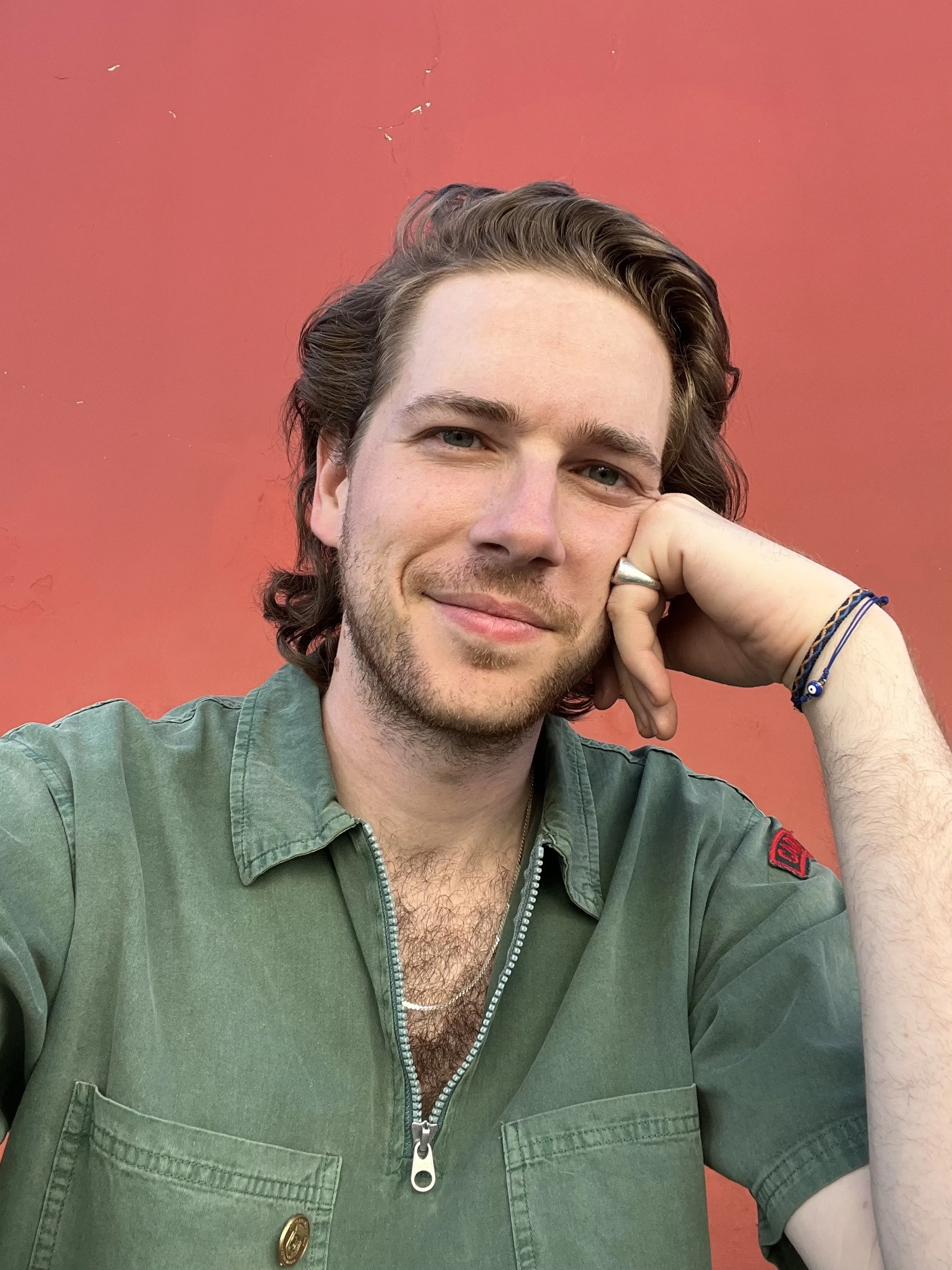
In Henry Bermúdez's paintings, a jungle from the shores of Lake Maracaibo grows through the wrought iron of a cathedral gate, tangles with the feathers of Quetzalcóatl, and opens onto the frescoed ceilings of Rome and the marbles of the British Museum.
At 75, the Venezuelan painter has lived and worked in Caracas, Miami, Philadelphia, Mexico City, New York, Rome, and London—each city leaving behind a mythology he folds into the next canvas, the same instinct that shapes his reimagined Miss America, one of the anchoring works in the Woodmere Museum's Arc of Promise exhibition. The show takes its title from the illustrator Jerry Pinkney's phrase for looking back at America's most painful history while still holding, in the tradition of Dr. Martin Luther King Jr, to the belief that a better future lies ahead—and Bermúdez's piece, which buries a hidden history of erasure inside a familiar American image, was built for exactly that kind of double vision.
Bermúdez’s teaching career runs alongside all of it, from his very first job out of art school on the shores of that same lake through the classes he still leads today in Philadelphia. We spoke with him about where that layering began, what it cost him to build and then lose an entire career in Venezuela, and how a season spent washing dishes in Philadelphia became, in his words, the moment he started over.
Teaching has always been part of your life as an artist. What does that side of your practice actually look like these days?
Right now, I teach at a very small high school here in Philadelphia, built to help low-income adults earn their diploma—almost all of my students there are African American, with a small percentage of Latino students. It's a chance for me, as an artist, to keep learning from a completely different practice.
I also teach basic painting on my own, mostly to retired adults who've never picked up a brush before. They walk in scared, full of limitations. So the first class is never about technique—it's a conversation. I ask, “What is art? Why does a human being make it? What's the real difference between someone who makes art and someone who doesn't? What does it actually take to make art? It’s not about becoming an artist. That's a different question entirely.
Being an artist is a profession. Making art is a human quality. Everyone can make art; dedicating yourself to it professionally, becoming an artist, is another problem. So I tell them: “This room is the one place where you're allowed to be crazy—the crazier, the better—and, at the same time, the one place where it's impossible to make a mistake, because there's no such thing as a mistake here.
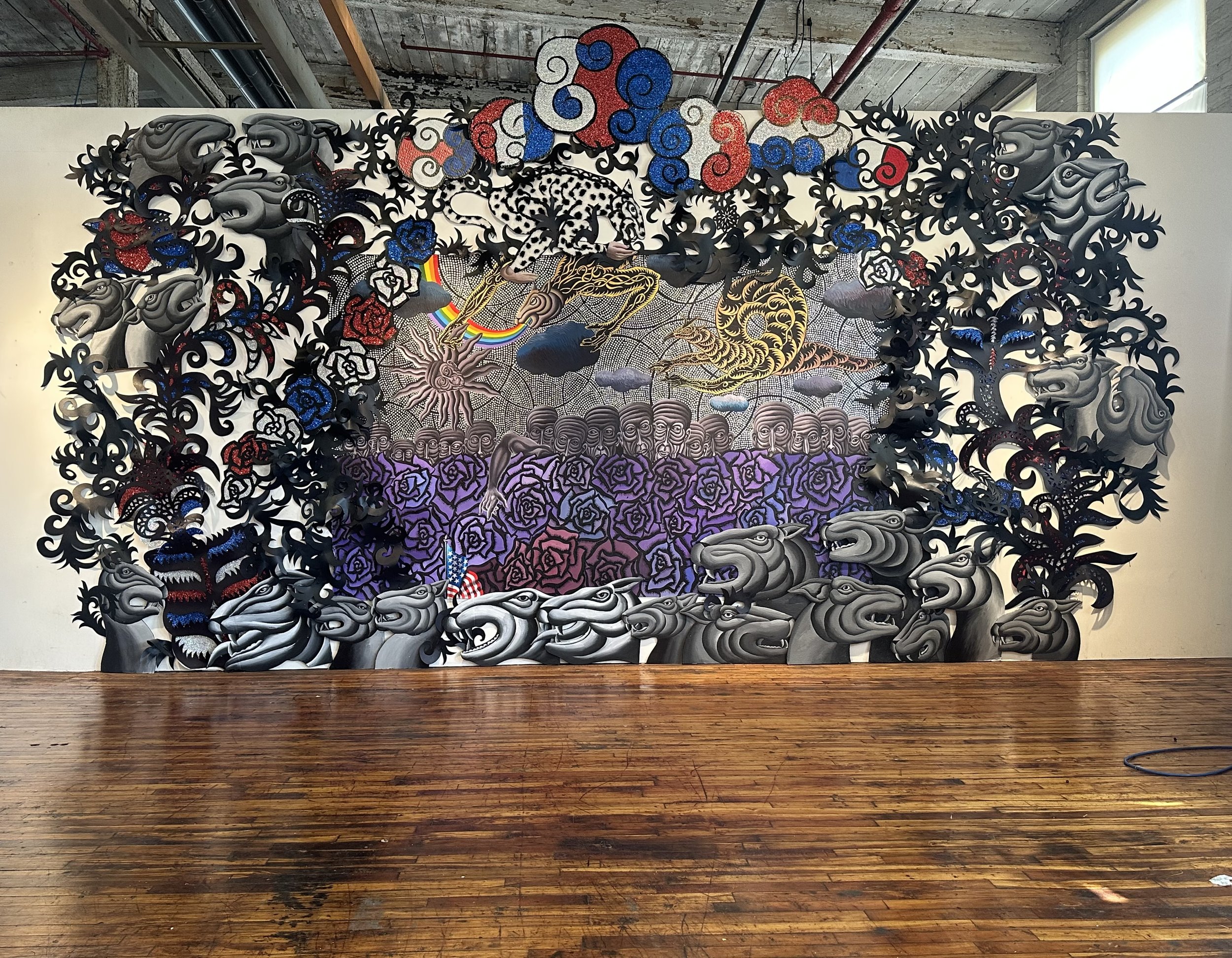
Henry Bermúdez, 250 years celebration (2026), mixed medium, approximately 20’ x 12.’
The way you describe accepting that there are no mistakes, that it's all play—I think that carries over a lot into your own work. This piece, for instance, you can see so many different ideas being worked out on one plane, but clearly in different materials, from different angles.
You mentioned that the Miss America figure here is different from the model in an earlier project. What was behind that shift?
After I finished that whole project with that model, I kept working on the figure based on my own imagination—it became something more creative, where I could modify reality. Miss America, as a concept, is, for me, very connected to Miss Venezuela—we've had seven Miss Universes, so it's a familiar myth. But I took the idea of Miss America and gave it a political charge. When people say "Miss America," they picture white skin. In this piece, she's surrounded by the myths of an African culture that we also carry in Venezuela—except here, it's the African culture embedded inside American culture, and that culture has been completely erased. These are myths and legends that are still there, just underneath the ground.
You're creating that link with Black people today who maybe aren’t familiar with these myths. You're bringing to light the evidence of this country's act of erasure. Where does that instinct to load a familiar image with a hidden history actually begin for you?
It begins in Bobures, a tiny town on the shore of Lake Maracaibo, one street long, jungle pressing in from the other side. I took my first teaching post there right out of art school at 19. Bobures was founded during the colonial period on sugarcane land worked by enslaved people who built their own religion out of Catholicism—a syncretism that's still alive there. There's a Black saint, San Benito, celebrated with a drumbeat called the ajé and dances called chimbangles—a whole structure, with a captain, with vassals. I came from a very Catholic family; my brother is a bishop, so that imagery found fertile ground in me. I became a devoted follower of the San Benito rituals. The rest of Venezuela never had a large enslaved population the way that region did, so this was my first real contact with a kind of art I'd never seen or heard before. I went there to teach and ended up learning everything. Bobures is where my real beginning is.
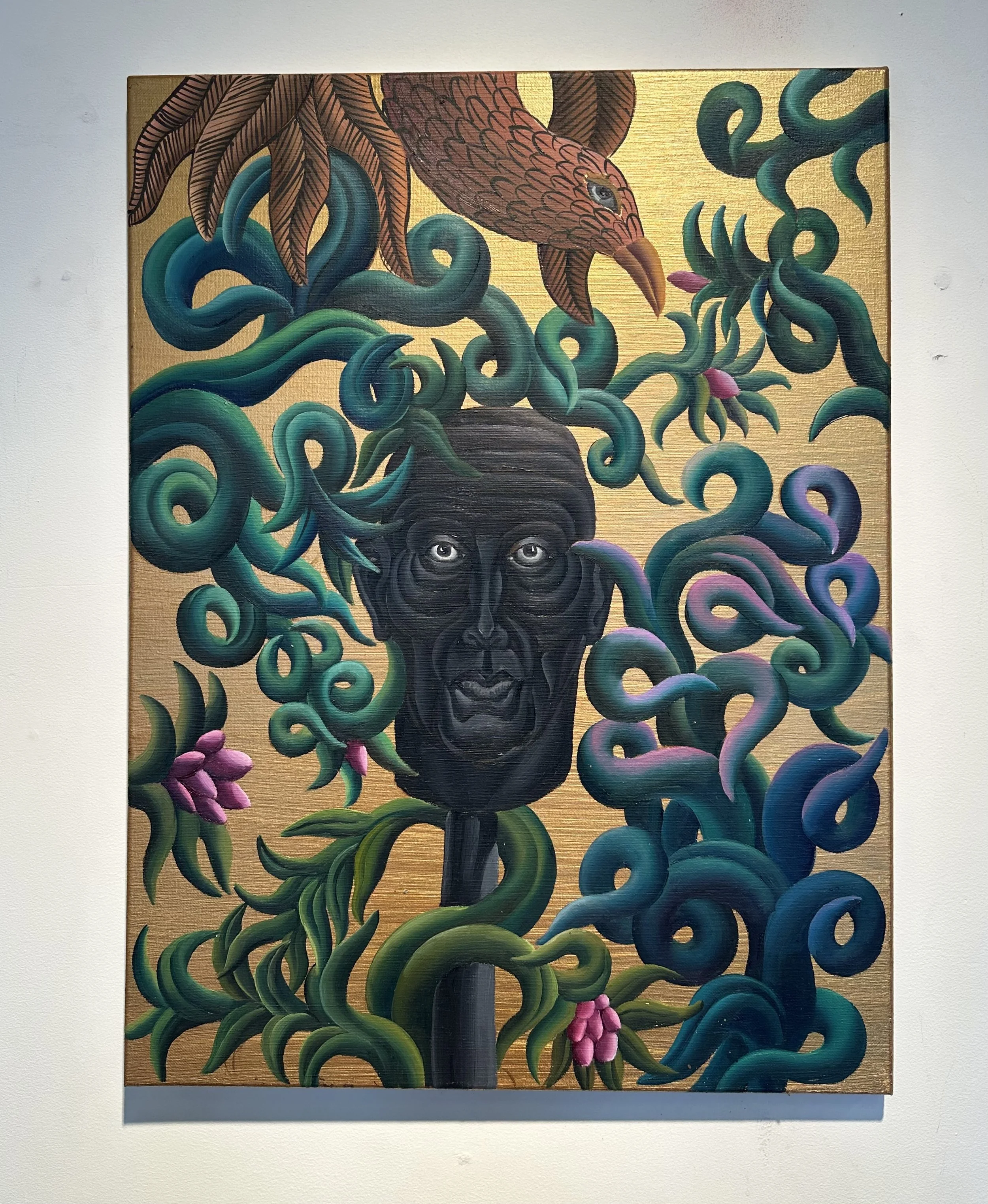
Henry Bermúdez, Mask (2026), acrylic and oil on canvas, 24” by 18.”
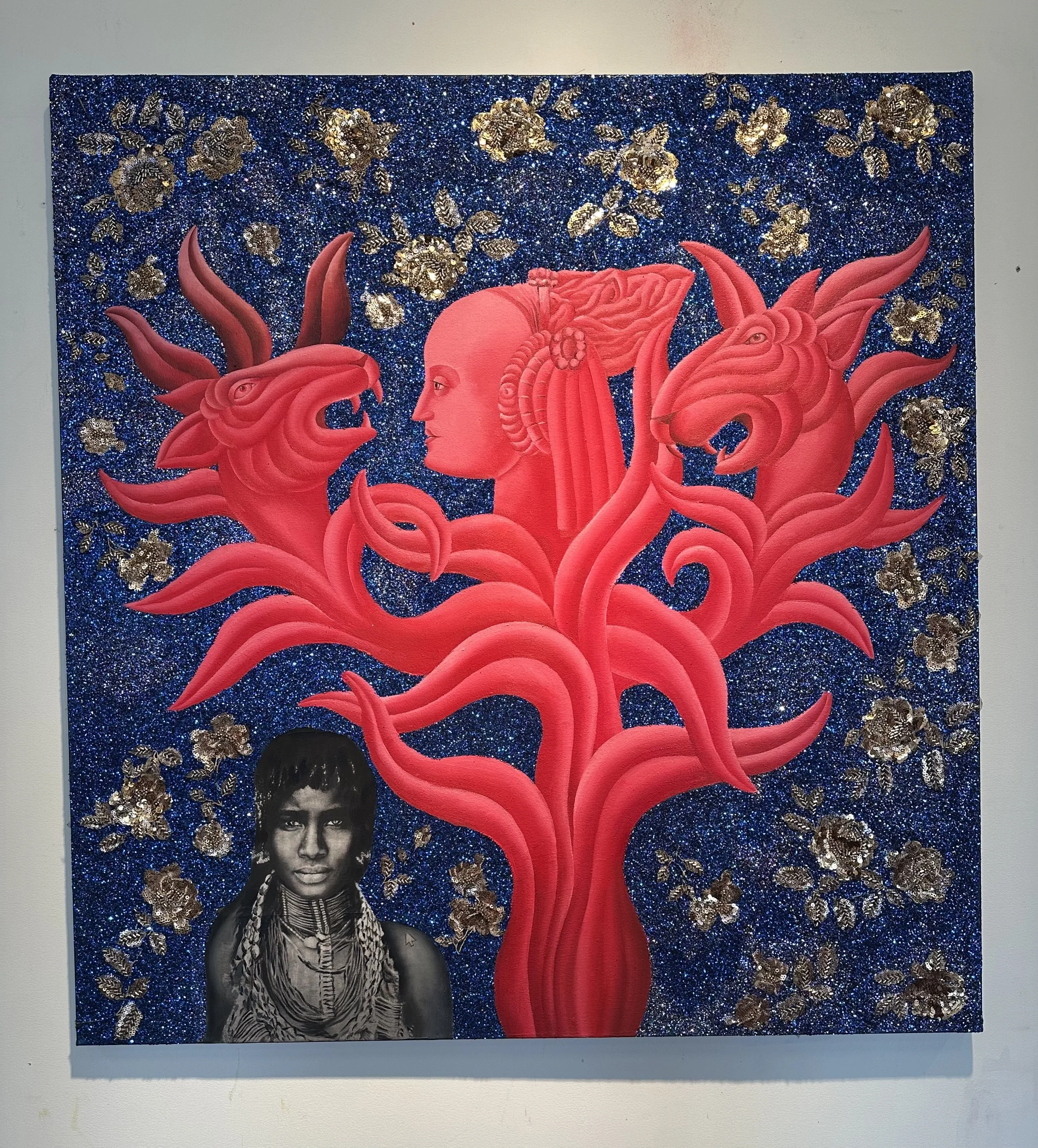
Henry Bermúdez, Red tree (2026), oil and glitter on canvas, 40” x 38.”
And your work today carries all of it: the specificity of Bobures, Venezuela at large, your travels to Mexico, New York, Rome, and London. How does that layering actually happen on the canvas?
After Bobures, I went to Mexico, and what pulled me in was Aztec mythology, Quetzalcóatl especially, the feathered serpent, because he's a fusion of bird and snake. And both had already been living in my work since Bobures: Birds because I painted trees. Snakes because if there's a jungle, there are snakes.
Then, New York. I was living near Central Park, and I started thinking of it as a jungle walled inside a jungle of concrete. I built a whole series around it, and at one point, I used the exact ironwork pattern from the gate of the Maracaibo Cathedral to design a fence around the park, directly integrating my own culture into that Manhattan landscape.
Later, in Rome, all of that—Bobures, Mexico, and New York—collided with Judeo-Christian mythology: the tree, the apple, the apostles, painted with such magnificence that I started folding it all together. And then London, the British Museum, the Greek marbles, added one more layer. None of it replaces what came before. It just keeps stacking.
You've said that isolation in Bobures is part of what gave you your own style, the one people in Caracas came to call "los paisajes bermudescos." How did that happen?
There's a story a professor told me that stayed with me: He said that one day someone would walk by carrying a painting under their arm, and from a block away, you'd say, “There goes a Henry Bermúdez.” That's what it means to have an identity in art.
In Bobures, I had no contact with what was happening in Caracas or Maracaibo, and that isolation let me shape something very personal, a style people eventually started calling "los paisajes bermudescos." But it came at a cost. The Venezuelan art market was small, and collectors didn't buy because they loved a piece; they bought because they believed it would appreciate, because that artist’s value would appreciate. So you were trapped into repeating yourself. If you showed something different in your studio, the collector would say, "No, I don't want that; I want a Henry Bermúdez." Ultimately, that market collapsed when Chávez came to power.
What happened to you after that political shift in Venezuela?
The economy started to fall apart, and the art market disappeared with it. I went from a very good life––an apartment in one of the best areas of Caracas, even representing the country at the Venice Biennale––to, five years later, not being able to pay my condo fees. It wasn't enough to simply not oppose Chávez; you had to be a declared Chavista, working for the revolution. I was never attacked, but I was erased. Art became a product for promoting a specific idea of the country, and my work didn't fit anywhere in that.
I went to Miami for an exhibition, banking on all the Caracas collectors who'd relocated there. But everyone I'd known back home had the same story: "I have two of your pieces. I have three. I'm just waiting for Chávez to leave so I can go back." The show was an economic failure, and I had to decide: go back to Venezuela or stay in Florida. Thankfully, an art critic named Milagros Bello, who had written her thesis on my work, told me to reconsider. She helped me get a visa extension, put me in the first Latin American Art Fair in Miami, and found me a gallerist. That bought me time, but Miami itself was hard. It's a demanding city, and I didn't have the resources to keep up with that world.
From Miami, you moved to Philadelphia, and by your own account, hit bottom before things turned around.
A friend from Caracas, the artist Frank Heider, was living in Philadelphia and got me an interview with Mural Arts, which offered me a three-year contract to paint murals. But nobody knew me there, I didn't speak English, and the mural project wouldn't start for another six or eight months. So I was washing dishes at two restaurants, living in a tiny room, waiting. The Henry Bermúdez I had been, I no longer was. But that stripped away the idea of the successful artist who'd come from Venezuela. I started from zero. And that's what let me redefine myself, as a person and as an artist, at the same time. I started using new materials, understanding contemporary art differently. Now, I'd say I'm a Philadelphia artist in the best sense of the word, fully part of the community.
And as part of your experience in Philadelphia, you've had various opportunities working with the Woodmere Museum. For their current exhibition, Arc of Promise — what did it mean to you to be invited, to have Miss America included within the curatorial framework of the show, thinking about Venezuelan cosmology in conversation with histories of slavery, colonization, and, at the same time, a celebration of 250 years of the United States?
You don't really know the history of the United States until you get here and actually start studying it. There are people who are scholars, who are academics, who do know the history. But someone like me only knew the myths this country sells about itself, the version you see from outside. Then, you get here and start discovering that things aren't the way they told you they are—that there's another reality. I have another piece at Woodmere about migration, and in both, I'm pushing against something that worries me: art has become very decorative. It doesn't critique, it doesn't analyze, it doesn't offer an opinion about anything—and that can happen in Latin American art.
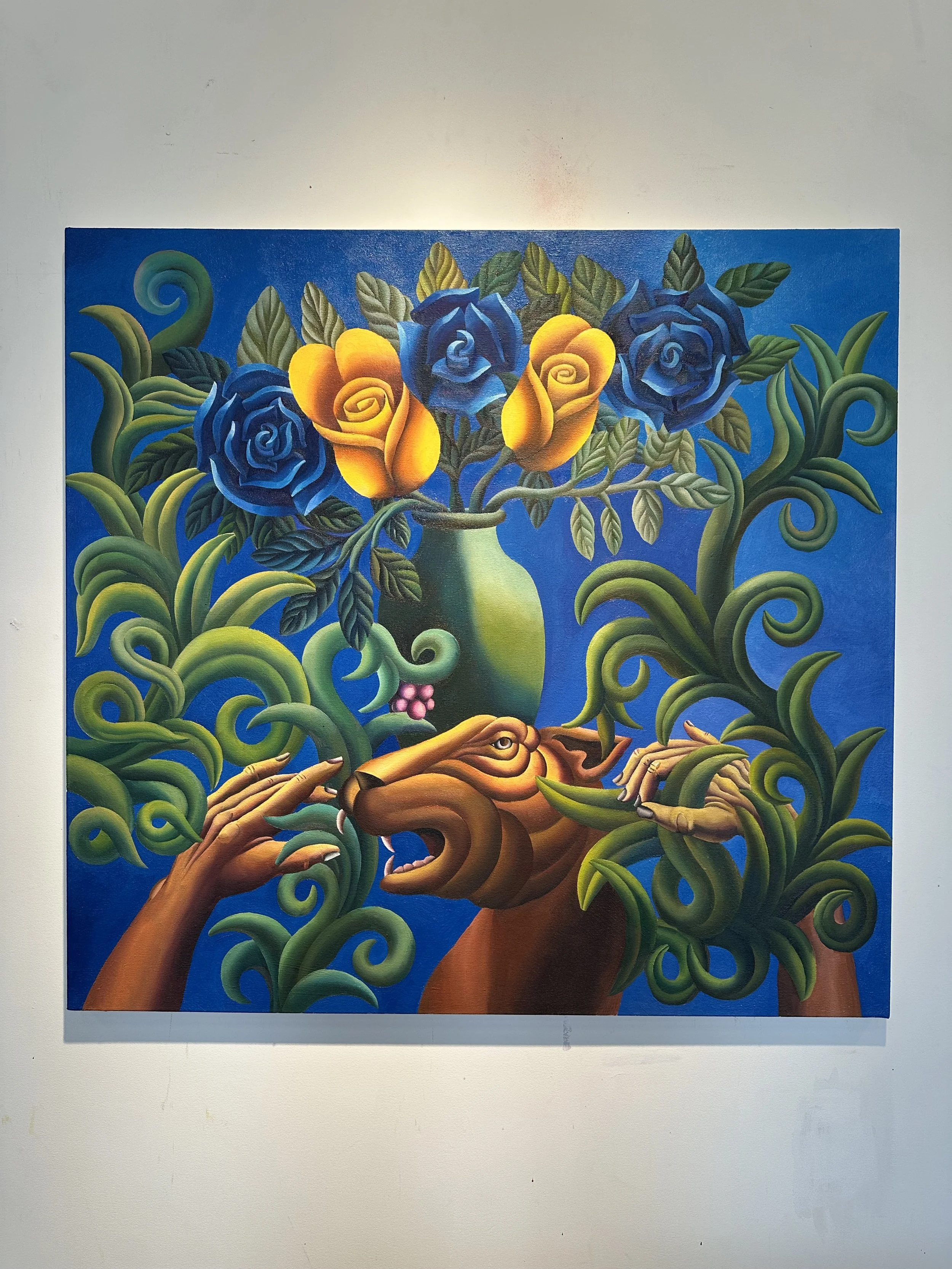
Henry Bermúdez, Five roses bouquet (2026), oil on canvas, 38” X 40.”
As we walked through the show, William Valerio, director of the Woodmere Art Museum, mentioned that if people take away one thing from Arc of Promise, it's the idea behind a Tom Judd painting in the show—Mount Rushmore, still mid-carving. America, he said, is a project that's never finished. Does that land for you, given everything you've just described?
It does. Look at where I started—from the moment I left art school and went to live in Bobures, to arriving here 22 years ago, to the studio I just moved into. None of it was finished at any point along the way; it was always the next place, the next material, the next thing I had to learn from zero. That's the whole story, really. America is a project. And it's definitely not done.