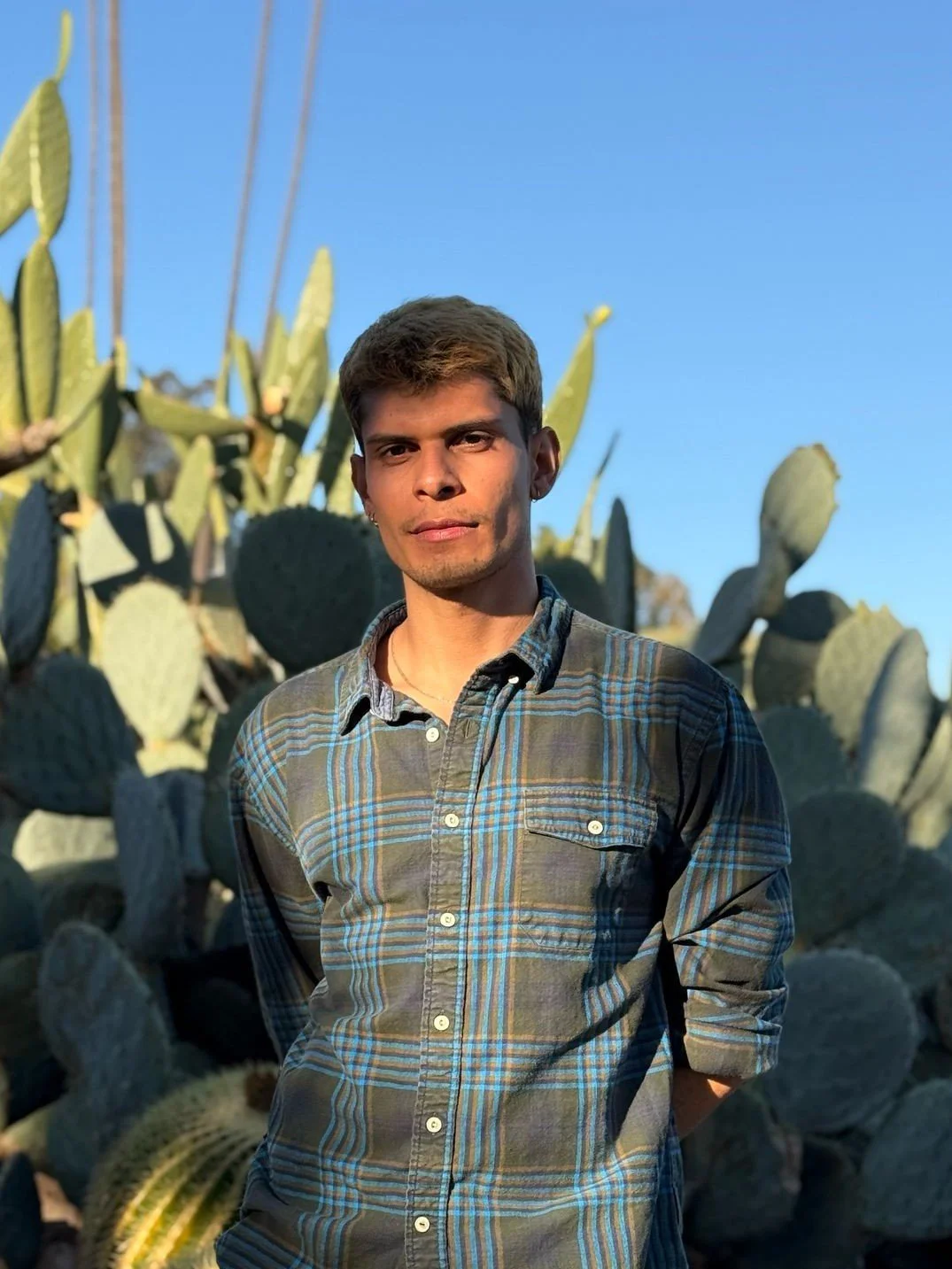
Kaleb Duarte, Embassy of the Refugee, 2026. Detail of the scaffolding structure wrapped in golden thermal blankets. Photo by Nicholas Lea Bruno. Image courtesy of the Kaleb Duarte and Monument Lab.
Within Western societies, monuments have historically acted as expressions of nation-states’ power over the public space. They commemorate significant individuals, groups, events, and ideals to the nation’s narrative and, in doing so, contribute to the dissemination of a shared memory and national identity among its citizens. In this context, disputes around public art and the memories they enact often reveal struggles over the contours of citizenship and who counts as members of a civic community of rights.
In his most recent public installation, Kaleb Duarte grappled with the challenge of publicly commemorating those who are excluded from that community: undocumented migrants and refugees. Titled Embassy of the Refugee, the piece contends with the exclusionary framework of national monumentality while inviting individuals to recognize one another as part of a shared world mediated through relations of labor.
Created as part of San Francisco’s Shaping Legacy Project, which critically assesses the city’s memorial landscape, the work was a large-scale scaffolding structure that wrapped around the Pioneer Monument in San Francisco’s Civic Center between June and September 2026. At the center of the structure, a translucent tent floated above the ground, covering, without fully concealing, most of the monument’s pedestal. Beyond the installation itself, the project included a series of activations, with public performances and interventions by diasporic artists such as Regina José Galindo, Mia Eve Rollow, Marilyn Boror-Bor, and Guillermo Gómez-Peña. There were also workshops with local artists and migrant communities, like the contribution of Latinx workers who, over the course of two months, swathed the scaffolding structure in golden thermal blankets—the same kind immigrants receive in humanitarian shelters and detention centers.

Kaleb Duarte, Embassy of the Refugee, San Francisco Civic Center, 2026. Photo by Nicholas Lea Bruno. Image courtesy of the Kaleb Duarte and Monument Lab.
This extended action resulted in a piece of public art that was simultaneously beautiful and politically haunting. It imagined transgressive forms of belonging and recognition among individuals bound together by histories of imperialism and neoliberal exploitation—individuals whose lands, resources, and labor have been historically expropriated for the benefit of a nation that now denies them entry into its community of citizens.
To better grasp how Embassy of the Refugee approached this situation, it’s important to consider its strategic placement around the Pioneer Monument in San Francisco’s Civic Center. Real estate investor James Lick gifted Pioneer Monument to the City of San in the late 1800s. The public art piece tells a story in which migration—specifically, the westward expansion of European settlers—plays a civilizational role. The figure of the pioneer as a patriotic hero lies at the heart of American national identity, set against the presence of Indigenous peoples, whose extermination became naturalized and unacknowledged in the name of progress.
Protests against the honoring of this violent history led to the removal of one of the Pioneer Monument’s sculptural ensembles in 2018. Titled The Early Days, this sculptural ensemble staged the subordination of an Indigenous man to a European priest and a white settler. Since then, the pedestal where the sculpture stood has remained empty.
It was from the top of that pedestal that on July 25, 2026, a series of public performances activated Embassy of the Refugee. Resulting from a short-term international art residency, Duarte organized with the support of Philadelphia-based nonprofit organization Monument Lab. Regina José Galindo, Marilyn Boror-Bor, and Guillermo Gómez-Peña performed pieces that reflected on Indigenous displacement across Central and North America, connecting it to the current persecution of migrants within the United States while challenging conventional frameworks of monument-making.
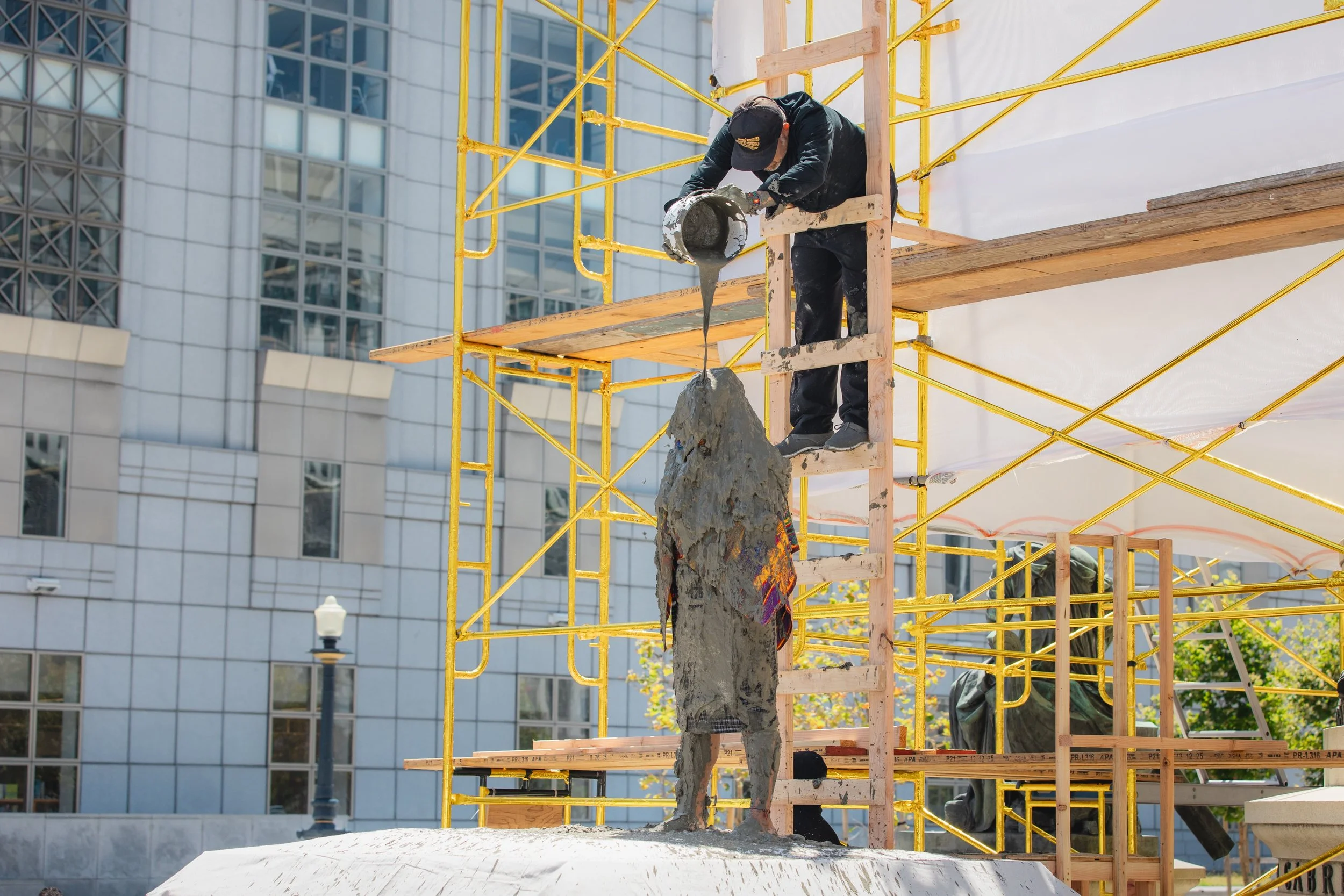
Performance by Marilyn Boror-Bor as part of the artist residency held at Embassy of the Refugee, July 25, 2026. Photo by Nicholas Lea Bruno. Image courtesy of the artist/Monument Lab.
Reclaiming the space The Early Days sculpture previously occupied, these actions undermined the pioneer’s monumental imaginary, replacing the image of civilizational migration with another, in which Indigeneity is central to the identity of migrants across the Americas and the extermination of Indigenous populations is inseparable from the longer history of U.S. border imperialism.
Mia Eve Rollow, also a participant in the residency, took a different approach, engaging, over the course of two months with the neighboring unhoused community and street workers. Her work reflects on and confronts the structures of power that regulate access and movement within public space.
Beyond welcoming these transgressive performative gestures, Embassy of the Refugee subverted the very language of conventional monumentality, providing a disruptive representation of migrant labor.
Evoking labor, as part of a narrative of economic prosperity and national development, is common in arguments that either justify or disqualify immigrants’ presence in a host country, consequently shaping how they are commemorated in public space.
The monumentalization of gold diggers in the Pioneer Monument is one instance, but there is no shortage of more contemporary examples in which labor serves as a symbol for commemorating migrants within the national framework, such as the Bracero Monument erected in Los Angeles in 2019 to celebrate Mexican workers who helped mitigate the United States’ labor shortage during and after World War II.
This symbolization contributes to the invisibilization of the material and often precarious conditions of that labor and its broader impact on the nation’s political, social, and economic life—scholars have extensively documented and studied the economic dependency of the Global North on migrants’ low-wage labor.¹
It is primarily against this commemorative invisibilization that Duarte’s public installation stood. Embassy of the Refugee rejected the paradigm of monumental permanence. The scaffolding structure was both a metaphor for transience and a space where impermanence was performed. There, a group of artist ambassadors—composed of members of migrant communities—worked for two months to wrap the entire structure in golden thermal blankets.
This collaboration, Duare emphasizes, happened organically and involved the covering of the scaffolding structure and many other actions, including workshops, conversations, and group performances, in which participants worked through the obstacles they faced in their migratory journeys and confronted the system of violence that constrained them.
This reflects Duarte’s long-standing commitment to working with local communities to tackle urgent issues that directly affect their lives, an approach captured in the idea of Arte Urgente. Duarte, Rollow, and other artists with whom they collaborated in Chiapas generated the idea as “a practice of immediate investigation, developed in response to the cultural, social, personal, and political [issues] that occur within its geographical context.”²
The aesthetic labor the artist ambassadors performed inscribes the poetic process of artmaking in the perceptual surface of the artwork; furthermore, it decentralizes the prerogative of artistic production as a path toward social transformation in a manner that resonates with German artist Joseph Beuys’ ideas on social sculpture.³ In doing so, it contributes to surfacing the invisible work that shapes public space and its monuments. Hence, rather than symbolizing labor, the artwork embodied it, inviting us to consider its conflictual dimension and its material impact on the conditions that regulate access to civic and public life.
Another important attribute of Duarte’s work lies in its poetic reappropriation of humanitarian symbols. The tent that floated at the center of the installation evokes the precarious forms of dwelling that populate refugee camps, while the thermal blankets were the same as those immigrants receive in situations of humanitarian rescue and detention.
Nevertheless, this evocation is not celebratory. On the contrary, it points to the continued failure of that language, and of those institutions, to address the various forms of violence migrant communities face. The symbols of precarity—the tent and the thermal blankets—were poetically and collectively reworked, reinvested with a material presence that confronts the depersonalization enacted by humanitarian language.
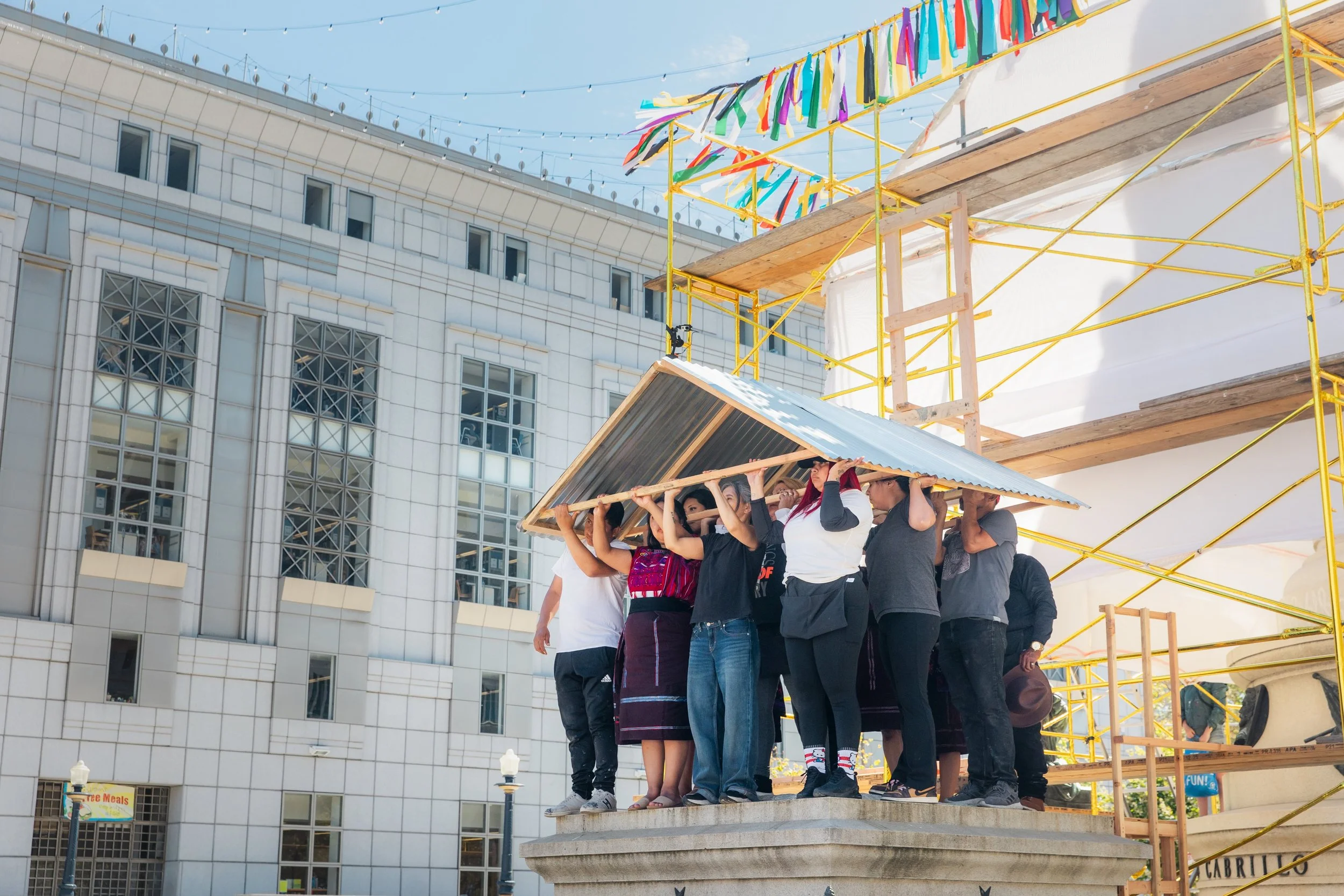
Performance by Regina José Galindo as part of the artist residency held at Embassy of the Refugee, July 25, 2026. Photo by Nicholas Lea Bruno. Image courtesy of Kaleb Duarte and Monument Lab.
If they evoke human rights, they do so in the form of what author and theorist Ariella Azoulay calls a “civic discourse,” that is, “as a form of discourse created by cocitizens in order to actively interfere in the way they share a world with others.”⁴ Within this framework, the experience of civic belonging—that of participating in the same community of rights—is less a direct consequence of any statutory principle of citizenship, granted by the state, than a form of recognition of the material conditions that bind people together, such as the relations of dependency and exploitation within particular sociohistorical contexts.
The scaffolding structure in Duarte’s work was a reminder that conflictual relations already sustain public spaces. Nevertheless, the scaffolding’s function was not merely metaphorical. Instead, it staged a space of gathering, inviting participatory engagement, and converting labor from a symbolic object of immigrants’ public commemoration into a framework through which the very experience of public space, and the civic community that emerges within it, are reconstructed.
Rather than a monument to migrant labor, Embassy of the Refugee was a monument of migrant labor. As such, it invited viewers to look into the material conditions that shape the present, and monuments, to imagine a different world, in which civic belonging is not regulated by the custody of the nation-state, but also, and perhaps more importantly, where the transformation of those conditions construct a more dignified life for all.
¹ Sassen, Saskia. The mobility of labor and capital: A study in international investment and labor flow. Cambridge University Press, 1988.
² Duarte’s statement in Schreiber, Rebecca M. "The Work of Arte Urgente: Performative Acts of Political and Artistic Imagination." Latin American and Latinx Visual Culture 4.3 (2022), p. 32.
³ Joseph Beuys, “I Am Searching for Field Character,” in Art Into Society, Society Into Art, ed. and trans. Caroline Tisdall (London: Institute of Contemporary Art, 1974).
⁴ Azoulay, Ariella. "What are human rights?" Comparative Studies of South Asia, Africa and the Middle East 35.1 (2015), p. 14.