
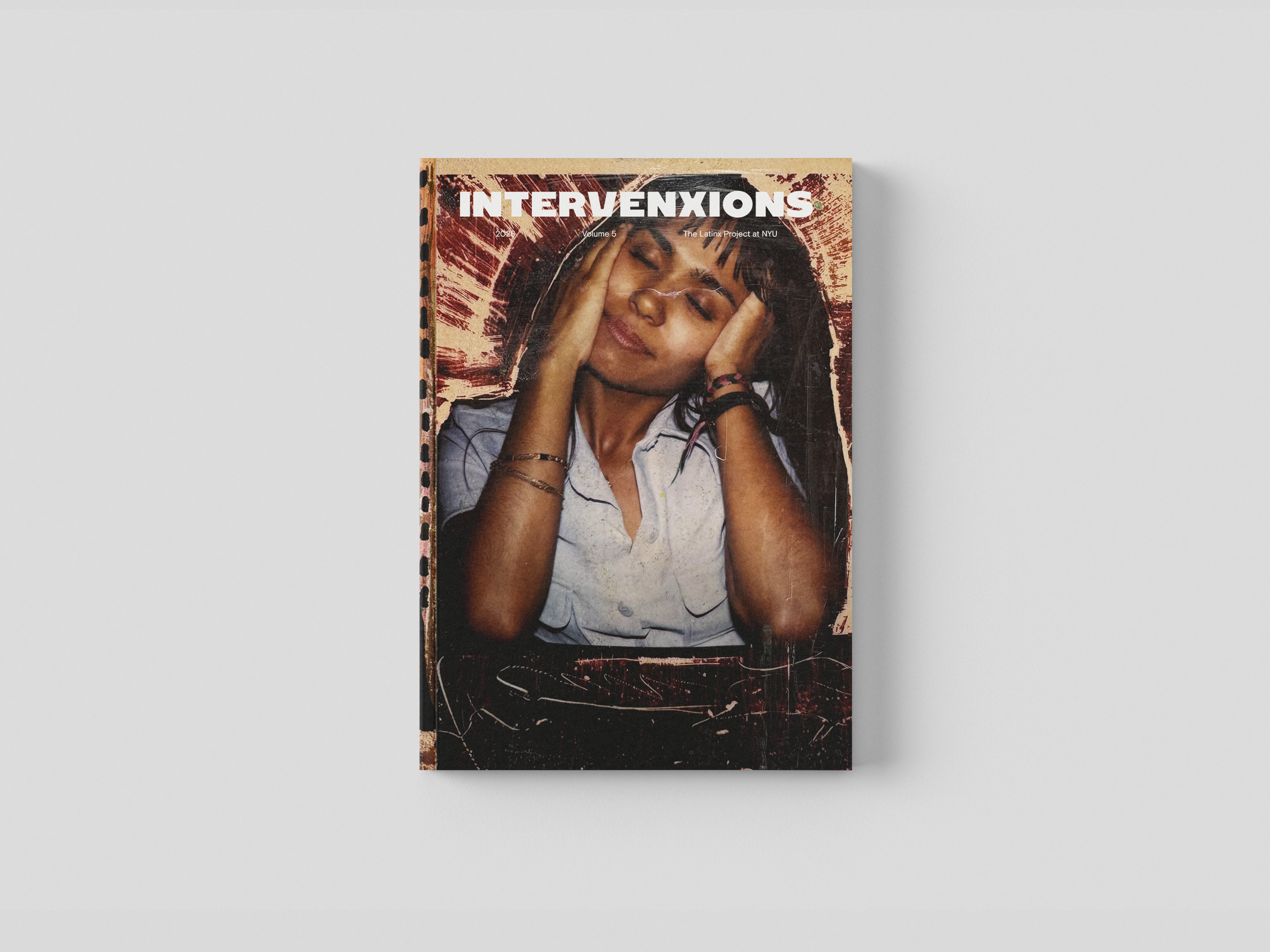
Intervenxions Vol. 5. Pictured on the cover: Eliezer Parrilla Mena, ‘Niña, Arcilla, Marrón, I,’ 1997, Polaroid.
If you’re looking at the official narratives, you might not know how deeply ingrained punk is in Chicano culture. Or how an immigrant from Brazil has helped reshape the contours of the New York Ballroom scene.
Broken up into three sections—Germination, Regional Undergrounds, and Aftereffects—this volume of Intervenxions examines the hidden art scenes and subcultures that are integral to our communities. In many cases, they are either underrecognized by incomplete histories or not deemed important enough to document in the first place.
This is a special edition, as this year marks our fifth printed volume. Originally this project started as a way to preserve digital content in physical media, but it has grown to be more than just that. It’s become a way of connecting with writers and artists, increasing access and awareness, and safeguarding our contributions for the future.
In 2024, the Intervenxions printed volume launched at La Feria: Print Media Fair, The Latinx Project’s annual gathering of independent publishers, artists, and creatives. This has become the perfect venue to debut each subsequent issue because it gives us an opportunity to meet contributors and readers beyond our screens.
We’ve also spent time doing outreach to library and museum collections so that these issues are a resource for future scholarship. This is an important component of what we’re doing––we are committed to highlighting the work of cultural practitioners who have been marginalized from academic inquiry. Intervenxions exists between academia and popular knowledge, and within that space, there are countless stories to be uncovered.
We look forward to expanding the range of what Latinx encompasses and also ensuring everyone feels like there is something here for them. “Latinx” is a term that broadens through diffraction. Increasingly, it intersects with other diasporas of the global South, across memetic subcultures on the internet, through widened understandings of gender and sexuality, and new futures yet to be imagined. This work is a reality because of the writers who choose to publish with Intervenxions and funding from the Henry Luce Foundation, Ford Foundation, and Mellon Foundation.
As we build this universe, we welcome pitches from writers who want to embark on this exploratory journey with us.
Germination
Redwood trees are towering presences, but they start as inconspicuous seeds. Similarly, many concepts and movements start small—imperceptible to others. The germination process gets things in motion, but it takes time and effort for them to sprout. This section revolves around what’s possible through the act of nurturing.
We start in New York, where Afrofutur1st Garçon has made their mark on the New York Ballroom scene, both through their creative practice and their advocacy for the opening of the gender nonconforming category in the city.
Then, we move to New Jersey, the setting of the 2024 film Ponyboi, a Hollywood-funded feature with an intersex character at the center of the narrative. Written by and starring River Gallo, the historic movie threads an intimate account of intersex and Salvadoran identities.
In Los Angeles, Rudi Goblen, the playwright and poet behind littleboy/littleman, tells a different untold story. His dynamic play follows two Nicaraguan brothers living in Miami, torn by their differences. On the stage, the actors represent a culture rarely visible in popular media.
Back in New York, interdisciplinary artist Coco Villa explores the way the body, objects, and landscapes work together in a performance that mixes photography, costume design, film, and dance. Taking place in a traditionally white, avant-garde space, Villa’s work is unapologetically Black.
Rounding out this section is a feature on Eliezer Parrilla Mena, an artist whose interest in painting began at 12 years old when he visited the Metropolitan Museum of Art. Parrilla Mena has spent more than four decades nurturing his voice, producing works that question social mores and challenge the status quo.
Regional Undergrounds
There are many hyper-local communities that retain their sense of autonomy and creativity by insulating themselves—often this is a protective mechanism that allows a movement to thrive despite threatening exterior forces. This is the case for collectives of artists, nascent political networks, and other cultural practitioners operating within “regional undergrounds.”
In this section, we start along the U.S.–Mexico border, specifically the Rio Grande Valley. In a roundtable dialogue, visual artists in the area discuss how their region has changed and what it means to create in a highly contested area.
Then, we examine the photography of Ecuadorian and Peruvian creatives who now call New York City home. While they all made their way to New York at different stages of their lives, their lens-based works demonstrate the myriad ways that South American cultural traditions are woven into the fabric of the city.
On an opposite but parallel journey, we uncover the diasporic ambient works of Roberto Parrilla, who captures the spirit of a Puerto Rican avant-garde on the archipelago informed by a people in constant movement.
Another example of resilience in this section focuses on the land and people of California’s Central Valley and the ancestral wisdom tied to that specific ecology. Kathya Maria Landero’s photobook Verdant Land captures these vibrant stories while challenging stereotypes of the American West.
Finally, we turn to the catalytic youth activism of 1970s and 1980s Chicago, specifically its intergenerational focus and cross-cultural solidarity. The rippling legacy of this movement informs the public sector of the city today, with many Puerto Ricans reaching positions of influence in and beyond government.
Aftereffects
An aftereffect is a secondary occurrence after an initial event––the reverberations, murmurs, and impressions of what once was. It is a category that has to do with memory and its preservation of a collective spirit.
In this section, we scout these lingering territories, including the historic and contemporary relationship between the U.S. and Panama through the collages of Giana De Dier. Her works challenge colonial archive narratives by subversively positioning Caribbean women in contexts where they are absent.
Fire is often seen as a destructive force, but after fire comes new life. Elsa Muñoz’s paintings underscore the importance of fire-following plant species. Their botanical intelligence provides new models for survival under conditions one might normally consider threatening. Despite this, they flourish.
Mainstream media has a history of presenting incomplete stories about immigration. However, on the periphery, there have always been outlets willing to capture the full picture, looking beyond the most scandalous headlines. One story highlights independent Latinx news outlets, like LA Taco and The LA Local, that go beyond reductive coverage, aiming to educate people on their rights.
Relatedly, the violence of the U.S.–Mexico border has repercussions that produce new transcultural flows. In Tijuana, the mass displacement of Haitian refugees waiting for Temporary Protected Status creates situations of duress and endless limbo, while also fomenting solidarity.
Finally, we revisit the seminal 1996 film Pretty Vacant, which follows a young Tejana punk through nostalgic vignettes, blending references and remixing them through the protagonist’s original artwork. Thirty years later, the film retains its magic, reminding us that a Chicana lens bestows new meaning onto tired tropes.