
‘De tierra a estrellas’: Celestial Migrations
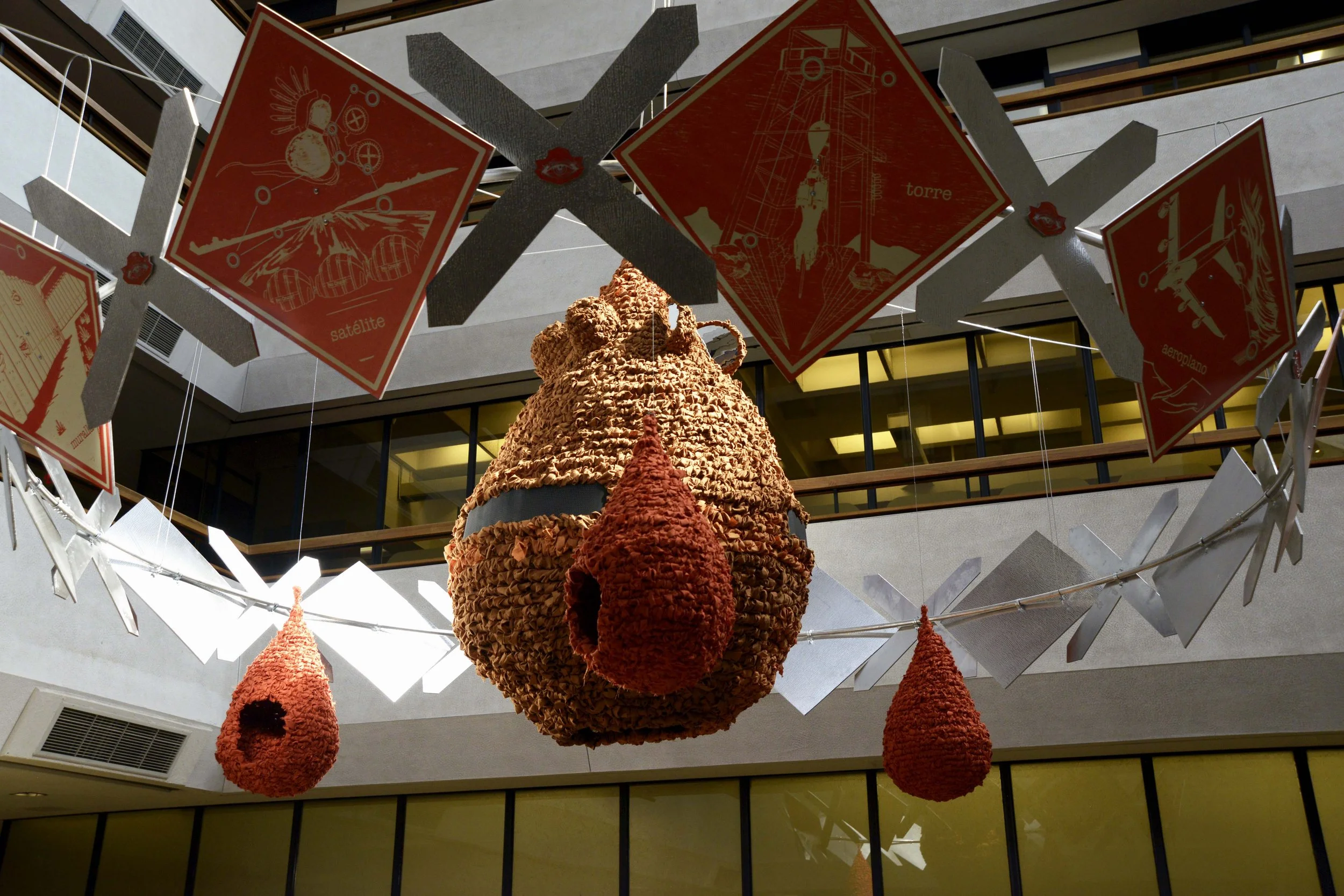
Photo courtesy of Josué Guarionex.
Recalling the alignment of their ancient origin, astrology and astronomy once held to the same basic premise: that we may look up to find meaning and purpose among the stars, in particular, as we reach toward new horizons. Our perspective, however, has since shifted, along with the night sky, to understand the world in the stark, contrasting terms of Western modernity, in which the science of astronomy compels billionaires to consider fleeing the planet. Meanwhile, the pseudoscience of Western astrology—though technically out of date—preserves the constellations first mapped by our ancestors. Both continue to move us in ways that Puerto Rican artist José Ortiz Pagán explores in his large-scale installation, De tierra a estrellas (From Soil to Stars), a celestial ode to migration and the ancestral technologies that connect us from past to present.
Suspended above the atrium of the McNeil Building on the University of Pennsylvania campus in Philadelphia, where Ortiz Pagán is based, this conceptual work includes a handwoven solar system of hollow, gourd-like textile structures, a reference to the spiritual beliefs of Taíno natives of the Caribbean, as well as a large metal ring affixed with an alternating sequence of woodcuts and diagonal crosses that orbit a larger, central gourd. This centerpiece contains an LED display programmed to continuously reproduce a sequence of quotes culled from the closing scenes of the 2016 sci-fi film Arrival, in which the story comes full circle: “Despite knowing the journey and where it leads, I embrace it. And I welcome every moment of it.”
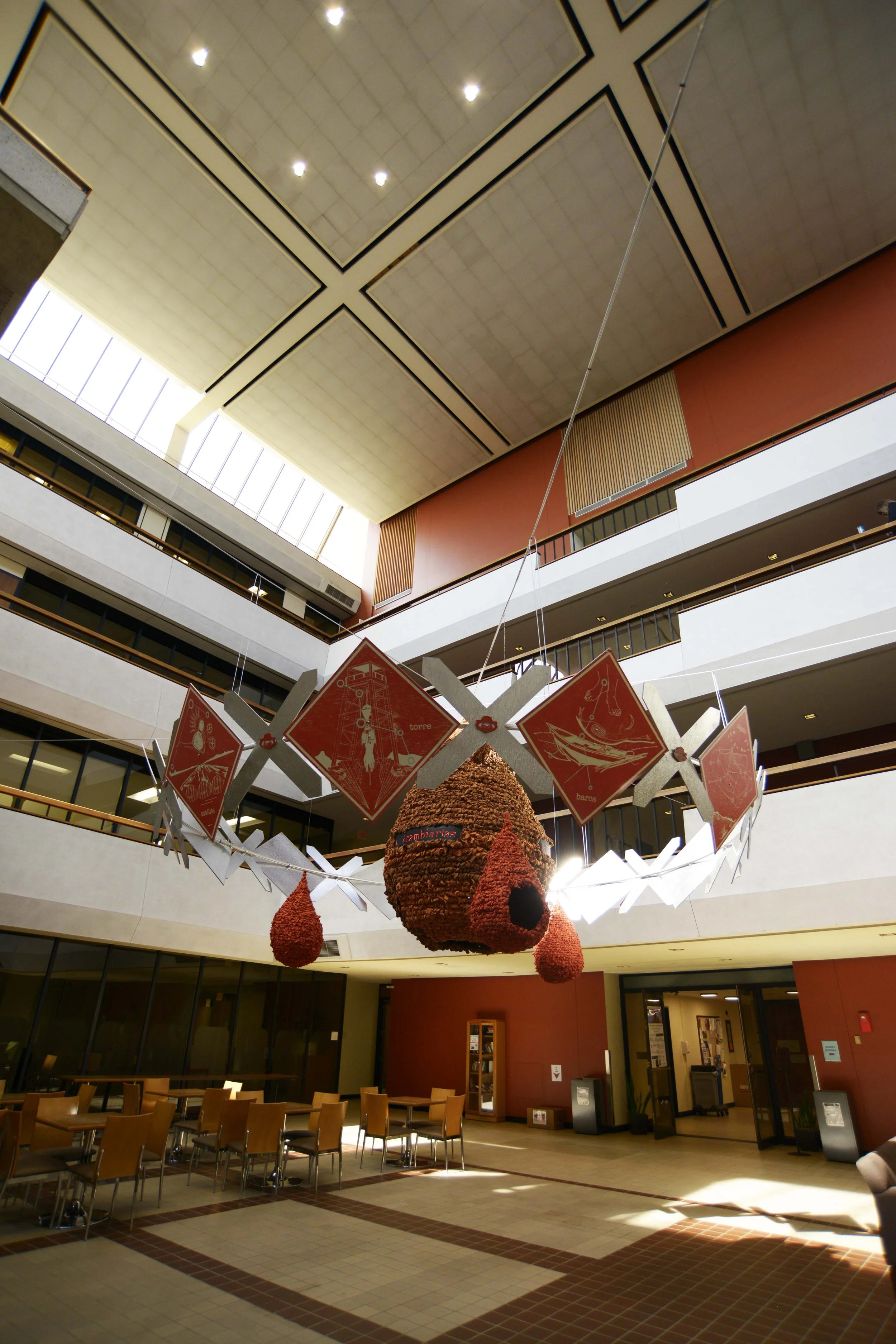
Photo courtesy of Josué Guarionex.
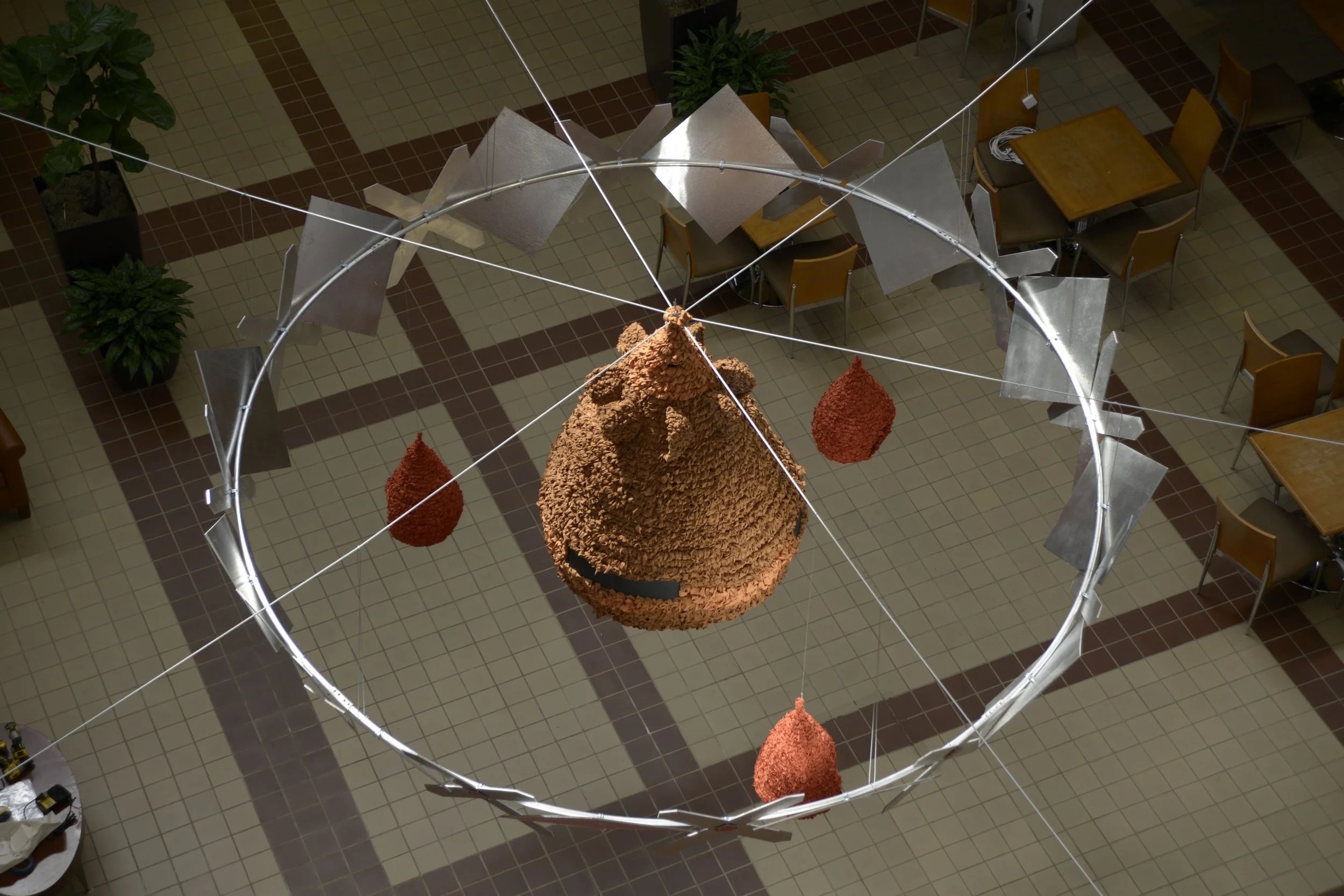
Photo courtesy of Josué Guarionex.
Recontextualized from a film in which the presence of an alien race provokes widespread fear and panic as a political commentary on immigration and militarization, the arriving cohort consists of 12 oblong-shaped, talismanic objects that deliver a 12-part message—coincidentally, the same number of signs of the Western zodiac. This mantra or prayer applies to life’s journey in universal terms: the need, as individuals and as a people, to adapt, survive, and most importantly, communicate.
With only the hope of safe passage, protection from the unknown is essential. Hence, the amulet and its magical properties as a universal cultural symbol. Small objects from Latin America and the Caribbean, each carrying a personal significance for the artist, as well as elemental quality, were placed inside the gourds to serve this purpose: sage that grows in the high altitudes of the Dominican Republic; the feather of a Macaw from South America; a rock from Colombia that had been struck by lightning. This Arrival quote precedes another from the film: Si pudieras ver tu vida de principio a fin, ¿cambiarías algo? ¹ Translated into Spanish from the original English as if to remind the viewer that othering is as simple as not speaking the same language. Here, however, it is an invitation to find common ground, amid hope and doubt.
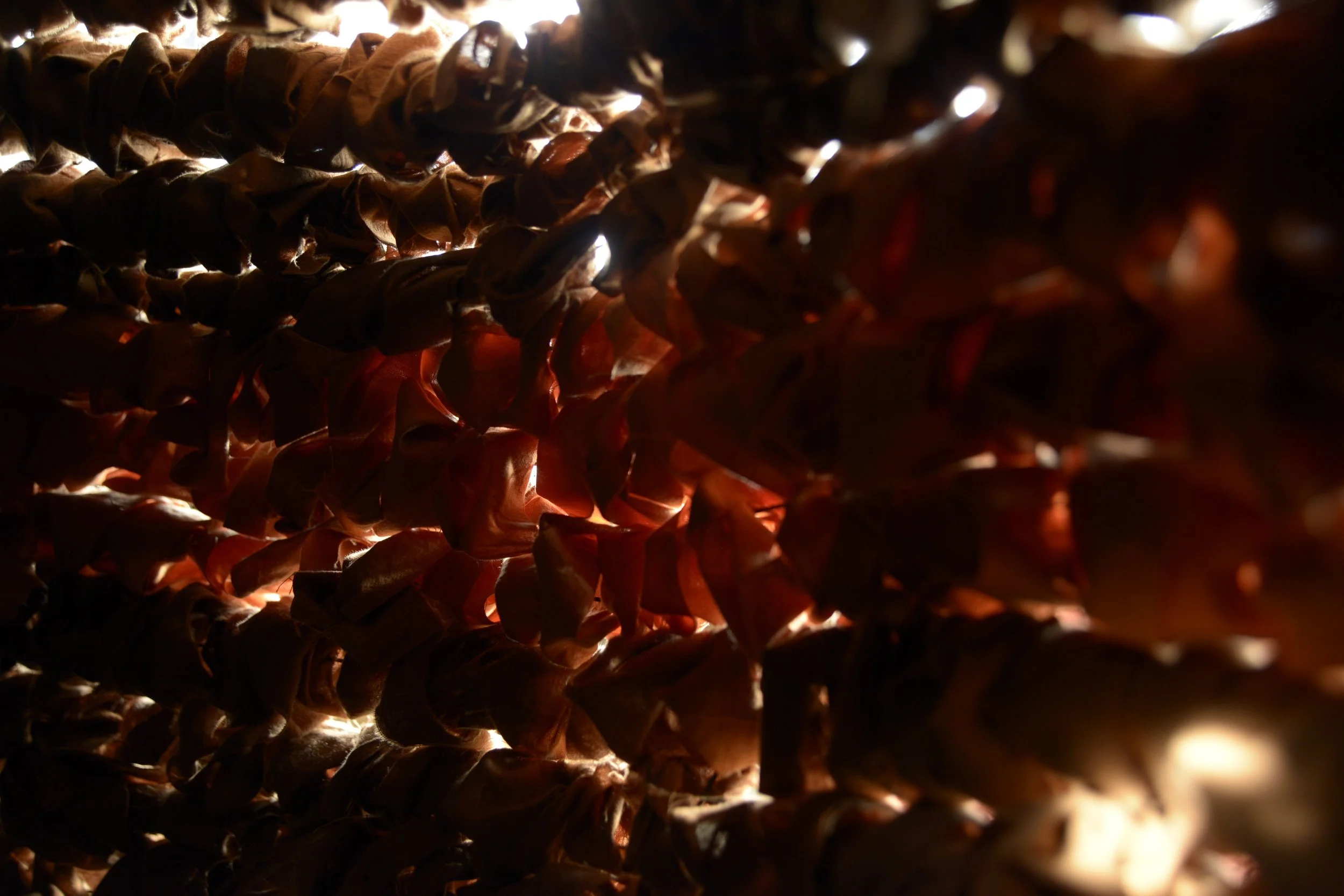
Photo courtesy of Josué Guarionex.
Again, astrology is divinatory, while astronomy is an exact science. Where they intersect allows Ortiz Pagán a holistic perspective to concern himself with migration as an expression of this shared humanity, including his personal experience of leaving Puerto Rico to settle in Philadelphia. In the process of doing research, the artist came across the Picatrix,² an “anonymous” Arabic text from the 10th century historically attributed to renowned Muslim scholar Maslama al-Majriti. Translated into Spanish and Latin in the mid-13th century, it is an influential guide on the making of astrological talismans. The text is also notable as a precursor to the scientific method later adopted during the Enlightenment.
Introducing the experimental method as a form of inquiry reinforces the notion that all generative forms of human knowledge, even the most esoteric, are a byproduct of this interconnectedness, which is fitting as the scientific method is literally represented as a circular process. Epistemology is, above all, a system based on trust, like faith in the kindness of strangers during a long journey or the belief in finding a route to new worlds, regardless of intention. Instead, we have seen trust eroded by a combination of old and new technologies in the form of misinformation, propaganda, and now, the slop of artificial intelligence.
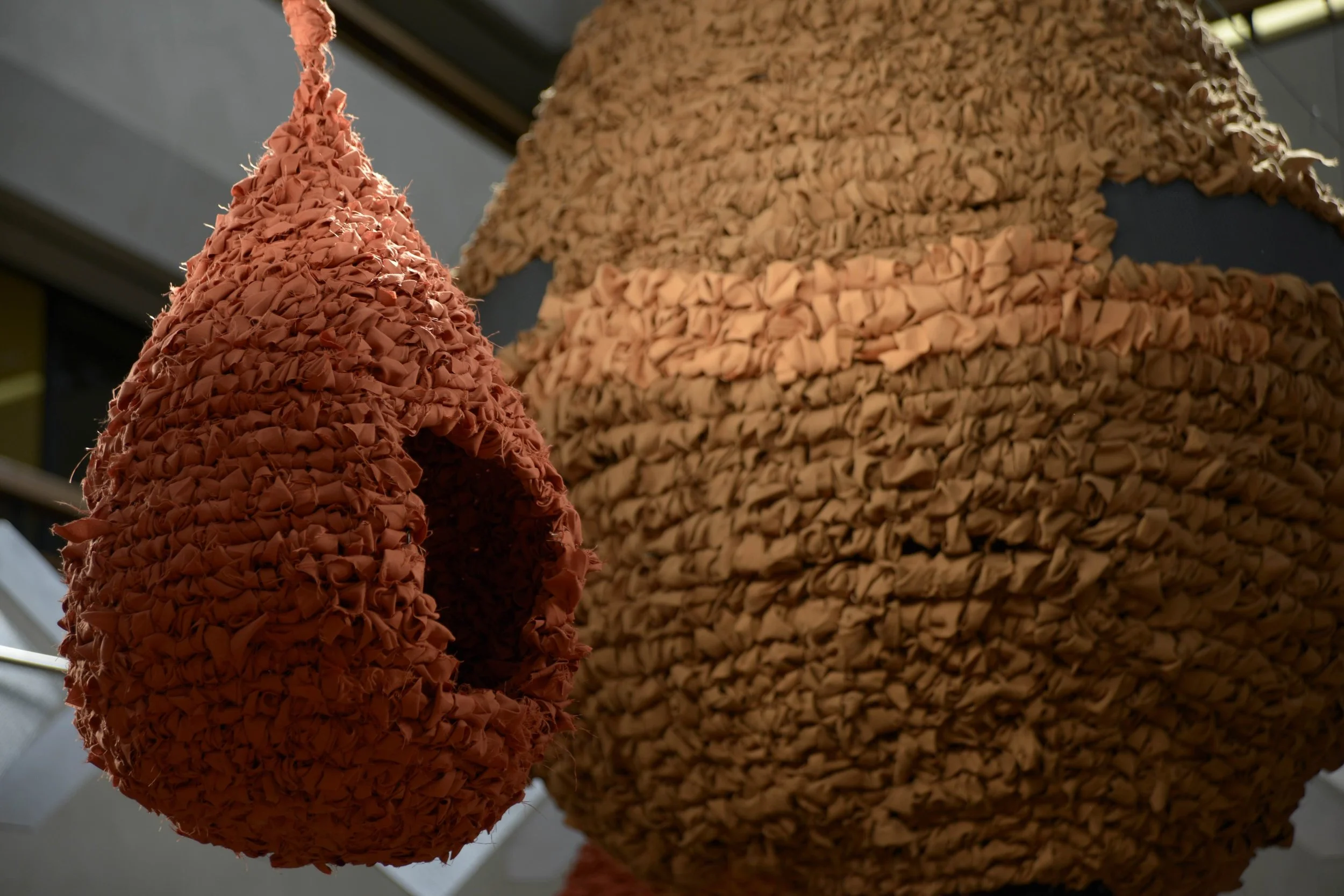
Photo courtesy of Josué Guarionex.
Utilizing the Picatrix, Ortiz Pagán created his own proto-algorithm to produce what amounts to a talisman of sorts rooted in astrological concepts. Significant dates of arrival or departure inform the constellations that appear on each of the 12 woodcuts, like a self-contained universe of migration stories. Ortiz Pagán says that during this process, constellations would repeat, often coinciding with similar outcomes, such as crossing bodies of water. This calendar of events includes everything from a trip to the wall at the West Bank in Palestine to a migrant family tragically drowned at sea; Christopher Columbus making landfall in 1492; a friend being released from immigration detention; and so on. The designs, moreover, pay homage to the style developed in mid-20th century Puerto Rico by renowned artists Lorenzo Homar and Rafael Tufiño, specifically the Las Plenas portfolio of woodcuts illustrating different songs from the folk genre of the same name.
On either side of these woodcuts appear diagonal crosses, each with a small nazar, or eye-shaped amulet in the center that is also reminiscent of the Eye of Providence. They could alternatively be a warning sign found at a railroad crossing, a naval ensign, or some sort of purposeful obstacle, like a cheval de frise or a Czech hedgehog. Similarly, the gourd structures represent the large orange buoys in the Río Grande meant to deter migrants at the U.S. southern border. Small flaps on the main gourd draw inspiration from the elaborate design of the helmet of the Beaded Zemí, a Taíno artifact of disputed origin that represents the New World syncretism of African, Taíno, and European affect.
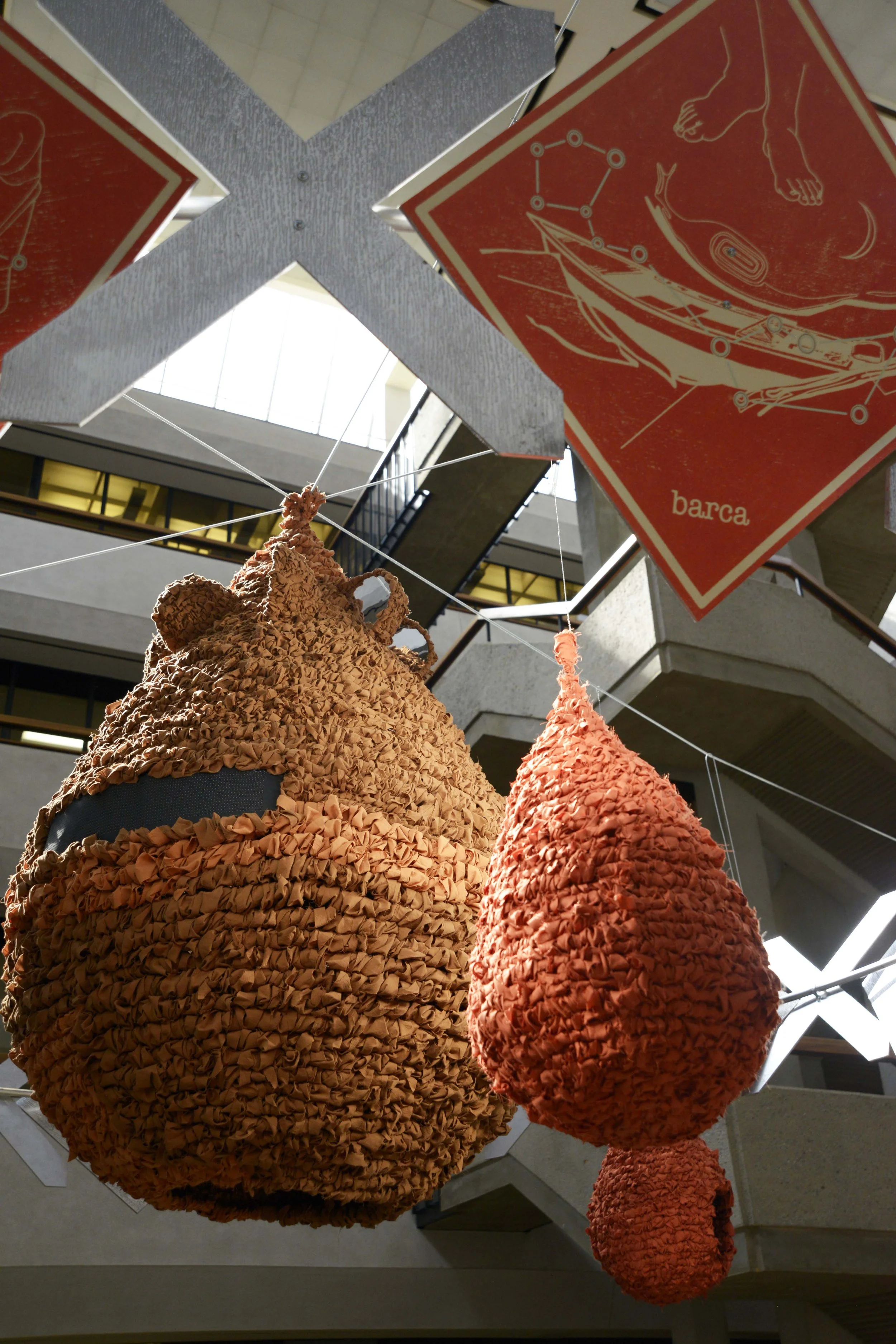
Photo courtesy of Josué Guarionex.
These are some of the many syncretic references to the ancestral rite of migration, as well as the contemporary reality of militarized borders and mass displacement. Here, the power dynamics are explicit, especially considering the location of the installation at an institution from the colonial era, situated in the first capital of the United States, led by one of its graduates currently enacting a despotic program of ethnic cleansing across the nation. This was evident from the outset, when the project first began taking form.
Through a summer youth program sponsored by the nonprofit Centro de Cultura Arte Trabajo y Educacion (Center for Culture, Art, Training and Education, CCATE) and the Center for Latin American and Latinx Studies (CLALS) at UPenn, Ortiz Pagán, who began a residency at CLALS in the summer of 2024, collaborated with local Latine youth, predominantly Mexican, to develop awareness around these power structures. In addition to meditative walks through campus and journaling exercises, Ortiz Pagán designed a simple card game to serve as an introduction to power mapping, a lesson in cartography where the rich and powerful form a constellation of sorts. The program ended with a woodcut workshop in which participants created personal amulets.
Ultimately, this experience formed the basis of what Ortiz Pagán calls a talismanic print installation, which fittingly, opened to the public on the spring equinox in March 2025 with a special ceremony led by the artist. While he played güiro for monkey figurines inside the gourd structures, they began to rotate slowly, as if possessed. Only when they stopped did the artist place the personal objects in each gourd. As Ortiz Pagán says, “We're talking about magic at the end of the day.”
De tierra a estrellas is on view at the Center for Latin American and Latinx Studies in the McNeil Building at the University of Pennsylvania in Philadelphia until December 4.
¹ “If you could see your whole life from start to finish, would you change things?”
² Also known as the Ghāyat al-Ḥakīm or Ghayat al-hakim wa-ahaqq al-natijatayn bi-altaqdim, which roughly translates to “The Aim of the Sage” or “The Goal of The Wise.”