
Julia de Burgos in Translation
Educator, essayist, and poet Julia de Burgos was a foremother of the Nuyorican literary movement. But Burgos, who mainly wrote in Spanish, is not as widely known outside of Nuyorican and Puerto Rican spaces. With I Am My Own Path: Selected Writing of Julia de Burgos, editor Vanessa Pérez-Rosario has brought together a team of translators to put a bigger spotlight on her prescient texts.
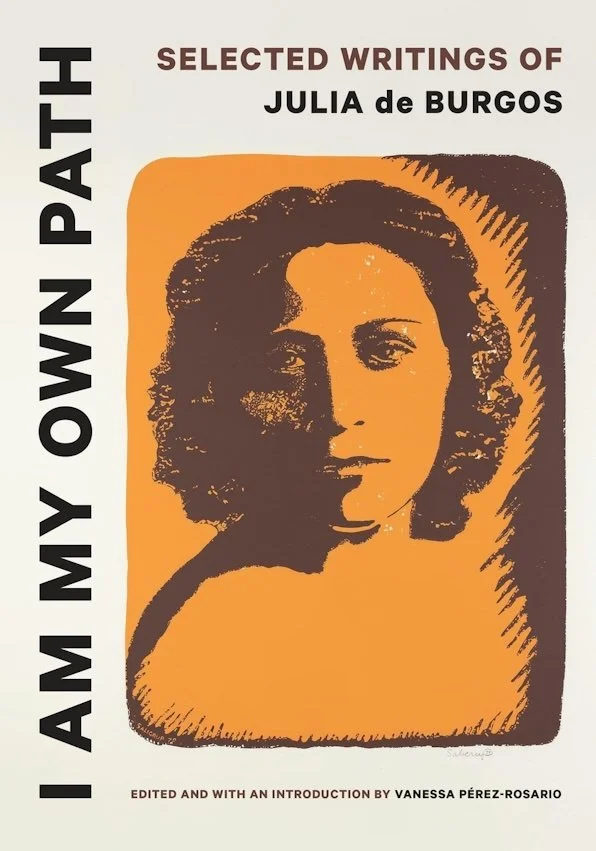
Courtesy of the University of Texas Press
Burgos was born in Puerto Rico in 1914, lived in Cuba and Washington, D.C. for short periods of time, and died at 39 in New York City in 1953. She never returned to Puerto Rico after her departure. In her lifetime, she published several collections of poetry, worked as journalist in the Spanish-language press in New York City, and was the recipient of a number of literary awards in her native Puerto Rico. In 2018, The New York Times published the obituary “Overlooked No More: Julia de Burgos, a Poet Who Helped Shape Puerto Rico’s Identity” meant to highlight the life and cultural contributions of this remarkable poet.
Though seven decades have passed since her death, her writing, which touched on themes of slavery, U.S. imperialism, and Puerto Rican identity, remains relevant. By bringing together different translators and doing archival research, Pérez-Rosario has offered more context on the life and work of the poet. The book includes poetry, essays, and personal correspondence by Julia de Burgos in the original Spanish with English translations by Jack Agüeros, Josefina Báez, Cyrus Cassells, Aurora Levins Morales, Roberto Márquez, Robin Myers, Urayoán Noel, Pérez-Rosario, Roque Raquel Salas Rivera, Mayra Santos-Febres, Carina del Valle Schorske, and Grace Shulman.
In the introductory essay, titled “Translating Julia de Burgos,” Pérez-Rosario writes about when Burgos wrote in English and what English meant to her as a colonized subject. As a bilingual writer, poet, and journalist, language was at the forefront of Burgos’s life.
In this section, Pérez-Rosario provides sociopolitical context, discusses Burgos’s upbringing in poverty, her formation as a teacher, and how this clashed with Burgos’s independentista and progressive politics. These experiences shaped Burgos’s writing and made her grapple with what it meant for her to be a racialized subject, a woman, and divorcée. Pérez-Rosario also uses the introduction as a way to reassure the audience. Showing a deep understanding of the weight of this undertaking, she writes, “What are the politics at stake when translating Burgos’s work into English? What are the scenes of translation in her work?”
The scenes of translation in her work include the FBI agents who were the first to translate Burgos’s writing into English as they kept a carpeta (or file) on her, which led to her being fired from a federal job in Washington, D.C. because she was in favor of Puerto Rican independence. Translation, whether this means Burgos living a translated life in New York City and Washington D.C., or the work of the translators included in this volume, is central, and Pérez-Rosario is careful not to render the translators’ work invisible.
The volume comprises three parts: Selected Poems; Essays, Interview Essays, Vignettes and Sketches; and Letters. As Pérez-Rosario states in the introduction, “I Am My Own Path includes a selection of poems from each of Burgos’s published poetry collections, as well as a selection of poems referred to as ‘lost’ or ‘loose’ poems, with new English translations.” As such, the poems in the first part span Burgos’s lifetime as a poet, including “Transmutation,” translated by the late Agüeros. His 1997 anthology of Burgos’s poetry in translation, Song of the Simple Truth, gave wider audiences access to her oeuvre.
Some of the poems in this section include English versions by more than one translator. One of the reasons why this edition by Pérez-Rosario is so valuable is that it provides detailed explanations in the section titled “Publication History and Textual Changes to Poetry Included in This Edition.” “To Julia de Burgos” includes an English translation by Schulman and another by Márquez. In the case of “A Julia de Burgos,” Schulman didn’t know she translated a shortened version of the original poem, and Pérez-Rosario has included it in the book for comparison. In the introduction, Pérez-Rosario provides context for this truncated translation.
Similarly, “Río Grande de Loíza” includes one translation by Schulman and another by Salas Rivera, in part because one version of the poem was published in a single stanza, while the other version had 12. For “Campo,” Pérez-Rosario traces the two versions of these poems that Burgos called “Campo 1” and “Campo 2.” Salas Riveras translates the titular word to “country,” while Meyers uses “countryside.” Slight variations can be the result of where the translators grew up or even what they thought sounded more poetic.
With her politically engaged poetry, Burgos also turned her attention to tyranny in the Dominican Republic. This materialized in her poem “Bloody Hymn for Trujillo,” translated by Levins Morales.
Part I also includes the only two poems Julia de Burgos wrote in English: “Farewell in Welfare Island” and “The Sun in Welfare Island.” There exist at least three versions of “Farewell in Welfare Island,” and Pérez-Rosario provides a detailed account of her own editing of this poem for this volume. Even though Burgos expressed that the English language made her feel more cosmopolitan, her saddest poems are the only ones she wrote in English. As Pérez-Rosario states, “[‘The Sun in Welfare Island’] is Burgos’s last known poem, written just a couple of months before her death,” when Burgos was dealing with depression and alcoholism.
Myers translated both Part II Part III. Although the English language and life in New York gave Burgos a more global worldview, she didn’t leave the Spanish language and the people of Puerto Rico behind. In New York, she could write freely as a leftist and independentista intellectual who was politically engaged with Spanish speakers in the metropolis and throughout the Spanish-speaking world. She devoted herself to progressive political values and combating the oppression and colonization of Puerto Rico. Burgos found a place for her advocacy work in the Spanish-language press in New York. Her essays pushed the boundaries of political issues in the publications for which she wrote by putting feminist issues before the reader. She was concerned with the historical moment of her time as a writer.
Burgos participated in pan-Hispanic or Latino politics at the time. In Cuba, she met the Dominican writer and statesman Juan Bosch, whose work and politics she took up in her essays and poetry. (See “Bloody Hymn for Trujillo,” translated by Levins Morales in Part I.) Taken together, the essays reprinted in the original Spanish with English translation rescue from erasure a part of the cultural history of Hispanics in New York in the mid-20th century. A number of the essays in Part II include introductory notes by Pérez-Rosario that contextualize the piece for the contemporary reader.
In the “Note on Translations and Editions,” Pérez-Rosario states, “I also added biographical details on the network of leftists, communists, socialists, and nationalist intellectuals who were part of Burgos’s world. I focused on adding notes about women writers, declamadoras, editors, and founders of magazines and newspapers, whose work has largely dropped out of circulation, even though they were popular in their time. The women cultural workers who appear in these letters present new avenues for research.”
The letters and essays let the reader experience Burgos as a woman who writes for the Spanish-speaking community in New York as well as for her sister in Puerto Rico. Reading the letters in Part III, the largest section in the volume, left me with several unanswered questions: Why did Burgos stop asking her sister about their father? What led to the decline of her mental health?
I would like to posit that these unanswered questions about her life and her writing have led to her becoming a legend. Perhaps, instead of referring to Burgos as a cultural icon, it would be better to call her an urban Nuyorican cultural legend. The letters show Burgos the poet and journalist as a human being trying to survive and live day-to-day in New York, just like any other Nuyorican or Latinx member in the city. This body of work goes beyond portraying Julia de Burgos as a cultural icon that is distinct from the reader.
Pérez-Rosario has carried out a systematic endeavor dedicated to compiling Burgos’s poetry, essays, and letters. Thoughtful sections dedicated to acknowledgements, contributors, translations, and editions, as well as extensive endnotes make this volume complete. I Am My Own Path: Selected Writings of Julia de Burgos is a portable archive accessible in English and Spanish to readers, scholars, and admirers of Burgos’s oeuvre.