
‘Imagination Doctors’ On Stage and In Community
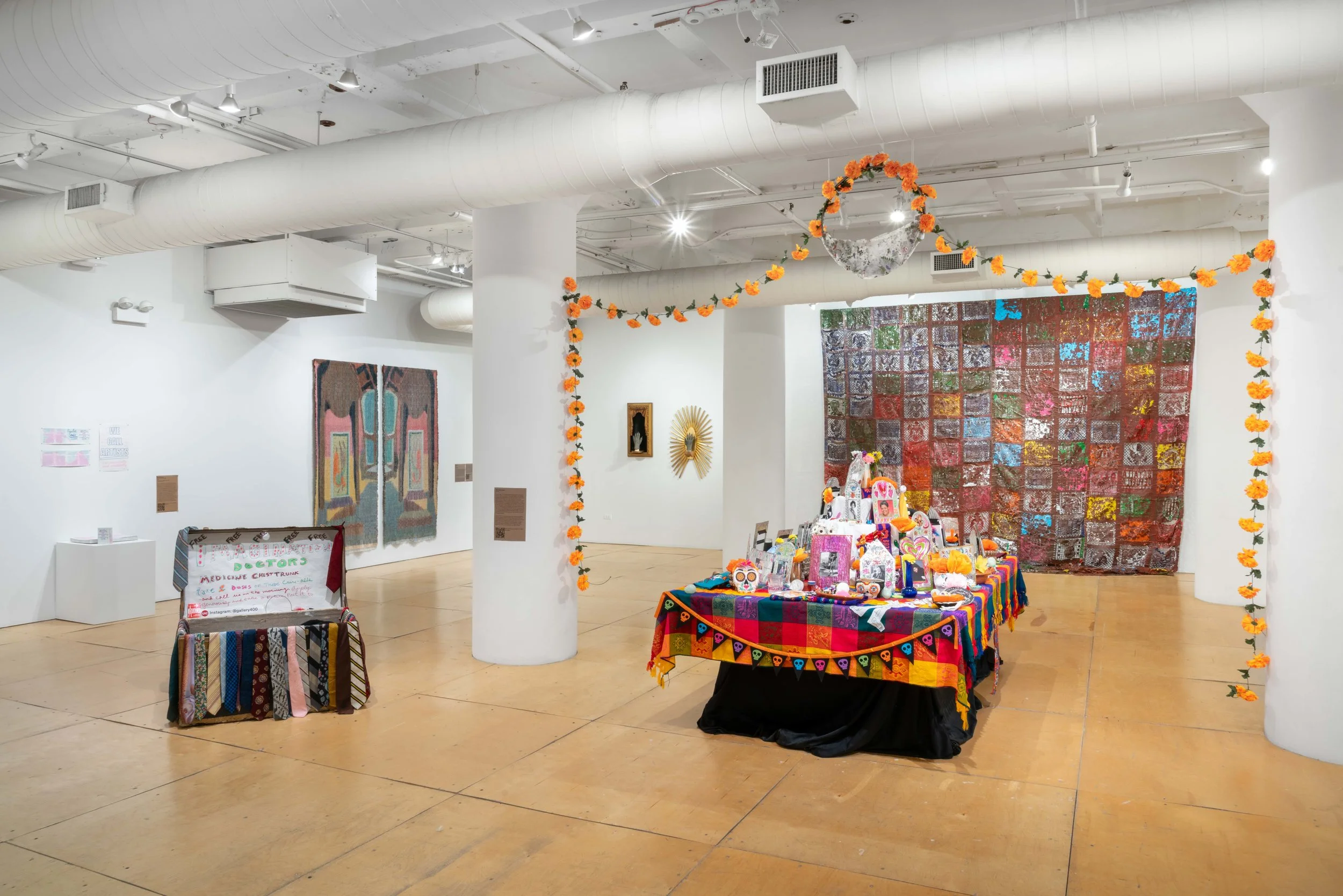
Imagination Doctors installation view, 2026. Photo by Jonas Mikowsch Müller-Ahlheim.
In 1978, a caring group of constituents in Pilsen, Chicago’s largely Latino neighborhood, attempted to demonstrate one way public life could nurture community. Almost immediately, they succeeded. At the forefront of these efforts was Pros Arts Studio, a newly established organization primarily devised to amplify the role art plays within social life. With over 150 creative members, the many programs, workshops, and performances it put on combined artistry with educational pedagogy.
Such an electric and eclectic mix was the direct result of the many creative backgrounds of the founders, organizers, volunteers, and participants who worked with Pros Arts. From organizing the Pros Arts Kids Circus to devising a call-in show on Chicago Access Network Television to increase young student literacy, the group catered to everyone. Perhaps, there was no greater testament to the broad accessibility and appeal of the diverse art initiatives than the fact that the ages of those engaged ranged from 3 to 93 years old.
It was the group’s belief in the capacity for art to create social change that made its work charming and effective. Across various avenues, these changemakers found ways to empower the community, serving as unconventional part-time policymakers, teachers, neighbors, friends, and much more. Capable of seeing and functioning in multiple ways, Pros Arts was an adaptive and holistic affair. Ultimately ending in 2013, the organization spent some 35 years fostering and uplifting artistic and social vitalities. At every step of the way, it placed its community front and center.
The history of Pros Arts Studio, its dynamic lineage, and consequential aftereffects is on view at the University of Illinois Chicago’s Gallery 400. The exhibition, Imagination Doctors, provides two invaluable corpuses of information. First, viewers can look, read, and reflect on a portion of the vast and rarely displayed archival material created by the organization across decades.
Second, visitors can learn more about the collective’s history through a wealth of artistic responses that draw inspiration from the group’s efforts. The artist list alone makes the show worth attending, including works by: Alberto Aguilar, Sophia Karina English, William Estrada, Mauricio López F., Maria Gaspar, Victoria Martinez, Alan Medina, Leticia Pardo, and Jiashun Zhou. For some of these artists, Pros Arts was newly familiar, while others had worked with the organization for many years. In drawing across time, the exhibition conjures the past through a historical outlook and demonstrates how Pros Arts continues to make a lasting impact on Chicago.
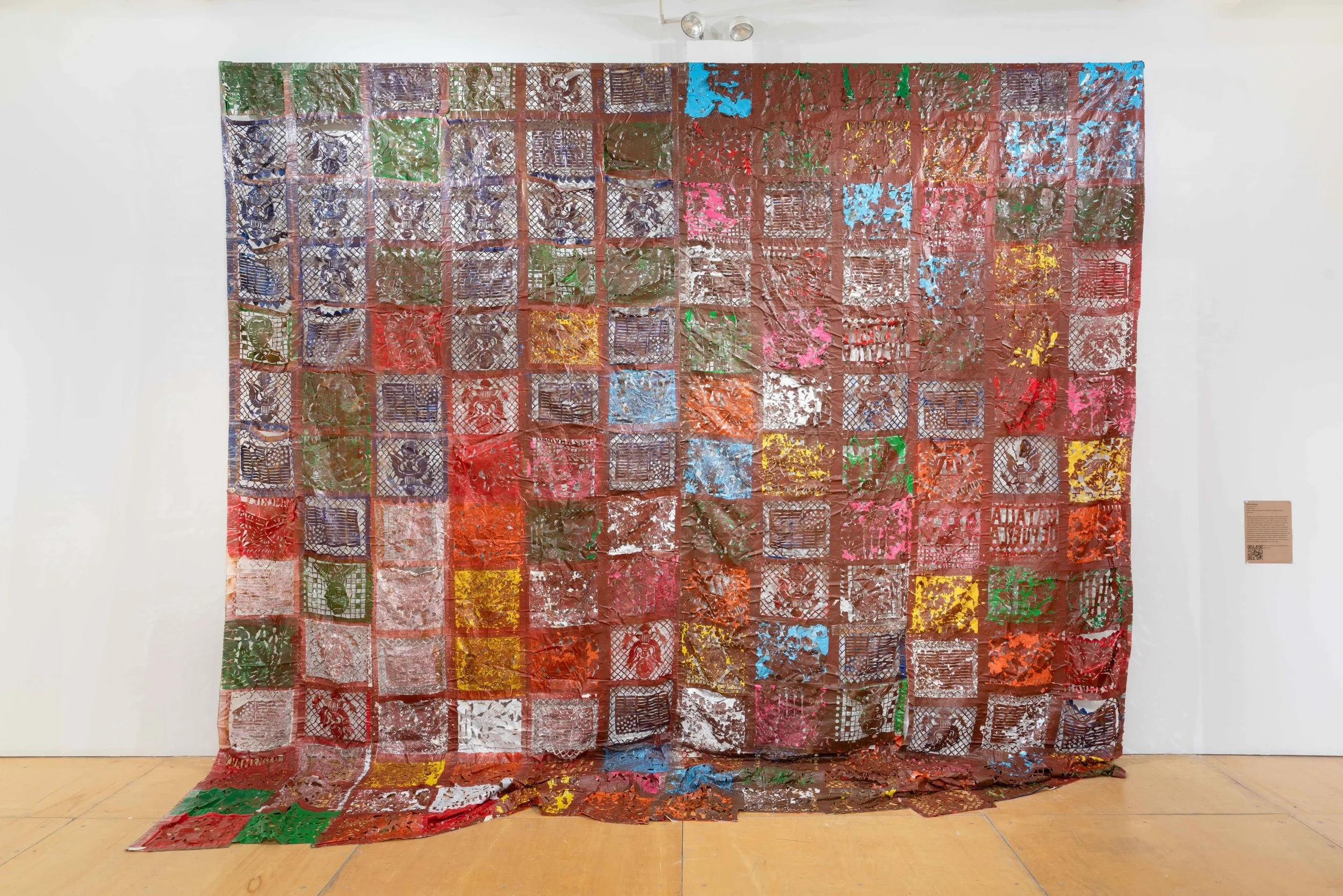
Maria Gaspar, Hovering Cloud, 2008/2025. Photo by Jonas Mikowsch Müller-Ahlheim.
Right at the entrance of the exhibition, a quotidian reliquary sits proudly. It’s a “Medicine Chestrunk.” Inside is a hodge-podge of clothes, either a fashionista’s nightmare or essentials. The instructions on the inside of the treasure chest are straightforward: Take two doses of these “cure-alls.” Handouts are not rare in galleries or art exhibitions. But a portable accessory station is, even if only for the duration of a visit.
This bit of parenthetical fun is both playfully innocent and intentionally serious, an evocative duality that not only anchors the entirety of the show but also reveals a foundational aspect of Pros Art’s identity. Namely, that creative and cultural vitality could be suitable substitutions or additions to alleviate unstable social realities. And yes, sometimes that means dressing up as a clown (as Pros Arts members frequently did). It means taking to the stage, and putting yourself out there. Pros Arts inspired working with others as an ensemble, embracing your inner weirdness, and letting yourself be who you are in your truest form.
Jiaashun Zhou’s laborious but terrific tapestry Staying weaves a rich portrait in the show’s first room. The tapestry depicts an abstracted interior space on two joint yet disconnected pieces and responds to the architectural sites that defined the organization’s existence. Here, viewers can take in some of Pros Arts’ immense history through the work’s accompanying label. The didactics contextualize the group’s origins.
Born out of Ruth Bauman’s and Jean Parisi’s volunteer work at Pilsen’s St. Procopius Church and School—colloquially known as St. Pros—the two would start the nonprofit after advice from Urban Gateways, a similarly minded institution. And so, Pros Arts received its name and frequently found its activities sheltered within the religious confines of that church and school. When access to that site was no longer readily available, Pros Arts officially moved into an old tavern and dance hall. Structurally flexible, there wasn’t a place Pros Arts couldn’t occupy and teach the arts.
Art as pedagogy, passed from generation to generation, gives texture to Maria Gaspar’s materialization of Pros Arts’ history. Hovering Cloud uses papel picado, a significant object within the Mexican paper art tradition and a frequently taught material in seminars by Pro Arts. Patterned in a gridded structure, turquoise, canary, and fuchsia squares pop against the space’s white background. The work is a double homage to cultural heritage, referencing the customary practice and its frequent employment in Pros Arts events. In the main room, like in Gaspar’s work, tradition appears time and again.
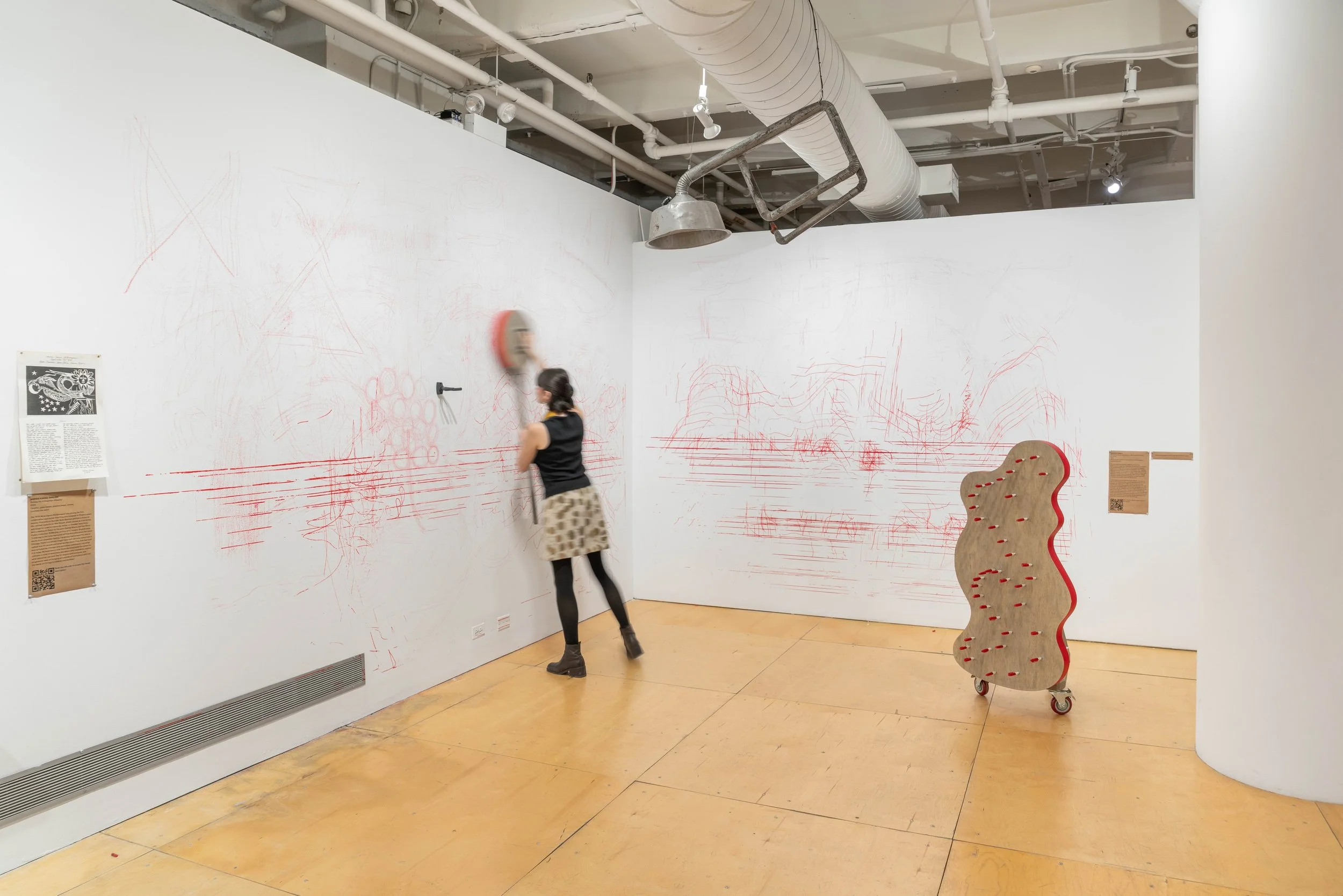
Mauricio López F., Eso que era una no, ahora es un sí / What used to be a no is now a yes, 2025. Photo by Jonas Mikowsch Müller-Ahlheim.
Vibrant contrasting colors appear closely and red haphazard looping lines trace the gallery’s walls. Mauricio López F.’s piece, titled Eso que era una no, ahora es un si / What used to be a no is now a yes, references a Pro Arts team performance. The work allows viewers to literally draw on the walls, transforming a segment of the room through this durational, participatory act. Three components make up the piece. Two of them are mobile drawing appliances, one on wheels and the other handheld, each with protruding red crayons. The last is an industrial looking sculpture—a kazoozaphone—that hangs from the ceiling and emits a scratching noise that replicates the sonic element of a good doodle. Together, the jury-rigged sculptural triptych is a journey back down childhood lane. It combines joyful bliss with radical defiance, bending the rules through the establishment of a new creative freedom. Unsurprisingly, it is exactly fitting for an exhibition about Pros Arts, exemplifying an unconventional approach that directly responds to the surrounding environment.
The remaining connected rooms of the gallery continue to draw directly from other intimate aspects of Pros Arts’ narrative. Components of the organization’s history stand activated once again, like a portion of a set Lionel Bottari designed for There Goes The Neighborhood!, a largely improvised tragic comedy that took place in Pilsen’s Dvorak Park in 2004. Alan Medina’s One Grand Place uses audio from Pros Arts to reflect on the first Día de Los Muertos Parade in Pilsen put on by the organization. Other creations like those by Leticia Pardo and Alberto Aguilar and three of his students (Ieva Maria Tersigni, Saoirse Ahumada Furin, and Nico Valentina Mairesse) only add to this vibrancy.
The last room is the most intimate space of the exhibition. Displayed inside glass cases, original ephemera creates a constellation of histories. Old photographs are wonderfully delightful and aged newspaper clippings demonstrate the organization’s local influence. On one portion of the wall, flyers and paraphernalia with proud promotional messaging call out major highlights. There’s the St. Procopius Art Studio Exhibit, the Pros Arts Payasos/Clown Ensemble: Uncle Toad and Aunt Phibian, and even Dancycle’s City Dances Summer 1981. Performances, festivities, and theatrics were staples of Pros Arts. The organization’s lightness and joviality took to the streets, showing how creativity was a community taking care of and honoring itself. This is best remembered by the impressive list of signatures on the opposite wall including former artists, interns, board members, staff, and community members. Maybe it’s a contract. Or a will. An agreement. Or a manifesto. Regardless, the signatures are an extension of Pros Arts’ life and celebration that fills the space.
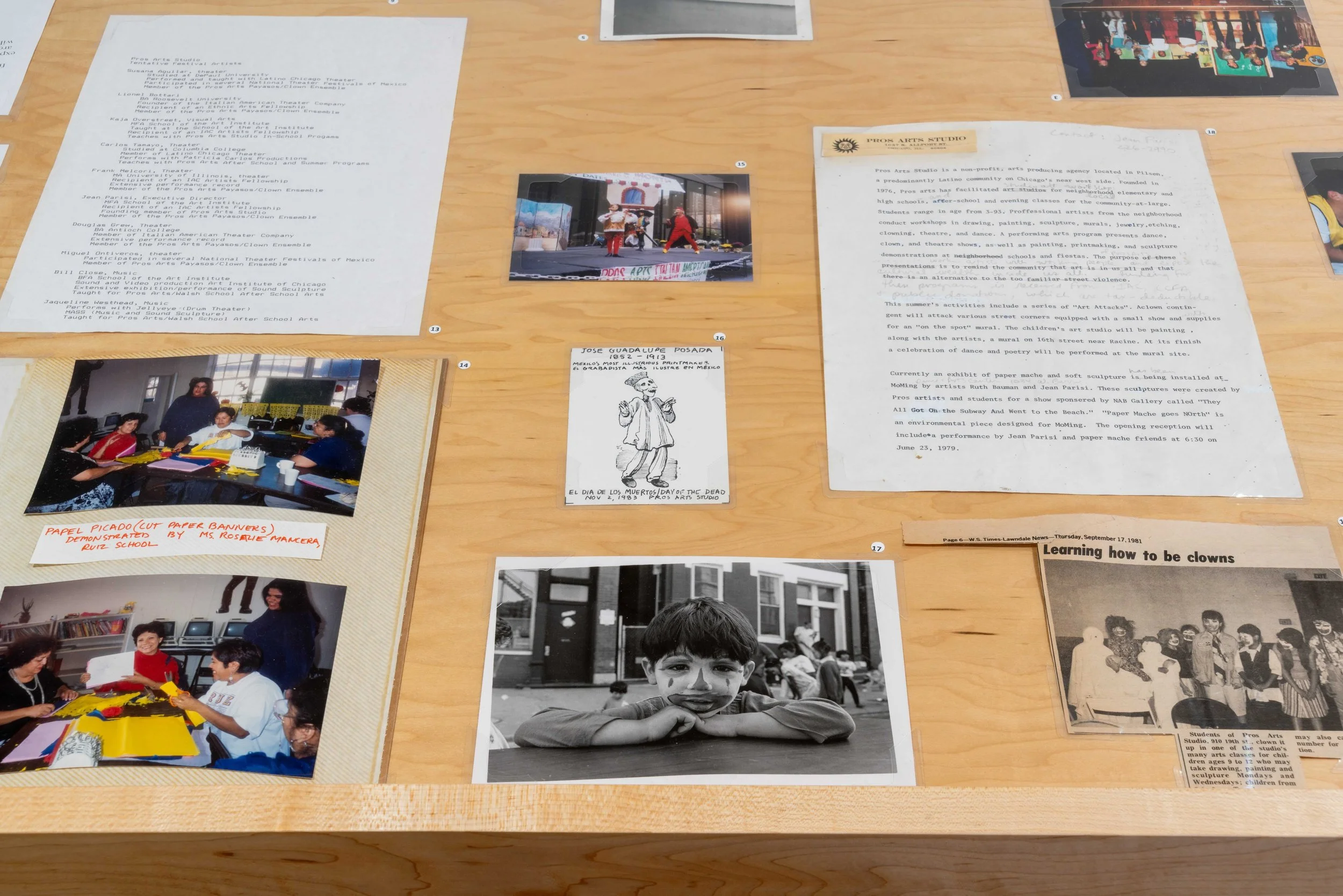
Pros Arts Studio, Print Ephemera, 1978–2004. Photo by Jonas Mikowsch Müller-Ahlheim.
Every now and then you need an exhibition like this: one that pays attention to how the past continues to roll its way into the present. Community blueprints leave lasting imprints. If there was anything to improve about the exhibition it would be to simply include more material, especially the archival elements that saturate the utter importance of community. Spatial limitations get in the way, but when the subject matter is as captivating as it is here, there is no need to be shy. When leaving from the exhibition, rich ongoing histories should not be the only thing accompanying you on your way out. Another essential suggestion is that every visitor should leave with the sensational souvenir We Call Artist Zine and Poster by William Estrada, a former teaching artist with Pros Arts. It is worth quoting at length, to remember and honor what the group meant and still means:
Community art centers on community, shifting art from individual expression to collective action. It inspires commonality, belonging, and local pride by uniting diverse people to share stories, build networks, and address common needs. This shared ownership of public space and culture makes art accessible, encouraging dialogue, healing, and amplifying the brilliance already present in the community. The result is more meaningful and sustainable art that truly reflects and serves its participants.
Imagination is extremely important in community art; it drives social change, fosters empathy, and builds collective power. It enables communities to transcend limitations, express their unique experiences, and collectively envision and create equitable, just, and joyful futures, transforming shared ideas into tangible social realities. Imagination enables us to envision and create the world we want for one another.
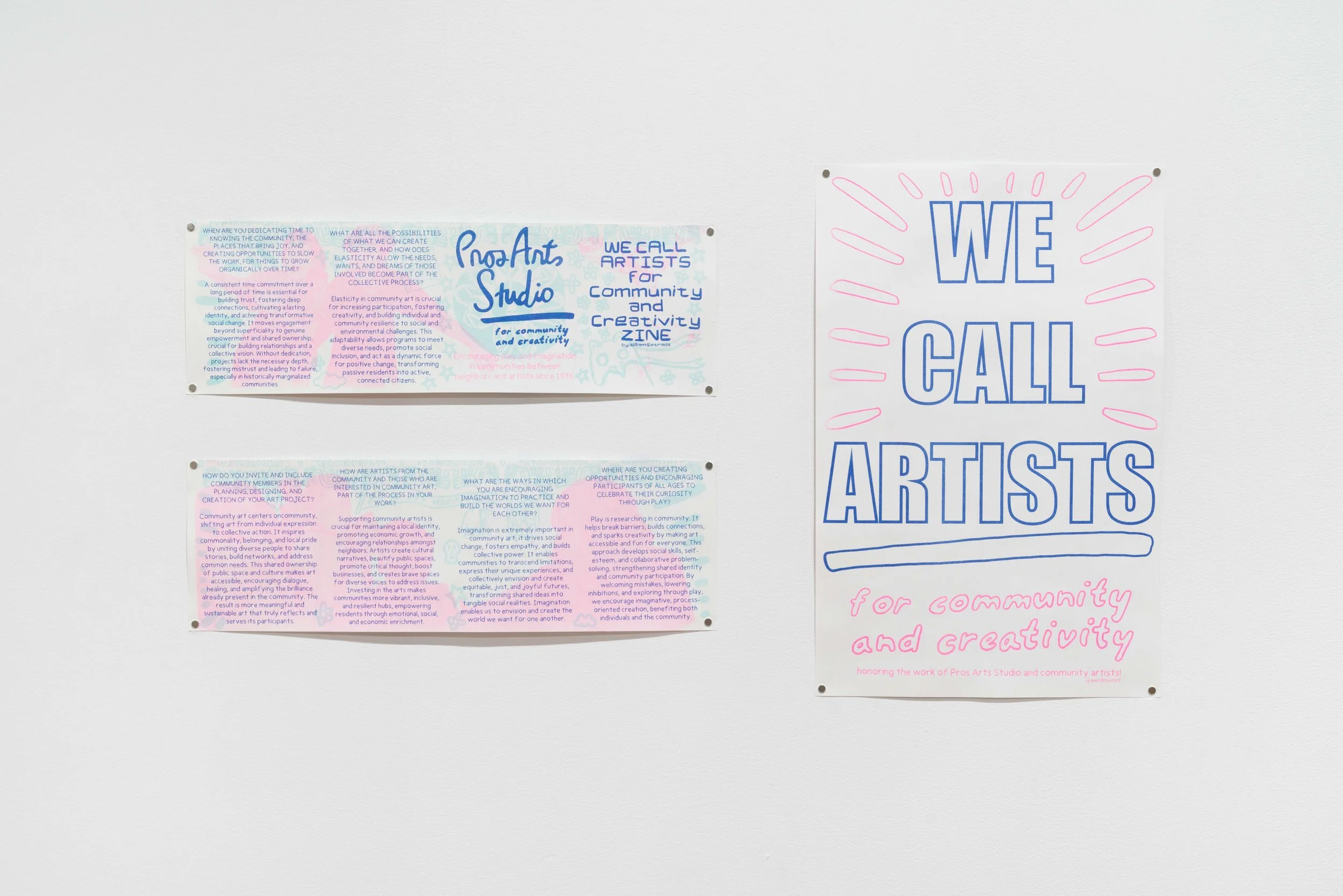
William Estrada, We Call Artist Zine and Poster, 2026. Photo by Jonas Mikowsch Müller-Ahlheim.
This world still needs dreamers. It still needs individuals who can imagine what is not yet in front of our eyes. Pros Arts Studio is one example of an operation that did this remarkably. There are countless others. Those that exist on regional, national, and even international levels. Frequently, however, our voices are loudest heard and listened to from within our communities. Change is incremental. It might crash down upon us with the power of a tsunami or build continuously like the mechanics of a perpetual clock. In either case, there is power in movement. Cherish it. Let it surprise. And maybe, let clowns take on the world.