The Harvest of Grief and Pleasure
It begins with a hand holding a mystery. When the Peruvian multidisciplinary artist Romina Chuls encountered The Paracas Textile (100–300 CE) at the Brooklyn Museum, she couldn’t stop observing one of the figures at the border of the fraying piece. Chuls looked at the anonymous character, and it looked back at her, holding in its hand one of the plants the museum’s staff had not identified. The piece in question is a funerary cloak from the Nasca society unearthed in the southern desert of present-day Peru: It was found wrapped around a corpse in a fetal position, protecting it in its journey toward another realm.

Detail of Nasca mantle, The Paracas Textile, 100–300 C.E., cotton, camelid fiber, 58 11/16 x 24 5/8 in. (149 x 62.5 cm). Brooklyn Museum, John Thomas Underwood Memorial Fund, 38.121. Photo by Romina Chuls.
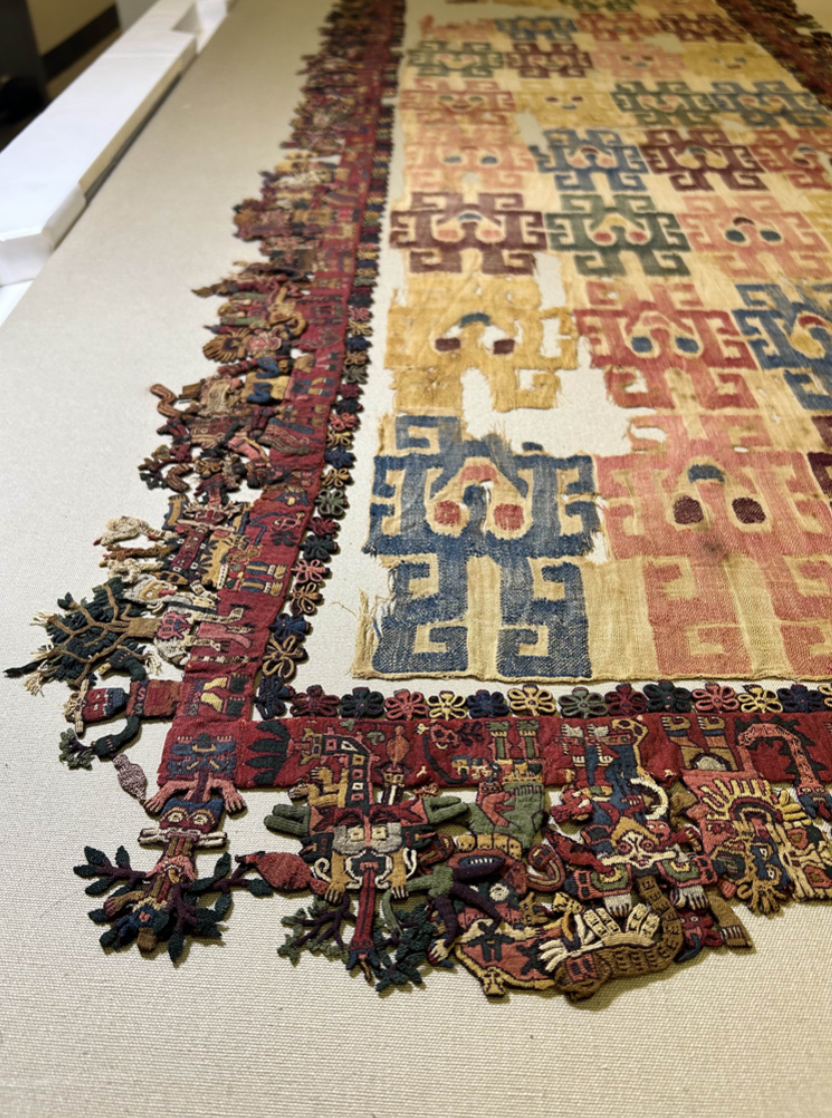
Nasca mantle, The Paracas Textile, 100–300 C.E., cotton, camelid fiber, 58 11/16 x 24 5/8 in. (149 x 62.5 cm), Brooklyn Museum, John Thomas Underwood Memorial Fund, 38.121. Photo by Romina Chuls.
Since the “discovery” of the manto—or rather, the unilateral decision to separate it from the body it covered—the piece has become a renowned representation of Andean textiles. Interestingly, it is not praised for its woven body but for the intricately knitted beings that animate its border. Surrounding this precious cloth a multispecies feast comes to life: a procession of a harvest, with figures sticking out their tongues, ready to lick and be licked embody an Andean cosmos of animist spirit. Blurring the division among animal, plant, human, and spirit, a playful crowd arises with their eyes and mouths agape. While many characters happily held peanuts or yucca, the one that looked back at Chuls held an “unidentifiable” plant, and she wondered what properties it possessed that made it remain hidden. The cryptic character of both the figure and the plant amid the pre-Inca weaving of fertility thus became an initiatory thread for Chuls’ work.
At first glance, it speaks of the reproductive potential of individual bodies, or pieces of land—their capacity to gestate other beings into life. Nevertheless, the funerary cloak is a reminder that there is no such thing as individual fertility: The apparent divisions between inside and outside are actually porous, and our very bodies, which seem to be our most basic private property, exist only within a multispecies crowd. Chuls drinks from this realization and responds to the cloak by creating her own landscape of fertility.
The artist constructs an ecosystemic world in which elongated hands echo those of past and present doulas; latex hoses stained with iron peroxide gesture toward a medical scene; and knitted patchwork streams of red evoke a common bleeding body.

Romina Chuls, Mi obstetra es una lombriz. Photography by Matthew Sherman. Courtesy of Romina Chuls and A.I.R. Gallery.
The piece Mi obstetra es una lombriz (My obstetrician is an earthworm) has two shiny ceramic hands at opposite ends of a tight rope. Here, Chuls knits around a latex hose with a cross-looping technique, the same used by the Nasca needleworkers for the mantle, forming a V shape with no discernible beginning or end in the fabric itself. In this way, she traces a connection between the two mirroring hands, reaffirming their anonymous but proliferating nature: hands that sew, sow, harvest, birth, and deliver both bodies and abortions.
Chuls’ La siembra que ríe y canta (The sowing that laughs and sings) seems to steal latex hoses from an obstetrician’s office and use them as communicating vessels, perhaps veins or mycelium, between ceramic pots with multiplying tongues. What are the tongues doing? Speaking, of course. This is the answer that many have given to the proliferation of tongues in the Nasca mantle as well. However, Chuls’ work illustrates that tongues are instruments of language as much of erotism, and the feast of fertility includes nonreproductive pleasure.

Romina Chuls, La siembra que ríe y canta. Photography by Matthew Sherman. Courtesy of the Romina Chuls and A.I.R. Gallery.
The strongest piece, however, was Eucaristía (Eucharist), where a single hand stands as the beginning of a stream of red and brown knots that, held together with what looks like a giant knitting needle, extend to the ground in a vowing, ceremonial manner and disgorge in a single, ceramic tongue. The force of Eucaristía lies in its unfinished, expanding quality, ready to reproduce the feast by devouring any sensible visitor. It doesn’t come as a surprise, then, that Chuls steamed this piece, along with Las tres Marías (The Three Marys), with rue, a powerful plant known for its abortive and magical qualities, demonstrating the artist’s commitment to the invisible.

Romina Chuls, Eucaristía. Photography by Matthew Sherman. Courtesy of the artist and A.I.R. Gallery.
While Chuls’ early pieces sought to embrace menstruation and break patriarchal forces that aim to control the bodies of feminized beings, La Cosecha / (The Harvest) (2026), her first solo show in New York, proposes a reconceptualization of reproductive and sexual practices beyond a democratic-liberal fight for rights. In speaking of midwifery, cyclical time, eroticism, and the biotechnologies of medicine without alluding to human or gendered figures, Chuls offers a radical feminist reading of bodies that echoes decolonial and Southern phenomenology. Some have thought and written about this as cuerpo-territorio.
At the same time, Chuls’ work is proof that an expansive understanding of bodies transcends academic time and was, for instance, knitted more than 2,000 years ago to hold a corpse as if it were a placenta. Opened at the feminist A.I.R. Gallery in DUMBO, New York, the Peruvian artist’s first solo exhibition leads the way in emerging feminist textile art, grounding itself in the political and symbolic history of craft in Latin America. Her abundant and generous encounter (or, perhaps, reencounter) with The Paracas Textile leaves many open-ended threads for more of us to reimagine the multispecies crowd she has woven.