Nansi Guevara Dreams Just Futures Into Being
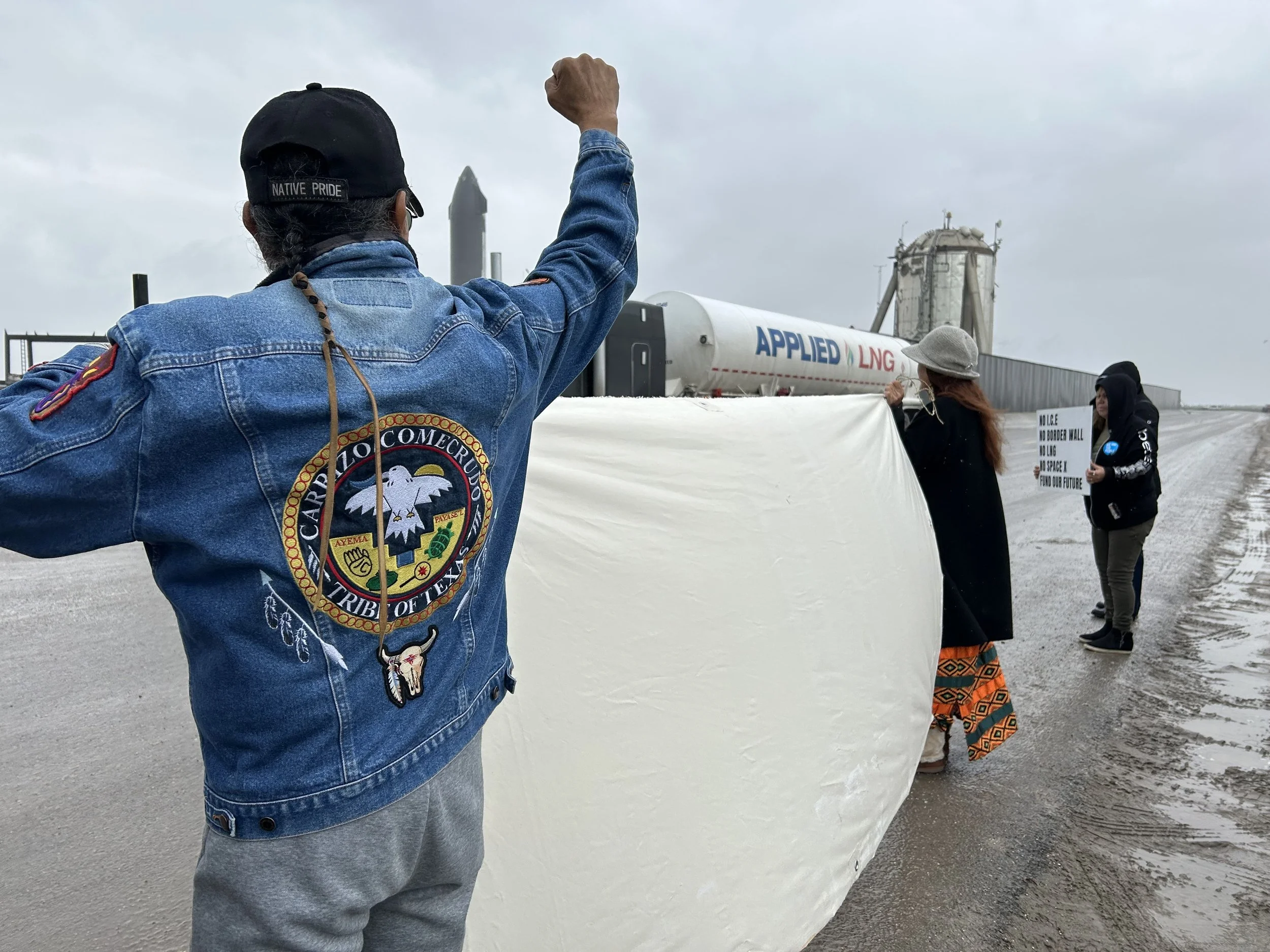
Esto’K Gna Somisek Tribal members protesting at SpaceX, January 28, 2023, Photo by Nansi Guevara.
In the cosmology of the Esto’K Gna Somisek peoples indigenous to the coastline of what is now considered South Texas and Northeast Mexico, the first woman was born from the river delta. Made up of everything that flows down the Rio Grande into the gulf, this original matriarch shared the qualities of not only the region’s unique plant and animal life, but the minerals, silts, and waters as well. During public artist and storyteller Nansi Guevara’s first visit to this sacred waterway, she immediately intuited this power in the river, though she didn’t yet know how to describe it. It was a place that helped her imagine life before the creation of the border and what a future might look like without it.
“The Rio Grande runs along the border in Texas, so the urban planning was designed to stop us from visiting. People still fish there sometimes, but in my neighborhood in Laredo for example, the Union Pacific Railroad tracks blocked us from going to the river,” Guevara says in an interview. “The first time I dipped my hands in its waters at Boca Chica Beach, I could feel its magic. Like us, the river and ocean blend together, and you can’t distinguish where one ends and the other begins. Not like the border wall that is this violent barrier, what Gloria Anzaldua called ‘an open wound, una herida abierta.’”
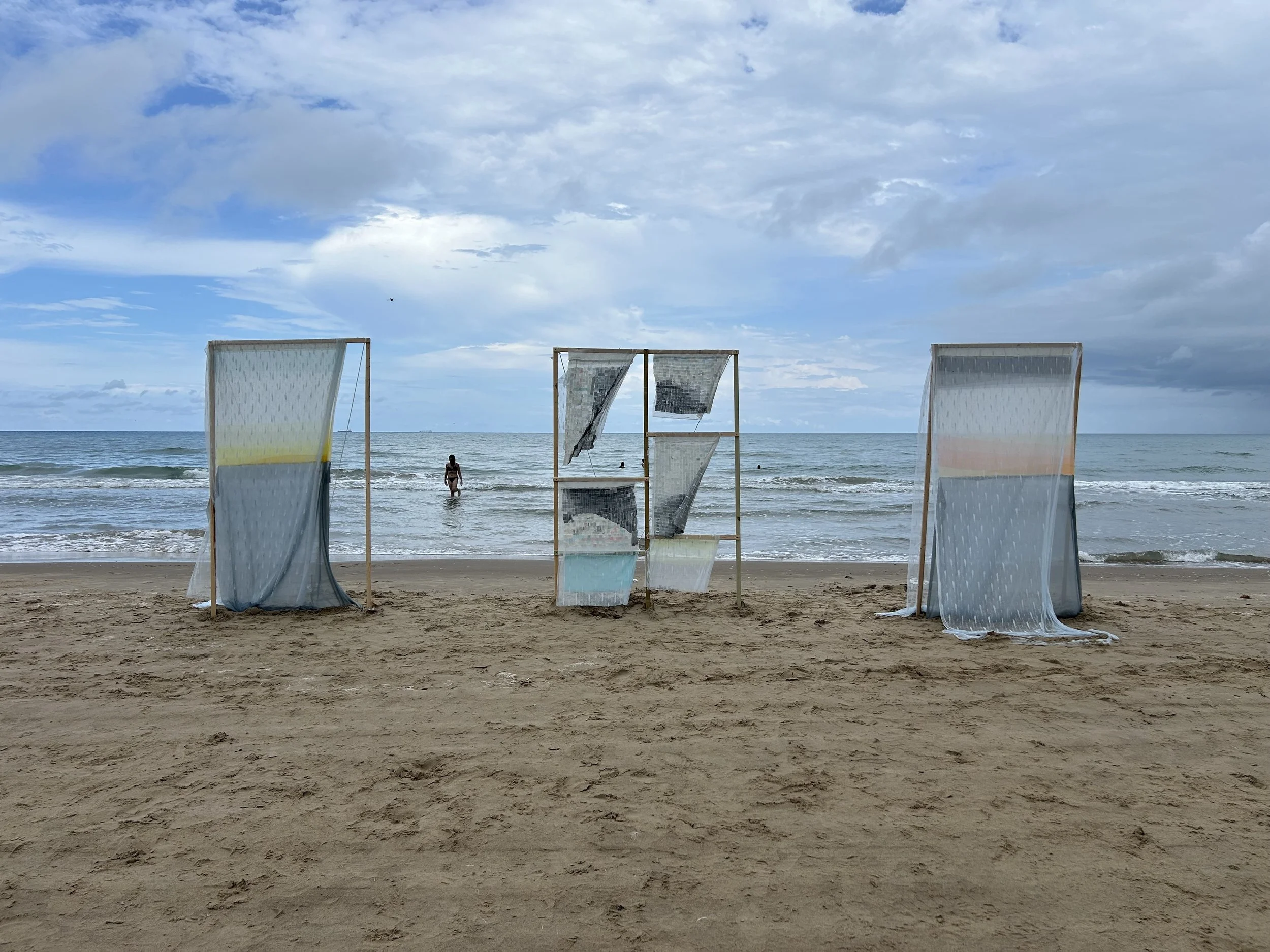
Nansi Guevara, Public Fabric Installation at Boca Chica Beach, 8’x24’, Boca Chica Beach on the Rio Grande Delta.
For the past decade, Guevara has devoted herself to the protection of cultural and ecological life in her adopted home of Brownsville, Texas. Employing her socially engaged practice to counter the common refrain, “no hay nada aqui,” Guevara not only makes South Texas’ rich cultures, histories, and wildlife more visible but also outlines possible futures centered in nurturing the land and each other. Often taking aim at extractive corporate behemoths like Elon Musk’s SpaceX, Guevara's nimble and expansive works strengthen the community bulwark against extractive industries colonizing the borderlands.
But when Guevara first moved back to Texas in 2016, she mostly focused on getting around without a car. Though she had always taken the bus growing up in Laredo and during her undergraduate experience in Austin, after nearly a decade away, she had forgotten the full extent of the car culture. Her return to South Texas for a National Endowment for the Arts–funded residency in Brownsville found herself equipped with just a bike.
“I rode everywhere on that bike,” she recalls fondly. “It was hard, but that’s how I got to know downtown. All the party shops, costureras, fabric stores, ropa usada, repair shops, street vendors selling candied apples, empanadas, flowers, everything.”
The city brought in Guevara and two other artists to support its ongoing initiative of “revitalizing” downtown Brownsville. Though Guevara set out to accomplish this lofty goal by centering community wisdom and needs, she quickly began to feel her vision was at odds with what city officials had in mind. “The city had these classist views of the ropa usada, repair, and mom-and-pop shops downtown and seemed to want to cater to wealthier people,” she says. “I think they envisioned a gentrified downtown, but I wanted to celebrate the cultural wealth and history that was already there. From my bike, I saw a downtown full of people making culture already, and I wanted to use my art to uplift their stories.”
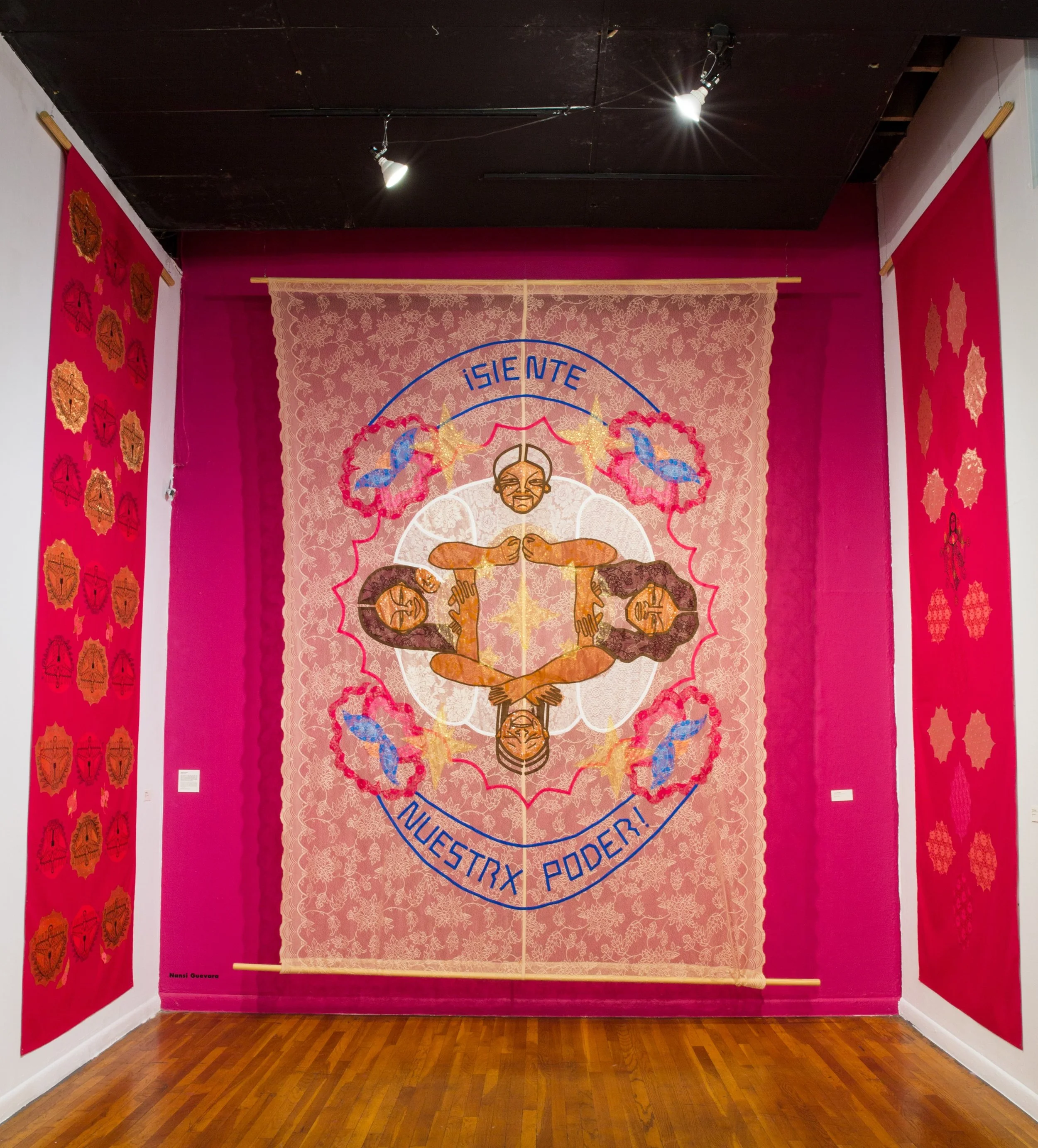
Nansi Guevara, Siente nuestrx poder, 2017, fabric collage installed at the Mexicarte Museum in Austin, TX, 12’ x 8.’
For this reason, many of Guevara’s early artworks in Brownsville drew on the everyday experiences and objects she encountered on her rides. She began stocking her bicycle basket with the artificial flowers from the party shops, inspired by a floral arranging class she took as a child at a Laredo community center with her mom. During the city’s annual CycloBia event, Guevara exchanged these flowers for dreams, asking those she encountered along her route to share their hopes for the future. “I didn’t document them at the time, but they were all really sweet,” she says of the responses she received from this intervention. “Things like, ‘I want to become this or that, I want to make my home better, help my family.’ It felt really special because on the border, we’re not really encouraged to dream beyond our means.”
Dreams became an organizing principle in Guevara’s work in downtown Brownsville, as she began collaborating with local businesses to organize community programs for women. Together, they produced healing circles and make-your-own chingona outfit workshops with ropa usada and local costureras to highlight the creative imaginations of women in the neighborhood. Through these experiences, Guevara became acquainted with local activists Maria Cordero and Dina Núñez, who she went on to honor in a large-scale textile work. Utilizing the aesthetics of domestic decor common to the region—floral print fabrics, glittering lace, hand-sewn embroidery, ofrendas, and more—Guevara’s portraits expand our understanding of activism from work done primarily in the public sphere (i.e. halls of government, city streets, plazas, etc.), to also include the homes, community centers, and churches where many woman-activists galvanize their communities.
However, this celebration of Brownsville’s woman-led activism in domestic spaces also uncovered a problem: Public space felt inaccessible to many Brownsville residents. As a socially engaged practitioner, much of Guevara’s practice revolves around this very issue, critically analysing who gets to occupy public space and how.
As a daughter, granddaughter, and great-granddaughter of street vendors, an early frustration in Guevara’s first year in Brownsville was the realization that the city had no permitting process for micro-businesses to legally sell their goods in public space. This lack of official permission was putting thousands of practitioners at risk of criminalization for going to work and making a living for their families. Guevara set out to make the streets of Brownsville legal for street vendors to occupy, not only in support of the sellers themselves, but for their families and the communities they serve as well. “Street vendors are connectors in our communities, place-keepers,” she asserts. “When we think about ‘revitalizing’ public space or ‘placemaking,’ we need to think of them first. They keep our cultural heritage alive, share our foods and spread ancestral knowledge. They are leaders in economic justice and the city needs to recognize that.”
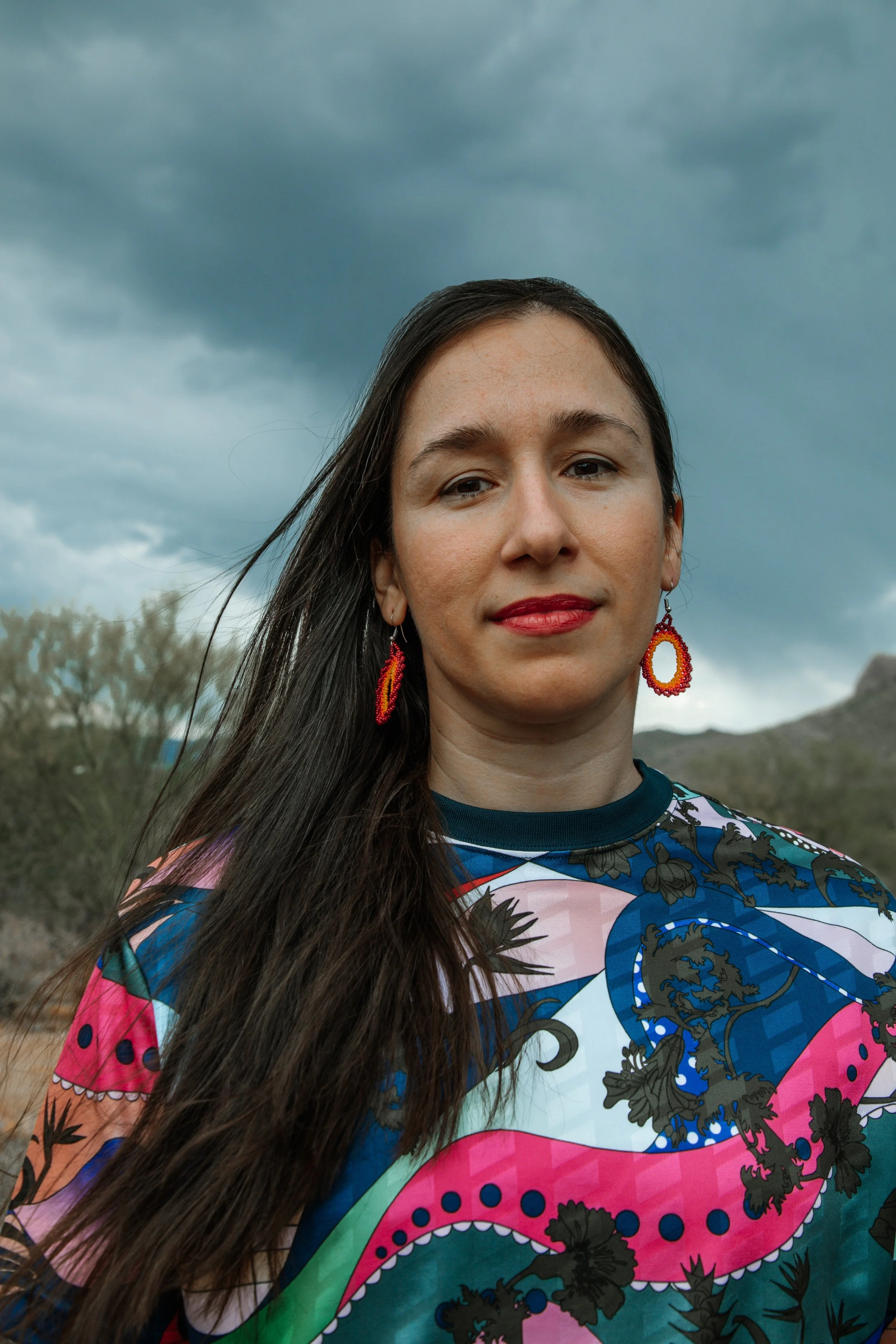
Nansi Guevara headshot.
Working with the then-artist collective Las Imaginistas, Guevara and her collaborators embarked on making this case to city officials, with the goal of obtaining official recognition (and protection) for the trade. Supported by hard-won grants from Artplace America and A Blade of Grass, they worked with local street vendors to produce a yearlong program of events highlighting the importance of micro-businesses to Brownsville, as well as gaps in civic policy that threaten their work. These programs included parades holding signs that read, “We deserve the right to dream” and “We give ourselves permission to dream,” pop-up markets featuring inventive tricyclo sculptures and local vendors, and “permits to dream” made in community and authorized by each other.
In an attempt to make these dreams a reality, Las Imaginistas also made connections with the local university to offer free professional development courses for micro-business owners and began conducting Spanish-language workshops to learn how street vendors envisioned the future of the city. By placing authorship of civic space (inclusive of health, economics, transportation) into the hands of these under-recognized cultural stewards, Guevara and her collaborators hoped to show city officials an inclusive and culturally sensitive vision of “revitalization” that could be beneficial to all.
However, around the same time, SpaceX was breaking ground on a private testing site just down the road near Boca Chica Beach. Developing rapidly, often without the required environmental review or construction permits, their move into the Brownsville area highlighted inconsistencies in the city’s rules for huge, invading industries versus small local businesses. “I saw how they would make everything easy for SpaceX, even though there were all these concerns in the community,” Guevara remembers. “But with us, they pretended to care but never ended up changing anything for street vendors. It’s still so disappointing. It feels like all our work never happened.”
While Guevara still maintains relationships with the street vendors she worked with during this time, and was even able to direct vital funds to their families during the height of the COVID-19 pandemic, the city’s attention was elsewhere. They never did create a permitting process for micro-businesses, nor did they implement any of the programs recommended by them. Instead, Brownsville was flooded with marketing promoting SpaceX and the earth-less future it envisioned. Public art depicted astronauts. Local businesses rebranded to fall in line with the new civic identity.
“Brownsville is very Mexican and many businesses were once painted bright colors,” Guevara says. “But since SpaceX moved in, storefronts have started to be painted white, gray, or black. Stores will add ‘Space’ to their names. Restaurants will have menu items like ‘Space Burgers.’ It’s trying to create this identity for our city like we didn’t already have one.”
Around this time, Guevara recalibrated her practice to focus on broader narrative change in Brownsville and beyond, envisioning an alternate future to the one extractive industries are currently selling the public. “This idea that ‘no hay nada aqui’ and that SpaceX put Brownsville on the map: they’re colonial narratives,” Guevara points out. “It’s not true. There’s so much that’s special about Brownsville and South Texas, and the idea that there’s nothing here just lets billionaire oligarchs take our land and extract labor from communities.”
Once again, looking to local culture bearers for the real Brownsville under the industrial hype, Guevara turned to her fellow artists and activists. Through these relationships and the histories they revealed, she became aware of an early 20th century ad campaign branding the city as the “Magic Valley,” an up-and-coming hub of mass agricultural industry. Reflecting on parallels between these historical advertisements and the contemporary astrocapitalist propaganda increasingly saturating Brownsville, Guevara developed a mixed-media installation-cum-altar entitled U.S. Militarism, Displacement, and Space (2022). In addition, she began co-organizing an exhibition of South Texas artists highlighting their responses to this synthetic, corporate placemaking.
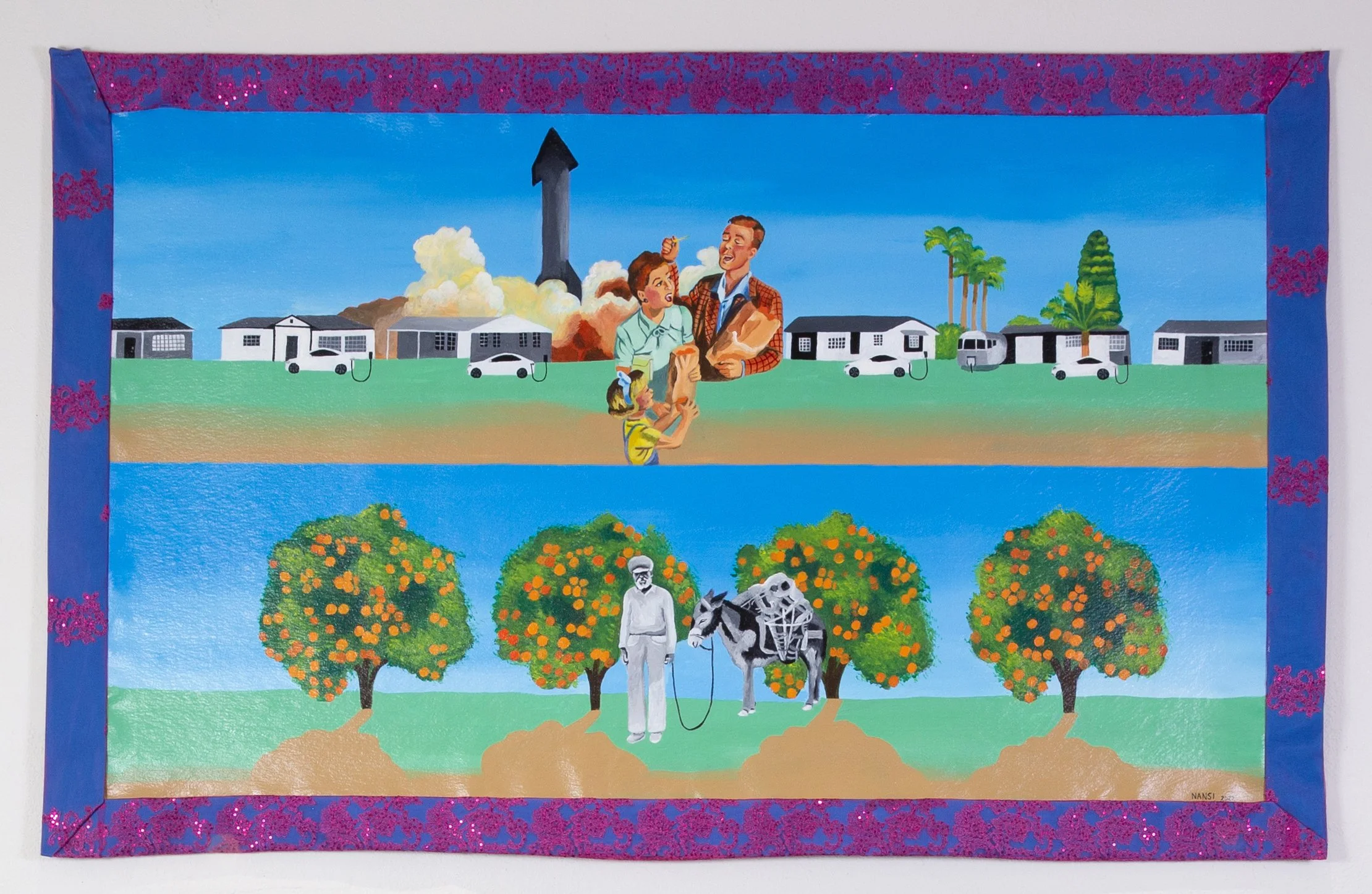
Nansi Guevara, U.S. Militarism, Displacement, and Space (detail), 2022, Mixed-media installation, 102” x 109” x 47”
Titled Nuestra Delta Magica: Settler Imaginaries & Community Resistance, this two-month exhibition soon became a much larger advocacy project tying South Texas’ history of colonization, environmental degradation, and social abuses to the arrival of present-day colonizers like SpaceX. With support from Anonymous Was a Woman (AWAW) Environmental Art Grants and the New York Foundation for the Arts (NYFA), Guevara and cocurator Monica Sosa elevated the voices of six South Texas artists and cultural workers to counter the idea that land is somehow empty until it is ‘developed,’ and that industry is an inarguable good for local economies.
“These extractive companies come in with the promise of creating more jobs and economic development. That’s a false narrative,” Guevara said during an artist panel for the exhibition. Nuestra Delta Magica’s richly researchedwebsite backs her assets, with news articles linking the arrival of SpaceX not with a newly thriving Brownsville, but with the destruction of nearly 100 acres of protected refuge land, attempted seizure of a beloved public beach, and a decade of waved corporate taxes that will never reach the community. Since this exhibition, SpaceX has left Brownsville behind altogether, creating its own incorporated city called Starbase. Populated exclusively by SpaceX workers, Starbase now sets its own civic rules to benefit the company. This insulation from civic consequences has been helpful as the company poses increasing risks to its workers, the surrounding environment, and even unwitting airline passengers passing through adjacent airspace.
Guevara has followed these developments with grim resolve, acknowledging her feelings of burnout but nonetheless pursuing narrative change and a dignified future for her community. “SpaceX is privatizing everything, exploiting our labor, killing our ecosystem, and buying out public space, but I’m still optimistic that this place can be better,” she says. “I can imagine our home without militarization, where state and local governments don’t create economic hardship, and our natural environment provides us with what we need.”
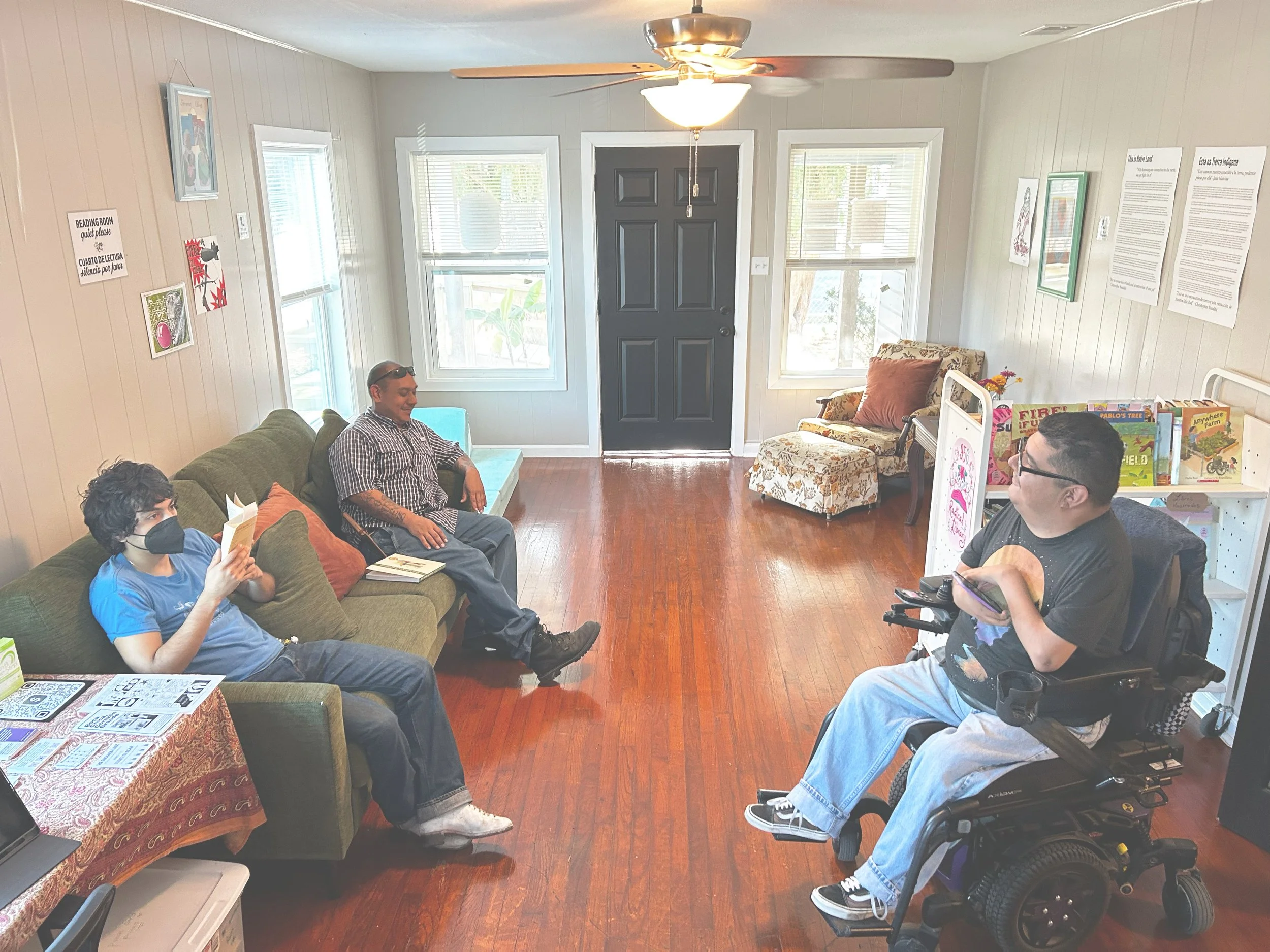
956 Radical Library’s reading and discussion room. Photo courtesy of Nansi Guevara.
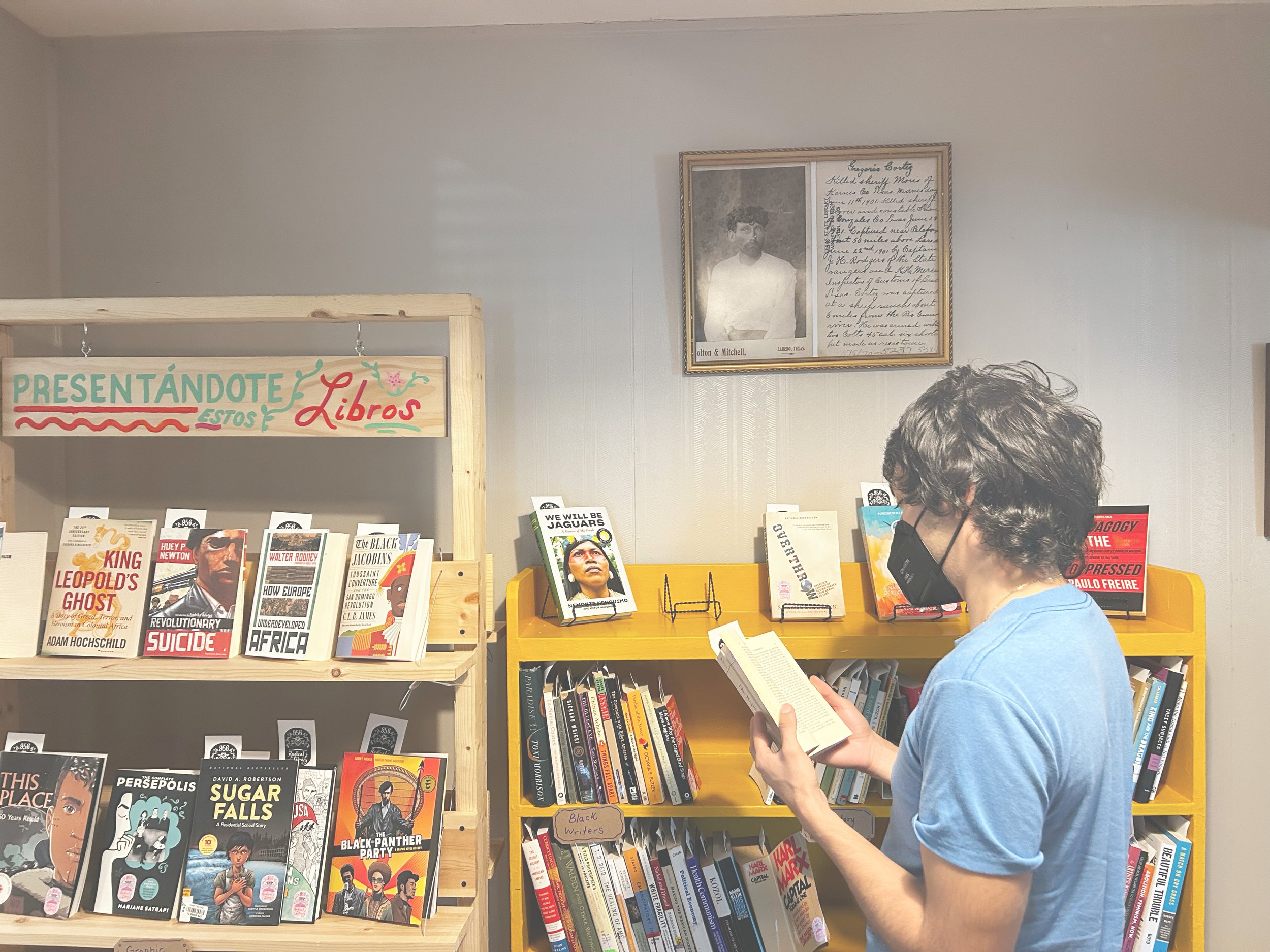
956 Radical Library. Photo courtesy of Nansi Guevara.
In service of making her dreams for the future more palpable to others, Guevara currently co-operates 956 Radical Library. Responding to the ever-increasing censorship in the state and its narrowly focused primary education curriculum, 956 Radical Library is an education hub stocked with books one might not encounter otherwise. Supported by the Mellon Foundation, the library’s volumes focus on Indigenous, Mexican-American, and Black history; social justice; and other topics banned from Texas public libraries and schools. Intended as a welcoming space for collective learning and unlearning, Guevara and her many collaborators host book clubs, discussion groups, and gardening instruction onsite.
“Spaces like the 956 Radical Library are important because we need access to our stories so we can claim our identities and care for our land,” Guevara declares. “We deserve books and education that isn’t indoctrination. I grew up inundated with this public messaging around immigrating ‘the right way,’ about industry being good for us, and a lot of other classist things from local politicians just using their platform to make themselves rich. It brainwashes people when you don’t hear anything else, and it manufactures consent.”
To Guevara, the impact of this indoctrination is currently on horrifying display in the recent killing of Alex Pretti by two agents from South Texas. “When we look at ICE killing protestors in Minnesota, we need to look to the borderlands because that type of policing started here,” she says. “I remember growing up seeing Latino border patrol agents, hearing Latino politicians demonize immigrants even when they’re descended from immigrants. People who hate being called ‘Mexican’ unless it's hyphenated with ‘American,’ like ‘Mexican-American’ is a step up. They think they can differentiate themselves through hate, but that’s another false narrative.”
Maintaining her laser focus on the stories we tell ourselves and each other about our place in the world, Guevara is singularly committed to manifesting a future at odds with our current trajectory toward deepening climate crisis, income inequality, police violence, surveillance capitalism, and space colonization. Quite literally envisioning better worlds through her work as an illustrator, she currently spends much of her time penning incendiary comics for local nonprofits and designing a children's book on the first Esto’K Gna Somisek woman with her longtime mentor and tribal chairman, Juan Mancias. She collects oral histories from her mother and grandmother on their youth and life working as street vendors and is writing fiction to share more hopeful, and importantly, possible dreams for the future with others.
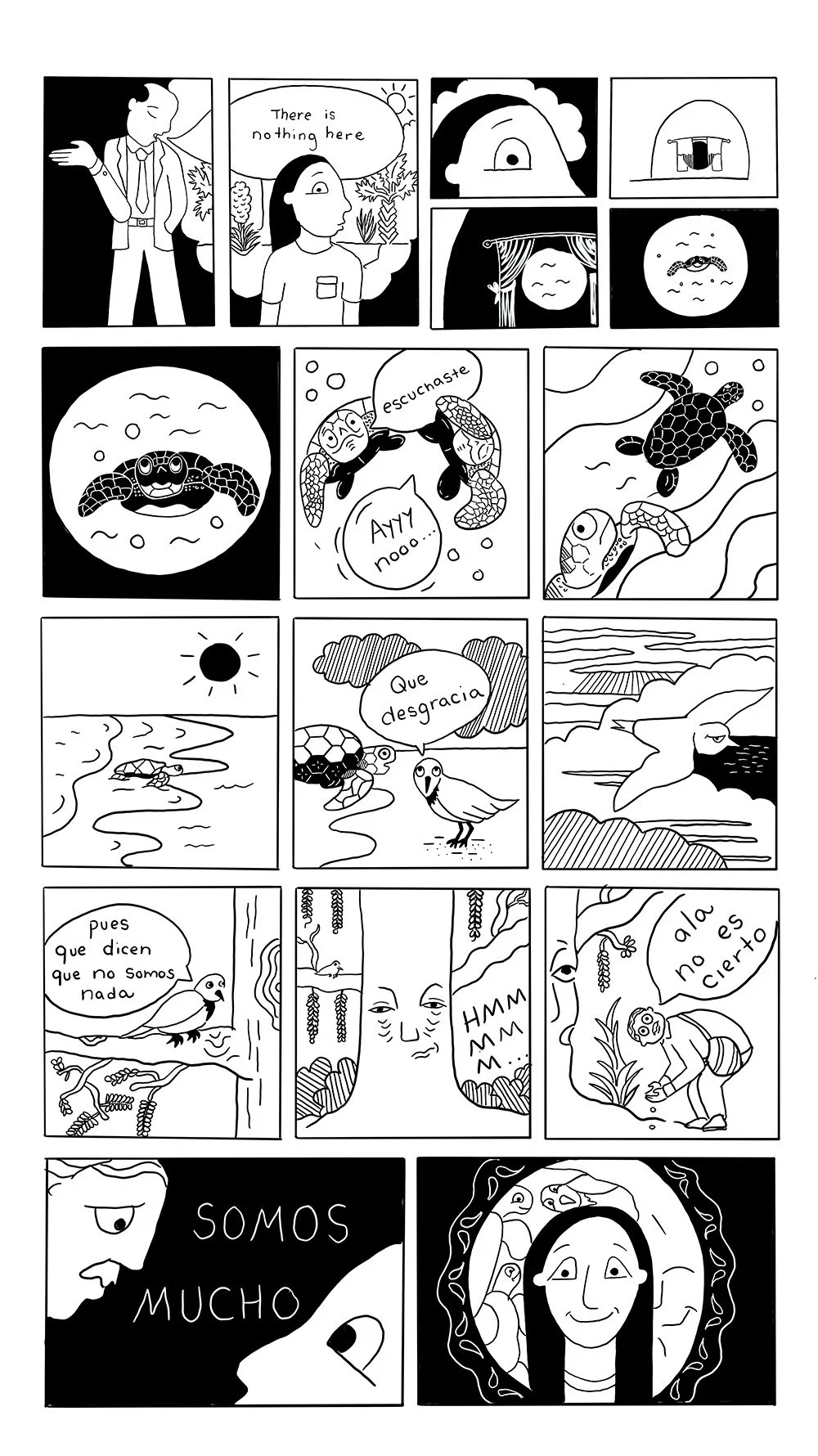
Nansi Guevara, Hay Mucho Aqui, 2024, Digital Print, 11” x 20.”
“Hay mucho aqui,” she proclaims proudly. “The natural abundance we see all around us is a testament to that, and that’s something I want people to take away from the work I do. My art will never stop being about the South Texas border. Here, immigration rights are environmental rights. It’s all blended together like the river delta, and there’s power in that togetherness. We get to decide what we want with our future here, not billionaire oligarchs.”