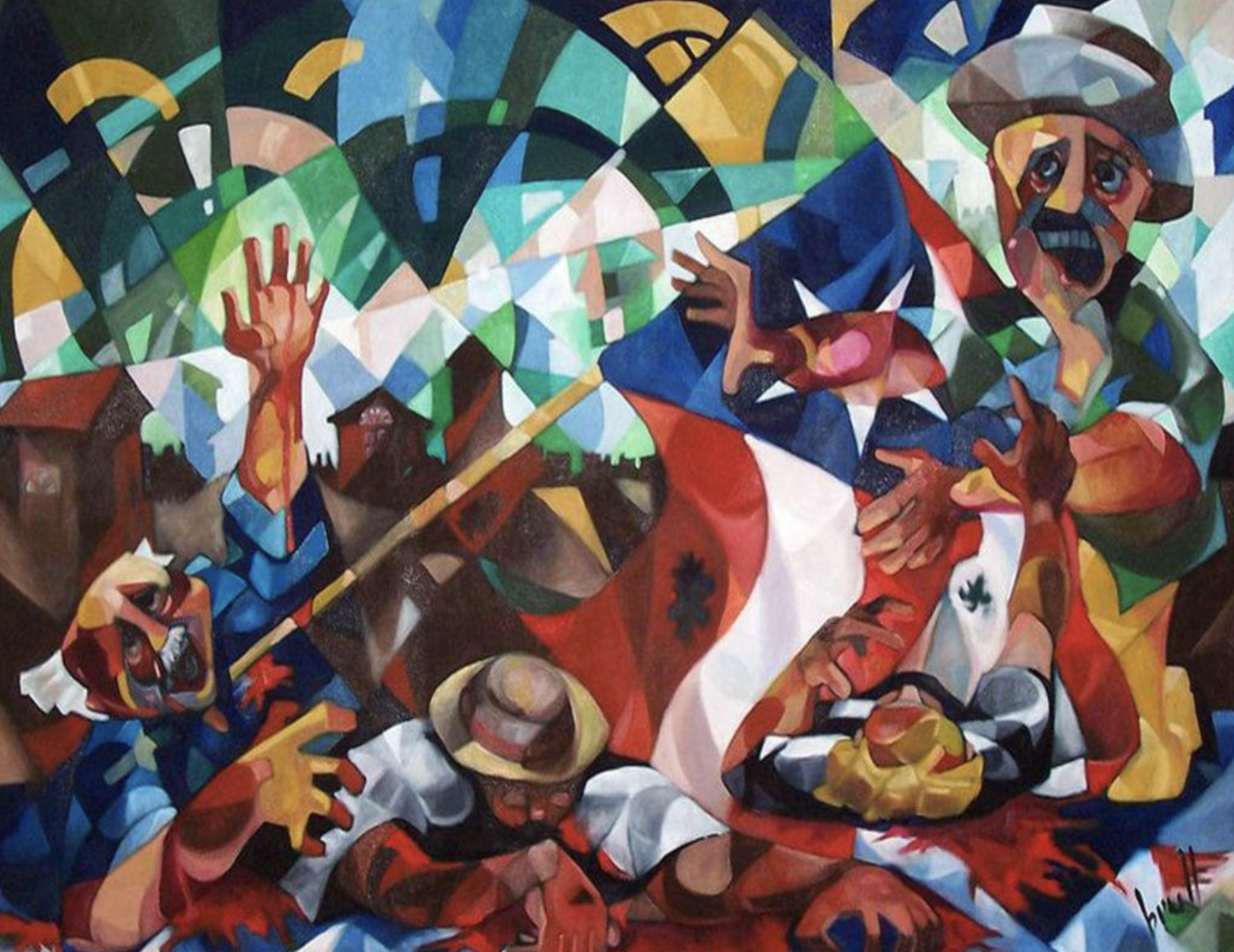
Pedro Brull, The Ponce Massacre (2007), oil on canvas, 39” X 36.”
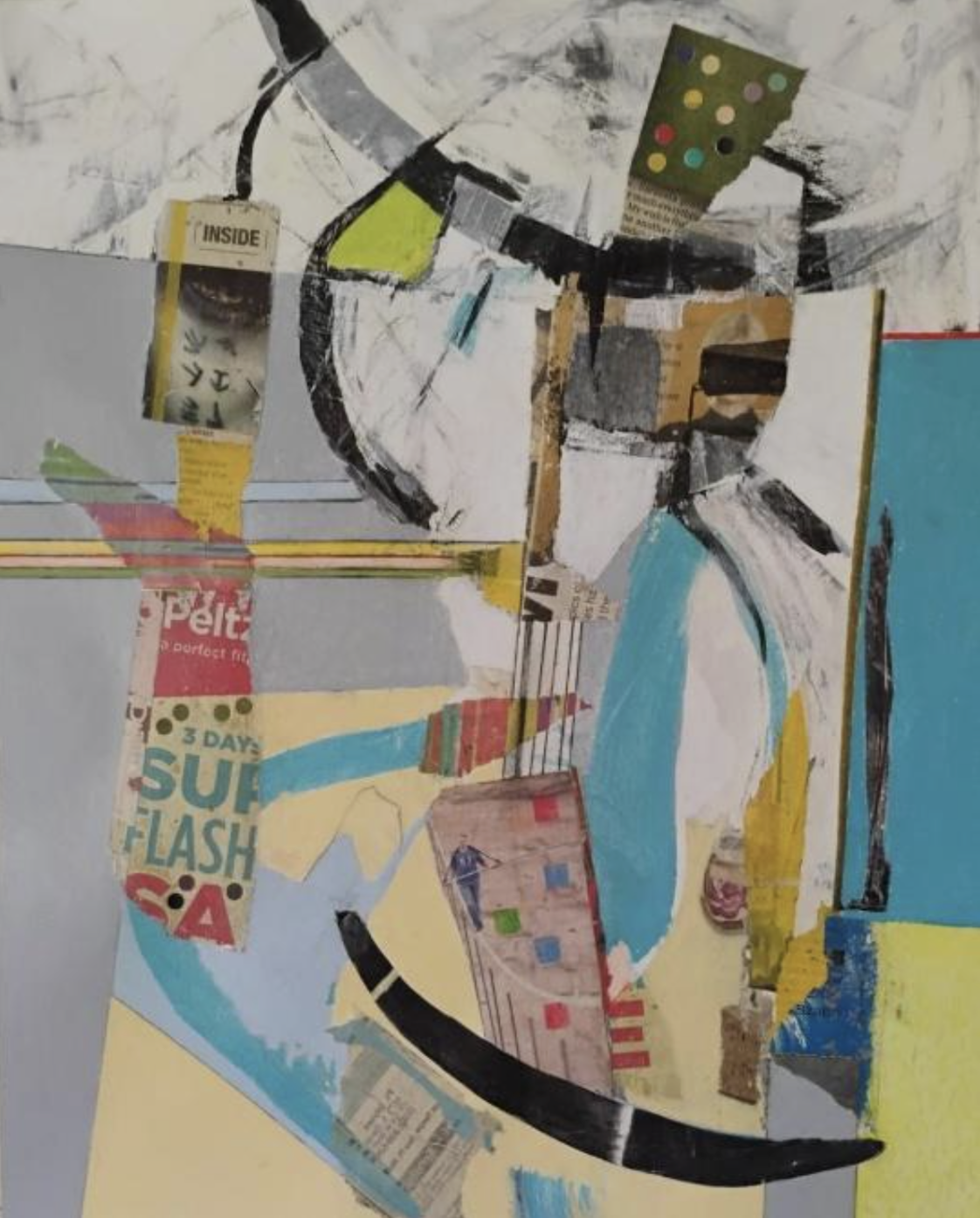
Peter Gaztambide, En la cuerda floja (2026), mixed-media /collage, 15” x 19 7/8.”
Artistic creation is a dynamic act inseparable from lived experience. It becomes real only when intention meets material, when gesture becomes mark, and when meaning emerges through practice. Creation is not a solitary event; it is a field of encounters where processes, methodologies, mediums, and realities converge.
For Pedro Brull and Peter Gaztambide, two Puerto Rican artists whose practices navigate the complex terrain between homeland and new geography, art reflects the dual condition of diasporic experience: rooted in cultural memory yet continually reshaped by movement, hybridity, and transformation.
To be part of a diaspora is to inhabit a space where memory and imagination meet. For these artists, this condition is not merely biographical; it’s also generative. Their works emerge from the tension between homeland and the U.S. mainland, what is carried and what is discovered, and longing and becoming.
Examining their practices within the broader context of Puerto Rican diasporic production—a terrain defined by cultural memory, geographic displacement, and the ongoing mediation of identity—it becomes clear their works speak to the long‑complicated ache of belonging to one landscape while living in another. Brull and Gaztambide share formative experiences rooted in Puerto Rico, where they grew up and went to school before relocating to the United States. Diasporic production is not simply a reflection of displacement; it is an aesthetic condition shaped by fragmentation, continuity, longing, belonging, and reinvention. Both artists transform inherited symbols into visual poetics capable of resonating across boundaries.
When it comes to art making, I think about the moment intention meets material and the hands that move the gesture becomes a mark. There is a quiet insistence that meaning will emerge with practice. For Brull and Gaztambide, art is not an escape from life; it’s life made visible.
Although they have never met, their work speaks to each other. Both explore what it means to live away from home. Both transform memory into material. Both create art that bridges the personal and the universal. Their practices share a profound commitment to identity, heritage, and cultural continuity. They activate identity rather than reproduce familiar motifs—Brull through narrative figuration and cultural testimony, Gaztambide through abstraction, chromatic intensity, and structural experimentation.
Within this evolving landscape, Brull and Gaztambide exemplify how diasporic artists navigate displacement through strategies of imagery, material memory, and cultural exemplification. Their work demonstrates that identity is not a fixed point but a dynamic field of encounters—one that expands, transforms, and connects.
Their works share a profound commitment to identity, heritage, and cultural continuity. Both artists activate identity. Rather than reproducing familiar motifs, they reimagine them—Brull through narrative figuration and cultural testimony, Gaztambide through abstraction, chromatic intensity, and structural experimentation.
What they have in common is conveyed in the works they’ve created that are not only artistic objects, but testaments to identity, memory, tradition and belonging. They navigate the complex terrain between homeland and a new place; it reflects the dual condition of the diaspora experience rooted in cultural memory, yet shaped by movement, hybridity and transformation.
The story of Puerto Rican art in the Diaspora is, at its core, one of movement, people, memory, and cultural forms that travel, transform, and take root in new geographies. In the 20th and 21st century, Puerto Rican artists living outside the archipelago shaped vital aesthetic languages that explore the complexities of migration, identity, and belonging. From the Nuyorican movement of the 1960s and ‘70s to contemporary multimedia practices, diasporic artists have interrogated colonial histories, migration narratives, and the politics of inclusion. Their work has shaped regionally specific diasporas across the United States, including the rapidly expanding Puerto Rican communities in Florida.
The works they created are a conversation with memory, with place, and with the long-complicated ache of being from one place and living somewhere else. They speak of Puerto Rico and its traditions, but also of migration, adaptation, and the creation of new forms of belonging. Their practices illuminate the diasporic condition as a space of expansion—where memory becomes material, identity becomes dynamic, and art becomes a bridge between the personal and the universal.
For Brull and Gaztambide the condition of living in the diaspora is not only defined by displacement; it is also defined by expansion. It is a space where identity becomes dynamic, where memory becomes material, and where art becomes a bridge between the personal and the universal. It generates hybrid languages that hold multiple stories at once.
Gaztambide maintains his own artistic appeal and individuality, which differs from Brull whose works remain deeply rooted in tradition. What both share is a shifting dimension shaped by the complexities of living away from their homeland. It explores the contours of diasporic in-depth knowledge that many of the artists experience as they reside outside of their homeland, thus becoming invisible and overlooked by the cultural and arts establishments.
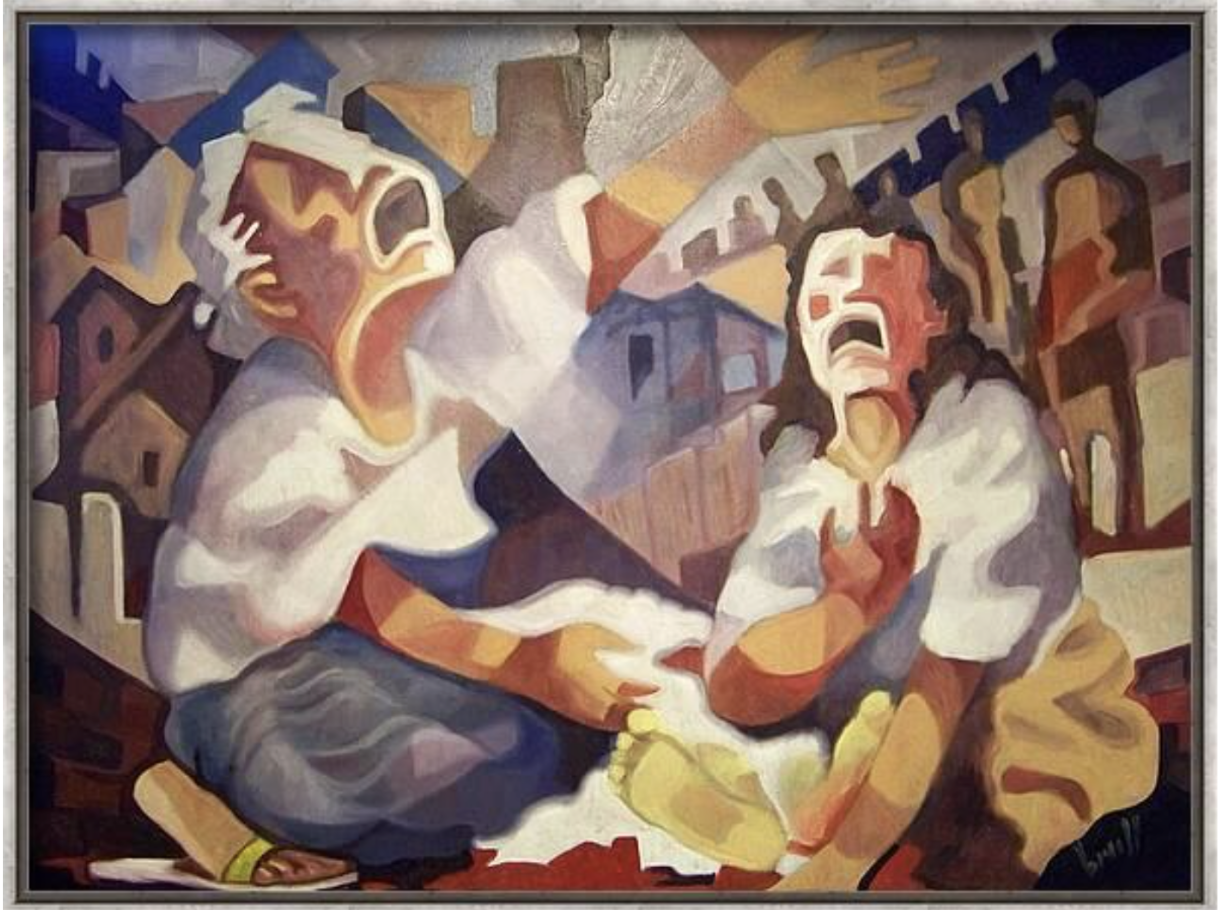
Peter Brull, The Cry (2017) from the series Ponce Massacre, oil on canvas.
Brull is a multifaceted person. Although he studied art, he became a scenic designer and a muralist. For many years, he was also a pastor running a church in Vega Baja. This role brought him to Florida. In that position, he made incredible contributions to alleviating the alienation and dislocation of Hispanics in the region.
Brull has lived in Florida for 30 years, building a career and continuing to produce artwork. His trajectory reflects the structural challenges faced by diasporic artists. Despite decades of production, he encountered repeated institutional rejection in both Puerto Rico and Florida. He built visibility through community spaces, grassroots exhibitions, and cultural leadership—work that stands as a testament to resilience and the persistence of cultural memory. His leadership was formally recognized when he earned the title “Father of the Florida Puerto Rican diaspora.”
Brull’s practice emerges from a tactile engagement with memory and ancestry. His works often address migration, historical memory, and sociopolitical events. Working across painting, mixed media, and printmaking, he creates compositions that feel archaeologically layered and insistent. His materials, paper, pigment, fabric, and domestic textures, function as carriers of cultural inheritance.
Brull’s diasporic approach juxtaposes landscapes, bodies, archival traces, and symbolic markers, creating compositions suspended between past and present, between island and mainland. Brull creates national art by capturing and painting its people and cultural traditions. His approach is distinctly diasporic; his images juxtapose landscapes, bodies, archival traces, and symbolic markers, creating compositions that feel suspended between past and present, between the island and the United States mainland.
Brull uses narrative and figurative references to address the issue of migration, historical memory and socio-political events in his artworks. His works are charged with emotional intensity, such as in The Ponce Massacre. The piece revisits the tragic 1937 event in which police opened fire on a peaceful march, killing civilians and wounding hundreds. The Puerto Rican Nationalist Party organized a march to commemorate the abolition of slavery and to protest the U.S. imprisonment of the party's leader, Pedro Albizu Campos.
In another notable series, Brull explores the catastrophic aftermath of Hurricane María, both the social effects on contemporary mass culture often with reference to historical events and subsequent difficulty recreating the emotions caused by the hurricane. In his mixed-media series What Maria Left, he captures drama and movement pulsating with the devastating aftermath of Hurricane María in Puerto Rico. In a catalog for an exhibition on his work, Camilo Velazquez, the curator at Anita S. Wooten Gallery at Valencia College, wrote that in one of Brull’s paintings “a woman handwashes clothes in open air under a blue tarp surrounded by ominous, leaning power lines and debris. Through this image, Brull has created an iconic female symbol of struggle and resilience.”
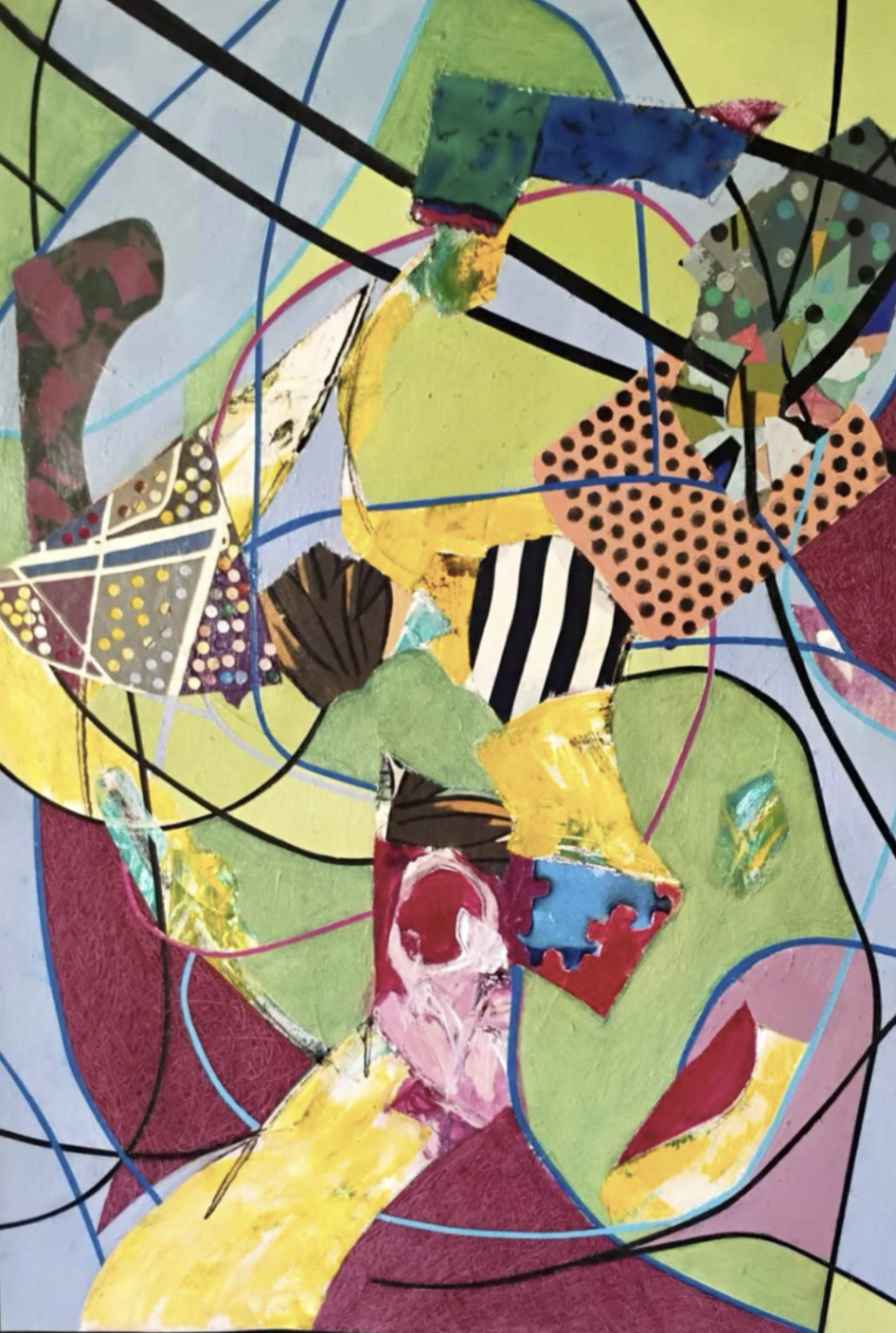
Peter Gaztambide, De donde tela (2026), mixed-media on paper, 15” X 19 ¾.”
Unlike Brull, Gaztambide’s work holds and understands that art could carry memory, identity, and worldview without literal representation. His abstract language—rooted in balance, color, texture, and compositional rigor—still reflects emotions and his subjective vision rather than representing the natural world. Abstraction, for Gaztambide, is not freedom without limits; it is a disciplined practice governed by structural integrity and chromatic harmony.
Gaztambide’s artistic journey has been marked by resilience, curiosity, and devotion to craft. Through decades of disciplined exploration, he has created a body of work that is both deeply Puerto Rican and expansively global. His paintings are layered world‑sites where color, culture, and memory converge, carrying the pulse of Caribbean lyrical abstraction and a remarkable exploration of various forms of abstraction, constant innovation and expressive fusion of conventional and unadventurous materials that stands as a testament to the power of art to transform lived experience into lasting meaning. Gaztambide values all aspects of life, no matter how seemingly insignificant, and seeks to interpret them through his art. He aims to break down barriers for other creators and adapt to new technologies to reach a wider audience.
Gaztambide’s formation unfolded through apprenticeships with renowned Puerto Rican artists, including Eliasim Cruz in serigraphy and poster design; Armando Rubbo in drawing, design, printmaking, and painting; Wilfredo Labiosa in monotype; John Balossi in ink drawing, ceramics, and metal sculpture. Lope Max and Antonio Navia guided him into experimental painting. During this fertile decade, he founded Galería sin Paredes, one of Puerto Rico’s earliest itinerant galleries—an emblem of his belief that art should move freely through the world.
By the early 1980s, Gaztambide became a respected serigrapher, producing prints for artists including Francisco Rodón, Lorenzo Homar, Andrés and Andy Bueso, and Ralph de Romero, during those years his position within the canon of Puerto Rican and Caribbean abstraction was firmly established. These collaborations handed him not only technical breadth but also a deep sense of cultural belonging where he felt welcome and connected.
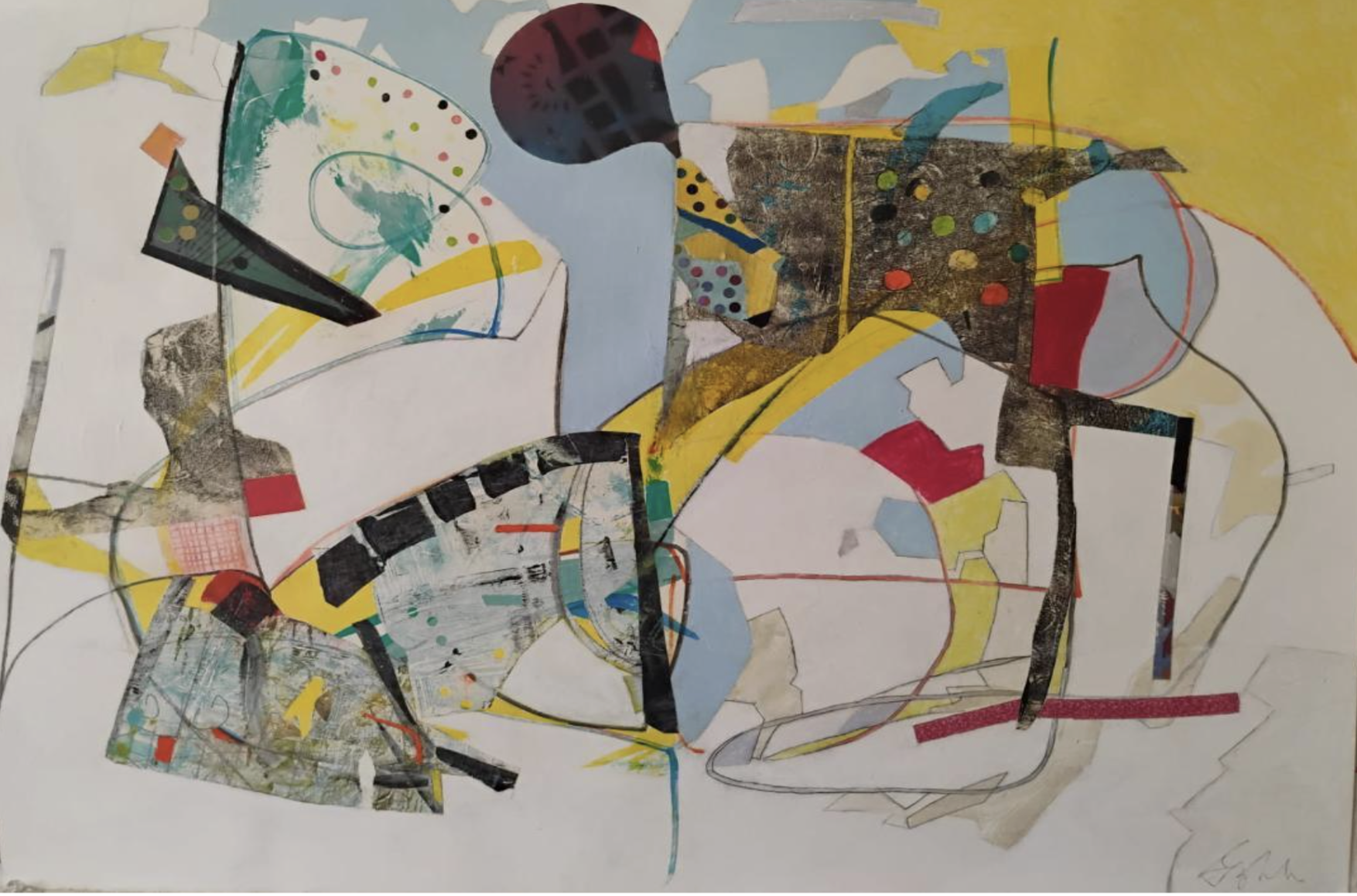
Peter Gaztambide, No hay peor ciego del que no quiere ver (2024), mixed-media on paper, 15 ¼ X 20 ½.”
His career spans significant exhibitions in Puerto Rico, earning him an impressive following. He exhibited at prominent galleries such as Galería Botello, Galería Coabey, and Galería Guaraguao, and at institutions including the Museum of Contemporary Art of Puerto Rico (MAC), the Museum of Latin American Printmaking of the Institute of Puerto Rican Culture, and the National Center for the Arts.
Gaztambide returned to Florida, his birthplace, in 1985. The scarcity of exhibition spaces forced him to adapt to an atmosphere of invisibility, yet he persisted, exhibiting in group shows in the regional art organizations and continuing to participate annually in Hispanic Heritage Month exhibitions at the Tampa Arts Council, the Atlantic Center for the Arts in New Smyrna Beach, the Arts and Humanities Council of Charlotte County, the Englewood Art Center, the Sarasota Cultural Center, Maria Sonia Martin Gallery in Miami, and Art for ACT Gallery in Fort Myers, among others.
His art is held in public and private collections worldwide, including the Paris National Library (France), Ibero-American Institute (Berlin), National Museum of Modern Art (Tokyo), British Museum (London), Valencia Museum (Venezuela), Modern Art Museum (Brazil), NYC Printmaking Workshop, Arts and Sciences Museum (Daytona, FL), Dominican Republic National Library, Institute of Puerto Rican Culture (San Juan), and University of Puerto Rico’s Museum of History,
Gaztambide has had an impressive trajectory. Although he did not pursue formal art studies during his early university years, a single course at Loyola University in New Orleans—Art for Non-Art Students—ignited a lifelong commitment to artistic practice. His autodidactic approach, marked by discipline and experimentation, eventually led him to acquire knowledge often associated with formal training.
This academic experience formalized his practice while preserving the experimental ethos that had defined his earlier trajectory as cultural anchors within nonfigurative compositions. They evoke humor, wisdom, and the oral traditions of the island, embedding Puerto Rican identity within nonfigurative compositions.
Many of his paintings carry a historical dimension since the titles represent scenes characteristic of his hometown customs and character. The titles whisper the wisdom of the island that for many years were drawn from Puerto Rican proverbs and folk expressions.
Works such as, Pancha plancha con cuatro planchas, and en la cuerda floja activate narrative inside layered shapes, gestural marks, and chromatic contrasts. Through these titles, Gaztambide activates narrative and fiction inside works full of chromatic intensity, irregular shapes, and layered textures. His paintings become spaces of transit, where cultural memory and abstraction meet.
He uses asymmetry and chromatic contrast to evoke spontaneity. Ni fu ni fa explores tension and balance through layered shapes and gestural marks, reflecting the proverb’s cautionary wisdom. This style is understood as a location of transit from which fiction and narrative are activated in diverse works full of complexities, which he achieves by richly mixing shapes and filling it with a mixture of irregular color, memory and reinvention, belonging and beyond.
Together, Brull and Gaztambide illuminate the diasporic condition as a space of expansion rather than rupture a dynamic field where identity transforms, memory materializes, and art becomes a bridge between personal and universal experience. Their works remind us that cultural continuity is not static; it is activated through practice, reinvention, and the persistent desire to belong. Their practices illuminate the diasporic condition as a generative space, one where identity expands, memory materializes, and art becomes a site of connection.