
Creative Fronterizxs: A Spotlight on RGV Artists
In summer 2024, Professor Arlene Dávila (NYU) and Ph.D. student Orlando Ochoa Jr. (NYU) traveled to the Rio Grande Valley of South Texas to meet with artists and organizations like Cactus Valley Art & Supply Company, Resistencia Fronteriza, and Trucha RGV based across the lower and upper parts of the region. Following a series of studio visits, they organized a community dinner and conversation in Flowershop Art Studio, an art space Jesus Treviño founded in 2022.
The insights local artists shared are in a chapter titled “Visual Artists on the Frontlines” in Dávila’s forthcoming book, Visualizing Latinx, with Duke University Press. By no means comprehensive, what is offered here is an edited part of the conversation and a glimpse into the creative, activist, and community work of local artists. This area has a rich and evolving network of artists and activists who respond to the entwined issues of settler colonialism, gentrification, border militarization, and the general devaluation of the region’s life. Cultural production from the 956 reflects the Rasquache ethos of making do with the at hand and underscores the role storytelling plays in creating change en la frontera.
Acknowledgements: We thank Josué Ramirez, cofounder of Trucha RGV, for the time and generosity in introducing us to artists as well as offering helpful feedback. Any errors are entirely our own.
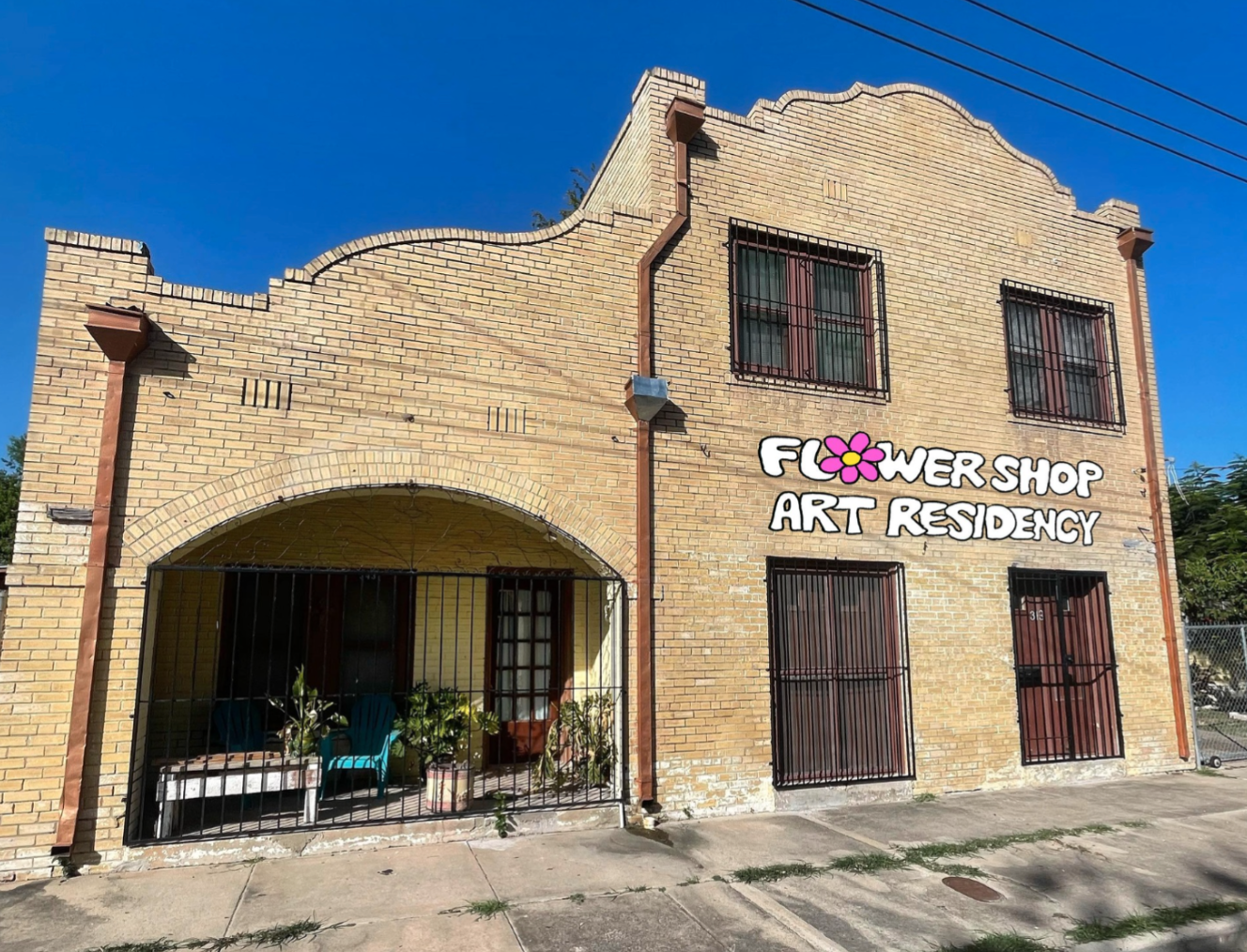
Flowershop Art Residency (Frontera Arts in Bloom). Image courtesy of Flower Shop Art Residency.
What does it mean to be an artist and make art in the RGV? What makes the Brownsville art community unique?
Josué Ramirez: There's obviously visual cues that stand out. But I think one, for me, is the self-taught aspect. People who just kind of do things and kind of learn trial by fire because they see a gap in things or just want to learn.
It reminds me of the punk scene, It's a very DIY, fuck the system kind of mentality. We gotta do it ourselves because no one's gonna do it for us.
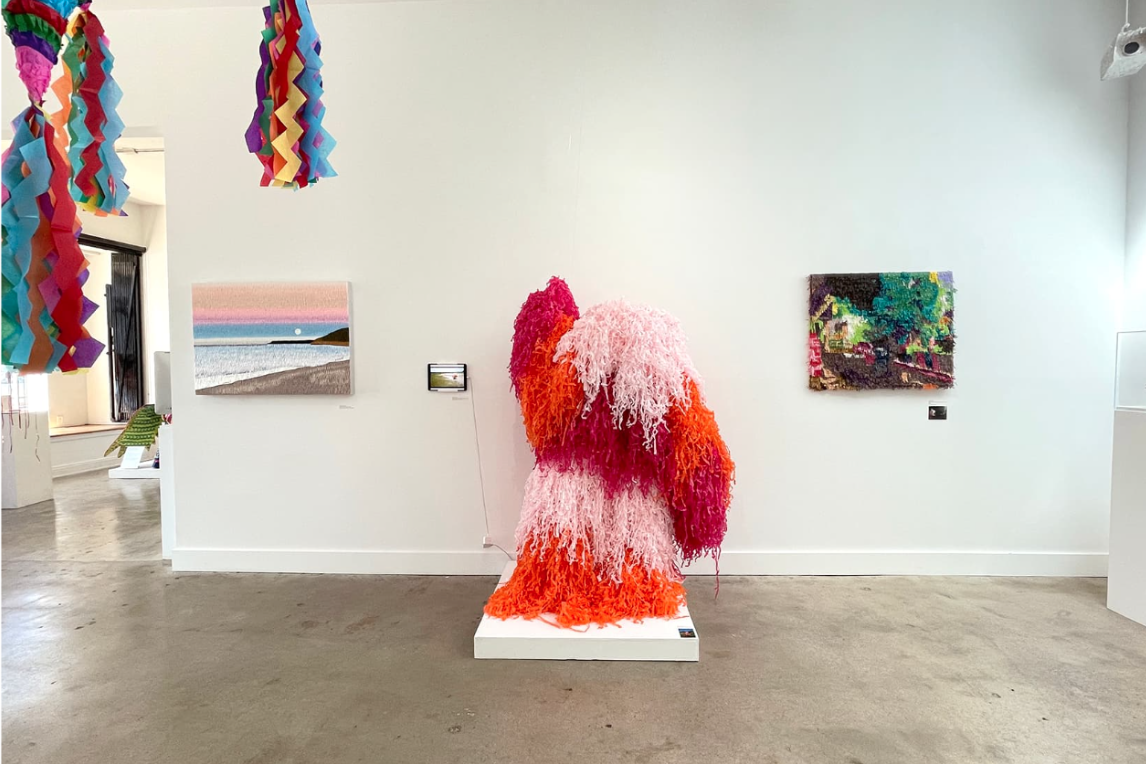
Josue Ramirez, Piñata People (Orange) Installation (2021). Photo courtesy of Madison Metro, Craft in America.
Sam Rawls: I think for most of us, our parents have always pushed us somewhere else. We've always been pushed to a medical field down here. I feel like a lot of us push ourselves with our artwork here to just show that this is important.
As artists, we are telling stories that not everyone gets a chance to. It helps us connect with each other and continue that dialogue with other artists who are coming in and who are emerging.
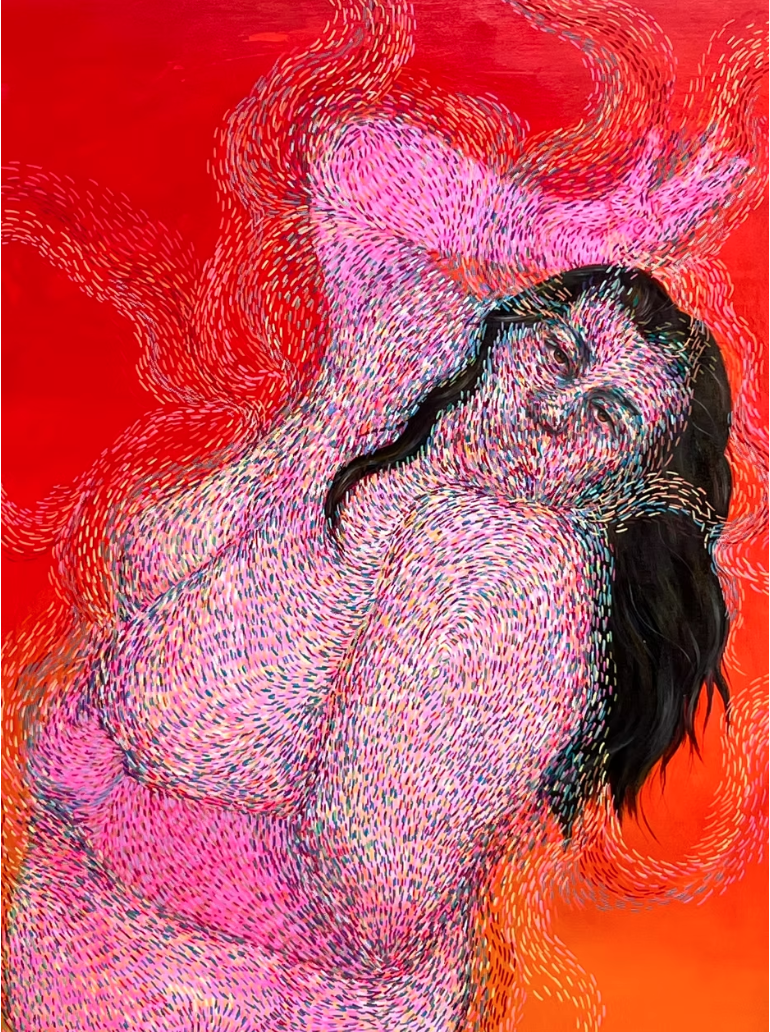
Sam Rawls, Una Balada Cromatica (2023), acrylic and marker on canvas, 36’’ x 48.” Photo courtesy of Sam Rawls.
Monica Sosa: I feel like the valley is contained in many different ways and it's challenging because we have the same histories repeating themselves and the same kind of inequities of wealth and resources that are not distributed within the community.
I had to leave because of the lack of resources. But in my experience working as an arts administrator and working on border initiatives, it's obvious that our communities are creating amazing work across the borderlands. Art is a lifeline for people in ways that you just don't see in other places.
Dolissa Medina: As a filmmaker, it's so frustrating that sometimes I'll see independent filmmakers either who are from here or who are coming down here. It’s like, “Wow, they're coming here to make a movie.” And they’re like, “Yeah, we’re gonna do something original.” And it’s just the same tired story about narcos.
And what a failure of imagination. Is this all that we think we are? Is this all the storytelling that we think we're capable of? Where do we see reflections of ourselves? For me, the kind of work I want to do, just, like, even portraying our celebration of childhood or these kinds of images, just this kind of representation of beauty, of things that you have not seen before. What that can do to decolonize someone, I think in cinema, it's especially important.
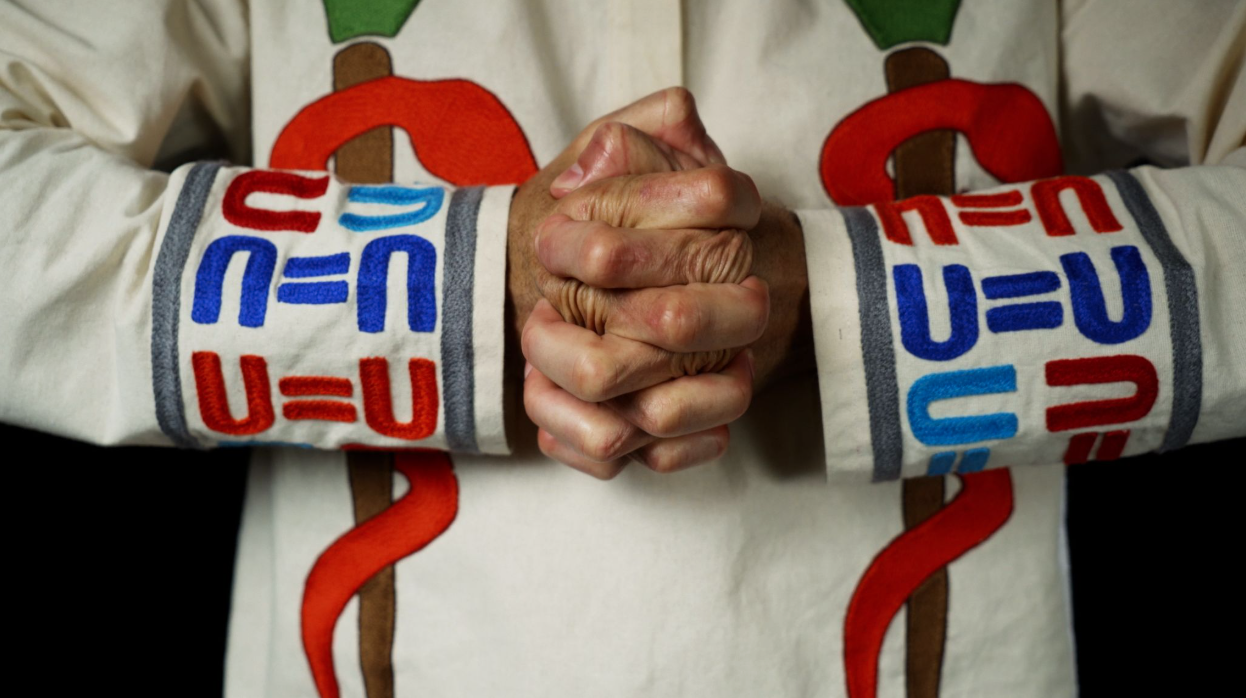
Director Dolissa Medina and collaborator Gera Ananias P. Soria, still from Viejito/Enfermito/Grito (Old Man/Sick Man/Shout), 10 minutes, 2023. Courtesy of Dolissa Medina and Gera Ananias P. Soria.
Marcelina Gonzales: In the news, when we’re mentioned, it was about murder and Matamoros or it was about drugs. Nothing was a positive storyline. So I told myself, “I'm here in America. I'm gonna present myself as American as I can.” So I dyed my hair blonde. I tried to really fit into that character, and that was because of shame.
I did not want to be associated with anything relatively Mexican. I don't speak the language anymore. I totally just stopped speaking because of the embarrassment. With my art, I'm trying to say, “Sorry for all that. Sorry for being embarrassed. I'm proud of how I grew up, where I came from, my family.” So all the works are about apologizing to my younger self and trying to appreciate the way I came up. I was very lucky that it was like a beautiful, full of love family, and I'm just trying to recreate that and forget about all that shame, trying to heal.
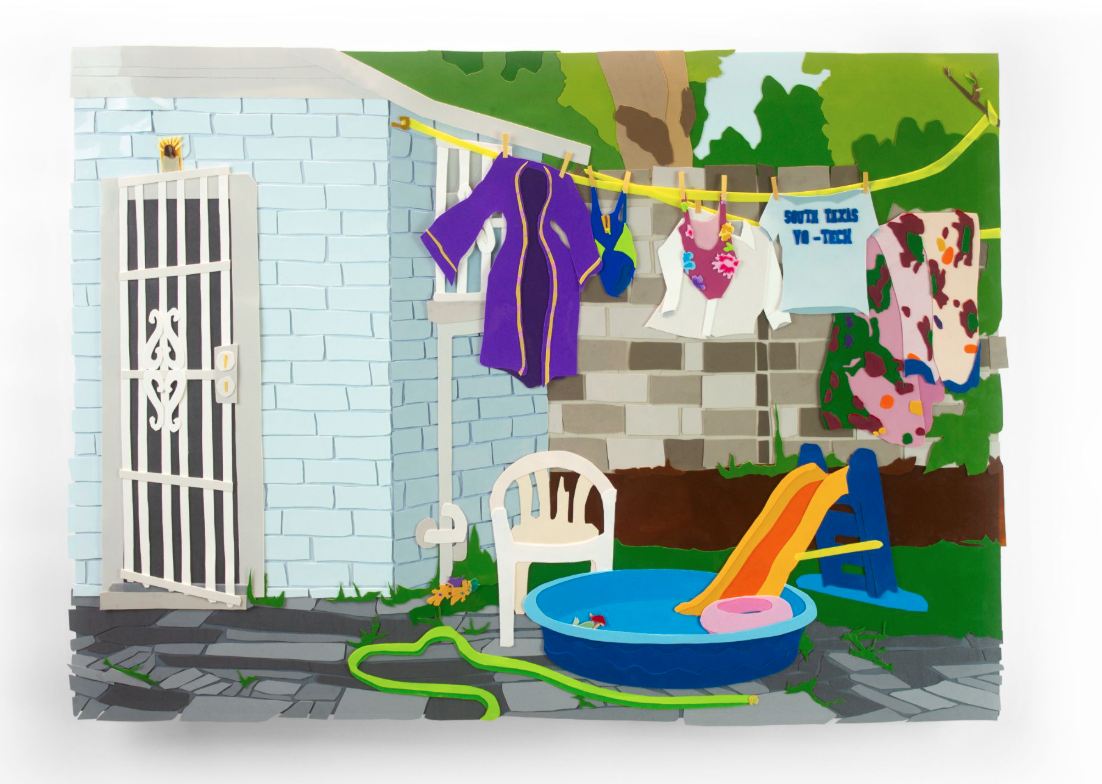
Marcelina Gonzales, Sunny South Texas at our casita, tinted resin cut and collaged on wood. Courtesy of Marcelina Gonzales.
Ramiro Gonzalez: I used to think there was nothing here in the valley. I wasn't educating myself on what was out there. Once I began involving myself in the arts, involving myself with creatives, I started seeing the value of making. We can scratch the surface and kind of see what's really in our own home. If you have something you want to bring in or a calling, there's different orgs in the valley to do that with. There's different collectives you can work with to kind of put art together.
From our studio visits, we learned that recovering histories, retelling, going back to the past to reexamine and honor it seems to be an important component of your work. Can you talk about your practice and why this approach is so critical?
Gina Gwen Palacios: I was living in Austin at the time—San Antonio and then Austin—and going back and forth. I would drive through the landscape as fast as I could. It's so flat and boring in my mind. It wasn't until I started realizing that all the fields that I passed were the ones my parents picked and that generations of people here pick and still work the land.
The landscape took on a whole different meaning. Whenever my parents did tell stories, I think of generational trauma, but I also think about generational joy. Because my mom was like, “Oh, no, I was with all my cousins, and were all together and laughing, even though it's very hard labor.” I started trying to think, “Well, how do I make work that goes between those two things of trauma but also joy?”
I started making a lot of landscape paintings or working, but it was mainly to look back and dig that history. My parents used to say, “Don't tell anybody. ¡Qué vergüenza! Why are you sharing that?” Now they don’t say that. Suddenly it’s art.
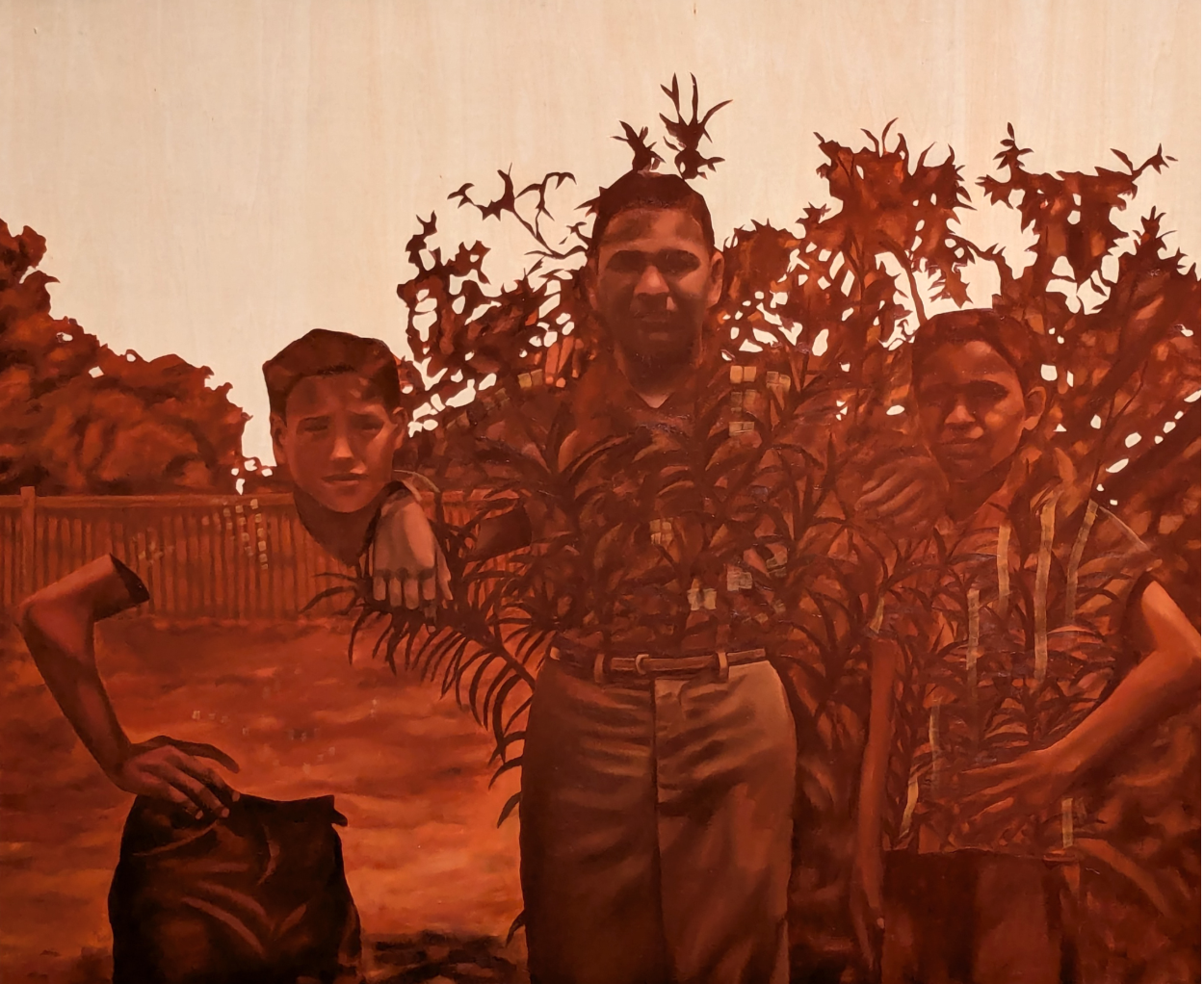
Gina Gwen Palacios, Los Boys (2026), oil on panel, 36 x 30 inches. Courtesy of Gina Gwen Palacios.
Cielo Zuniga: When I was working on the animation for the fellowship, I was in my grandma's house just making a mess; she didn't understand what I was doing. I tried to explain to her, but she just saw a mess. It’s that validation that they need to see other people recognize what you're doing is art.
When she saw it at IMAS is when she finally understood. She came up to me and she gave me a hug, with tears and everything. It really touched me.
I use my grandpa's guayabera because I'm making work about grief, about losing him. And it felt almost, like, wrong to be cutting up his clothes and the things that he used to own to create art, because I was kind of internalizing that. Like what am I even doing here? So being able to see it on the walls of a museum that I've never even been to and my parents looking and pointing at it and understanding and recognizing, I consider that to be the moment that I told myself, “OK, what I'm doing is valid, and I want to keep doing it.”
I use that as fuel for why I am continuing to do work about my family. It feels personal. Do other people get it? A lot of our lives are similar. A lot of the things that we consider to be really unique to us, other people can recognize in their own families. And I think that's very important, especially for younger generations coming in.
Growing up, I didn't have access to museums. I didn't have access to art that looked familiar at all. So being able to provide that or at least try to provide that, I think that's something that a lot of us Valley artists are trying to do.
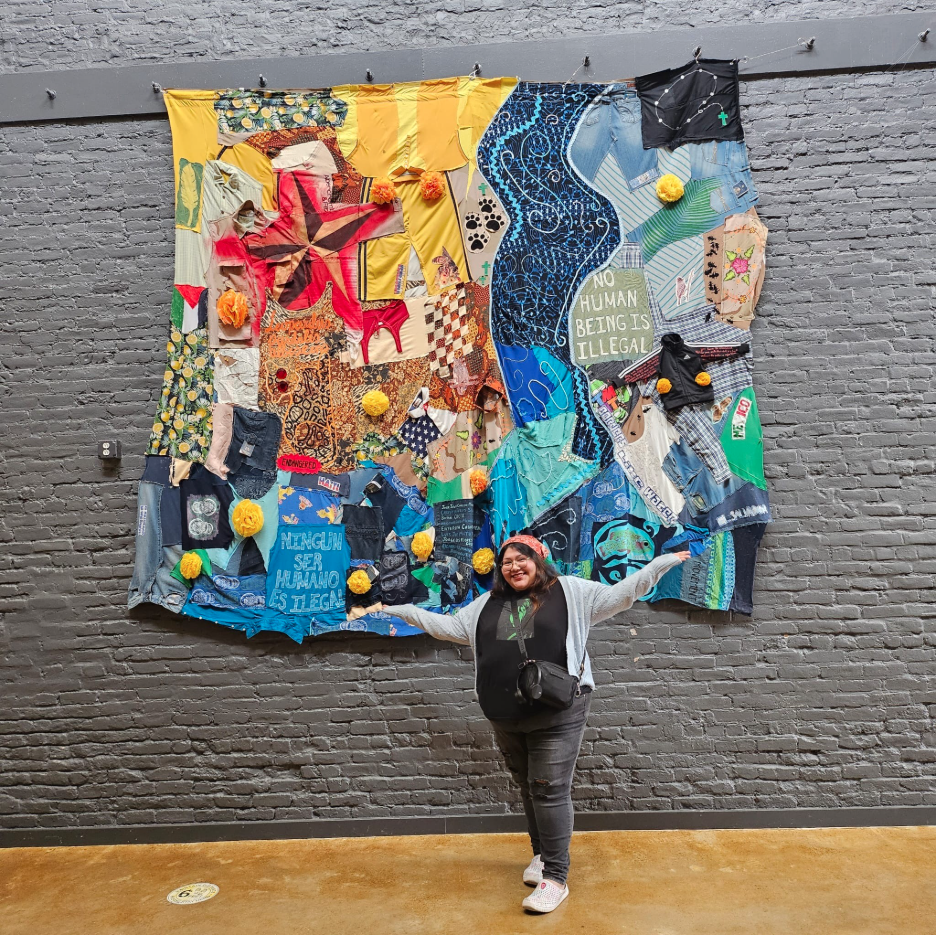
Cielo Zuniga and Alicia Garza, River of Remembrance (2013). Courtesy of Cielo Zuniga and Alicia Garza.
Monica Sosa: Before 2012, I was working as an intern at the Brownsville Museum of Fine Arts, and there was no representation there at all. It was always external and was expected to be “fine art.” Anything that was vernacular, Rasquache, DIY, was not acknowledged and often dismissed. It's exciting to see a new wave of institutions finally making that space; the Brownsville Museum of Fine Art is opening to local community members. (The BMFA has since closed in late 2024).
My work is very personal and family oriented with memory work, environment, and grief and joy. My personal work is to sit with my mom, who was stripped of her identity, who is sometimes scared of her memory. She's approaching her 80th year, so I fear that if we don't have these conversations with our elders and translate this into our artwork, it is also going to be a lost narrative. I get so passionate about it because I'm like, these are the original artists and the original activists without even naming them. Their existence is resistance, and they taught us how to survive with what they had, which wasn't a lot.
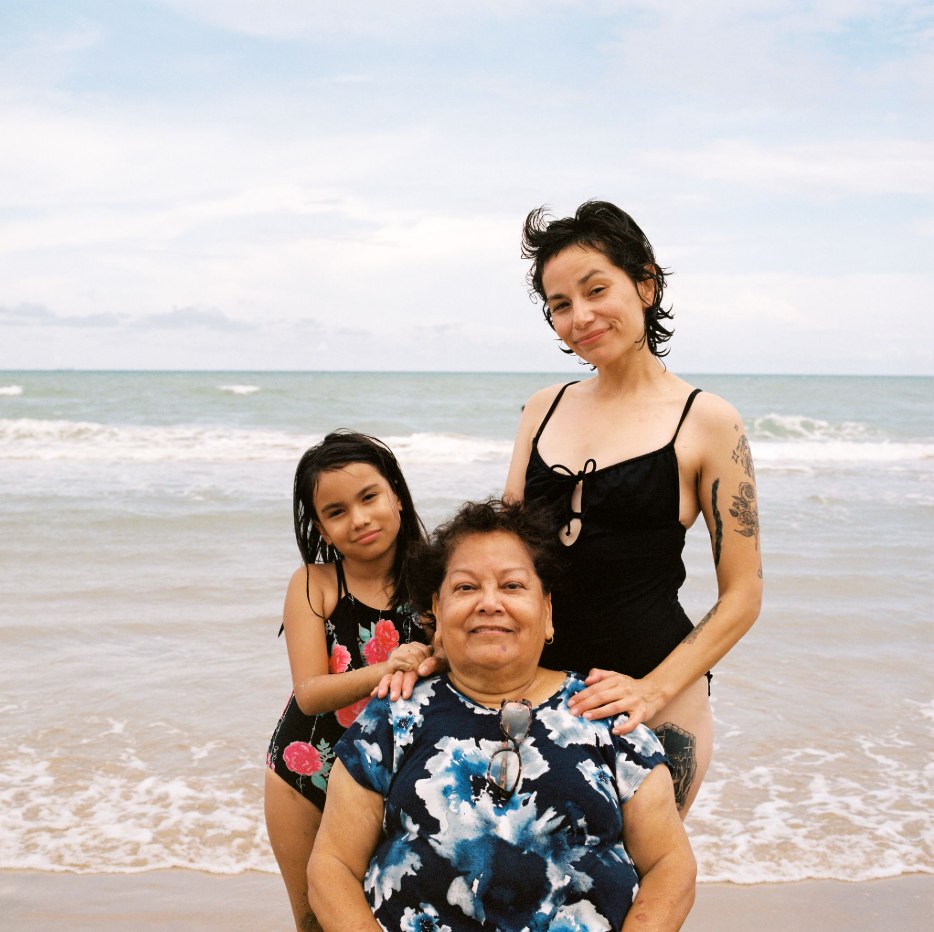
Photo from ENTRE’s Boca Chica, Corazón Grande archival collection, courtesy of the Sosa familia, featuring Monica Sosa, her daughter Remedios, and mother Ramona at Playa de Memorias. Photo by Amalia Michelle Gonzalez.
Can we talk about the particular regional challenges you face living and working in this area?
Michelle Serrano: The region itself has been within persistent poverty for generations—regardless of how many generations, the economic bracket does not change. Because of that history, there's just been a lot of inaction by city-level governments. The people who have the wealth and the money, they hoard it. They kind of control the resources and the land and everything that goes on there.
And things don't really change with the onset of SpaceX, which was sold to us incorrectly. It was sold to us with this whole idea of, “This is just going to be a few satellite launches every year, with little footprint. Don't even worry about it.” I can completely understand the fact that we have a lot of flight from this area because there have been historically no opportunities to get ahead. But the way that they're stewarding the land, this growth has been so mismanaged, and it has so much to do with the fact that the people who have the resources or access to this land are the ones who are deciding, “I'm going to get my payday, and this is my time.”
But ultimately, the people remain in the place that they're in, which is in persistent poverty, living creatively nonetheless.
Monica Sosa: Our problems aren’t just caused by the city. There are a lot of things because we have the border, the border wall, the military. It didn't start with SpaceX.
For example, there was a border checkpoint that popped up in 1997 under Bill Clinton that increased border surveillance and militarization of our cities. Then in 2013, rep. Rene Oliveira and other corrupt lawmakers overturned the Open Beach Act at Boca Chica Beach and gave full jurisdiction of Highway 44 to SpaceX. This is the only road that goes to Boca Chica Beach and now they have the authority to shut it down for any space activities, as vague as that could be. They can shut it down whenever, with no proper notice and complete disregard to the well-being of our community members.
It's not just our political officials. It's all these people who have power, who have influence, and who continue to repeat the historical inequities that we have had. Our current mayor, John Cowen Jr. is a proud descendant of William Neale, a former mayor who was an officer in the confederacy, supported slavery and gained a reputation for being a “good hunter” of runaway slaves in search of basic human rights in Mexico.There's a lot of racism, internalized racism, and I think those are huge inequities that are still perpetuated by current local officials
The big, important piece is that we are using art to persist and resist and move forward and advance, even though we're continuously silenced by multiple entities.
We were very inspired by this conversation and would like to end by discussing your visions for the future.
Josue Ramirez: For me, my dream is to have a center for creativity in the Rio Grande Valley. I want local government and the people to buy into it. I want them to give us the fucking tax break, just like they give SpaceX. I want them to give us a fucking byline in the goddamn budget for the city every year without having us to fight for it. I want a space that's run by artists, that is seen for its value.
Monica Sosa: More people should be out in the streets saying, eff LNG and SpaceX all these different things that continue to harm our communities. But we are scared. I want to see our community empowered. I want to see our community sin miedo.
We encourage readers to learn more about these artists and their practices by following them on social media and staying updated on their latest work via the hyperlinked resources included in this piece.