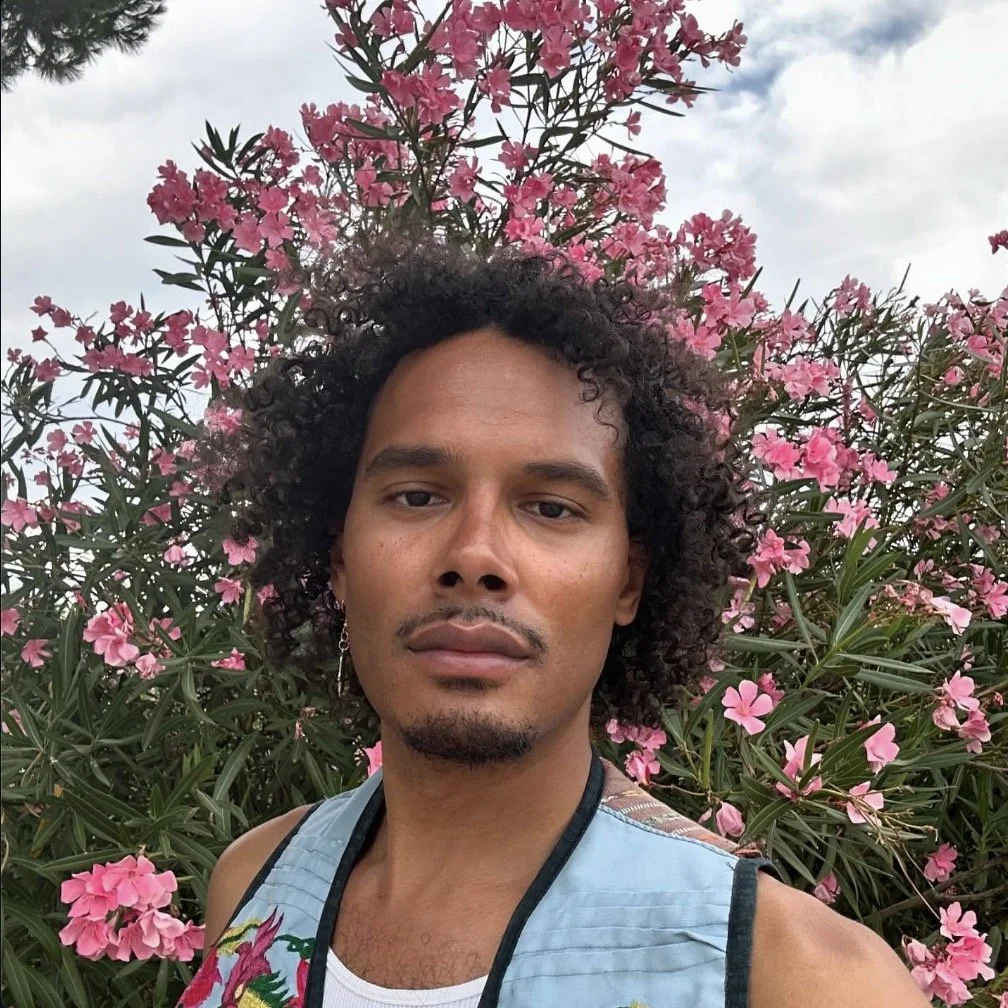
The Puerto Rican Youth Movement Remakes Chicago
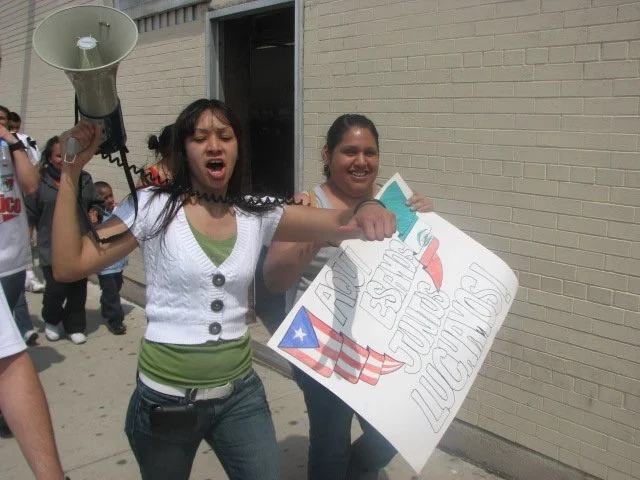
Humboldt Park youth march for immigrants down Division Street/ Paseo Boricua, 2007. Courtesy of Puerto Rican Cultural Center / National Boricua Human Rights Network (Digitizing the Barrio).
Chicago is a city where politics is life and Puerto Ricans raise organizers. A shining example is the last 25 years when Puerto Rican youth forged new movements to successfully remake universities, and the city, for collective liberation.
In a leviathan of 2.5 million, 100,000 Puerto Ricans have built five major museums and cultural institutions, dozens of schools and education centers, thousands of housing units, and the largest festivals in the state. All this after two major street rebellions. Providing direction is a coalition of leaders frankly called The Puerto Rican Agenda. In 2004, a Puerto Rico governor commented that every Puerto Rican should make a trip to the Paseo Boricua corridor on Division Street.
At the start of the century, Puerto Ricans in Chicago were ready for new battles as they coalesced in developing Paseo Boricua, inaugurated by two steel Puerto Rican flags. Vocal calls for equity and justice were central to these efforts, as they were for decades. New generations of Puerto Rican youth embraced these lineages to cement support for Puerto Rico’s independence, Boricua collective determination on the city’s West and Northwest sides, and respect for the undocumented. Students were paramount to these radical efforts.
Today the mayor’s chief-of-staff, a board member of Chicago Public Schools, the city’s official poet laureate, secretary of the city’s LGBTQ+ advisory council; and the superintendent of the park system are all Puerto Rican and connected to its student and youth movements.¹
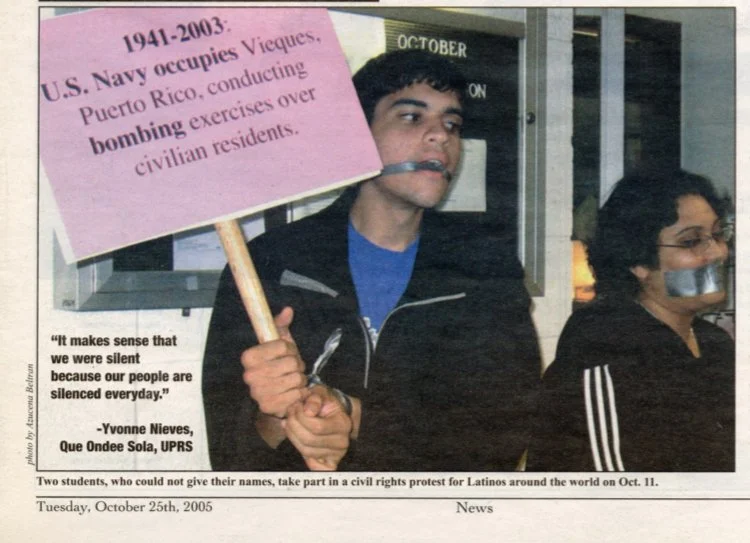
Protest by UPRS, QOS, & ChiMexLa at Northeastern Illinois University (NEIU), 2005. Archives of The Independent at NEIU.
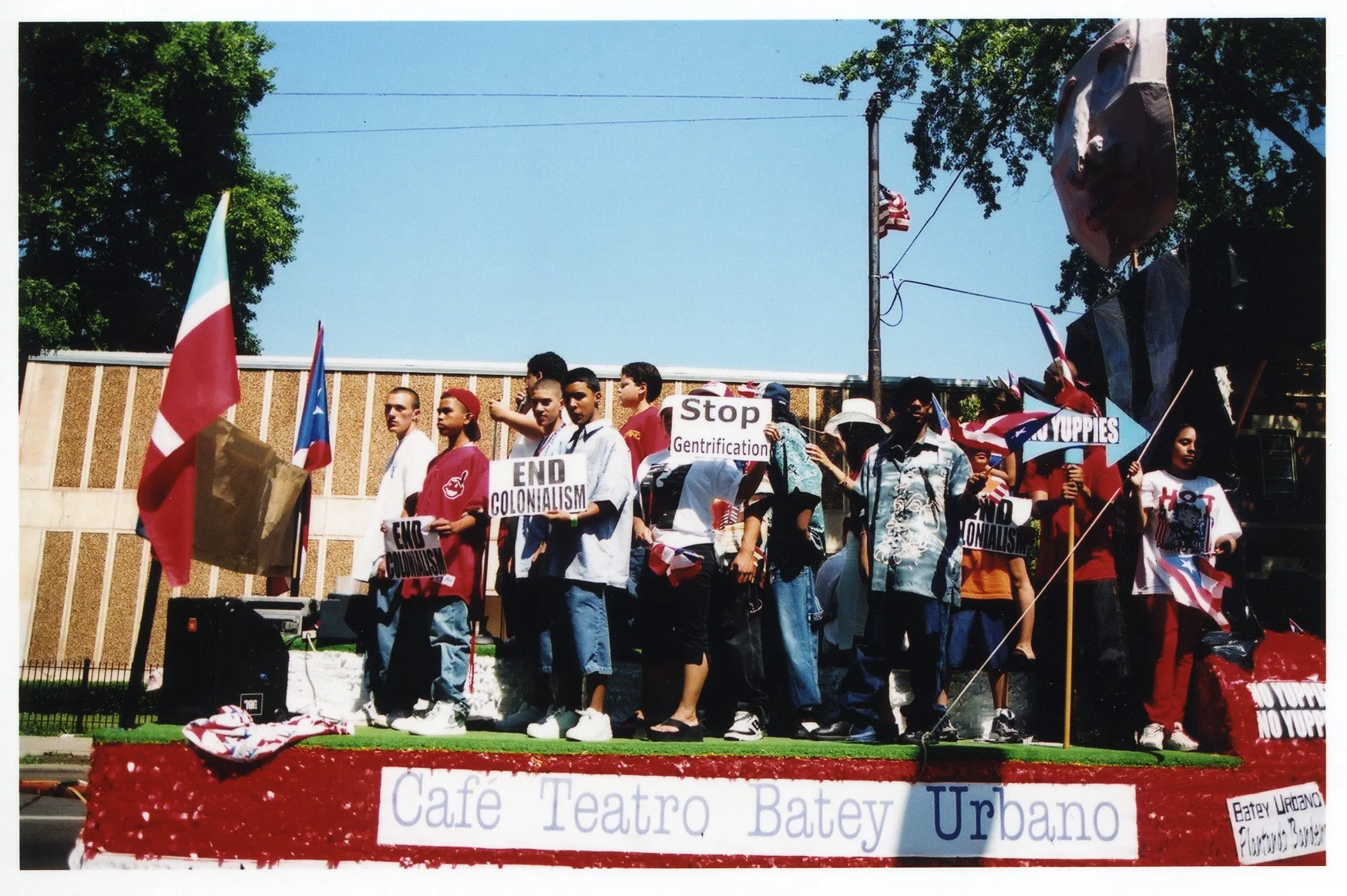
Youth of Café Teatro Batey Urbano at Puerto Rican People’s Parade on Division Street/ Paseo Boricua, 2002. Puerto Rican Cultural Center / National Boricua Human Rights Network (Digitizing the Barrio).
A dozen youth dressed in black walk silently through campus at its busiest hour. Some lend their shoulders to carry a long coffin, while others lift hand-painted and printed signs. The procession swerves through the indoor quad, passing hundreds of students shuffling to class. Participants solemnly distribute small red leaflets. The energy shifts in the dark basement computer lab to the sounds of flipping paper and hurried steps. Some stop their studies to read the meaning of this radical pageantry:
We want amnesty for undocumented immigrants. A borderless society. Stop United States military intervention in Latin America. Stop the wars in Iraq and Afghanistan. Free the Puerto Rican political prisoners. Independence for Puerto Rico.
This was the fall of 2005. The group tirelessly assembled text, bodily adornments, and artworks the night before at Café Teatro Batey Urbano, a former organizing arts hub that started in 2002 by youth of the Puerto Rican Cultural Center. Conversation sparked around barrio life and ideas of homeland. These working-class youth were members of the Union for Puerto Rican Students (UPRS), Que Ondee Sola (QOS), and the Chica@ Mexican@ Latin@ Student Union (ChiMexLa), all founded at Northeastern Illinois University (NEIU) decades before.
A recent summer trip to the 16th World Festival of Youth and Students in Caracas, Venezuela, invigorated many members. After weeks of intense fundraising, dozens of youth from Chicago’s Puerto Rican, Dominican, and Mexican West and South sides joined thousands in Hugo Chávez’s new Bolivarian Revolution. The gathering resulted in the erosion of thinking of a bicameral world—a wealthy imperial North and an impoverished colonized South. Youth quickly connected with organizers in Caracas’ historic barrios, exchanging visions of liberation and detailing efforts in Chicago’s Latine hoods. By the time the school year began, they were prepared to make official institutions value this knowledge and experiences.
NEIU was then, and now, an institution promoting stability and social mobility to the city’s working and middle classes. It is the alma mater of tens of thousands of educators. As it were, the battles at NEIU were reflective of those rooted in the city, where Puerto Rican, Black, and Mexican youth disrupted beliefs in the “American Dream,” or gaining wealth and status through assimilation or racism.
Latine politics-in-the-making was instead presented that afternoon on campus. Rather than a meshing of identities for just joy and entertainment, Latine was reaffirmed as a phenomenon of organizing for each other’s struggles. The action asserted that Chicago Latinidad was a demonstration of art and agitation for linked concerns, with specifically named places and histories to fight for.
Since the foundational Young Lords Organization, New York’s Young Lords Party (YLO), the Illinois Chapter of the Black Panther Party, and the Movimiento de Liberación Nacional, for many youth “Black” and “Latine” were coded language for coalitions of a joint revolution. This funeral procession for Latin America, México, and Puerto Rico indeed stood in a legacy of many past creative interventions but boldly marked a definable new beginning of a new generation seeding our current world.
All this is the direct result of the youth reclaiming and remixing an inheritance of struggle for a Chicago with them firmly directing its future. For that to be, it was necessary to practice solidarity with Black, Mexican, Dominican, and working-class, leftist white residents. It meant provoking attention to the political visions of young people cultivating identities to build a new society. The 21st-century barrio-hood, queer and trans, Afro and Indigenous; and women and femmes of Puerto Rican Chicago reclaimed past presences of kinship and carried out new demands.
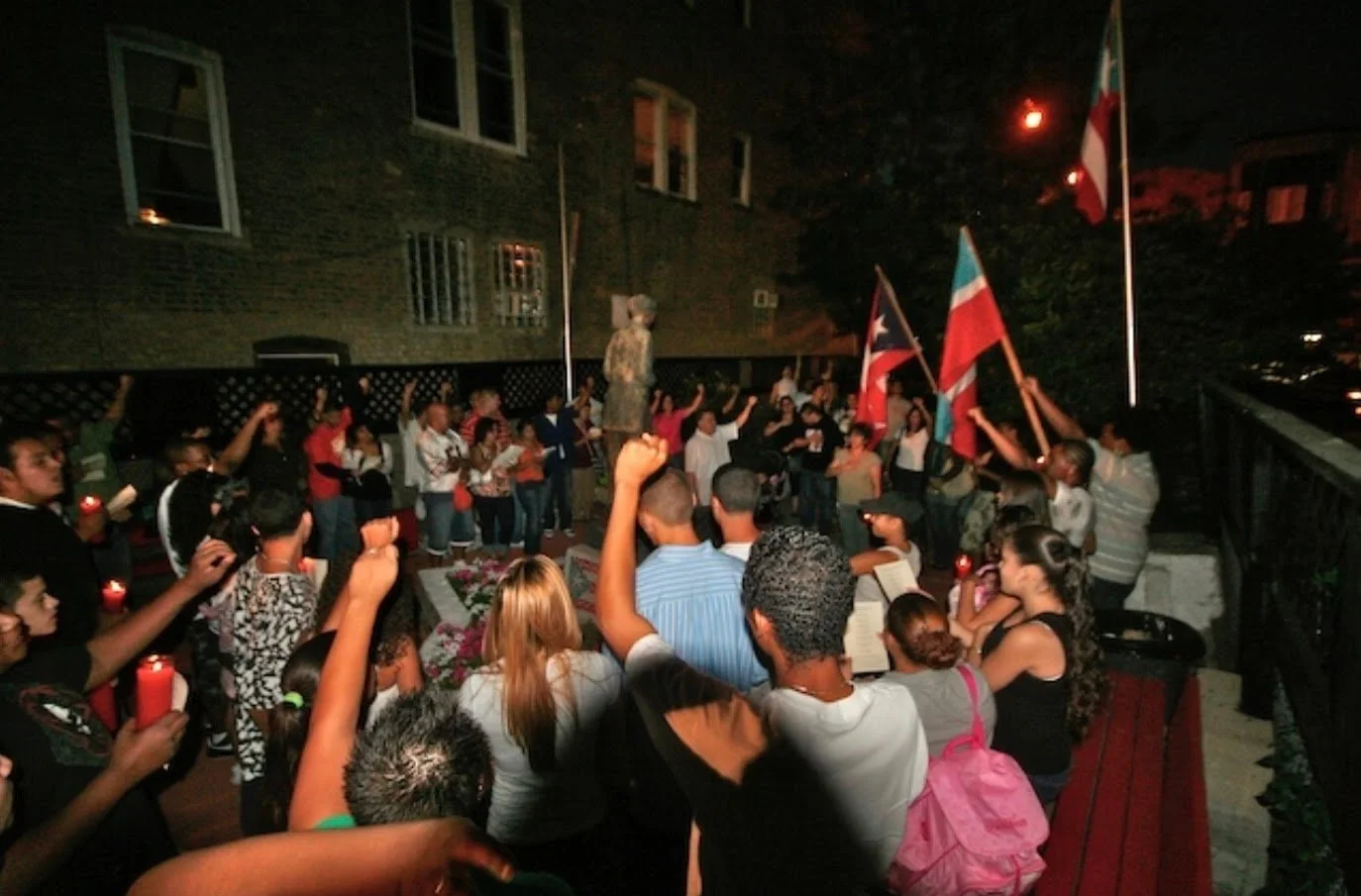
Youth commemorating the El Grito de Lares revolution and the assassination of an independence movement leader. La Casita de Don Pedro on Division Street/ Paseo Boricua, 2007. Courtesy of Puerto Rican Cultural Center / National Boricua Human Rights Network (Digitizing the Barrio)
In spring 2007, youth from the most active and rebellious organizations at NEIU quickly filled the basement office of Que Ondee Sola, a Puerto Rican and Latine magazine founded in 1972. It was at the same hour as the official forum for a proposed multicultural center. Members of UPRS, QOS, and ChiMexLa had entered the large study hall and loudly announced both their opposition and an invitation.
The Black Student Union, Justice Studies Club, socialist students, Latine fraternities and sororities, such as Alpha Psi Lambda; and Movimiento Cultural Latino Americano exploded the small room with passionate debate. One attendee pointed out there already was a student-led center created by ethnic coalitions, namely Albizu-Zapata Portable 1, demolished in 1982 by the university after a decade of use. Others raised worry that opposing a multicultural center may result in none at all. Emotions ran high on the risk of exclusionary nationalisms and the needs of each ethnic group on campus. Some proposed a specific and connected Latina/o Cultural and Resource Center and Black cultural center. Many stressed that this was an opportunity to remake the university.
Later, the director of the Center for Inner City Studies—one of the university’s campuses in the heart of Bronzeville, an historic Black community—supported the organizing of Puerto Rican and Mexican youth. The new governor appointed to the Board of Trustees a former leader of UPRS and QOS. The new university president appointed as its diversity, inclusion, and compliance officer a veteran of HIV and LGBTQAI organizing through ACT-UP and Vida/ SIDA. Members of UPRS and QOS quickly met with them and local Puerto Rican elected officials, to push for a Latina/o Cultural and Resource Center.
After years of forums, meetings, and fights over budgets and student inclusion, in 2009, the Illinois legislature approved funds. In 2011, NEIU inaugurated the Angelina Pedroso Center, housing Latine, Black, Asian, and Women-centered cultural centers. The Latin American and Latino Studies minor became a major—another student demand. The university later rebuilt a monumental El Centro, its community campus in a Northwest side Puerto Rican and Mexican neighborhood.
Miles southwest, in the 1950s, another community was bulldozed to build a university. Not seen on a scale since the foundational uprooting of Indigenous peoples, the Near West Side was decimated by turning hundreds of brick homes encased in elaborate ornaments into jagged heaps of rubble. Puerto Rican, Mexican, Black, Greek, and Italian residents resisted. Parts were spared to become Little Italy and Greektown. The rest was detonated.
The building of University of Illinois-Chicago (UIC), first dubbed “Circle Campus,” aptly represents displacement as government policy. The same “slum clearance" took root in the city’s Puerto Rican barrios in West Town, Lincoln Park, Lakeview, and La Clark in the Near North Side. These projects destroyed thousands of local businesses and community spaces for a gargantuan highway system, hospitals, and housing that were later segregated, terrorized, and demolished.
By the 1970s, Puerto Rican youth entered UIC with this collective memory, determined for justice. They also established a Union for Puerto Rican Students (UPRS-UIC, and briefly the Puerto Rican Student Union), whose motto is “Estudiar y Aprender, Para el Pueblo Defender!” (“to study and learn for a people to defend”).
Committed to this ethos, UPRS-UIC built coalitions to fight for official recruitment in Latine communities, launching the Latin American Recruitment and Educational Services (LARES). The acronym references a town liberated during a 1868 revolution to end African and Black enslavement and free Puerto Rico. University students created Pa’lante, the annual conference of scholars and activists and later printed the booklet El Grito Borincano. Youth electrified campus to achieve a Latino Cultural Center in 1976, later named after Rafael Cintrón, a UIC professor assassinated to disrupt the growing Puerto Rican independence movement.
This climate radicalized student organizers, with some establishing a guerrilla organization, Fuerzas Armadas de Liberación Nacional. The capture of alleged members in the early 1980s sparked a decades-long campaign for their freedom.
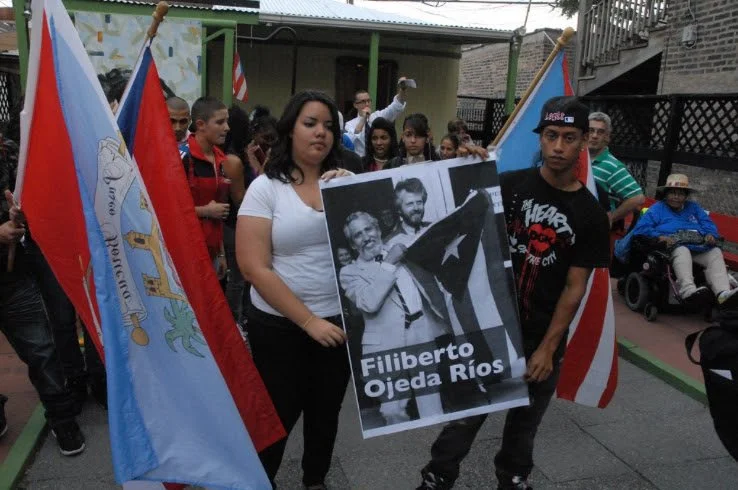
Youth of Dr. Pedro Albizu Campos High School at the commemoration of the El Grito de Lares revolution and the assassination of an independence movement leader. La Casita de Don Pedro on Division Street/ Paseo Boricua, 2008. Puerto Rican Cultural Center/ National Boricua Human Rights Network (Digitizing The Barrio).
That night, the air was solemn but busy in Café Teatro Batey Urbano. Dozens of youth adorned shirts with the name “Filiberto.” Hundreds raised their fists in the air to sing the pro-independence anthem, “La Borinqueña.” Its final line of “la libertad”—“the freedom”—rang loudly with echoes of pain and longing.
A day earlier, the San Juan office of the Federal Bureau of Investigation (FBI) splattered a rural, mountain home with bullets, sparking a gun battle inside. Filiberto Ojeda Ríos, the 72-year-old resident, bled to death even after hundreds of people arrived in protest. The FBI blocked all entrances. The day, September 23, 2005, was the anniversary of Grito de Lares, the 1868 revolution.
The murder of the clandestine leader of an armed organization, Ejército Popular Boricua—Los Macheteros—and the date chosen signaled to the entire independence movement a resurgence of repression. As with the experience of multiple grand jury hearings and ferocious militancy in the 1980s, prospects arose of state ire in the city’s Puerto Rican community. Youth and students spoke more loudly about independence, protesting in front of FBI offices downtown.
These early moments made it clear that student leaders of the 1990s profoundly shaped the successes of this new generation. That era’s youth reinvigorated an unbroken succession of generational uproars in the city’s independence movement.
To help free Vieques island from U.S. military bases, ‘90s youth cultivated a coalition to be arrested for civil disobedience, including near the White House in 2001. They led with ferocity the exoneration of many Puerto Rican political prisoners, engraving the beginnings of the current prison abolitionist movement. They fought to have a statue of an Afro-Boricua independence leader in the park district, paving the way to the gateway flag monuments.
As it were for their mentors of the 1960s through the 1980s, triumphs came with the specter of state repression. These generations were chiseled by years of institutional onslaught to dismantle activism at DePaul University and Roberto Clemente Community Academy, which deeply influenced 21st-century youth facing new challenges.
In 2007, a grand jury was called in New York City to inquire on its local independence movement, spurring hundreds to the court house in opposition. UPRS-NEIU invited one of the subpoenaed to speak about their activism, and joined community teach-ins by National Boricua Human Rights Network on interactions with the FBI. Puerto Rican youth and students of this era exposed oppression as proof of unequal citizenship and organized for Puerto Rico’s independence as the solution.
At Pa’lante, UPRS, and other UIC youth promoted the movement to free remaining and new political prisoners and Vieques island from military toxins. UPRS youth from both campuses got together at La Capilla del Barrio neighborhood church to honor the birthday of a long-imprisoned community organizer, attesting to a deeply local political spirituality. This could also be found in storefront and large ministries, like First Congregational, New Life, and Rebaño, with youth leading community works.
Puerto Rican youth retained links to the archipelago’s movements, traveling yearly to Puerto Rico with National Boricua Human Rights Network to exhibit art by political prisoners and dialogue with organizers. They met with elders of the legendary Partido Nacionalista, Partido Independentista Puertorriqueño, and Partido Socialista Puertorriqueño organizations at the commemoration of the murder of two independentista youth at Cerro Maravilla. On one occasion, they heard a speech by a gubernatorial candidate who's become a political icon.
As youth retained links to Puerto Rico, they continued firmer roots in local needs. These past two decades manifested fresh initiatives and mass organizing that proved a tenacity in transforming society.
The first decade of 2000 saw students and other youth arrested on live T.V. for blocking Immigration and Customs Enforcement (ICE) headquarters. The “¡Humboldt Park NO SE VENDE!/ NOT FOR SALE!” campaign ignited, mobilizing hundreds with Brickerdike Redevelopment Corporation/ Humboldt Construction to defend and create affordable housing. The campaign’s annual Paseo Boricua Parranda gathered hundreds to sing in the snow to visit elders in towering, community-built Hispanic Housing complexes.
Students from ASPIRA of Illinois organized teach-ins with QOS on African and Indigenous ancestries and marches for community peace. Students from Dr. Pedro Albizu Campos Puerto Rican High School convened hundreds for the annual Three Kings Day parade to nourish historic roots on Division Street. In the same neighborhood, in places like Youth Service Project, students and youth painted and restored dozens of murals depicting migration, cultural traditions, and collective experiences. In the hundreds, they learned the traditional cuatro guitar and performed for thousands in annual concerts by the Puerto Rican Arts Alliance (PRAA). All this growth of artistic activity empowered the crafting of theatre and gallery spaces, like el schomburg, and the expansion of PRAA, Puerto Rican Cultural Center, Urban Theater Company, Segundo Ruiz Belvis Cultural Center, and the National Museum of Puerto Rican Arts and Culture.
By the second decade of 2000, the queer and trans-led Chicago Dyke March and the once-repressed Puerto Rican People’s Parade activated thousands through radical politics and art in marches through Paseo Boricua. After hurricanes Irma and María, students, alumni, and community elders raised millions in relief for their homeland. Youth organized larger gatherings for Black and Palestinian life.
In the third decade, after the 2020 uprisings, the Afrorriqueñes conference at Segundo Ruiz Belvis Cultural Center brought days of dialogue and healing among Black artists and activists. Chicago Boricua Resistance captivated a new cohort to combat the federal board imposed on Puerto Rico and provoke their governor’s resignation in 2019. The YLO resurrected as New Era Young Lords and organized mutual aid and first aid classes.
In one of the most audacious moments in the entire epoch, a coalition of Puerto Rican, Mexican, and Black youth and elders mobilized hundreds to Washington D.C. in a call for immigrant amnesty. After a press conference, the youth ambushed the office halls of Congress, loudly chanting “Sí, Se Puede,” and smashing a youth-led Chicago Puerto Rican newspaper with their demands. Capitol security arrested a member UPRS and another youth.
Alumni of these struggles later founded La Respuesta, a diaspora-wide magazine to agitate and exchange these political strategies. Between 2013 and 2018, it published 300 Puerto Rican writers, expanded in Chicago and New York City, and reached a monthly audience of over a million.
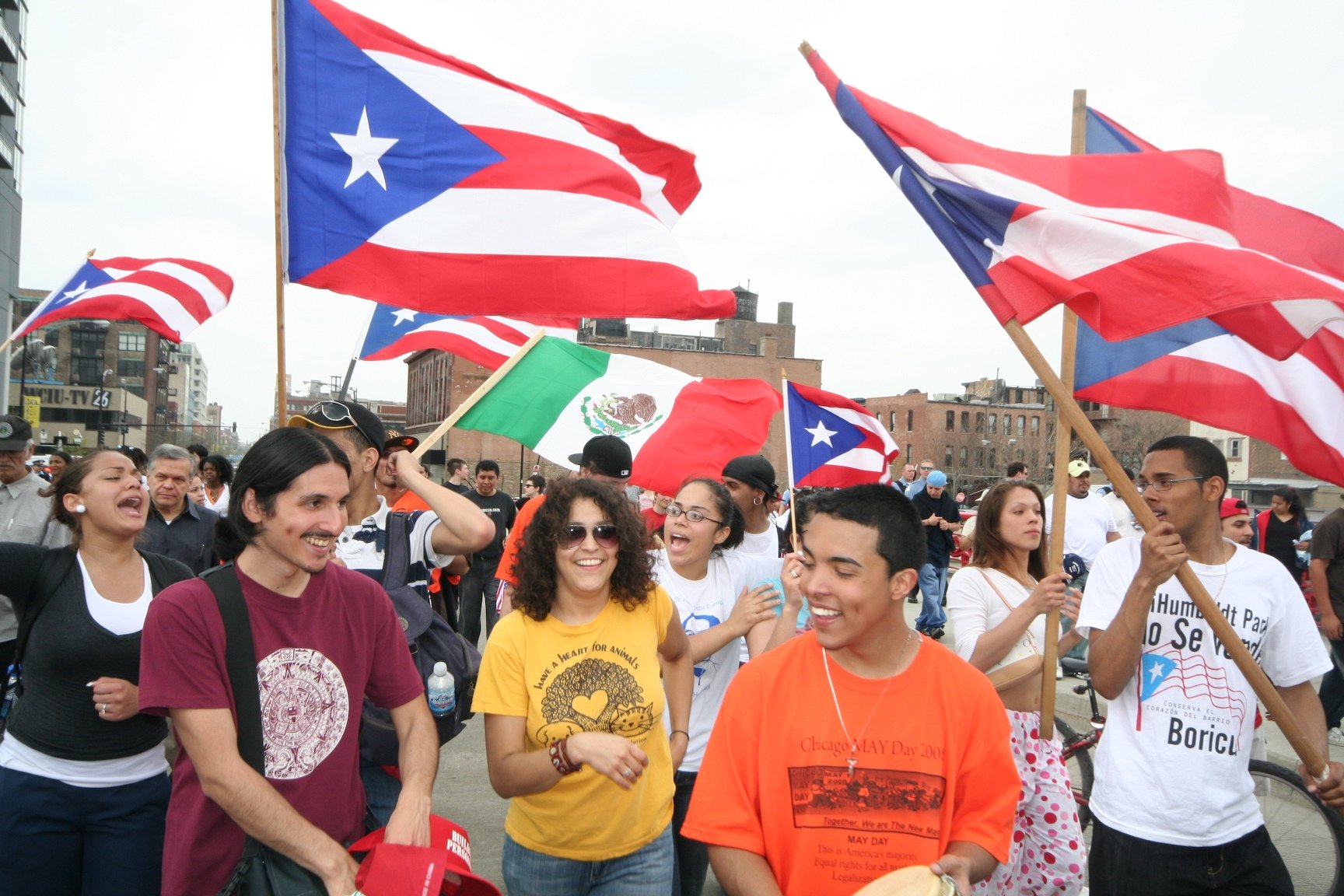
Humboldt Park and university youth march for immigrants, 2008. Photo courtesy of Puerto Rican Cultural Center / National Boricua Human Rights Network (Digitizing the Barrio).
By the first decade of 2000, Puerto Rican students at UIC, NEIU, and other universities were still organizing for their political prisoners, alongside other rising challenges. Military spending increased alongside hate for immigrants and Islam. The economy crashed more than once, with thousands of their peers dying or being injured in Iraq and Afghanistan. Instead of bulldozing blocks, the city instead supported smaller scale expensive housing to gentrify incrementally. In response, Chicago youth marched in the hundreds of thousands for affordable housing, an end to war, and amnesty for the undocumented.
Chicago’s Puerto Rican Student and Youth Movements mobilized deeply for immigrant rights. For weeks, over a dozen stood in shifts, holding a light-blue Puerto Rican flag to demonstrate protection for an undocumented family under sanctuary in a Humboldt Park church. Working intimately with Pilsen-based Centro Sin Fronteras and its Zócolo Urbano youth hub with the historic motto “Boricua Mexicano, Luchando Mano a Mano,” this coalition demonstrated a politics of respect for legacy and reciprocity.
For two years, Puerto Rican youth from local high schools and universities across Illinois— including Loyola University, DePaul University, Northwestern University, University of Illinois-Urbana Champaign, University of Chicago, Columbia College Chicago, and city and suburban colleges, such as Wright, Harold Washington, Kennedy-King, and Triton—mobilized thousands in marches for amnesty and against war. Members of UPRS-NEIU and Mexican organizers in the Humboldt Park and Pilsen neighborhoods met at the Rainbow Push Coalition headquarters to plan action.
As the city transformed into the campaign headquarters to elect a local resident as the first Black president, civil rights for immigrants was central to a Chicago-style coalition of identities. A UPRS–NEIU alum and the most pro-immigrant member of congress ran a mayoral campaign with a march with youth in 2011. Another alum launched a major progressive challenge to the decades-long status quo at city hall.
Meanwhile, the federal administration deported millions and supported increased federal control in Puerto Rico. Simultaneously, it recommended a Puerto Rican from the Bronx, another major center in the Boricuascape, to the Supreme Court and in 2016 granted clemency to a Puerto Rican political prisoner and veteran of the 1970s youth movement. Today, with a federal government widely described as fascist, students and movement veterans are center stage in street battles for immigrants.
Immigrant communities in the Albany Park neighborhood organized rapid response teams to deportation operations alongside alumni of UPRS and QOS, and the Alderperson, a longtime youth arts educator and cofounder of Chicago Boricua Resistance. Concurrently, Homeland Security stormed the parking lot of the National Museum of Puerto Rican Arts and Culture. Later, agents burst into a hospital, arresting the neighborhood alderperson, an alum of UPRS-NEIU and QOS, who calmly stressed the violation of constitutional rights. As it seems, wide successes in life-saving activations are still responded with violence.
Decades of confrontation and survival also attest to the power of radical solidarity and ethnic coalition building. In the past quarter century, equipped with this knowledge and ethos, Boricua youth commanded new building structures at universities, founded powerful institutions, freed political prisoners, mobilized tens of thousands of people, and launched mass media. Undoubtedly, this century’s Chicago politics owes much of its form and participation to Puerto Rican youth - where support for Latines, immigrants, Black and Palestinian life, and Puerto Rico’s independence are common and official. As fascism threatens hard-won achievements, you can count on Chicago Boricuas to fight until victory.
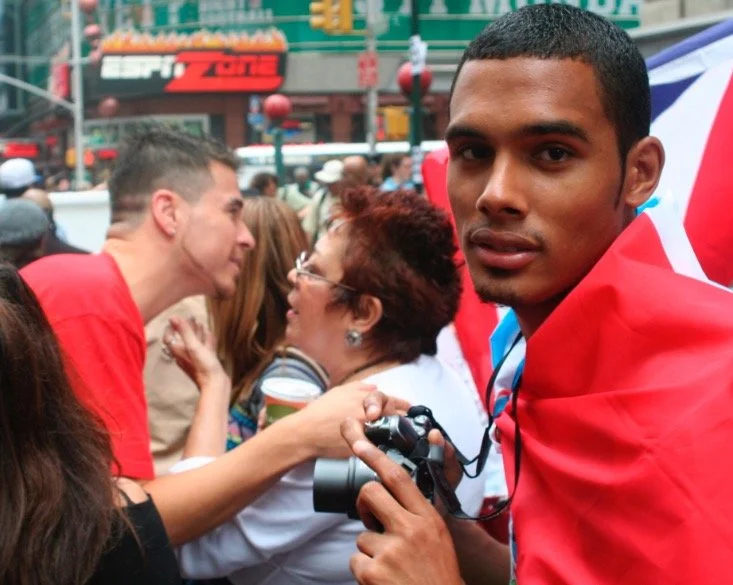
Author at 20-years-old. March to the United Nations for Puerto Rico’s independence. New York City, 2006. Puerto Rican Cultural Center / National Boricua Human Rights Network (Digitizing the Barrio)
¹ This is a reflective, historical essay of the century’s first quarter, motioning attention to the impact and power of Puerto Rican youth-led organizing (ages 12 to 29). Organizations are named in lieu of individuals to keep the collective spirit of freedom-making. Linked references provide more details. To everyone who showed up in these times for joy and struggle, I have tried, with heart, to give my best in describing our youth and devotions.