
The Legacy of Barrio Borikén in Illinois
Chicago carries the heartbeat of Puerto Rico—you sense it before you see it: in the easy movement between Spanish and English, the aroma of cafecitodrifting from corner cafés, the pulse of salsa and reggaeton spilling into the streets. At its center, Humboldt Park is more than a neighborhood; it is a living archive, framed by towering steel Puerto Rican flags along Division Street—monuments to community pride, the industrial labor of Puerto Rican migrants, and resistance to displacement. Over six decades, Puerto Ricans have carved pedacitos de patria—enduring pieces of homeland—through struggle, care, and collective imagination, building institutions and cultural networks that anchor community life across Chicago and Illinois.
One of the most compelling chroniclers of this world was poet David Hernández (1947–2013), who arrived in Chicago in 1955 and became a defining literary voice of the Puerto Rican experience. In his poem La Armitage,he traced lives navigating gentrifying streets, revealing tensions between middle-class façades and the working-class memories of displaced families. Blending humor, grit, and tenderness, his poetry forms a lyrical ledger of resilience—an archive of everyday experience often absent from official histories.
If Hernández documented community life through language, his brother Eliud Hernández helped build the institutional foundations that sustained it. His commitment to cultural survival spanned visual and organizational realms. He cofounded El Taller in the early 1970s to cultivate Latino arts and later cofounded and directed the Humboldt Park Cultural Arts Center (1978–1982). He then joined the Illinois Arts Council, where he served for three decades—first as a program associate overseeing visual arts, media arts, and literature, and later as deputy director, a leadership role he held for more than twenty years. There he helped the state agency invest in a durable mosaic of arts organizations and artists, fostering a vibrant cultural ecosystem that supported the full spectrum of the arts—from major mainstream institutions to rural initiatives—while advancing an inclusive cultural landscape for Puerto Rican, Mexican, Asian, Native American and African American communities, among others, across Illinois.
Nationally, he served as an original board member of the Association of American Cultures (TAAC), which convened regional and national multicultural “Open Dialogue” forums, and as a board member of the National Association of Latino Arts and Culture (NALAC).
Together, the Hernández brothers exemplify how education, the arts, and cultural practice function as vital social infrastructure. In the face of displacement and marginalization, poetry, visual art, music, and community institutions carry memory, dignity, and belonging. They make visible lives often overlooked while asserting pride, continuity, and attachment to place. Through cultural expression, Puerto Rican communities document and defend their presence, claiming home even as it has been repeatedly contested.
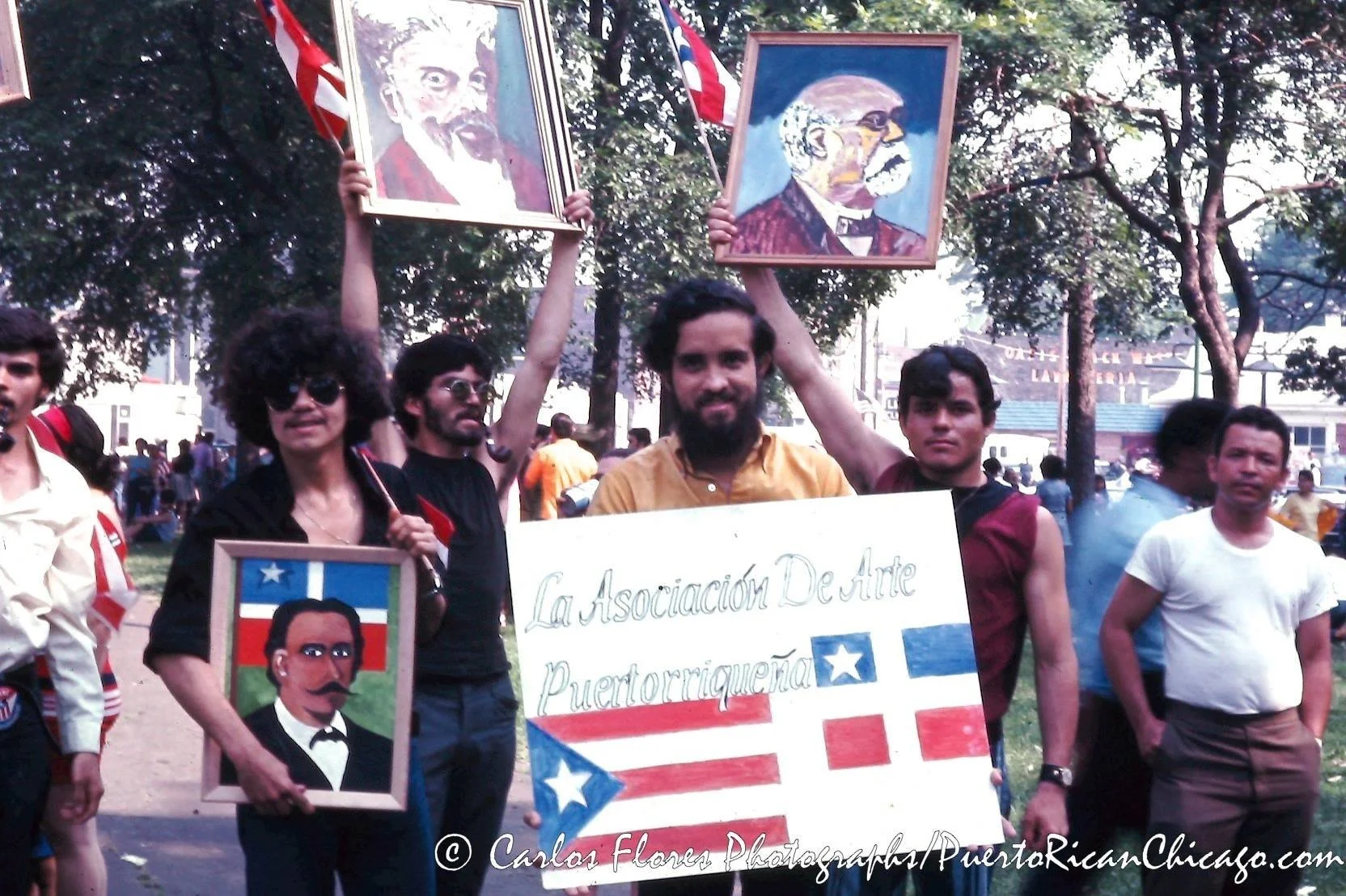
‘LA ASSOCIACION DE ARTE PUERTORRIQUENO – THE PUERTO RICAN ART ASSOCIATION” – June, 1971. La Associacion De Arte Puertorriqueño, was a group of young local Puerto Rican artist founded in the early 1970's, and led by Hector Rosario (middle). © Carlos Flores.
This creative and civic resilience is inseparable from migration. As scholars Maura I. Toro-Morn and Ivis García document in Puerto Ricans in Illinois, migration to Chicago began in the 1950s under labor recruitment contracts tied to Operation Bootstrap. Working-class families followed initial waves of contract workers—men and women recruited for industrial labor—in a steady migration spanning three decades. Although migration slowed in the 1980s, Puerto Ricans across social classes continued settling in Chicago and throughout Illinois, building durable communities despite economic and spatial constraints.
Toro-Morn and García challenge the misconception that Puerto Rican migrants were solely poor or working class. In Illinois, the University of Chicago became a hub for Puerto Rican leadership, including Elena Padilla and Ricardo Alegría. Padilla authored the first empirical study of Puerto Ricans in Chicago, documenting discrimination against contract workers and advocating on their behalf—an early contribution to urban ethnography. Later scholarship, particularly that of Toro-Morn and García, enriches this record through empirical research and first-person testimony, pairing rigorous analysis with lived experience. In Puerto Ricans in Illinois, voices such as Isabel Cintrón, who migrated to attend Loyola University in 2007, illuminate how migration, education, and belonging unfold across generations.
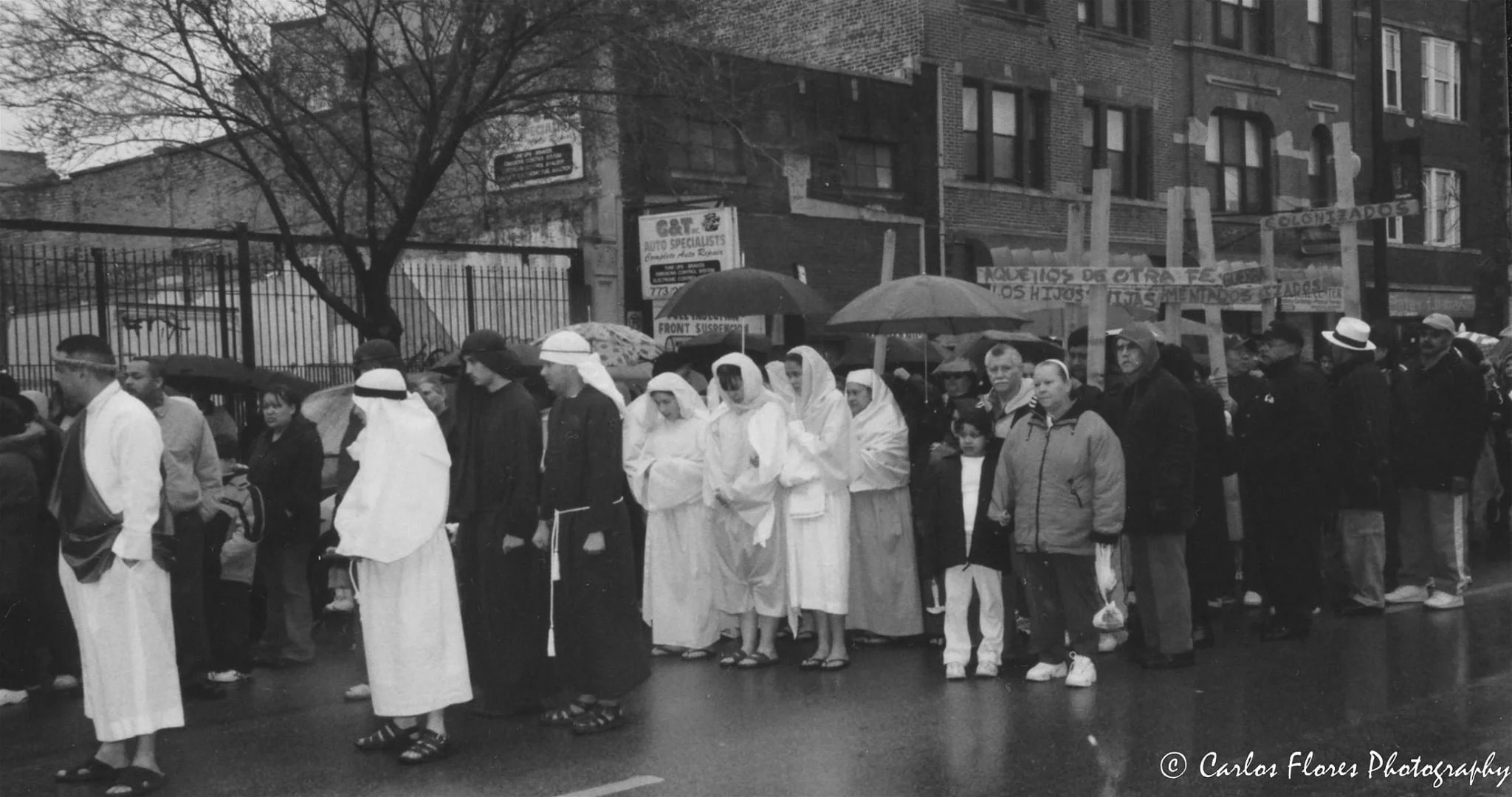
THE RE-ENACTMENT OF THE DEATH OF JESUS CHRIST – HUMBOLDT PARK, CHICAGO, ILLINOIS – MARCH 25, 2005, © Carlos Flores.
Puerto Rican scholars based in the Midwest—including Marisa Alicea, Jacqueline Lazu, Nilda Flores-Gonzalez, Gina Pérez, Merida Rua, Jose Lopez, Ada Nivia López, Mirelsie Velazquez, Michael Rodriguez Muniz, and Lilia Fernández, among others—have further deepened understanding of community life in Chicago. Across generations, their empirical and deeply grounded research illuminates the lived experiences, networks, and cultural practices of the community, emphasizing how social, cultural, and transnational ties are maintained and nurtured, reflecting a commitment to preserving memory, cohesion, and continuity.
Chicago’s Puerto Rican community consolidated most visibly in Humboldt Park, the historic heart of what is now widely known as Barrio Borikén. Community institutions flourished. The Puerto Rican Cultural Center (PRCC) emerged as a cornerstone, offering education, youth leadership development, advocacy, and health services. Among its most significant initiatives is Dr. Pedro Albizu Campos Puerto Rican High School (PACHS), founded in 1972—originally as La Escuelita Puertorriqueña—to confront high dropout rates. Emphasizing self-determination, critical thinking, and social empowerment, PACHS serves about 185 students while maintaining deep community ties. Organizations such as ASPIRA, Batey Urbano, and other youth programs further support mentorship, leadership, and artistic expression.
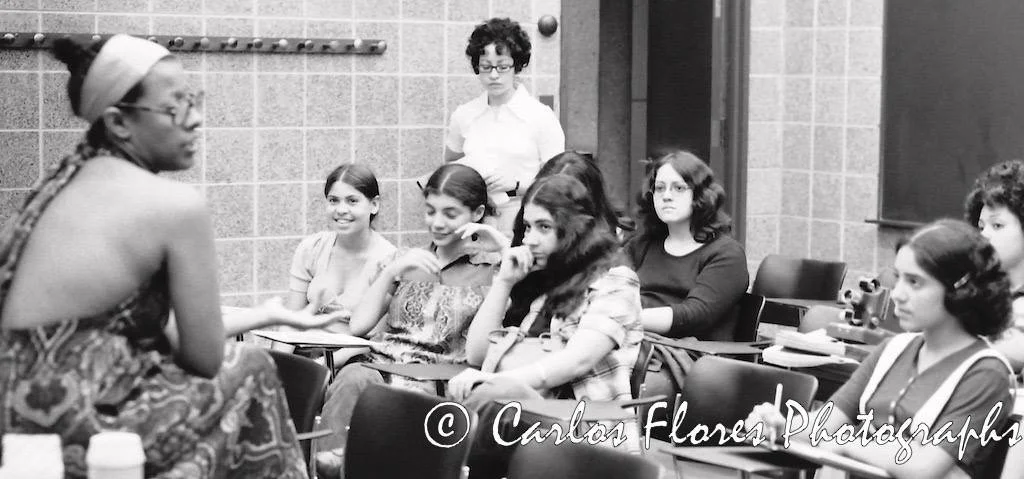
A.S.P.I.R.A. Summer sessions for high school seniors at the University of Illinois @ Chicago. Summer of 1973, Chicago, Illinois. © Carlos Flores.
The community’s history is inseparable from struggle. The Division Street Riots of 1966, urban renewal, and successive waves of gentrification displaced families and scarred neighborhoods. Yet, Puerto Rican residents and organizations adapted, rebuilt, and reclaimed space—transforming loss into collective purpose. Education, activism, and cultural memory intersect in the history of José “Cha Cha” Jiménez and the Young Lords, whose Chicago roots in Humboldt Park show how youth politicization emerged in response to displacement, inequity, and policing. The group’s legacy continues to shape contemporary curricula and youth programs centered on experiential learning, reflection, and self-determination.
Chicago’s Puerto Rican community faces yet another cycle of displacement driven by gentrification, shifting labor markets, and decades of urban renewal. Since the 1960s, residents have been pushed northwest—from Lincoln Park to Wicker Park, West Town, and Humboldt Park—eroding community wealth as property values rose. The opening of The 606, a 2.7-mile rail-to-trail park, has intensified these pressures, raising rents and taxes and displacing long-standing residents and businesses. The decline of manufacturing jobs, the rise of low-wage service work, and uneven development funding have further narrowed economic footholds. In response, community leaders have embraced plantando bandera, asserting cultural and spatial presence through Paseo Boricua, officially rebranded as Barrio Borikén in 2024, insisting on the right not only to remain but to endure with dignity.
The arts remain the community’s lifeblood, capturing its stories and sustaining memory. Afro-Boricua photographer Carlos Flores has documented many of these moments, both intimate and public; his exhibition, curated by Jorge Félix and opening August 28, 2026, at the Puerto Rican Arts Alliance, presents a vivid Chicago Rican Story.This cultural landscape is further enriched by curator and cultural worker Brenda Torres, founder of El Schomburg Espacio de Arte Interdisciplinario, an art space on Division Street dedicated to making visible the Puerto Rican experience through experimentation, collaboration, and critical reflection, and established in 2023 to amplify Puerto Rican and diaspora artists in the city. Alongside institutions like the Segundo Ruiz Belvis Cultural Center and Institute of Puerto Rican Art & Culture, these organizations form a dense cultural infrastructure—shaped in part by Eliud Hernández’s early stewardship and the contributions of other cultural leaders—that continues to nurture pride, creativity, and civic engagement, ensuring Chicago’s Puerto Rican artistic legacy remains vibrant and enduring.
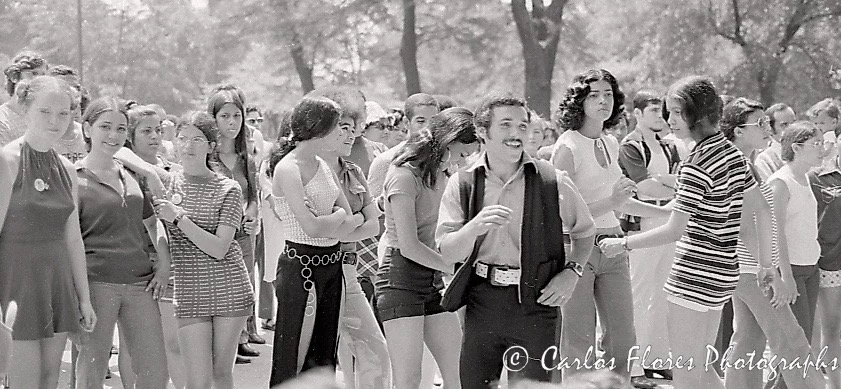
Joseito Rodriguez enjoying the music at the Battle of the Bands Event @ Chicago's Humboldt Park Boathouse. Early to mid 1970's. Chicago, Ill. © Carlos Flores.
Today, leaders such as Billy and Veronica Ocasio of the National Museum of Puerto Rican Arts and Culture carry this legacy forward, situating Chicago’s Puerto Rican experience within broader cultural and civic narratives. The museum builds on the vision of artists like Oscar Martinez and Gamaliel Ramirez and, through Billy Ocasio’s practice of plantando bandera, asserts cultural presence along “La División,” connecting artistic affirmation to initiatives in affordable housing, education, and workforce development. This work reflects the aims of the Puerto Rican Agenda of Chicago, a coalition advancing self-determination through policy and advocacy for Puerto Ricans both locally and on the island, addressing the economic, social, and colonial conditions shaping the diaspora, as Professors Toro-Morn and García underscore in their account.
Humboldt Park and Barrio Borikén pulse with life. Murals speak of pride and struggle; cafés, studios, and parks hum with conversation; schools and cultural centers transmit history and possibility. Despite the harsh winters of the Windy City and the distance from Puerto Rico, the island is never far. Like David and Eliud, I, too, was raised here and can say with certainty: Los Boricuas de Chicago son otra cosa! Finally, the city speaks through the words of Mayda Del Valle, Chicago’s second Poet Laureate (2026), in her celebrated poem “The Windy City’s Song”:
Come and bring your music
Bring your own song
And sing with me
And we did Chicago
We brought all the music we could hold in our hands
We brought barriles and cuatros
Le-lo-lais and piquetes
Our salsa boleros and boogaloo
Our guiros and guitaras
We brought our own pain and laughter in a song