
In many ways, our memory of home, where we come from, who we think we are, and the future we imagine we are creating is abstract. But these are empty abstractions that exist in the realm of ideas and not action.
There’s a lesson Detroiters teach when they hear politicians and investors talk. They conclude: “It’s the overlay for the underplay.” When Detroiters refer to the overlay and the underplay, they mean powerful groups say one thing (overlay) and do another (underplay).
For example, mortgage lenders spun an overlay when they targeted racially segregated areas and exploited social networks of trust to market subprime loans to the Latinx population. Countrywide Financial visited churches where they steered Latinx families into risky loans with higher fees than the ones offered to white borrowers with similar credit. The lenders’ overlay promised homeownership, which is tied to the conception of citizenship and belonging in the United States. The lenders essentially promised the Latinx population the American Dream.
The underplay was the profit lenders secured for themselves and their banks from high-interest rate mortgages. Lenders also benefitted from extending mortgages that were more likely to foreclose because they could more quickly capitalize on their investment in substandard properties, especially when homes were backed by a Federal Housing Authority (FHA)-secured mortgage.
Another reason Latinx people lost their homes was the overlay that politicians made when they claimed to promote “Secure Communities.” They passed the 2008 program to intensify internal immigration enforcement and require police share information about arrests with federal authorities. The underplay was that politicians gained political capital, private prisons gained new contracts, and the surveillance industry extended its markets.
The way that mortgage lenders and politicians acted were two sides of the relation between the overlay and the underplay. They explain why words like “Secure Communities” are more than meaning; they do things. In this case, they reassure voters who associate immigrants with crime. The words not only reinforce this association (an action), but also encourage other actions like immigration enforcement. The words and the deportations they encourage contribute toward the public illusion of increased security for some communities at the expense of other communities. "Secure Communities" means increased policing, profiling, and deportation. These actions partly explain why the Latinx population represents 11% of mortgage originations between 2005 and 2008, but 16% of foreclosures in the 2007–2009 period.
Lenders would eventually be prosecuted for misrepresenting the loans, but they left hundreds of thousands of Latinx families with debt and negative wealth. The effects of the foreclosure crisis also stretched over a much longer period for the Latina/o/x population: From 2001 to2013, Hispanic homeowners were more likely to enter foreclosure than Black or white owners. The effects of the foreclosure crisis included the loss of credit to the Latinx population and even impacted the health of future generations.
The relation between the overlay and the underplay is often mapped through bordering practices. There is a concentrated Latinx population in Southwest Detroit. Residents of the area include recent immigrants and fifth-generation Mexican immigrants, but what makes it especially worthy of study is that it hosts the busiest international land border crossing in North America. Borders simultaneously divide, distinguish, and connect. The overlay is that the Ambassador Bridge crossing to Canada is privately owned. Residents point out the underplay: city officials actively displace unhoused people (“squatters”) but allow the bridge to illegally occupy public property adjoining the bridge. The lesson was an early example of a broader pattern: References to “illegal occupants” are frequently used against many residents who occupy the home they had lived in before it was foreclosed by a mortgage lender or through public auction. Public officials never applied the term to speculators who bought homes at public auction, failed to pay property taxes, extracted rent from tenants, and allowed homes to go back into foreclosure.
The bordering and crossing practices are the two sides of abstraction, just like the overlay is made up of empty abstractions and the underplay is made up of concrete experiences. Scholars have recently begun looking at the tension between empty abstractions and experience to explain the relation between space and race and between displacement and dispossession. Through interviews with planners, policy makers, and nonprofit leaders; content analysis of media, corporate and philanthropic press releases and annual reports; U.S. Census; and ethnographic data, there’s enough information to explain how urban development in the years leading up to and following the city’s bankruptcy relied on empty abstraction to favor investors over residents.
One of the important consequences this has had on Southwest Detroit, and the city more generally, has been in displacing some of the poorest residents of the city. Some areas of Southwest Detroit have been “gentrified,” which means wealthier white residents and business owners have moved into some (eastern) areas of Southwest Detroit. The western side of Southwest Detroit was not targeted by the city’s development plans, developers, or investors. Residents there were more likely to be in poverty. They also saw their homeownership rates decline from 2010 to 2022 and the median value of their homes remain relatively static. Their experience undermined the abstract overlay that “Detroit is Back” after its bankruptcy.
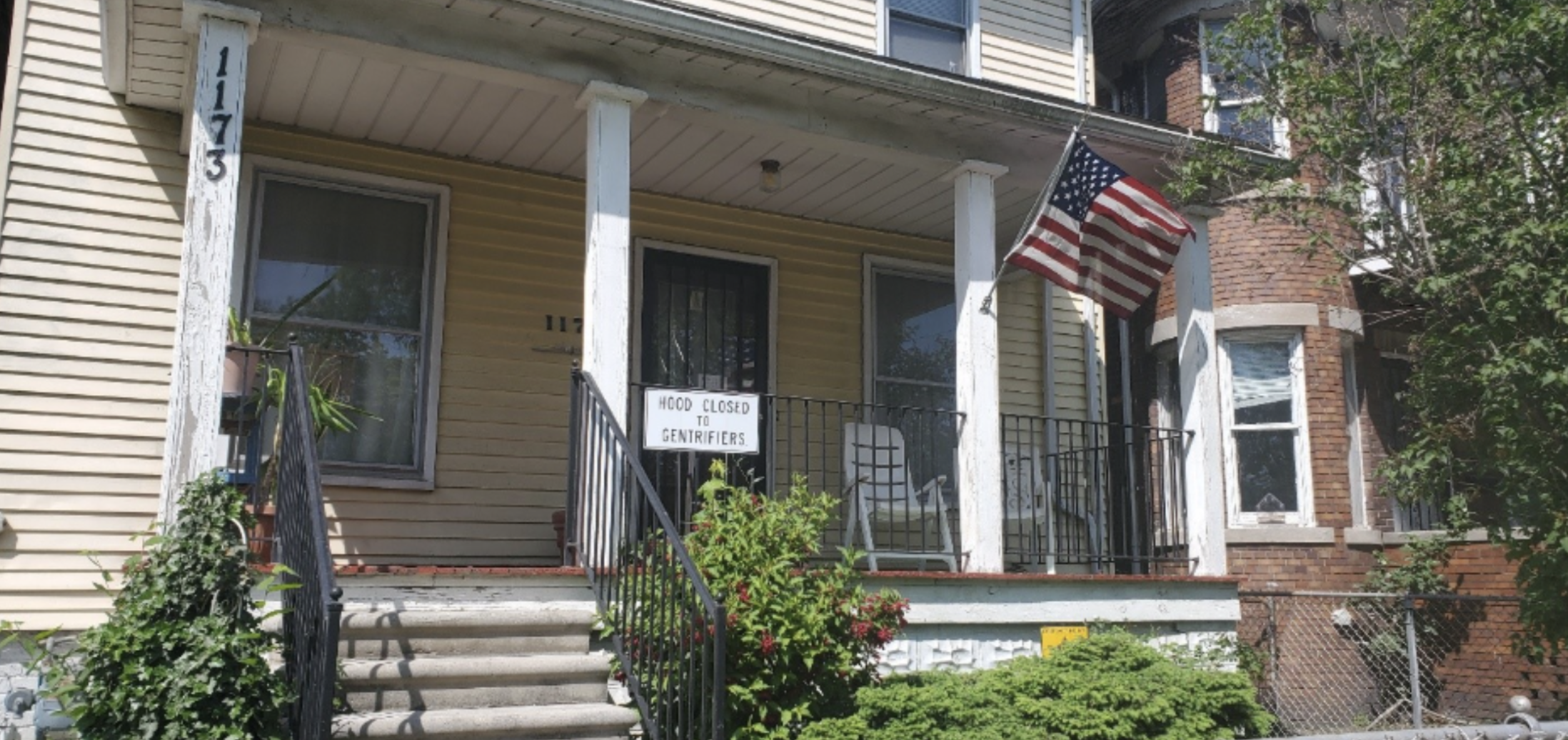
A house in Southwest Detroit with a sign that reads “Hood Closed to Gentrifiers.” Photo by Nicole Trujillo-Pagán, Ph.D.
My research offers two important lessons. First, the Latinx youth I interviewed refused to see themselves as white or Black, even though the U.S. Census has defined the Latinx population as an ethnic group that can be of any race. Some respondent’s “street race” was white; this is the race strangers assume they are based on how they look. These respondents nonetheless distinguished themselves because of their upbringing or the fact that they had been raised in an area with many other Latinos. They struggled to identify and talk about the privileges that their light skin afforded them. Similarly, those who may be considered Black said they were brown or “… and white, too” when I ask how they see themselves. This experience of living “on the border” between the nation’s largest Black city and some of the whitest, wealthiest suburban areas in the United States demonstrates the ongoing significance of white supremacy and anti-Blackness. After all, the violence of white supremacy depends on ignoring and denying that rights and privileges accrue to whiteness. These benefits also accrue to people who are considered white by others, such as when passing each other on the street, irrespective of the way they may identify themselves, e.g. "street race."
Second, the 2030 U.S. Census marks the first time that the separate “Hispanic/Latino” ethnic group will be eliminated; respondents will be able to choose the category as a race. The ambivalence my interviewees on the border shared will be echoed by millions of Latinos who avoid confronting the legacy of white supremacy, to our detriment. The recent 2026 case of Jesus Ochoa and Raymundo Gutierrez, and the older 2012 case of George Zimmerman are indicative of the fatal consequences that this collective evasion has had on our communities.
My research contributes toward a Latinx scholarship that documents that our population continues to ignore race even after they arrive and settle in the United States. It is a discussion that haunts our families; the poem “¿Y tu agüela, aonde ejtá?” attests to this deeply powerful and personal legacy. Our youth pushed us all to recognize that “tu lucha as mi lucha” as the Black Lives Matter protests over the summer of 2020 crossed the country. The real lesson is that the overlay is not only exercised by people who have power over us. We cast the overlay when we say we are all “Brown” and deny that we contribute to white supremacy and anti-Blackness..