
‘Back to the Source’: Ana Mendieta at Marian Goodman
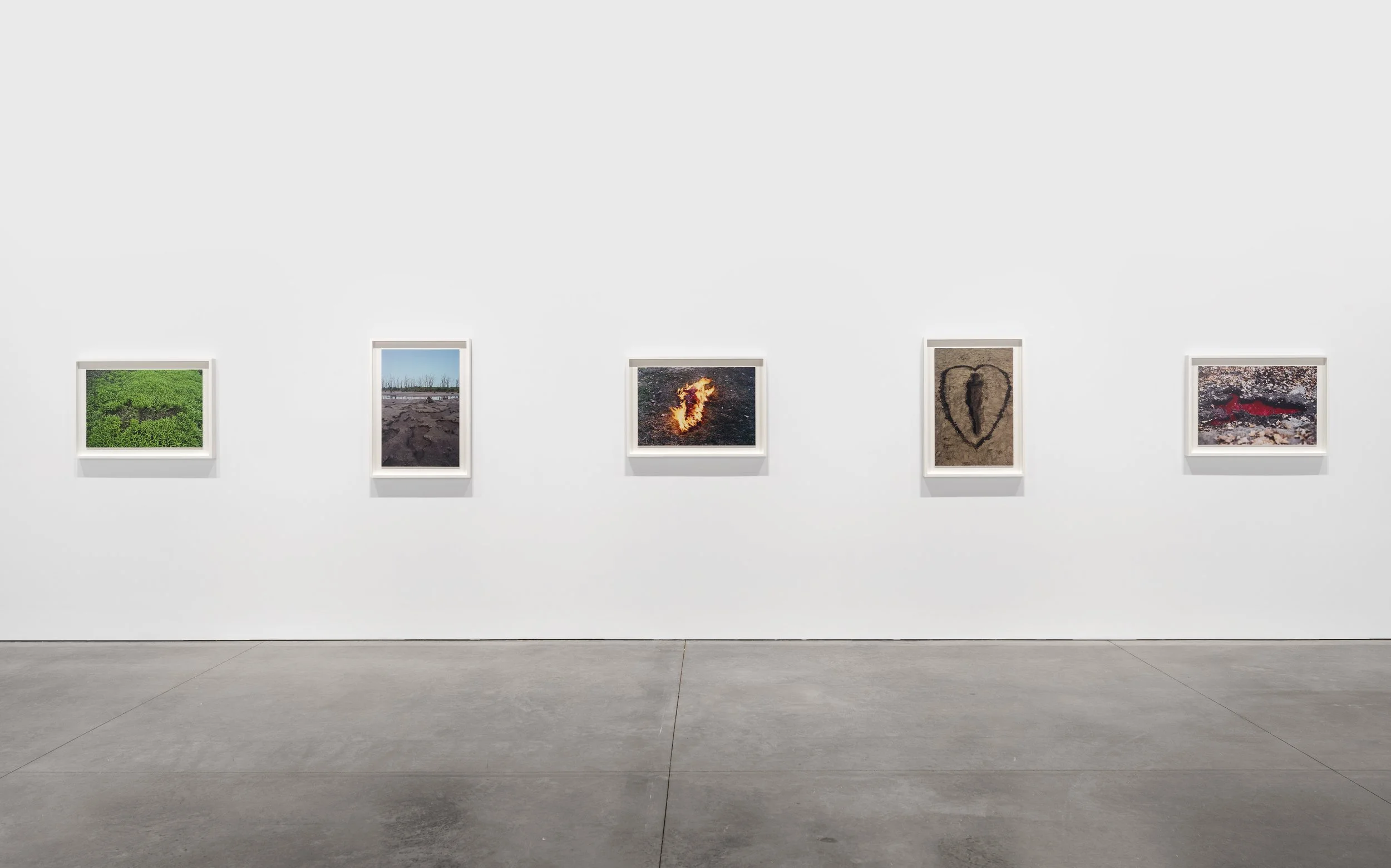
Ana Mendieta, Installation view, Back to the Source, Marian Goodman Gallery, New York, 2025-2026. © The Estate of Ana Mendieta Collection, LLC. Licensed by Artists Rights Society (ARS), NY. Courtesy of Marian Goodman Gallery. Photo credit: Alex Yudzon.
In the penultimate chapter to his seminal Cuban Palimpsests, the late José Quiroga searches for the origin of a lost work by Ana Mendieta. He travels to Cuba’s Jaruco State Park and scours sea caves that Indigenous people, maroons, and Mambises once used. There, in the early 1980s, Mendieta made her Rupestrian Sculptures, larger-than-life iconic forms carved into limestone and later exhibited as photographs. Tellingly, Quiroga finds only the caves themselves, the sculptures either too well hidden or too eroded by time. If he fails to identify the works, however, he succeeds in recuperating something else: a method insistent on attending to process in Mendieta’s work.
Notwithstanding a late-career interest in more permanent materials, Mendieta’s practice was not designed for durability. Her most well-known art is premised in its material elusiveness, its ability to signify through documentation, as opposed to objects themselves, as well as traces, impressions, and visual echoes. Curator Charles Merewether describes this as “negative dialectic of exile,” a practice, forged through her childhood displacement from Cuba, that accrues meaning through absence and negation. Quiroga similarly notes that “the island of our birth . . . could only be grasped by means of paradox, or chiasmus.”
Within a career often dedicated to subtle interventions into the natural world, to visit the specific sites where Mendieta worked—in Iowa, Mexico, or Cuba—would leave, as Quiroga learned, little to see, the works given over to change and transformation. Quiroga’s text was modeling a way to access Mendieta’s work, premised less in viewing it than in the search itself. Searching for foreclosed origins, vital traces, and permanence in the ephemeral inheres in Mendieta’s art, and a new show at Marian Goodman Gallery invites pause and reflection at a transitional moment in the artist’s posthumous career.
As an artist who had three solo shows in New York during her lifetime, Mendieta has enjoyed a prolific posthumous career. In the wake of her untimely death in 1985 and a retrospective at the New Museum a few years later, her estate signed with Galerie Lelong in 1991. Raquelín Mendieta and Mary Sabbatino, who led the estate and Galerie Lelong, respectively, shepherded a decades-long project of custodianship and cataloging work that crossed performance, photography, film, sculpture, and installation—often confounding the distinctions therein. There were more than 200 Silueta works, color slides, black-and-white negatives, and Super 8 film by the time Mendieta went to Rome in 1983. Raquelín Mendieta and Sabbatino’s endeavors yielded a steady stream of books and exhibitions that illuminated understudied or altogether unknown corners of her work.
In 2008, curator Olga Viso’s book Unseen Mendieta: The Unpublished Works of Ana Mendieta; in 2016, an exhibit featured never-before-shown film work on the heels of a massive digitization effort; and, in 2023, a European-touring show exhibited early paintings for the first time. These efforts recuperated the work of the artist from under the weight of her death, navigated artist editions with archival and unexhibited work, and opened critical horizons beyond feminism and Latinx art that emerged as defacto lenses in the heyday of multiculturalism.
The 2025–2026 exhibit comes on the heels of the announcement in summer 2025 that the artist’s estate would head to the Marian Goodman Gallery and, weeks ahead of the show's opening in November, news of her sister’s passing. Raquelín Mendieta not only accompanied her sister in exile and witnessed the creation of key works but was the longtime administrator of her estate. Since 2013, Raquel Cecilia Mendieta, Raquelín Mendieta’s daughter, has taken on that job.
While Mendieta’s work has received critical praise and achieved recognition denied in her life, the exhibit also comes amidst a high water mark in commercial and public interest in Mendieta. There have been graphic novels, podcasts, films, and fiction that have invoked, directly and indirectly, Mendieta’s life. In summer 2026, there will be a major retrospective at the Tate Modern. Mendieta is on the verge of becoming a folk feminist icon à la Frida Kahlo, whom she once dressed as for Halloween. With more to see than ever, at this particular juncture in Mendieta’s career, a paradigm of posthumous revelation is slowly giving way.
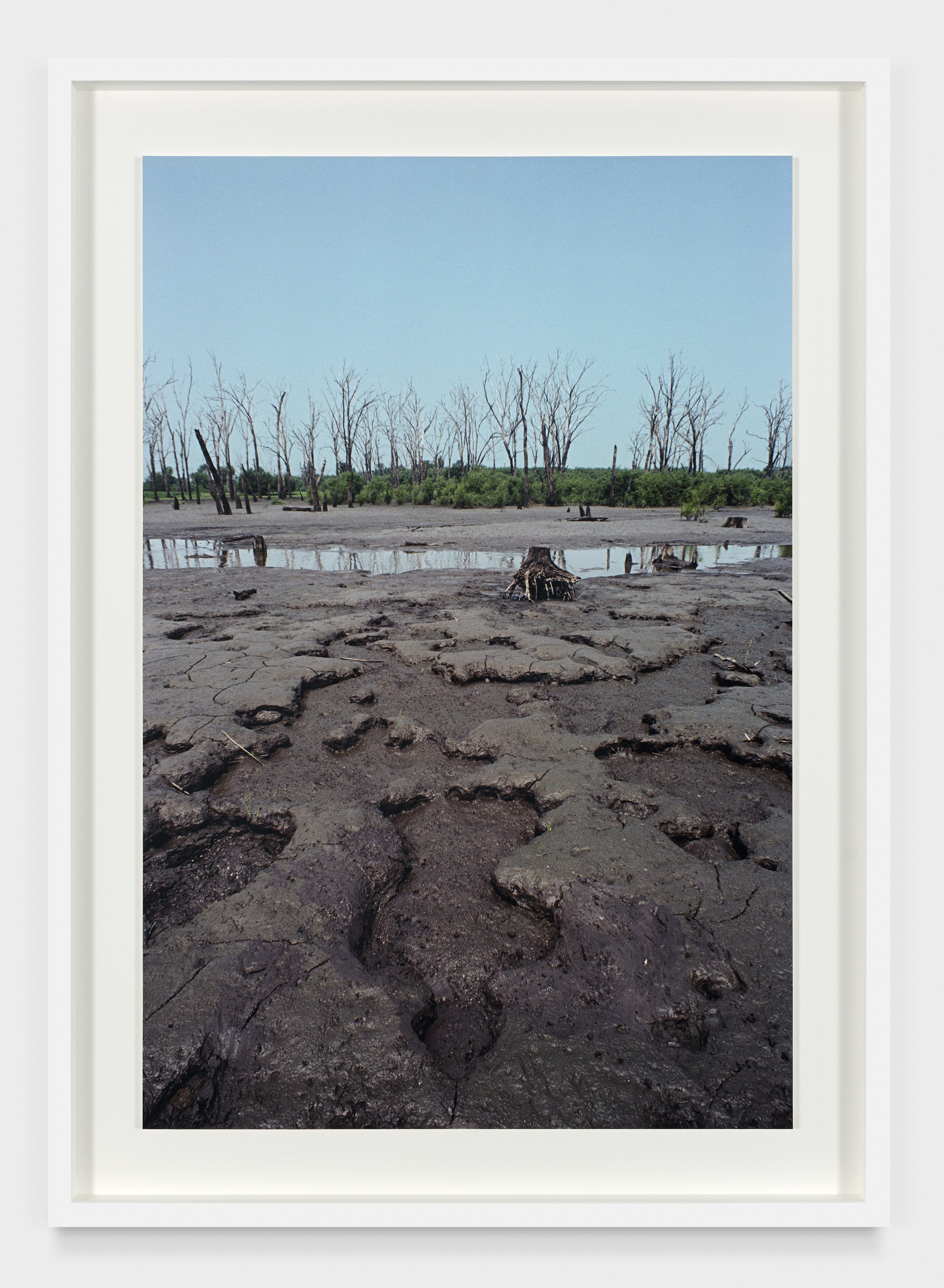
Ana Mendieta, Untitled: Silueta Series, 1979. C-print, Image: 30 x 20 inches. © The Estate of Ana Mendieta Collection, LLC. Licensed by Artists Rights Society (ARS), NY. Courtesy of Marian Goodman Gallery. Photo credit: Alex Yudzon.
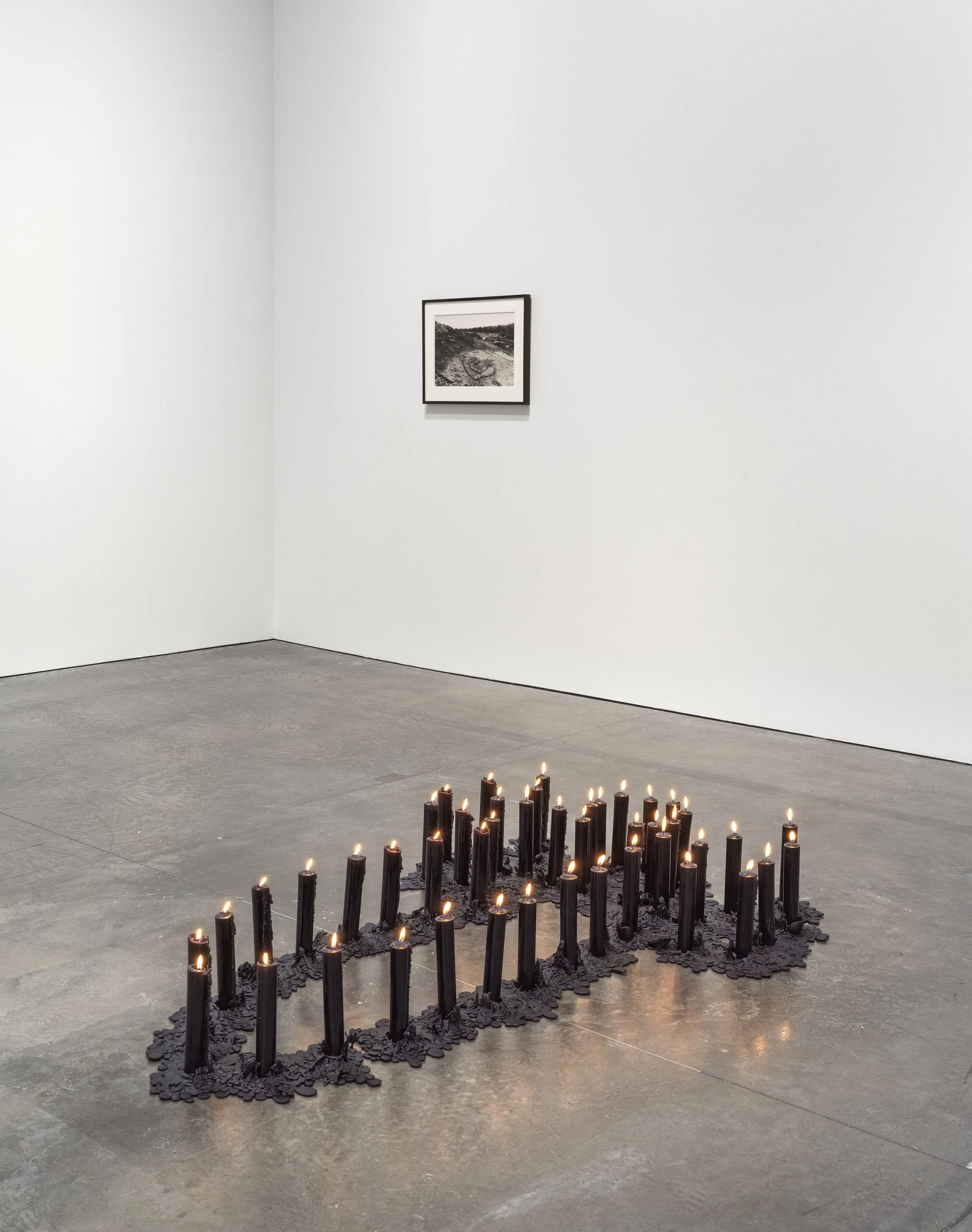
Installation view with Ñañigo Burial, 1976. 47 black ritual candles, 60 x 45 inches. © The Estate of Ana Mendieta Collection, LLC. Licensed by Artists Rights Society (ARS), NY. Courtesy of Marian Goodman Gallery. Photo credit: Alex Yudzon.
Spread across the two floors of Marian Goodman’s Tribeca space, the show unfolds at first with gestures to spectral femme presence. The first floor prioritizes her Silueta Series (1973–1980) through color prints of forms pressed into landscapes alternatively verdant, marshy, and sandy. At times, these forms emerge readily in flames or shocks of red. At others, however, identification is deferred and the viewer is left in an uncanny moment of suspense when these forms are not immediately discernable or extractable from the world that surrounds them. Flanked by two screening rooms, a program of 10 films alternate, mostly documenting Silueta works. Elsewhere, Ñañigo Burial, a work first debuted blocks away in 1976, uses black candlesticks to outline a human form, arms raised. A gesture to Mendieta’s interest in the Cuban Afro-diasporic fraternity Abakúa, the candles burned opening night until the wax became hardened puddles. After melting and calcifying, the lines once denoting a human form edge into textured indeterminacy. Across photography, installation, and film, works on the first floor compel the viewer to search, rather than simply look, for a semblance of human form suspended somewhere between iconicity and abstraction.
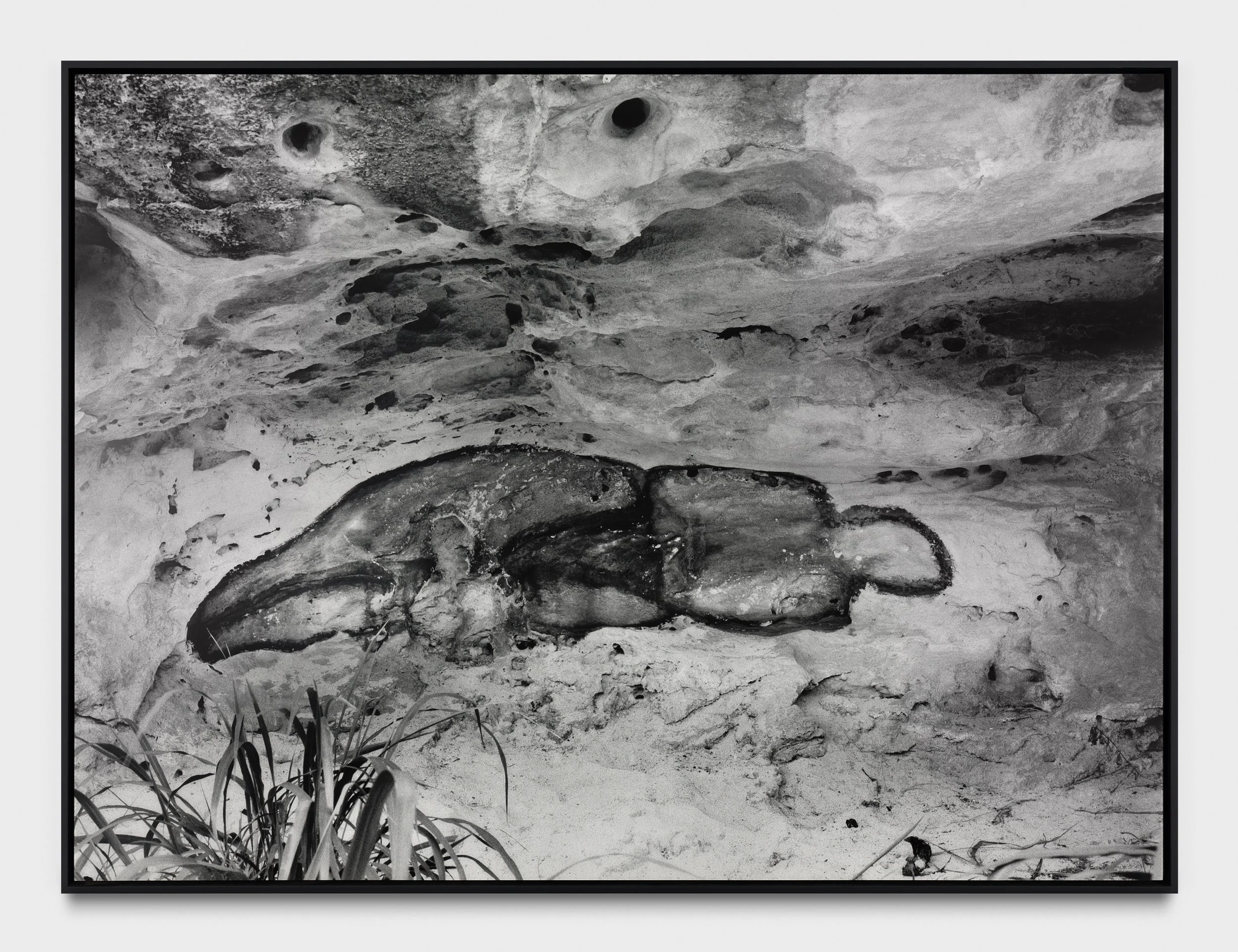
Ana Mendieta, La Venus Negra, 1981. Black and white photograph, Frame: 40 ½ x 55 x 2 inches. © The Estate of Ana Mendieta Collection, LLC. Licensed by Artists Rights Society (ARS), NY. Courtesy of Marian Goodman Gallery. Photo credit: Alex Yudzon.
The second floor balances earlier performances with later works. Spread across a wall, Body Tracks (1974) traces the downward slope of Mendieta’s gesture across nine prints. This presentation nods to the intermedia pioneer that Mendieta was, an artist who moved fluidly between installation, film, photography, and performance. These works, moreover, are among the few times that viewers encounter an image of Mendieta herself, which is reasonable given the strategic disappearance of her body from her work beginning in the mid-1970s. The adjoining room locates ephemera in one display case—a seashell-filled matchbook and some exhibition postcards—and prints of the Rupestrian Sculptures in another. The most striking works on this floor are a pair of large black-and-white photographs. Mendieta created the first, Black Venus (1980), in Iowa; the second, La Venus Negra (1981), she created in those very caves Quiroga visited. As ephemera points out, both emerge from a mythology Mendieta herself understood, drawing from women of color feminisms, as fugitive and decolonial. Evoking Quiroga’s methodological wager, these works are permeable and diffuse. The entire composition is animated by a dense landscape of tonality and texture, and the decoupling of form from context becomes impossible. They bleed into the world that surrounds them.
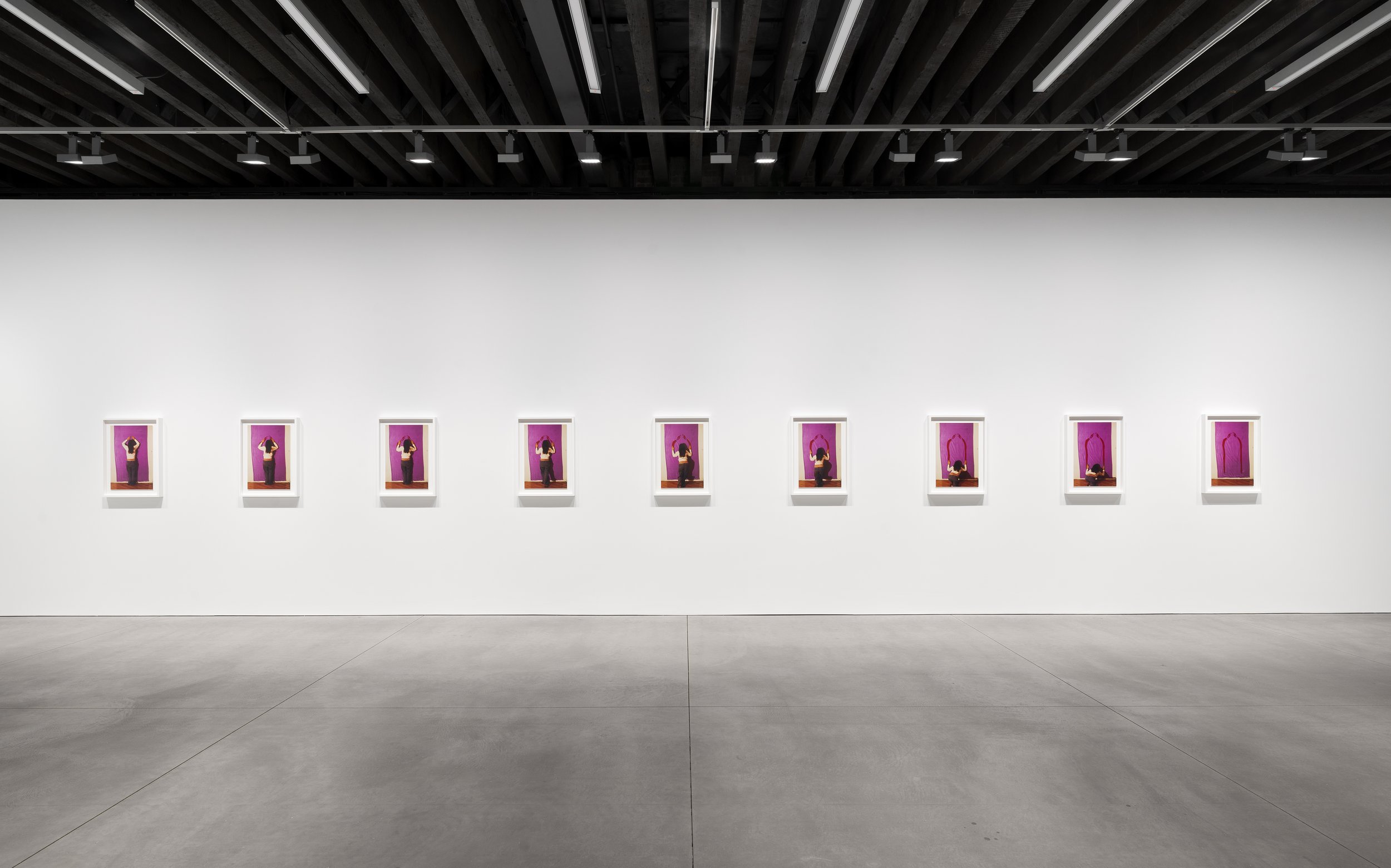
Ana Mendieta, Body Tracks, 1974. Suite of 9 C-prints, Image: 24 x 16 inches each. © The Estate of Ana Mendieta Collection, LLC. Licensed by Artists Rights Society (ARS), NY. Courtesy of Marian Goodman Gallery. Photo credit: Alex Yudzon.
To judge by the exhibit’s title, Back to the Source, it would appear that we’ve entered a moment of shoring up foundations. Noticeably absent, then, are Mendieta’s earlier, more explicitly political performances tackling gendered violence. As Professor Leticia Alvarado has pointed out, it is not incidental these abject performances are not anthologized as much. These works aside, Back to the Source acquits itself just fine. Amidst what The New York Times has called her “ascent to icon status,” there’s something affirming about the exhibition’s restraint in resisting, at least overtly, a play toward Mendieta’s iconicity. The show, moreover, balances nods to her best-known Silueta works with lesser-known ones while gesturing to her intermedial fluency.
To state the implicit, however, within the practice of an artist who imagined making a work from smoke, there’s an evident tension between, on one hand, evanescence and, on the other, durable exposure and logics of commodification and accumulation implicit in the context of commercial galleries. As Cuban scholarJosé Esteban Muñoz wrote, “While Mendieta could not absolutely defy the system of valuation that is essentially the art world, her work did point us to another way of desiring, of feeling, or radiating a value that resisted accumulation and ownership.” Within Mendieta’s work, there exists a space between the physical and the ephemeral, which is where she projected narratives of exile, ancestral connections, and spiritworlds, both studied and self-fashioned. The open-endedness of her work, like that of visual artist Felix Gonzalez-Torres, allows for the opportunistic insinuation of additional terms into the liminal spaces these artists cultivated. Always, but especially going forward, care must be taken with artists to ensure that capaciousness is not exploited into work that grants certain permission.
At the end of his chapter on Mendieta, Quiroga landed on a radical mode of viewing, wherein her work could appear in the seemingly mundane “bridge over the Iowa River in winter” or how a "particular tree branch cracks and falls.” And yet, near the end of her career, Mendieta began laboring toward more permanent works and was increasingly interested in securing gallery representation. Among the later works in the show are a pair of etchings on a leaf, which she often offered as gifts. Here, time’s passage, something mostly excised in contemporary presentations of Mendieta’s work, is visible through the delicate, aging leaf. These works are not so much an abdication of a desire for the permanent, but a fragile truce. They reject disappearance, but they don’t foreclose the effects of material wear. Keenly observant, they understand that, much as one might try, there are matters one cannot control.
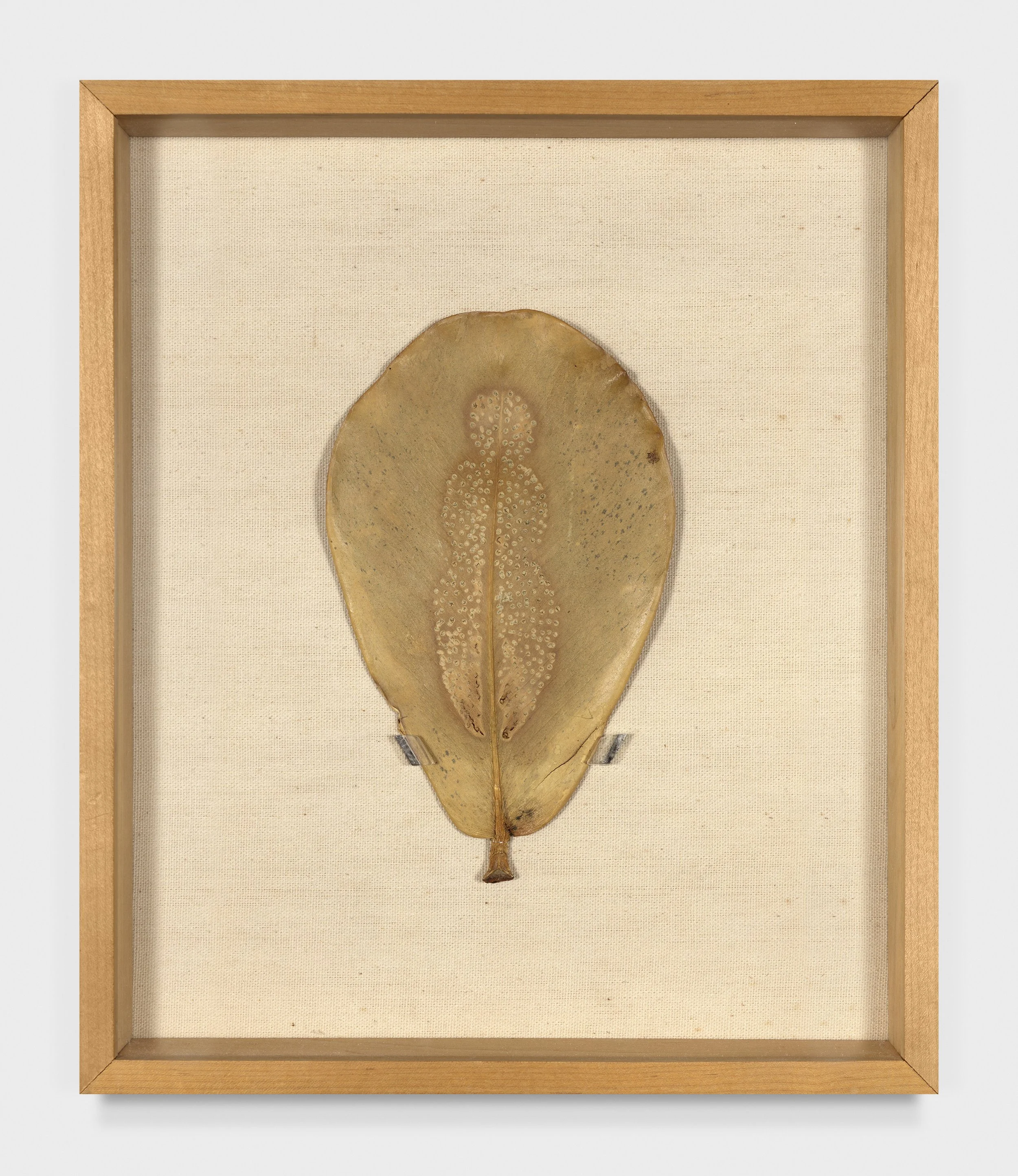
Ana Mendieta, Untitled, c. 1982. Design on leaf, Frame: 13 ¾ x 11 ½ x 2 1/12 inches. © The Estate of Ana Mendieta Collection, LLC. Licensed by Artists Rights Society (ARS), NY. Courtesy of Marian Goodman Gallery. Photo credit: Alex Yudzon.
Back to the Source is on view at Marian Goodman through January 17, 2026.